













Conversational analytics software is no longer just a transcription layer. It's becoming an operating system for turning voice, chat, email, and other customer interactions into decisions about quality, compliance, coaching, routing, automation, and service design. The market reflects that shift: one estimate places the global category at $11.7 billion in 2025, with a projection of $60.2 billion by 2034, while software represented 66.7% of market value in 2025, according to DataIntelo's conversational analytics market analysis. Cloud deployment accounted for 62.3% of the market, and North America represented 38.5% of revenue in the same estimate.
That growth creates a buying problem. A dashboard can show sentiment trends, but it won't automatically improve quality assurance, protect sensitive data, or fit an existing contact-center stack. This comparison evaluates ten enterprise-oriented platforms through those operating decisions, including real-time insight, sentiment and intent analysis, automated QA, reporting, integrations, deployment scale, governance, limitations, and buyer fit. Pricing is generally sales-led based on the supplied product information, so implementation scope matters as much as feature depth.
Table of Contents
- 1. Yellow.ai
- 2. CallMiner Eureka
- 3. NICE Enlighten AI and Interaction Analytics
- 4. Verint Speech and Text Analytics
- 5. Genesys Cloud CX Speech and Text Analytics
- 6. Talkdesk Interaction and Quality Analytics
- 7. Uniphore Conversation Insights Agent
- 8. Medallia Speech and Conversational Intelligence
- 9. Qualtrics XM Discover
- 10. Observe.AI Interaction Intelligence and Auto-QA
- Top 10 Conversational Analytics, Feature Comparison
- How to Choose Without Buying a Dashboard
1. Yellow.ai
Yellow.ai is best understood as an agentic AI platform with conversational analytics attached to the broader automation layer, rather than as a standalone call-monitoring product. That distinction matters for enterprises that want analytics to trigger action. The platform supports customer and employee experience workflows across voice, chat, email, images, and video, while its Analyze capability interprets conversations involving both AI and human agents.
The operational question is whether an insight can move directly into a service workflow. Yellow.ai combines conversation logs, sentiment analysis, topic clustering, resolution metrics, containment metrics, escalation signals, and chat metrics with agent-building and orchestration capabilities. Its AI Agent Builder 2.0, Conversational Knowledge Base with agentic retrieval, AI Copilot, and Automated Testing support a lifecycle from design to debugging and production monitoring.

Why enterprise teams shortlist it
Yellow.ai's strongest differentiator is the combination of voice automation, analytics, and orchestration. Nexus VOX supports voice cloning in seconds and operation in 500+ languages, according to the supplied product information, which makes the platform relevant to global service environments where language coverage and natural voice interactions are central requirements. Its multi-LLM architecture uses 15+ models, giving teams flexibility across speed, accuracy, and model selection.
The platform also offers 150+ pre-built integrations with systems including Salesforce, Zendesk, Genesys, HubSpot, Freshdesk, and NICE. Those connectors can reduce custom engineering, although buyers still need to validate authentication, data ownership, event handling, and governance in their own environment. Teams evaluating agent workflows should also review Yellow.ai's agent assist capabilities alongside analytics.
Practical rule: Choose Yellow.ai when analytics must feed automation, agent assistance, and omnichannel service decisions, not simply populate a reporting queue.
Yellow.ai advertises HIPAA, ISO 27001/27701, SOC 2 Type II, and PCI-DSS controls. Pricing isn't published as a standard public schedule, so buyers should expect demos, ROI assessment, and sales engagement. The platform may be excessive for a small organization seeking simple transcription or a narrow chatbot, but its breadth is valuable for enterprises modernizing CX and EX across regulated or multilingual operations.
2. CallMiner Eureka
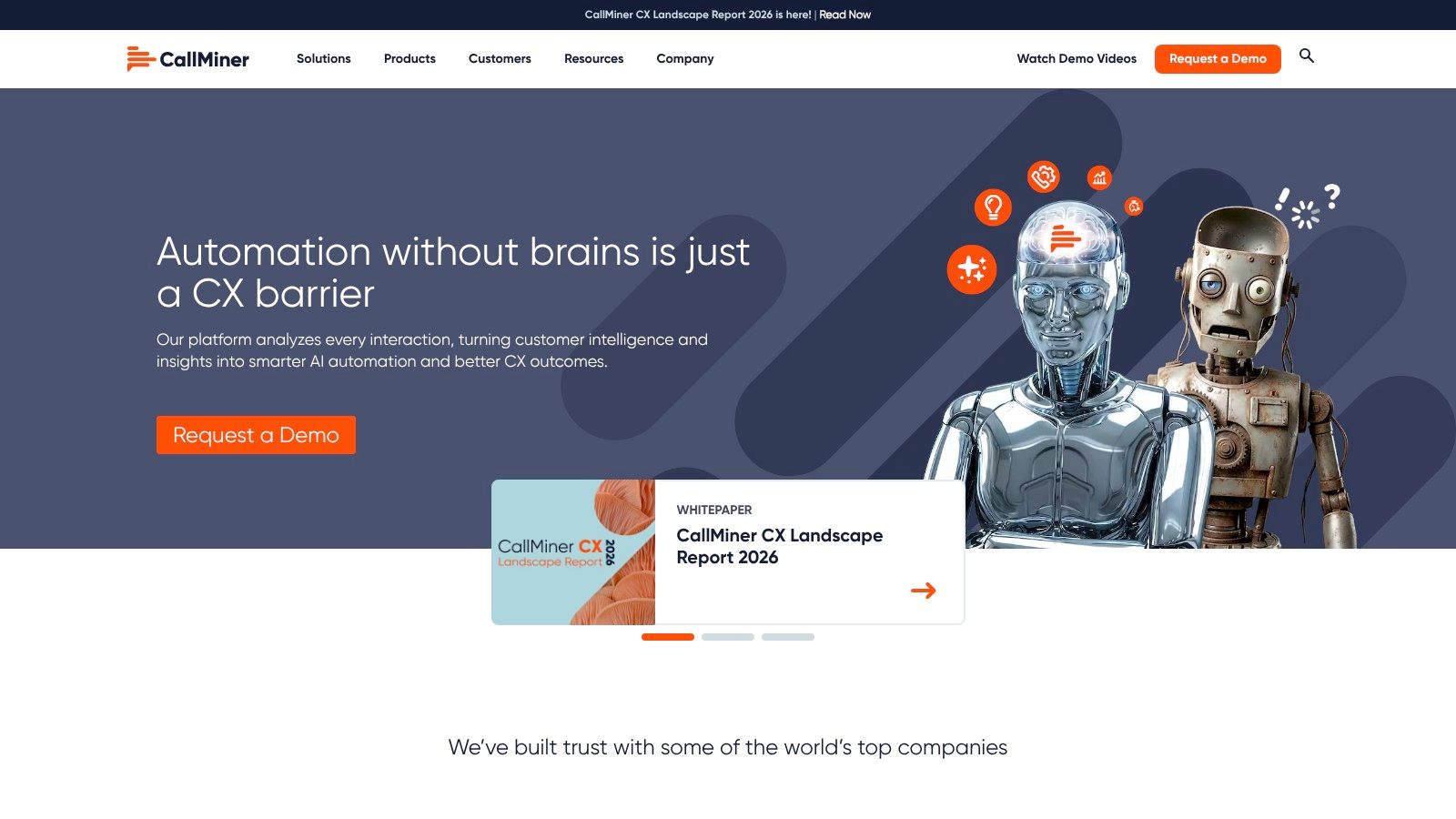
Most contact centers still QA a manually selected sample. CallMiner Eureka is designed for broader coverage, analyzing voice and digital interactions, including chat, email, and SMS, so supervisors can examine patterns across channels instead of isolated calls.
The platform's main value is the depth of its interaction analysis. Automatic speech recognition and natural language processing identify topics, intents, sentiment, emotion, and recurring sources of friction. Pre-built topics and scoring models can shorten initial configuration, while open connectors and APIs let technical teams adapt data flows to existing systems. CallMiner positions Eureka as a shared analytical foundation for quality assurance, compliance, customer experience, and operations.
Where it fits operationally
The key decision is whether the contact center needs QA coverage and discovery across a large interaction volume. Automated quality monitoring and agent scoring can surface coaching priorities, compliance exceptions, and recurring customer problems that manual review may miss. Real-time guidance extends the use case into live operations, while payment-card redaction supports environments handling sensitive information.
Teams comparing automated QA with analytics-driven agent support should also review Yellow.ai's AI analytics capabilities alongside CallMiner's scoring models.
Implementation scope remains the main constraint. Buyers must define taxonomy ownership, scoring logic, source-system connectivity, privacy controls, and responsibility for operational alerts. Because pricing is customized, the evaluation should separate licensing from transcription, integration, configuration, and ongoing model-management work.
Eureka suits enterprises seeking broad analysis across conversation data. A company that prioritizes analytics native to its chosen CCaaS platform, or has limited capacity for a separate implementation, may find the required integration work outweighs the added coverage.
3. NICE Enlighten AI and Interaction Analytics
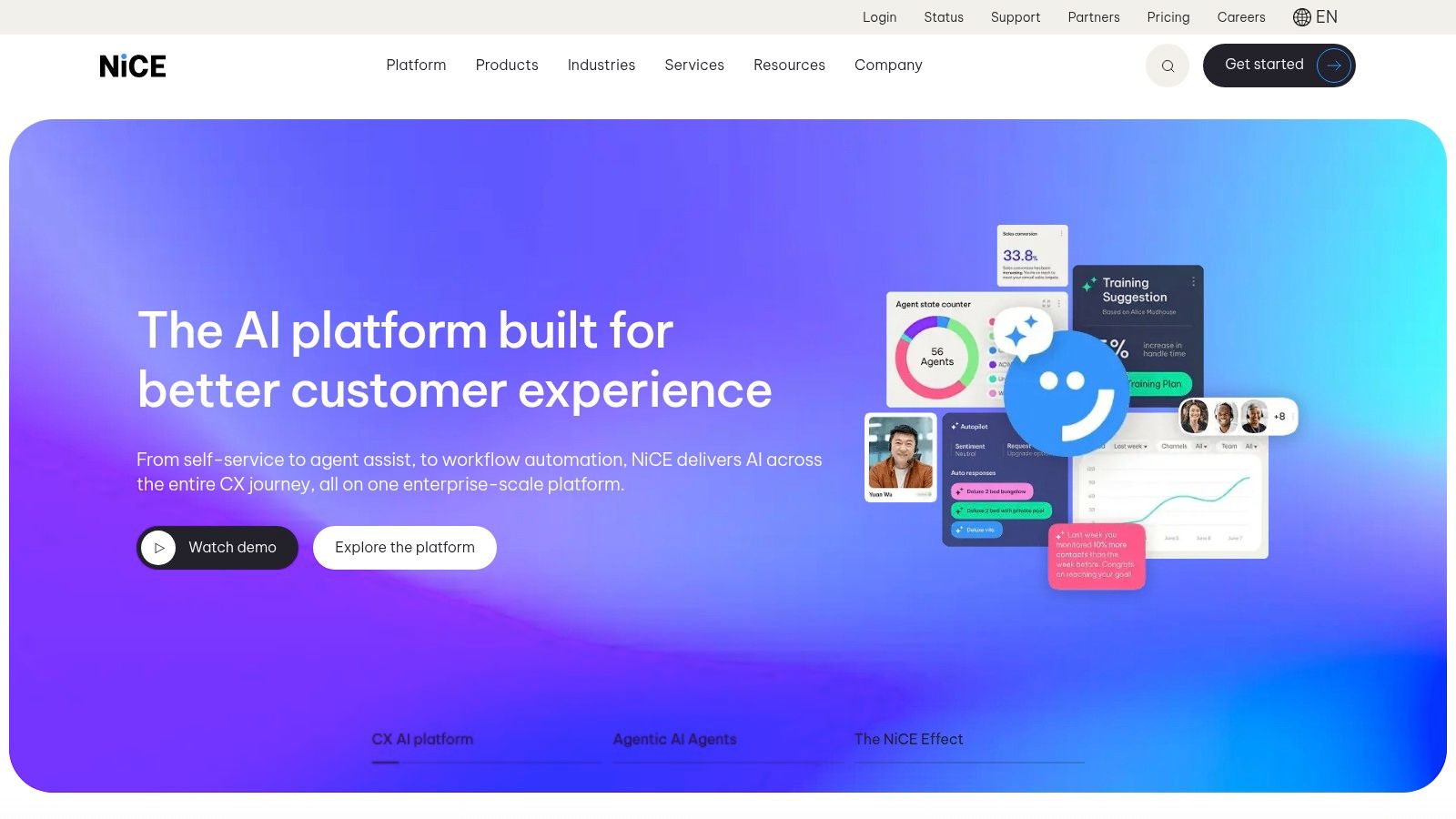
NICE combines Interaction Analytics with Enlighten AI behavior models inside a broader customer-experience suite. That native positioning is the central buying advantage. Instead of treating conversation analysis as an isolated repository, NICE connects interaction signals with performance management, coaching, and contact-center workflows.
The platform evaluates voice and digital interactions for sentiment, agent behavior, and customer-experience signals. Real-time guidance can reinforce next-best behaviors while an interaction is still active, which makes the product relevant to organizations that want analytics to influence service delivery rather than only explain past results.
The integration benefit comes with change management
NICE offers out-of-the-box analytics, visualizations, and reporting, reducing the need to assemble a reporting layer from separate components. Its behavior-oriented approach also gives CX leaders a way to connect agent actions with customer outcomes and compliance expectations.
However, the platform's enterprise packaging can make evaluation more complex. Buyers should determine which capabilities are included in their existing NICE environment, which require configuration, and which depend on additional licensing. They should also define how supervisors will respond to real-time recommendations and how quality teams will handle disagreements between automated evaluations and human review.
NICE is compelling for organizations already standardizing on its contact-center ecosystem. The platform is less attractive when a buyer wants a lightweight, standalone analytics product with minimal configuration or when the existing stack is built around another provider.
4. Verint Speech and Text Analytics
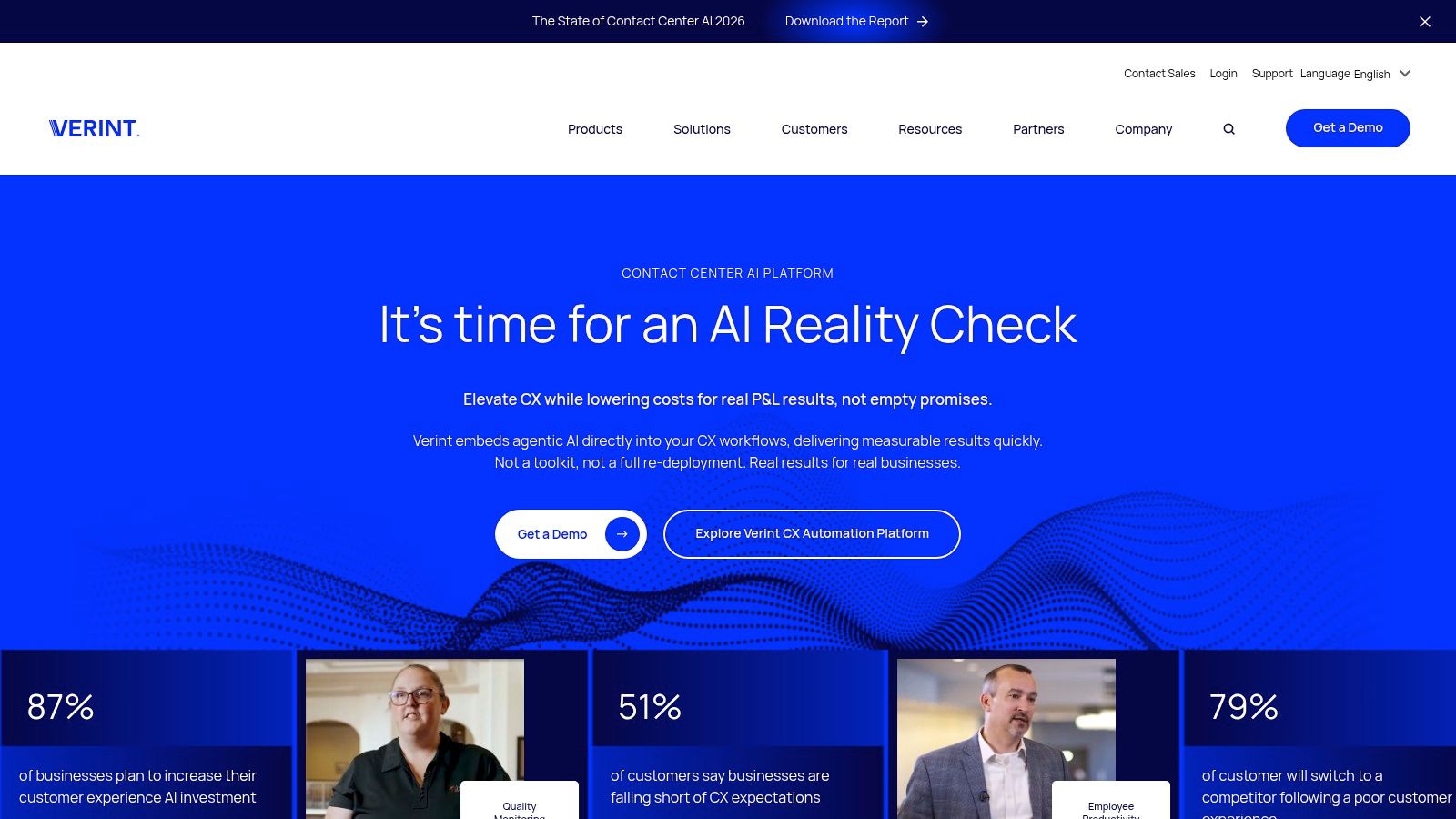
Verint Speech and Text Analytics combines voice transcription, topic detection, sentiment analysis, and text analytics with the wider Workforce Engagement Management and experience-management environment. Its appeal is not a single novel feature. It's the continuity between interaction data, workforce processes, KPI tracking, and operational outcomes.
The platform can analyze voice and text together, giving leaders a wider view of what customers are saying and how agents are handling those interactions. That combined perspective is useful when a contact center needs to compare call themes with written service channels instead of maintaining separate reporting systems.
A mature platform for outcome-led programs
Verint's strongest fit is an enterprise that already manages workforce engagement, quality, coaching, and performance through a connected operating model. Outcome-focused reporting helps teams tie themes and sentiment to business KPIs, but the buyer must define those outcomes clearly before configuration begins.
The platform is sales-led, and pricing isn't publicly available. Procurement therefore needs to examine more than the analytics license. Ask about data preparation, historical interaction ingestion, integration ownership, taxonomy maintenance, security review, and the training required for supervisors and analysts.
Verint can be a sensible choice for large organizations that value an established ecosystem and want analytics embedded in workforce processes. It may be more platform than necessary for a team that only needs searchable transcripts, basic topic trends, or a narrow quality-monitoring workflow.
5. Genesys Cloud CX Speech and Text Analytics
Genesys Cloud CX is the clearest option for organizations that already run their contact center on Genesys Cloud and want conversational analytics close to routing, workforce engagement, and automation. The product analyzes voice and digital interactions for sentiment, topics, empathy, and trends within the same operating environment.
Its native architecture changes the implementation question. Instead of asking how to move interaction data from one vendor into another, buyers can focus on how analytics should influence routing, coaching, automation, and reporting. Administrative tools support content search and historical reprocessing, while the Event Data Platform helps standardize interaction data for broader reporting.

Native doesn't mean automatically included
Genesys provides clear deployment guidance and useful controls for administrators. Teams can investigate interaction trends, revisit historical data, and connect analytics with other Genesys capabilities. That reduces integration friction compared with a separate platform.
The limitation is commercial and architectural. Analytics access can depend on license tiers or add-ons, and the buyer needs a Genesys Cloud CX subscription. A company should model the total cost of the required edition, analytics entitlement, data retention, implementation, and any external warehouse or reporting work.
For organizations comparing agentic automation with native CCaaS analytics, Yellow.ai's Genesys integration is also relevant. Genesys is usually the more direct choice when the contact-center stack is already standardized there. A different platform may be preferable when multilingual voice automation, broader agent orchestration, or cross-platform deployment is the primary goal.
6. Talkdesk Interaction and Quality Analytics
Talkdesk Interaction and Quality Analytics connects conversation analysis directly to automated quality workflows. Its generative AI approach identifies intents, emotions, friction points, and quality signals across interactions, then makes those signals useful for QA and customer-experience improvement.
This connection between analysis and evaluation is the product's central strength. A transcript or sentiment score has limited operational value if supervisors still need to find the relevant interaction, interpret it manually, and create a separate evaluation. Talkdesk instead aims to associate transcripts, tags, interaction themes, and automated quality assessments in one workflow.
Best for Talkdesk-centered operations
The interface emphasizes “moments that matter,” giving teams a practical way to find customer friction and agent-performance signals without starting from raw recordings. Knowledge resources and configuration support can help administrators shape the system around specific QA programs.
The most important trade-off is ecosystem dependence. Talkdesk is a stronger fit when the organization already uses Talkdesk or is willing to make a broader CCaaS decision. Moving only the analytics function into Talkdesk can create duplication if calls, routing, workforce data, and quality records remain elsewhere.
Pricing is packaged through enterprise plans and requires contact with Talkdesk. Evaluation should test whether automated evaluations match the organization's existing scorecards, whether supervisors can challenge or adjust results, and whether the product captures the channels that matter most to the service operation.
7. Uniphore Conversation Insights Agent
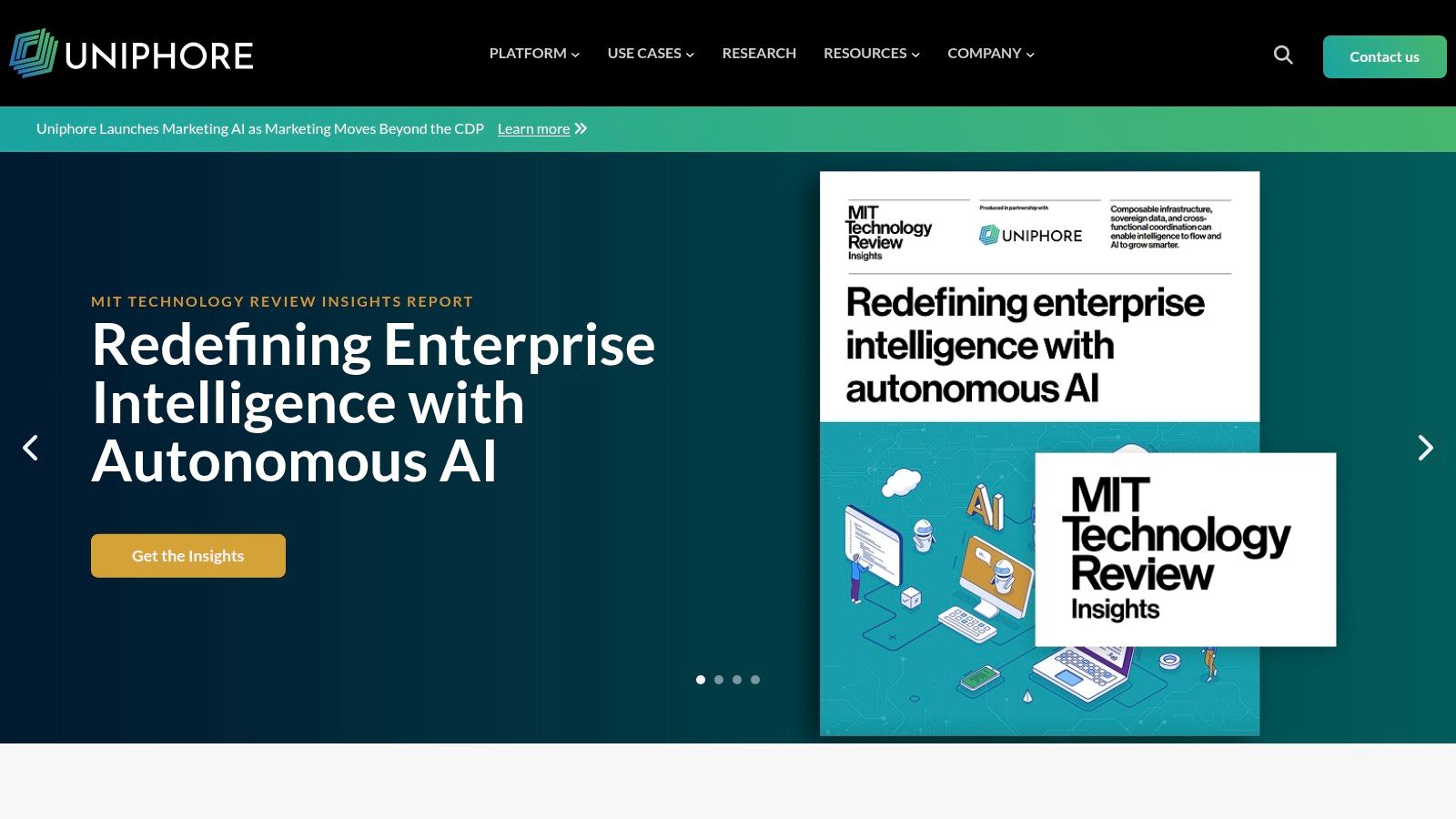
Uniphore focuses on reducing the distance between a conversation and an understandable operational explanation. Conversation Insights Agent uses generative AI to surface call drivers, summarize interactions, identify sentiment, and detect topic trends without relying entirely on rigid keyword lists.
That approach suits analysts and operations leaders who want to explore conversation data through natural-language questions. Dashboards can expose agent talk time, silence, hold behavior, and KPI breakouts, while coverage across voice, chat, and email supports an omnichannel view.
Fast insight is useful only when definitions hold
Uniphore's emphasis on setup speed and natural-language querying can help teams investigate emerging issues without building a new dashboard for every question. Summaries also give supervisors a faster starting point for coaching and escalation review.
However, natural-language access doesn't remove the need for governance. Buyers should verify how the system handles ambiguous topics, multilingual interactions, sensitive information, model changes, and conflicting definitions of operational metrics. Product terminology and documentation have changed over time through rebrands, so procurement should require current product mapping and written scope.
Pricing is sales-led and not public. Uniphore is a good candidate for teams prioritizing rapid exploration across several channels, but less suitable when the buyer needs a tightly standardized product with minimal terminology ambiguity or a native relationship with one CCaaS provider.
8. Medallia Speech and Conversational Intelligence
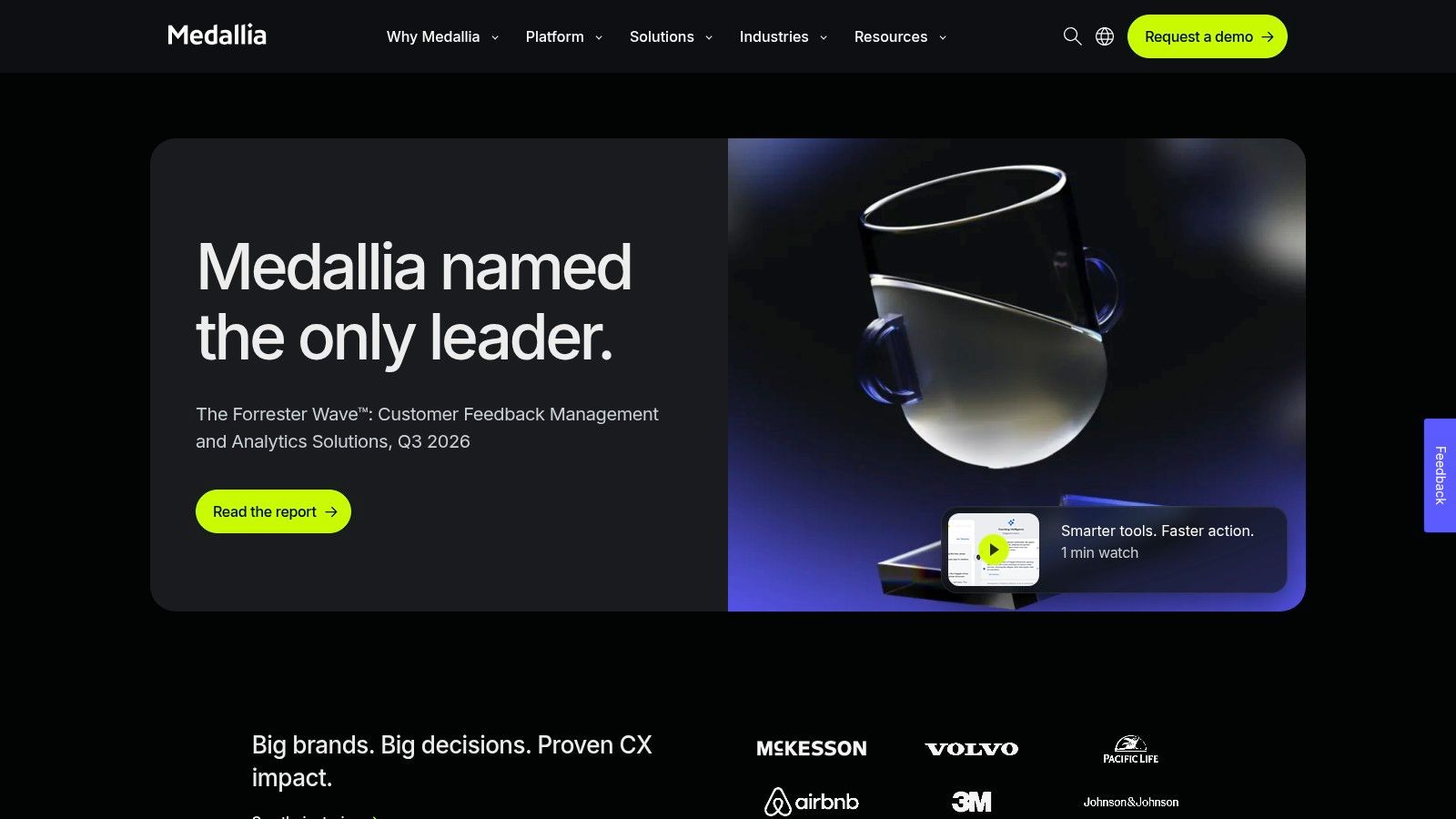
Medallia Speech and Conversational Intelligence is designed for experience-management programs that need to connect what customers say with downstream CX action. It combines acoustic sentiment with text analytics to produce signals around sentiment, emotion, compliance, and impact, then feeds those insights into Medallia Experience Cloud workflows.
The acoustic layer is important because words alone don't capture every interaction signal. Tone, energy, and other vocal characteristics can add context to text-based analysis, although buyers should test accuracy against their own languages, accents, recording conditions, and use cases.
Built for action after measurement
Medallia's experience-management lineage gives the platform a clear path from interaction signal to KPI dashboard, feedback program, and operational action. Support for dozens of languages and dialects is relevant to global teams, but enterprises should validate actual language performance rather than treating language coverage as a proxy for analytical quality.
The platform is custom-priced and typically requires implementation planning. That planning should include data connectors, score definitions, acoustic and text model validation, role permissions, escalation workflows, and ownership of the action loop. If the organization already uses Medallia, the added value may come from extending its existing experience system into contact-center conversations. If not, the broader platform commitment may outweigh the benefit of the analytics module alone.
9. Qualtrics XM Discover
Qualtrics XM Discover brings the former Clarabridge conversational analytics capability into the Qualtrics XM Platform. It analyzes calls, chats, cases, emails, social interactions, and reviews for topics, sentiment, emotion, intensity, and effort.
This broad channel coverage makes XM Discover attractive to organizations that treat contact-center data as one part of a larger experience program. A CX leader can compare themes in service conversations with feedback, reviews, and other experience signals rather than viewing the contact center in isolation.
Strongest inside a wider XM strategy
Qualtrics offers real-time and historical analysis, connectors for contact-center and digital sources, unified dashboards, and generative features intended to accelerate investigation. Its advanced NLP heritage gives experienced users a substantial analytical foundation, while AI-assisted capabilities such as Smart Audit support review and quality control.
The key question is whether the organization will use the broader XM workflows. XM Discover can be a powerful fit for a company that already operates Qualtrics across CX and EX, but the value proposition is weaker if the requirement is limited to contact-center QA or agent coaching.
Pricing and access are enterprise-led. Buyers should confirm which channels are included, how historical data is handled, what governance controls apply to sensitive interactions, and how insights reach operational owners. Qualtrics is a strategic experience platform choice, not merely a transcript search tool.
10. Observe.AI Interaction Intelligence and Auto-QA
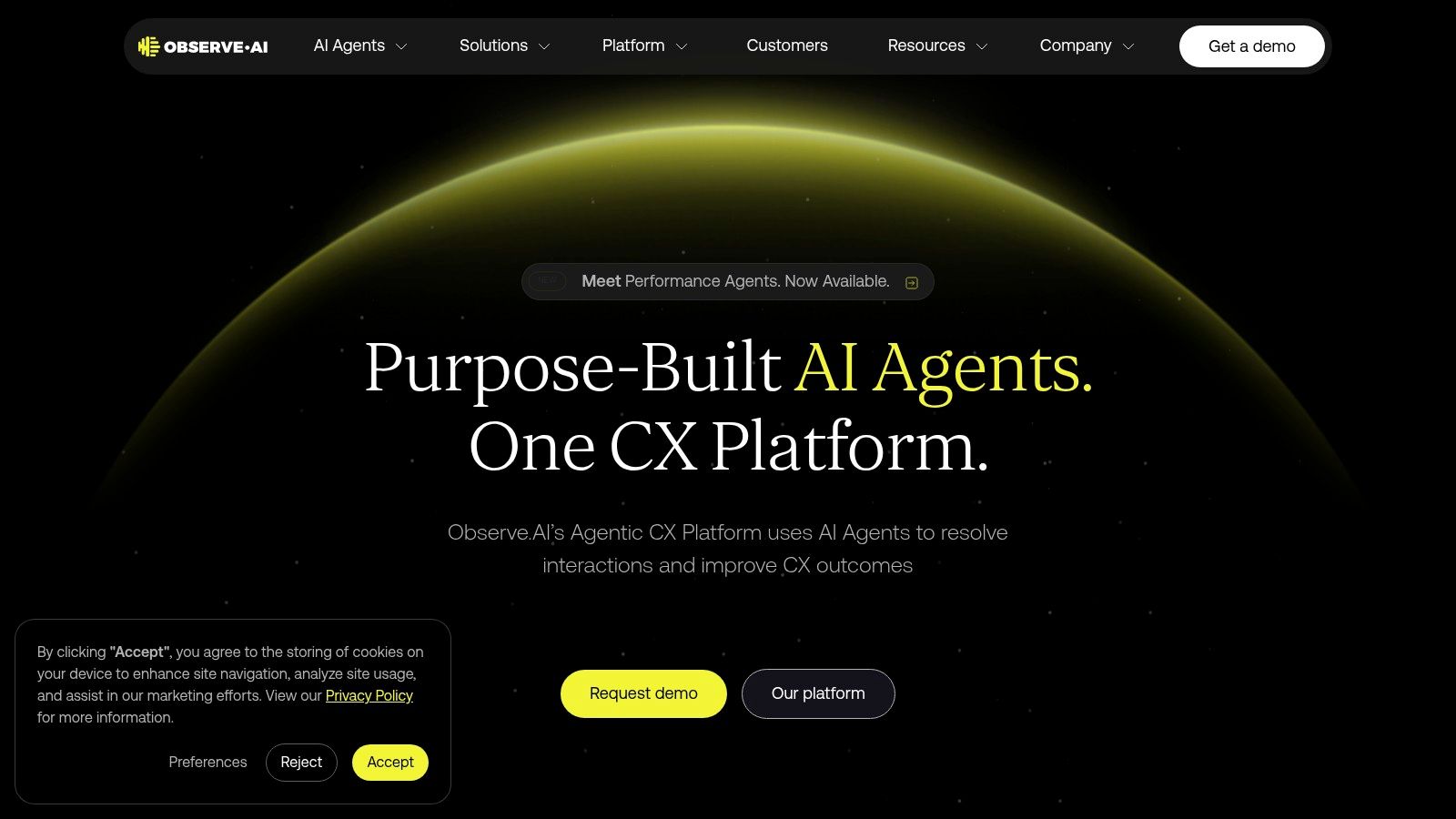
Observe.AI combines conversation intelligence, journey analytics, automated quality scoring, coaching, real-time assistance, and governance on a common intelligence layer. Its roots in automated QA make it especially relevant to contact centers that want to evaluate more interactions without expanding manual review at the same pace.
The platform extracts signals from conversations, connects them across customer journeys, and uses those signals to support quality scoring and operational decisions. AI Agents extend the platform beyond retrospective analysis, while controls for model monitoring and compliance address the trust requirements that come with automated evaluation.
A strong QA-first shortlist candidate
Observe.AI's advantage is the connection between analytics and action. A contact center can use interaction signals to identify coaching needs, support real-time assistance, and monitor quality through a shared layer rather than maintaining disconnected tools.
The buyer still needs to test the fundamentals. Automated scores must be compared with experienced evaluators, journey stitching must match the organization's customer identifiers, and governance teams must understand how models are monitored and updated. A modern AI roadmap doesn't replace the need for transcription validation, data controls, and clear escalation ownership.
Pricing isn't publicly listed, and enterprise deployment typically involves ROI modeling and implementation planning. Observe.AI is a strong fit for contact centers where automated QA is a primary business case. It may be less suitable when the main need is broad experience measurement across surveys, reviews, and non-contact-center data.
Top 10 Conversational Analytics, Feature Comparison
| Solution | Core features ✨ | Quality & analytics ★ | Target audience & value 👥💰 | Unique selling points |
|---|---|---|---|---|
| Yellow.ai 🏆 | Nexus VOX (voice cloning, 500+ langs), Agent Builder 2.0, multi-LLM, agentic RAG | ★★★★☆, real-time, multimodal analytics | 👥 Enterprise CX/EX & contact centers · 💰 Sales-led, ROI-focused | ✨ Voice-first scale, ultra-low latency, 150+ integrations, HIPAA/ISO/SOC2/PCI-DSS |
| CallMiner (Eureka) | Omnichannel ASR+NLP, automated QA, real-time redaction | ★★★★☆, deep topic/sentiment discovery | 👥 Large enterprises (QA/compliance) · 💰 Custom pricing | ✨ Pre-built topics/scores, strong discovery at scale |
| NICE Enlighten AI | Interaction analytics, behavior models, real-time guidance | ★★★★☆, behavior-driven CX metrics | 👥 Contact centers, ops & compliance · 💰 Enterprise pricing | ✨ Embedded across CX suite, next-best-behavior guidance |
| Verint Speech & Text Analytics | Transcription, topic & sentiment detection, KPI reporting | ★★★★☆, outcomes-focused reporting | 👥 WEM-focused enterprises · 💰 Sales-led quotes | ✨ Tight WEM/integration ecosystem, mature deployments |
| Genesys Cloud CX | Built-in speech/text analytics, sentiment, reprocessing | ★★★★☆, native platform analytics | 👥 Genesys customers, CCaaS users · 💰 Tiered add-ons/licenses | ✨ Seamless routing/WEM integration, Event Data Platform |
| Talkdesk Interaction & QA | Generative interaction analytics, auto quality evaluations | ★★★★☆, rapid "moments that matter" insights | 👥 Talkdesk users / modern CCaaS adopters · 💰 Packaged in enterprise plans | ✨ QA linked to transcripts, modern UI for ops |
| Uniphore Conversation Insights | GenAI summaries, topic trends, NL querying | ★★★★☆, fast time-to-insight | 👥 Teams needing rapid analytics · 💰 Sales-led pricing | ✨ Natural-language queries, quick setup |
| Medallia Speech & CI | Acoustic + text analytics, multilingual support, actioning | ★★★★☆, rich scoring (acoustic+text) | 👥 XM customers, enterprise CX teams · 💰 Custom enterprise pricing | ✨ Acoustic sentiment fusion, Experience Cloud integration |
| Qualtrics XM Discover | Omnichannel detection (sentiment, effort), generative assist | ★★★★☆, broad channel coverage | 👥 XM platform users, CX/EX programs · 💰 Best value with XM licensing | ✨ Clarabridge NLP heritage, frequent feature updates |
| Observe.AI Interaction Intelligence | Conversation + journey analytics, auto-QA, real-time assist | ★★★★☆, strong auto-QA & coaching signals | 👥 QA/coaching teams, contact centers · 💰 Sales-led pricing | ✨ Auto-scoring + AI agents, model monitoring & controls |
How to Choose Without Buying a Dashboard
Start with the decisions, not the vendor category. Identify which interactions create the greatest operational risk or the most valuable coaching opportunity, then name the people who must act on the resulting insight. A compliance leader may need reliable detection and redaction. A contact-center director may care more about automated QA and coaching. A CIO may focus on integration, data residency, model governance, and the long-term platform footprint.
The market's adoption pattern makes this prioritization urgent. A 2026 contact-center analytics roundup reports that speech analytics was deployed by 44% of contact centers, while 84% of respondents said speech and sentiment analytics were projected to be used. The same source cites growth in interaction and speech analytics usage from 28% in 2022 to 37.5% in 2023. Those figures describe category momentum, not proof that every deployment delivers value. Your evaluation still needs to establish whether the system produces trusted outputs and changes behavior.
Use this sequence:
- Start with priority sources: Select the voice, chat, email, SMS, or digital interactions connected to the decisions you want to improve.
- Verify analytical coverage: Ask vendors to demonstrate transcription, topic, intent, sentiment, emotion, and QA performance on representative conversations, including difficult accents, noisy recordings, code-switching, and regulated content.
- Test real outputs: Don't accept a generic demo. Provide anonymized conversations and compare automated results with assessments from experienced supervisors or compliance reviewers.
- Map the action path: Determine whether an insight creates a coaching task, QA evaluation, alert, knowledge update, routing change, escalation, or automation event.
- Validate integrations: Document connectors, APIs, identity handling, data ownership, historical reprocessing, CRM synchronization, contact-center events, and reporting destinations.
- Model the full scope: Include licensing, storage, transcription, configuration, integration engineering, security review, taxonomy management, training, and ongoing model monitoring.
The most revealing test is often the gap between recorded data and analyzed data. One speech analytics industry report says that more than 76% of U.S. enterprises record customer calls, but only 54% analyze them with advanced speech analytics platforms. It also reports that more than 65% analyze less than 40% of recorded calls. The implication is practical: buying another recording system won't solve the problem. The organization needs coverage, workflow ownership, and confidence in the outputs.
Integration and governance deserve equal weight. In a 2025 survey, more than 80% of respondents said they had integrated conversation intelligence more than a year earlier, and nearly half said it powered most customer interactions. The same AssemblyAI research report identifies accuracy, integration complexity, and security or privacy as the leading implementation hurdles. That evidence should change the procurement conversation. Ask not only whether a platform can analyze conversations, but who will maintain the data connections, approve taxonomies, investigate model errors, and respond when an automated score conflicts with human judgment.
Compare platforms inside the current contact-center ecosystem first. Genesys, NICE, Talkdesk, Verint, and Medallia can reduce integration effort when their surrounding systems already own routing, workforce, quality, or experience data. CallMiner, Observe.AI, Uniphore, and Qualtrics may be more attractive when the organization wants a specialized or broader analytical layer. Yellow.ai deserves special consideration when the priority is agentic automation, multilingual voice, omnichannel orchestration, rapid agent iteration, and enterprise controls across CX and EX.
Finally, run a pilot with a scorecard that measures insight quality, time to deployment, user adoption, actionability, and total operating scope. Include the effort required from IT, data, security, supervisors, analysts, and agents. The best conversational analytics software isn't the one with the longest feature list. It's the one that turns trusted interaction signals into repeatable decisions without creating a second, more expensive operating problem.
Yellow.ai combines conversational analytics with agentic automation across voice, chat, email, and employee-service workflows, supported by multilingual voice capabilities, enterprise integrations, automated testing, and governance controls. If your team wants to connect interaction insight with faster agent iteration and production action, visit Yellow.ai to evaluate the platform for your operating environment.



