













99% of organizations expect their conversational AI strategy to change within the next 12 months, while 59% expect to replace their current solution in less than a year, according to Twilio's 2025 global study. That reframes the enterprise decision. The central question isn't whether an AI assistant can answer customer questions today. It's whether the platform you buy can survive model churn, security review, integration complexity, and human handoffs over a three-to-five-year operating horizon.
Enterprise conversational AI has already moved beyond isolated FAQ bots. A 2026 survey of 1,840 organizations across 12 industries found that 72% of enterprises with more than 500 employees had deployed at least one AI chatbot or conversational AI system, up from 53% in 2024. The technology now sits inside customer experience, employee service, sales qualification, and contact-center workflows.
That adoption creates pressure for CIOs. Finance wants defensible economics, security wants control, operations wants reliable escalation, and procurement wants protection from vendor lock-in. This guide treats conversational AI for enterprises as an architecture and lifecycle decision, not a chatbot launch.
Table of Contents
- What Conversational AI for Enterprises Actually Means in 2026
- What Drives the Business Case for Enterprise Conversational AI
- Core Building Blocks of an Enterprise Conversational AI Stack
- Choosing a Vendor Without Getting Locked In
- A Practical Implementation Roadmap from Pilot to Production
- Why Human Handoff Quality Determines Enterprise Conversational AI Success
- Enterprise Use Cases That Move the Needle
- Your Next Step and What Comes After the Guide
What Conversational AI for Enterprises Actually Means in 2026
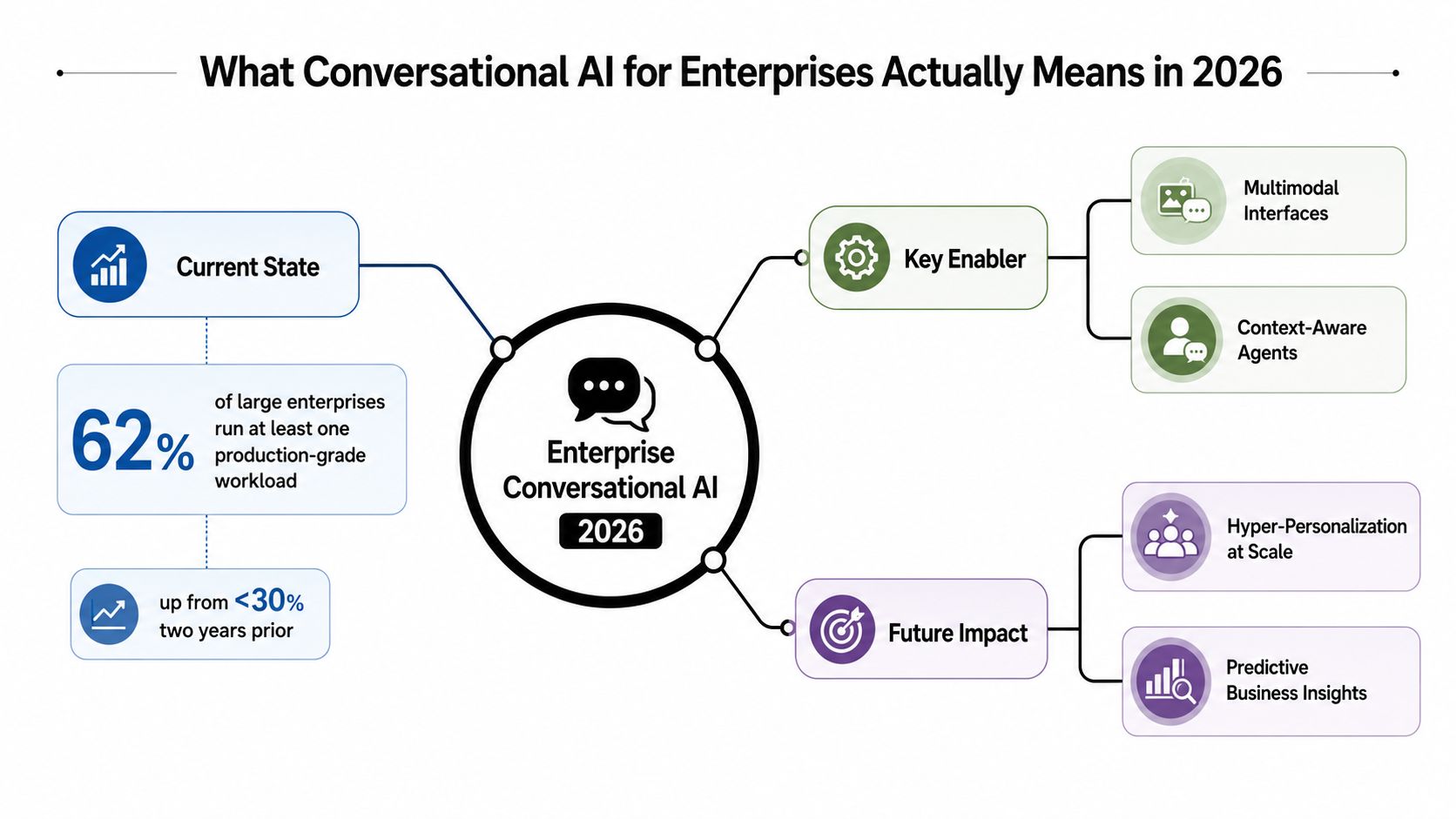
The 72% enterprise adoption rate reported in the 2026 enterprise survey signals a move from experimentation to operating infrastructure. Large organizations now connect conversational AI to customer records, ticketing systems, employee platforms, contact-center software, and voice channels. The central question shifts from answer quality alone to platform endurance across model churn, security review, integration complexity, and human handoffs over a three-to-five-year horizon.
Enterprise conversational AI is an orchestrated system combining large language models, retrieval, speech processing, identity, business rules, and workflow execution. It must complete a defined task, such as checking account status, updating a service request, finding an HR policy, qualifying a lead, or routing a complex issue to the right specialist.
The three capabilities that matter
A production platform must perform three jobs consistently:
- Understand language: identify intent, entities, context, urgency, and ambiguity in customer or employee language.
- Ground responses: retrieve approved information, apply metadata and access controls, and tie answers to governed sources.
- Execute actions: invoke tools and APIs, update systems of record, apply deterministic rules, and stop when authorization or confidence is insufficient.
A consumer chatbot may impress in a demonstration and still fail these requirements. Regulated deployments require identity-aware sessions, audit trails, deterministic escalation, policy controls, retention rules, and service-level agreements based on production behavior. Buyers should also demand exportable logs, replaceable model components, and clear ownership of prompts, retrieval data, and workflow definitions. Those controls reduce the cost of model changes and make audit reviews defensible.
Voice introduces a separate operating constraint. Production voice deployments commonly show median end-to-end latency around 1.4 to 1.7 seconds, while worst-case tail latency can reach 8 to 15 seconds under load, according to enterprise voice AI latency analysis. Optimized systems can approach 400 to 500 milliseconds at P50, which is closer to natural turn-taking.
Evaluate P95 and P99 latency under real telephony conditions, not average response time on a quiet test call. Parloa's latency guidance says transparent conversational interactivity is generally achievable below about 150 milliseconds of one-way delay, and recommends contracting for tail-latency SLAs. High-percentile delays create silence gaps, broken barge-in handling, and customer abandonment.
Deployment is an event. Ownership is a lifecycle decision.
What Drives the Business Case for Enterprise Conversational AI
The business case rests on operational economics and customer experience, but deflection is only one input. Over a three-to-five-year horizon, CIOs should judge the platform by its lifecycle cost, model portability, audit readiness, and human-handoff design. A system that answers routine questions cheaply can still become an expensive liability when models change, integrations require rework, or compliance teams cannot reconstruct a decision.
Start with interaction types that repeat at meaningful volume. A conversational system can reduce avoidable agent work for straightforward information, status updates, routine navigation, and guided transactions. Finance should connect those outcomes to cost per resolved contact, agent workload, average handle time, transfer volume, and rework, rather than accepting a vendor's headline containment figure.
The scale of current deployments supports this operating model. A 2026 market summary reports that average enterprise chatbot deployments manage more than 85,000 conversations per month, while 89% of enterprises integrate chatbots with CRM systems. The business value comes from repeated workflow execution inside existing operations, not from conversation volume by itself.
Experience is the second pillar. Faster access to accurate information can support first-contact resolution and reduce effort, but the assistant must stop at defined boundaries. Long-tail requests, emotionally charged complaints, complex exceptions, and low-volume regulatory questions expose automation limits. An incorrect answer can create another interaction, supervisor review, complaint, or compliance incident.
Practical rule: Model the cost of a failed automated interaction, not just the value of a successful one.
| Pillar | Metric | Realistic range | Where it breaks |
|---|---|---|---|
| Cost | Deflection | Establish a baseline by intent family rather than using one blended target | Long-tail intents and complex exceptions |
| Cost | Cost per resolved contact | Compare AI-only, agent-assisted, and transferred resolutions | Rework can erase savings |
| Experience | First-contact resolution | Track resolution without repeat contact or unnecessary transfer | Poor context and weak integrations |
| Experience | Agent productivity | Measure completed work quality, not conversation volume alone | Agents receive incomplete or low-quality escalations |
| Experience | Customer effort | Review abandonment, repetition, and handoff friction | Customers cannot reach a human easily |
The strongest model is blended automation. Use selective deflection for stable, low-risk intent clusters, then use agent assist to improve complex work. Keep authorization, regulated disclosures, and escalation decisions under explicit controls instead of leaving them to a model's judgment.
Build the financial case over the platform's expected life. The Twilio study found that 80% of business directors say keeping up with rapid model change is expensive. A first-year pilot may look attractive while migration, evaluation, retraining, integration maintenance, and model substitution make the three-year total cost unacceptable. Include those costs in the build-versus-buy review from the start.
Core Building Blocks of an Enterprise Conversational AI Stack
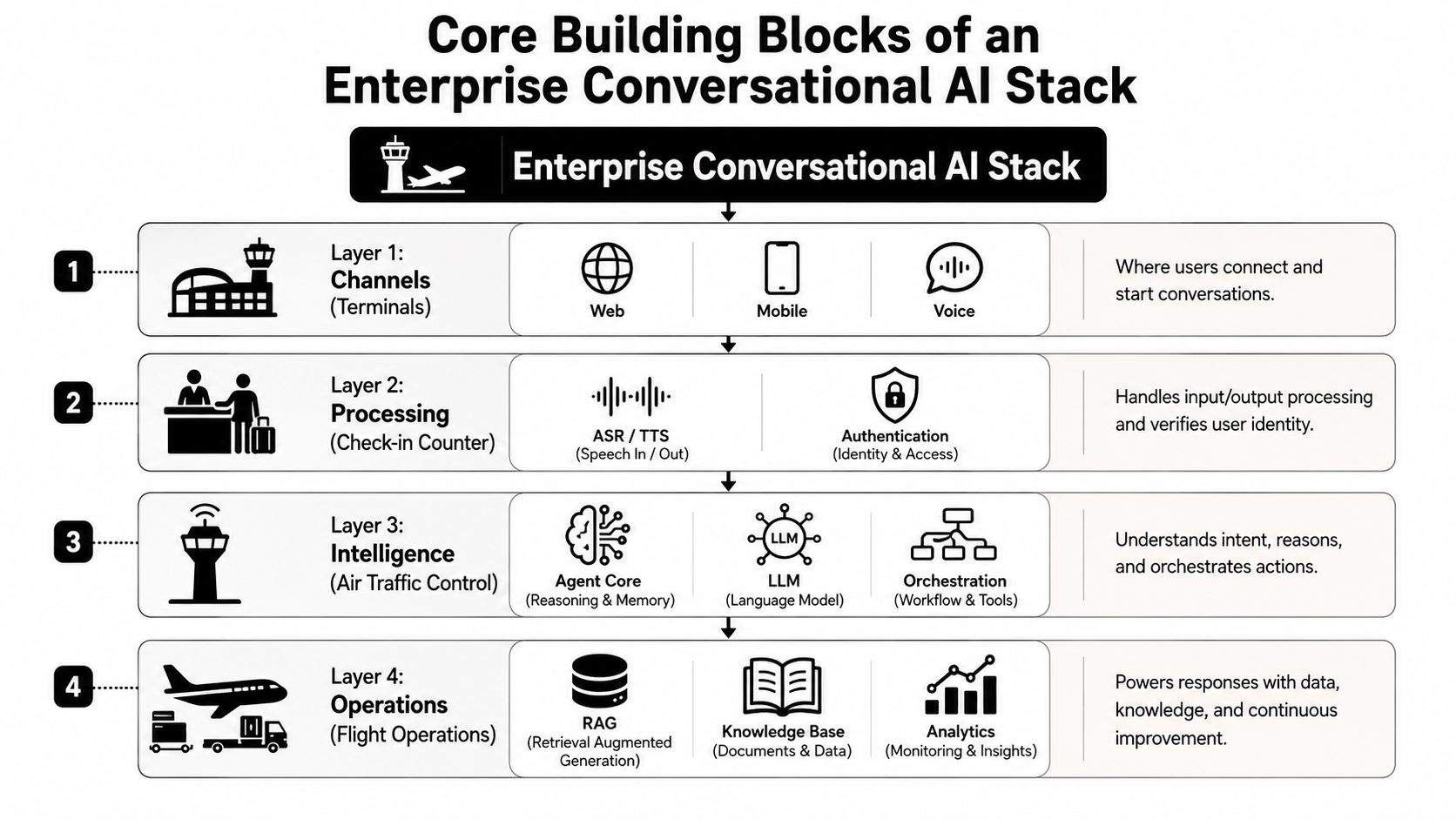
Enterprise conversational AI should be designed as an operating system for customer and employee interactions, not as a deflection-rate project. The architecture must survive model churn, audit scrutiny, and human handoffs across a three-to-five-year horizon. A language model is only one layer, and it is rarely the layer that creates the hardest dependency.
Start at the channels
Support may begin on a website, mobile app, WhatsApp, Teams, Slack, or a phone call. The channel layer should preserve conversation identity, permissions, and business context as the customer moves between surfaces. Keep channel-specific logic limited to cases where policy, security, or interaction design requires it.
For voice, the speech stack includes automatic speech recognition, domain tuning, text-to-speech, turn-taking, interruption detection, and barge-in handling. These components determine whether the caller feels heard or talks over a delayed machine response. Test them with real accents, background noise, and interruption patterns before approving production use.
The agent layer manages intent classification, dialogue state, policy decisions, and tool routing. Use the LLM for flexible language generation, while deterministic logic controls authorization, payments, account changes, regulated disclosures, and escalation boundaries. In regulated industries, those controls need explicit ownership and audit evidence.
Keep knowledge grounded
Retrieval-augmented generation should combine vector search with metadata filters, document permissions, source versioning, and explicit freshness controls. A retrieved document is not automatically an approved answer. The system must verify whether the user may see it and whether it applies to that customer, region, product, or policy version.
Integrations connect the assistant to CRM, ticketing, identity, payments, HRIS, payroll, and knowledge systems. This layer often drives production cost and failure rates. Slow synchronous CRM calls extend response time, while inconsistent records can produce confident but incorrect answers. Define timeout, retry, rollback, and human-escalation behavior for every critical tool.
Teams assessing visual development environments can review an AI agent builder as one example of how orchestration and deployment workflows may be packaged.
Build the control tower early
Observability should capture full traces, retrieved sources, tool calls, policy decisions, model versions, handoffs, user feedback, and evaluation results. Add automated test suites and red-team scenarios before production traffic arrives. Retain enough evidence for compliance reviews without storing sensitive data indefinitely.
Voice systems need a tight end-to-end latency budget covering speech recognition, orchestration, retrieval, model generation, text-to-speech, and telephony. P95 and P99 SLAs expose bottlenecks, especially retrieval hops and synchronous enterprise API calls.
The LLM is usually the easiest layer to replace. Integrations, conversation state, evaluation data, and operational telemetry create the durable dependency. Make those components portable before optimizing prompts, or model replacement will become a costly platform migration.
Choosing a Vendor Without Getting Locked In
Vendor selection shouldn't begin with a feature checklist. It should begin with the question, what can we still move if the model, pricing, or vendor strategy changes?
For a regulated enterprise, four requirements are essential: data isolation, complete audit logging, multi-LLM portability, and faithful human handoff. A platform that delivers fast time-to-value but keeps conversation state, retrieval data, and orchestration logic in proprietary stores can create a migration problem that appears only after adoption is widespread.
Use evidence, not product claims
Request concrete artifacts during evaluation:
- Security evidence: Review SOC 2 Type II and ISO 27001 documentation, incident processes, encryption controls, and access governance.
- Regulatory fit: Confirm HIPAA BAA eligibility where relevant, regional data residency, retention controls, and deletion workflows.
- Model flexibility: Verify BYO-LLM support, model routing, version controls, fallback behavior, and the ability to export prompts and evaluation data.
- Handoff fidelity: Test whether the human receives the transcript, detected intent, customer identity, retrieved evidence, tool state, and escalation reason.
- Exit readiness: Ask for exports of conversation state, training data, knowledge configurations, analytics, and workflow definitions in usable formats.
Platform vendors such as Salesforce, Genesys, and Microsoft can provide strong ecosystem integration. Specialist vendors such as Avaamo, Kore.ai, Cognigy, and Yellow.ai may offer deeper conversational tooling. The correct choice depends on your existing stack, operating model, and control requirements, not on a universal ranking.
| Criterion | Weight | What to verify | Red flag |
|---|---|---|---|
| Security and compliance | Highest | Independent reports, data controls, residency, retention | Vague security documentation |
| Model portability | High | Multiple model providers, routing, rollback, export | Single-model dependency |
| Workflow control | High | Deterministic rules, approvals, tool permissions | LLM controls critical actions alone |
| Human handoff | High | Context preservation and agent workspace integration | Customer must repeat the issue |
| Observability | High | Trace-level logs, evaluation, red-team support | Only aggregate dashboards |
| Exit and migration | High | Exportable state, knowledge, analytics, and configuration | Proprietary data store with limited export |
| Integration depth | Medium to high | CRM, CCaaS, identity, ticketing, and API behavior | Manual reconciliation |
| Time to value | Medium | Implementation ownership and reusable components | Speed depends on vendor services |
Use a buyer's guide to evaluating conversational AI solutions to structure procurement questions, but make your own architecture review the final authority. Don't accept single-LLM contracts, opaque audit trails, or handoff designs that treat people as an error queue.
A Practical Implementation Roadmap from Pilot to Production
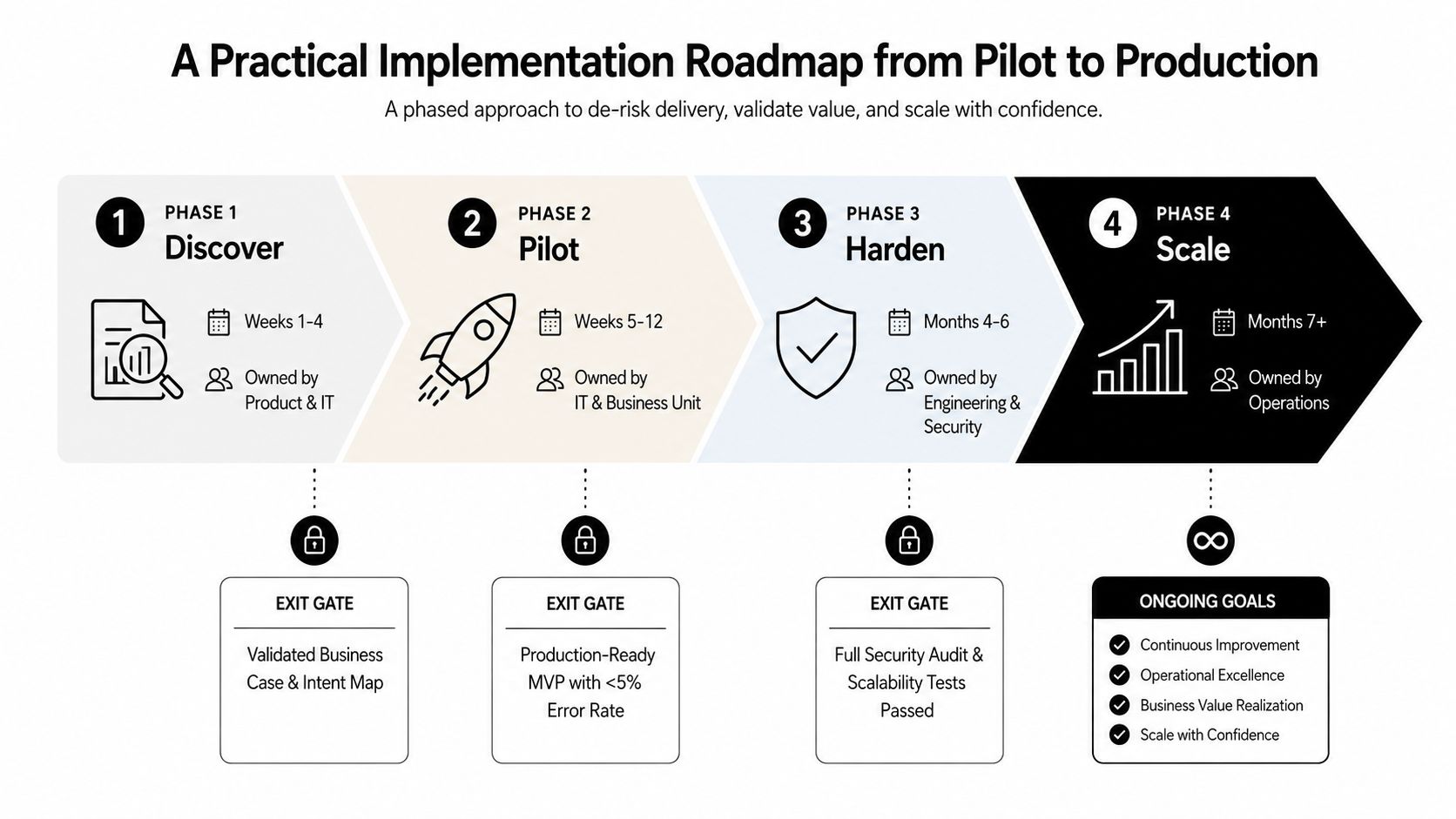
Production readiness requires explicit gates. Use four phases, Discover, Pilot, Harden, and Scale, with separate owners and measurable exit criteria. The objective is lifecycle control, not a short-term deflection result. The platform must withstand model changes, audits, outages, and human handoffs across its operating horizon.
Discover
Product, IT, security, and operations should map intent families, data access, escalation rules, and system dependencies. Establish baselines for cost per resolved contact, repeat contact, first-contact resolution, customer satisfaction, and agent workload. Include model maintenance, monitoring, compliance reviews, and eventual migration in the business case.
The exit gate is a validated intent map and a financial model covering ongoing platform ownership. Do not approve a pilot until one person owns the post-launch budget and operating decisions.
Pilot
Select one high-volume, low-risk intent family. Do not begin with a complex regulated transaction for executive visibility alone. Before the first test conversation, define containment rules, permitted tools, confidence thresholds, disclosure language, and the human-in-the-loop path.
Test answer quality, escalation correctness, retrieval grounding, integration behavior, and model-change handling. Judge the pilot against repeatable quality and control measures, not production-scale concurrency, regional failover, or broad containment targets the environment cannot reproduce.
Harden
Engineering and security own this phase. Add trace-level observability, red-team testing, evaluation harnesses, access reviews, data-loss prevention controls, rollback procedures, and a documented model-update runbook. Test P95 and P99 latency under concurrent voice and chat workloads, rather than only successful single-user turns.
Cover regional policy variations, multilingual content, failure modes, and system outages. Every tool call requires a timeout, fallback, authorization check, and audit record. Validate that logs, prompts, knowledge sources, and workflow state can be reviewed during an audit or exported during migration.
Scale
Operations owns the scaled service, while engineering, security, procurement, and business-unit governance remain involved. Expand by region and intent family only after the prior deployment shows stable quality and an accountable support model.
Ownership test: Name the people responsible for weekly evaluation review, policy updates, incident response, and vendor escalation. Without them, the assistant is not production-ready.
Why Human Handoff Quality Determines Enterprise Conversational AI Success
Enterprise AI should be judged over a three-to-five-year lifecycle, not by deflection rate at launch. Model churn, audit scrutiny, and weak escalation design create larger risks than an occasional unanswered question. A handoff is a product surface and an operating control.
The platform earns trust in the seconds after it reaches a boundary. The agent should receive the transcript, intent, customer identity, sentiment signal, retrieved sources, attempted actions, and escalation reason. If that context stays in disconnected systems, the customer repeats the story while the agent reconstructs it. That failure increases handling time and weakens accountability.
Design escalation as a controlled workflow
Set these rules before production:
- Preempt high-risk interactions: Transfer requests for regulated decisions, transaction disputes, vulnerability signals, or actions outside policy.
- Preserve context: Send the transcript, summary, detected intent, evidence, and unfinished workflow state to the agent desktop.
- Disclose appropriately: Tell customers when they are interacting with AI where transparency or consent obligations apply.
- Measure the transition: Track transfer abandonment, repeated explanations, time to agent acceptance, and resolution quality after handoff.
- Give agents authority: Let the human take over, correct the system, and block the assistant from resuming without an explicit decision.
This workflow also supports regulatory accountability. Privacy rules, sector obligations, and requirements around automated decision-making make opaque systems difficult to defend. Audit teams need to see what the assistant accessed, which policy applied, and why escalation occurred.
An agent assist platform can support the human side of the workflow, but it does not replace architecture decisions about identity, authorization, logging, or intervention. For a build-versus-buy review, require portable transcripts, exportable audit records, configurable routing, and model-agnostic orchestration. Those controls reduce exposure when vendors change models, pricing, or product direction.
Buy automation that makes intervention easier, not a platform whose reported automation rate depends on restricting human access. Over the long term, handoff quality is the clearest test of whether conversational AI can survive operational change.
Enterprise Use Cases That Move the Needle
The use case sets the architecture and its long-term cost. Customer support, employee service, and voice modernization can share a platform, yet each carries different integration, governance, and failure risks.
| Use-case pattern | Primary audience | Example scenario | Core platform dependency | Defensible outcome |
|---|---|---|---|---|
| Customer support | Customers and service teams | A bank assistant answers approved account questions and routes sensitive requests | Retrieval, identity, authorization, and CRM integration | Lower repetitive workload with controlled escalation |
| Employee service | Employees and shared services | An HR assistant handles policy questions and submits routine requests | SSO, HRIS, payroll, and knowledge access | Fewer avoidable service-desk cases |
| Voice contact center | Customers and contact-center agents | A telecom caller describes an issue in natural language and reaches the right team | ASR, TTS, turn-taking, barge-in, and routing | Better routing and a more usable IVR experience |
Customer support needs governed data
A regional bank might use a retrieval-augmented assistant for balance questions, transaction history, and card replacement. The assistant must authenticate the user, apply account-level permissions, retrieve current information, and stop before making a decision that requires a licensed employee or formal review.
Conversational fluency matters less than the identity and authorization path that separates public policy content from private account data. If the assistant cannot make that distinction, keep the deployment limited to general information. This boundary also determines whether the system can withstand audit review as models and retrieval components change.
Employee service needs system coordination
An HR assistant can answer policy questions, support benefits inquiries, and submit routine requests across HRIS, payroll, and learning systems. SSO and role-aware access determine whether an answer changes by country, employment type, business unit, or eligibility status.
The defensible outcome is consistent policy access with an auditable record of what the assistant showed and which system it queried. A platform that cannot preserve those records creates lifecycle cost even if the initial pilot reduces service-desk volume.
Voice modernization needs timing discipline
A telecom contact center replacing a legacy IVR needs accurate speech recognition, interruption handling, routing logic, and a reliable fallback. Callers should be able to describe a problem naturally, while the system must recognize when speech confidence, account context, or routing certainty is inadequate.
Voice exposes weak orchestration immediately. Delays, missed interruptions, and repeated prompts degrade the experience and increase transfers. Treat model replacement, speech-provider changes, and handoff behavior as design requirements from the start. Over a three-to-five-year horizon, those controls matter more than a short-term deflection result because they determine whether the platform can absorb model churn without rebuilding the workflow.
Your Next Step and What Comes After the Guide
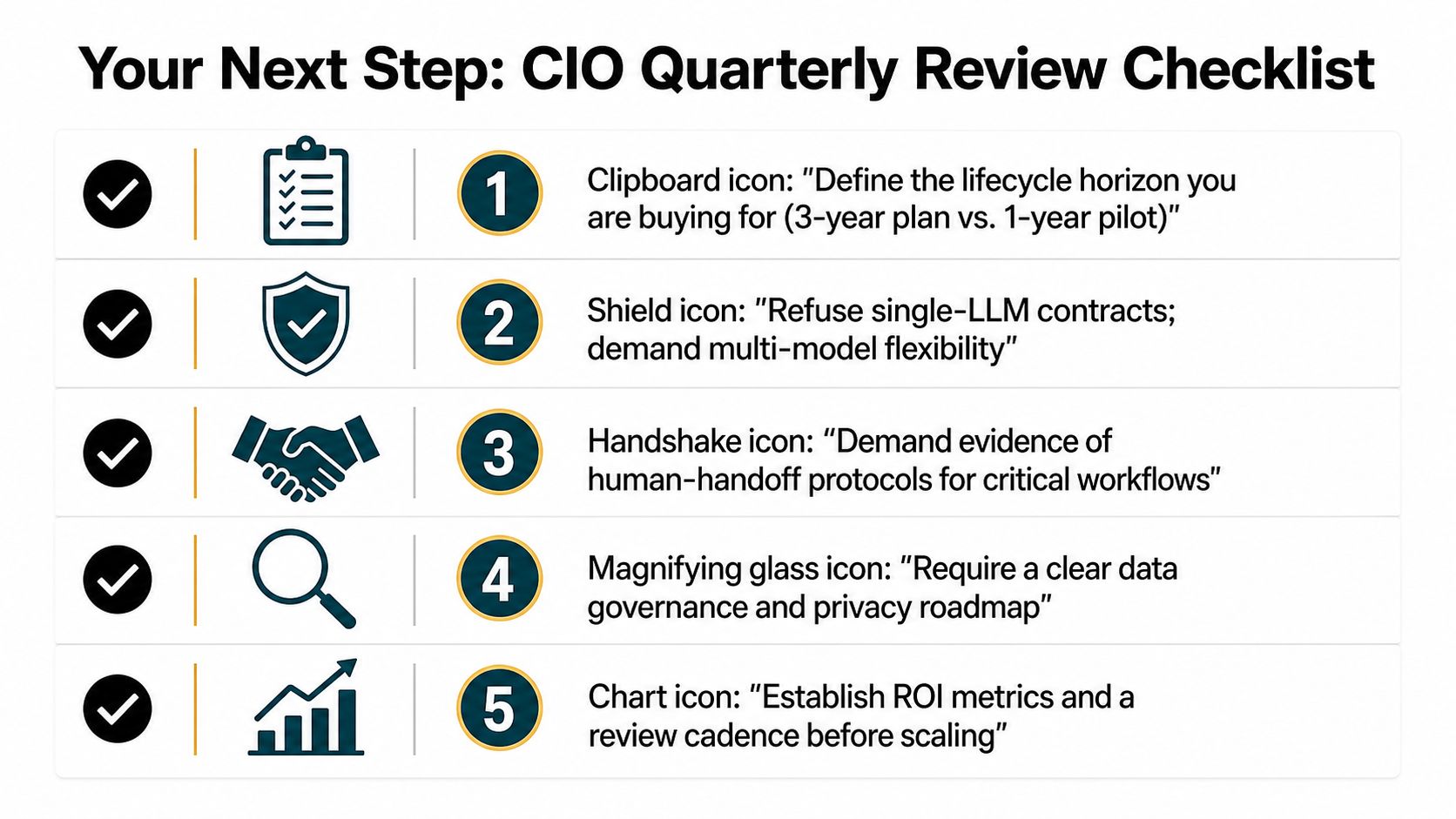
Take five questions into the quarterly review:
- What lifecycle are we buying for? Separate a short pilot from a platform expected to operate for years.
- Can we change models without rebuilding workflows? Refuse contracts and architectures that make one LLM indispensable.
- What happens when the assistant fails? Demand a tested handoff with complete context.
- Can we prove what the system did? Require governance for data access, retrieval, tool calls, policy decisions, and model updates.
- Who runs the service after launch? Assign ownership for evaluation, incidents, content, integrations, and vendor management.
The next phase of conversational AI will move from answering questions to executing multi-step workflows. An assistant may retrieve information, verify identity, update a record, request approval, and notify another system in one controlled interaction. That future makes portability and auditability more important, not less, because action expands the consequences of an incorrect response.
Choose an architecture that can evolve from Q&A to action without discarding its controls. Keep the model layer replaceable, keep business rules explicit, keep knowledge governed, and preserve the human as an active operating component.
Book a 45-minute architecture review with security, contact-center operations, procurement, and the relevant business owner in the same room. Use adoption, economics, stack design, vendor portability, implementation gates, handoff quality, and lifecycle ownership as the agenda, then visit Yellow.ai to assess how its enterprise agentic AI platform fits your CX and EX requirements.



