














Conversational AI for customer support is scaling faster than customer trust. Gartner-reported research found that only 8% of consumers had used a chatbot in their most recent service interaction, and only about one-quarter of those users said they'd use it again (Gartner-reported survey coverage). The lesson isn't that conversational AI has failed. It's that a fast answer means very little when the system can't resolve the customer's problem.
The enterprise decision in 2026 is no longer whether to launch a chatbot. It's where an AI agent gets permission to act, where it must ask for confirmation, and where a human must take over with full context. That boundary determines whether automation lowers cost while improving service, or creates a cheaper path to customer frustration.
Table of Contents
- Why Conversational AI for Customer Support Is a 2026 Inflection Point
- How Conversational AI Actually Works Under the Hood
- ROI Beyond Deflection Metrics
- An Enterprise Implementation Roadmap That Actually Ships
- Choosing a Platform Without Falling for the Demo
- KPIs That Separate Wins from Vanity Numbers
- Governance, Compliance, and the Human Handoff Boundary
- Where Conversational AI Wins and Where It Breaks
Why Conversational AI for Customer Support Is a 2026 Inflection Point
Conversational AI has become an agentic architecture decision, not a chatbot purchase. Gartner's forecast, as reported in industry coverage of Gartner's forecast, points to conversational AI reducing contact-center labor costs by $80 billion in 2026. The same forecast projects that agentic AI could autonomously resolve 80% of common customer service issues by 2029 and reduce operating costs by 30%. These projections matter because the technology is moving from scripted replies to systems that interpret intent, retrieve approved information, call enterprise tools, and complete defined work.
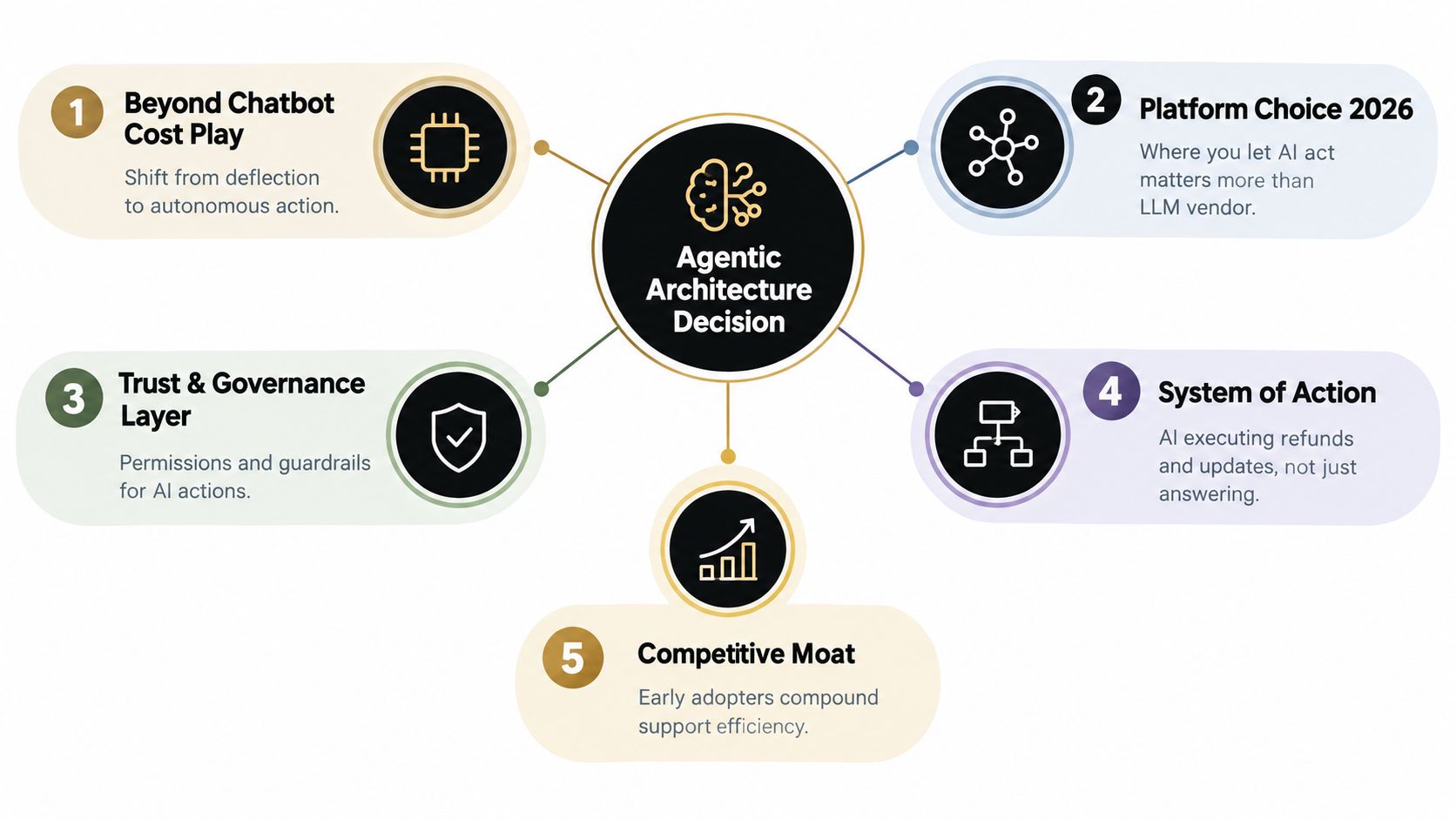
Choose the platform by deciding where AI can act safely. An agent answering an order-status question needs read access to order data. An agent issuing a refund needs policy checks, transaction controls, identity verification, and an auditable action trail. The language model supports the workflow. It does not govern the workflow by itself.
Three trade-offs determine whether the program earns executive support:
- Autonomous resolution versus safe escalation. Let AI close stable, low-risk intents. Require confirmation or human review when money, eligibility, safety, or emotional recovery is involved.
- Deflection versus first-contact resolution. Avoiding a transfer does not prove success. The customer's underlying issue must be closed.
- Pilot ROI versus enterprise readiness. A narrow demonstration can look strong while knowledge ownership, workforce design, quality assurance, and exception handling remain unresolved.
Architectural rule: Treat every automated intent as a controlled transaction, not a clever conversation.
The strongest programs build a system of action. They connect the conversation layer to CRM records, order management, billing, identity, scheduling, and ticketing. Grant autonomy only after the agent proves it can complete defined workflows, enforce permissions, and recognize uncertainty. Apply that standard to every vendor, pilot, and production release.
How Conversational AI Actually Works Under the Hood
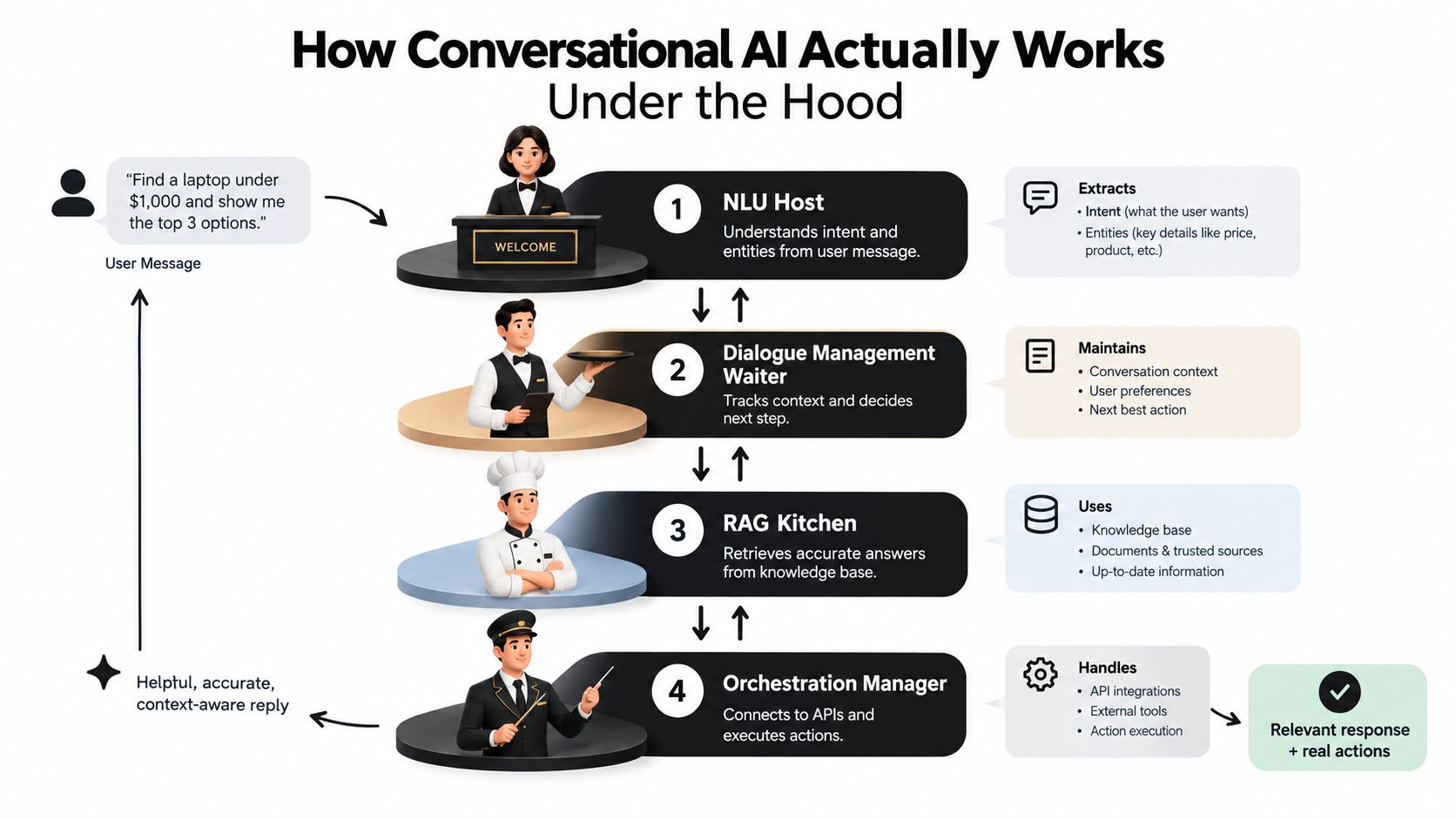
A conversational AI system resembles a well-run restaurant. Natural language understanding is the host, identifying why the guest arrived and what they're asking for. Dialogue management is the waiter, tracking context and deciding what should happen next. Retrieval-augmented generation is the kitchen, preparing an answer from approved information. Orchestration is the manager, coordinating staff, systems, and exceptions.
The input and interpretation layer
The customer's message first passes through intent recognition and entity extraction. The system needs to distinguish “Where is my order?” from “My order arrived damaged,” while identifying details such as an order number, product, date, location, or account type.
Natural language understanding handles ambiguity, slang, incomplete phrasing, and conversational context. Its weakness appears with multi-intent requests, such as a customer who wants to change an address, cancel an item, and understand a charge in one message. A classifier that forces the exchange into one intent can answer part of the request and lose the rest.
Dialogue management maintains state across turns. It decides whether to ask for missing information, confirm an action, retrieve policy, invoke a tool, or escalate. Without reliable state tracking, the agent repeats questions, forgets earlier answers, or takes an action before it has enough context.
The knowledge and action layer
RAG retrieves relevant content from a knowledge base instead of relying solely on the model's learned patterns. That improves grounding only when the source material is current, permission-aware, well-structured, and version controlled. A stale returns policy can produce a fluent but incorrect answer, so knowledge governance belongs inside the service architecture. Teams evaluating this layer can review a conversational knowledge base approach alongside retrieval tests, source attribution, and refusal behavior.
Orchestration connects the agent to APIs and business workflows. It may check an order, update an address, create a ticket, schedule an appointment, or initiate a refund. In production, this integration layer is usually the bottleneck. Backend APIs time out, return inconsistent fields, enforce hidden rules, or lack the write permissions the workflow requires.
The response layer then generates the customer-facing message, but generation should come last. A polished sentence can't compensate for incorrect state, stale knowledge, or an action that never completed.
A practical test is simple: remove the language model from the demo and inspect the workflow. If the system has weak identity, policy, API, logging, and handoff controls, changing models won't fix the deployment.
The customer journey becomes more concrete in this short visual explanation:
ROI Beyond Deflection Metrics
Conversational AI creates enterprise value only when it closes customer needs, protects revenue, and sends risky work to the right human. Leaders should measure those outcomes separately instead of treating every avoided transfer as savings.
Labor economics start with stable policies and standardized actions. Automating order status, returns, account updates, and billing questions can reduce repetitive workload, provided the system resolves the case instead of shifting the customer between channels. The business case should therefore include workflow completion, recontacts, escalations, and total cost per resolved interaction.
Revenue protection is harder to see in a chatbot dashboard. A correct answer can prevent a failed payment, preserve an order, reduce cancellation risk, or stop a customer from repeating the same explanation. Tie experience gains to post-resolution CSAT, customer effort, repeat contact, and retention signals. Faster replies alone do not prove better service.
Deflection is a weak proxy because it counts any interaction that does not transfer to a human. The customer may abandon the conversation, call later, reopen the issue, or accept an answer that fails to solve the problem. End-to-end resolution asks the better question: did the underlying need close without avoidable rework?
| ROI Layer | Example Metric | Benchmark Range | Hidden Cost |
|---|---|---|---|
| Labor cost reduction | Cost per resolved interaction | 20 to 40% reduction | Knowledge curation, workflow maintenance, and review |
| Revenue protection | Prevented cancellations or failed transactions | 5 to 15% improvement | Policy integration and transaction controls |
| Experience lift | First-contact resolution, CSAT, customer effort | 10 to 20% improvement | Conversation design, testing, and escalation tuning |
Treat these ranges as planning benchmarks, not guaranteed outcomes. Validate them against your own intent mix, action coverage, and escalation policy.
Capture baselines 60 to 90 days before go-live to separate AI impact from seasonality, staffing changes, and demand variation, following this ROI measurement guidance. Track first-contact resolution, average handle time, CSAT, cost per interaction, repeat contact, and reopened cases together. A lower transfer rate can hide a higher total cost if unresolved customers return through another channel.
Sequence the gains:
- Stabilization: Make knowledge, integrations, identity checks, and handoff reliable.
- Deflection: Automate simple information requests while keeping the human option visible.
- Resolution: Add backend actions and measure closed outcomes by intent.
- Revenue and retention lift: Connect service outcomes to commercial and relationship signals.
Use a conversational AI ROI calculator to structure assumptions, then test each assumption against resolved-case data. Approve the business case only when autonomous resolution, escalation quality, and downstream customer outcomes improve together.
An Enterprise Implementation Roadmap That Actually Ships
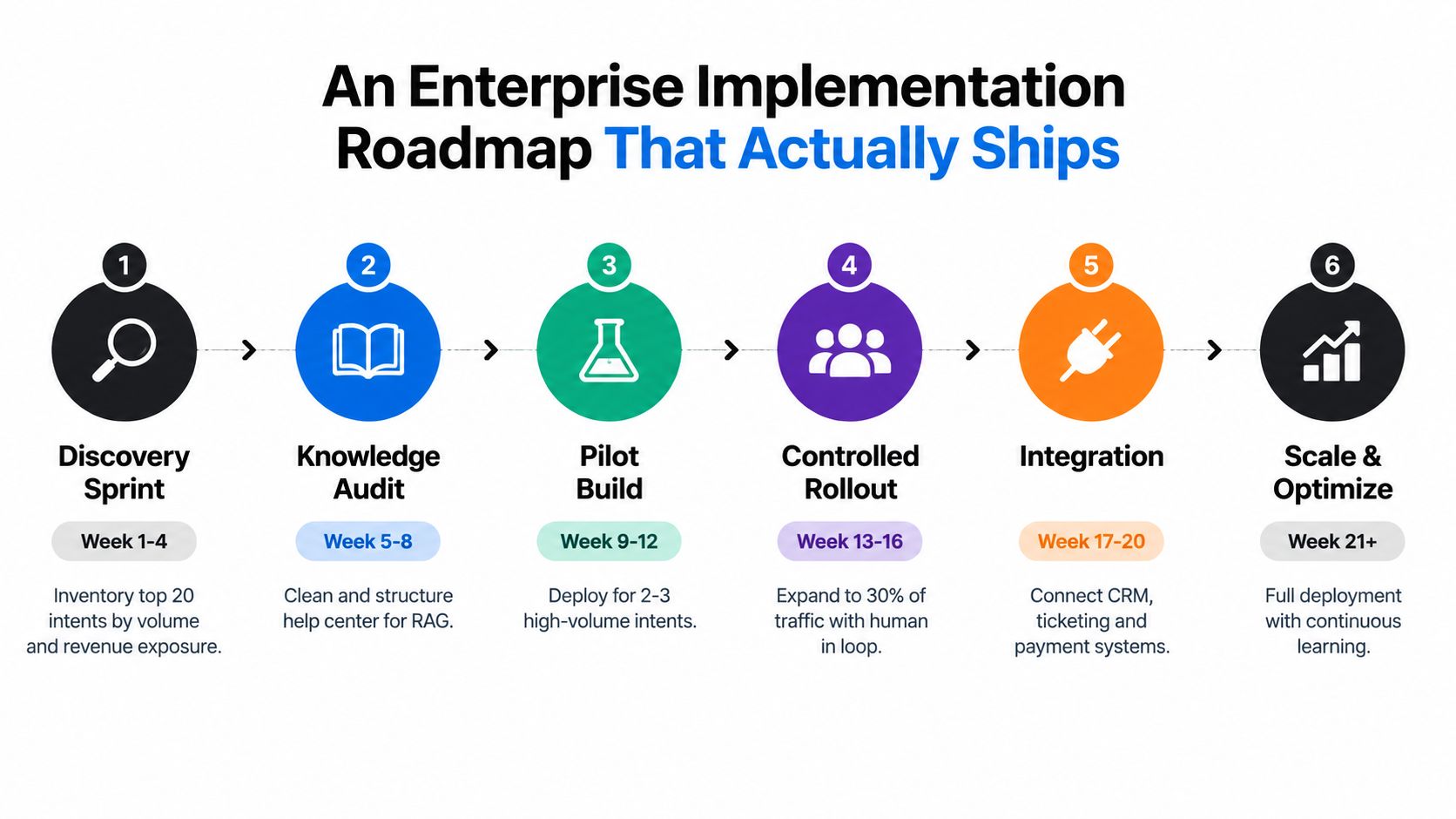
A production rollout needs sequence, ownership, and a kill switch. Leaders who launch across every channel and intent at once create an expensive diagnostic problem. When the system fails, nobody knows whether the cause is poor retrieval, weak intent routing, missing API permissions, unsuitable policy, or an escalation defect.
Start with discovery and data readiness
Run a four-week discovery sprint. Inventory the top 20 intents by volume and revenue exposure, then score each for ambiguity, policy stability, backend actionability, customer risk, and escalation complexity. Audit existing knowledge articles for accuracy, ownership, duplication, and reuse quality.
Next, clean transcripts and tag intent, outcome, escalation reason, and policy path. Build a retrieval corpus with version control. Every article needs an owner and a process for withdrawal when policy changes.
Build a narrow pilot
Choose two intents with clear containment and resolution definitions. Status checks and straightforward returns are stronger starting points than disputes, hardship programs, or emotionally charged complaints. Define success thresholds before deployment, and include a kill clause that pauses automation when escalation accuracy, CSAT, or compliance performance drops.
The pilot should run with human oversight and complete transcript capture. Test normal requests, incomplete requests, conflicting instructions, abusive language, policy exceptions, and backend failures. A system that performs well only on the happy path isn't ready for scale.
Expand by risk, not excitement
Expand first into low-risk FAQ and status-check surfaces, then transactional workflows. Reserve voice for later because latency, recognition errors, and interruption handling make mistakes more costly. Add channels only when the same intent logic, customer context, permissions, and handoff behavior work consistently.
After launch, establish operating rhythms:
- Weekly: Review intent drift, failed retrievals, escalations, and unresolved repeat contacts.
- Monthly: Refresh training and evaluation sets, then retest changed workflows.
- Quarterly: Audit permissions, retention, redaction, vendor controls, and autonomy settings.
- Always: Assign a named owner for the autonomy boundary who can reduce permissions or activate escalation.
Go-live isn't the finish line. It's the moment the organization starts operating an AI service.
Choosing a Platform Without Falling for the Demo
A polished demo proves almost nothing about production readiness. Vendors can select clean questions, preload ideal documents, hide latency, and simulate integrations. Your evaluation must expose uncertainty, failed actions, permission boundaries, and the quality of escalation.
| Criterion | What to Test | Pass Threshold | Red Flag |
|---|---|---|---|
| Latency | Measure end-to-end response and tool execution across digital and voice flows | Meets your channel-specific latency budget | Fast text response, slow action completion |
| Language coverage | Test real customer language, dialect variation, and code-switching | Reliable intent and entity handling for target markets | Strong performance only in polished standard language |
| RAG depth | Use current, conflicting, permissioned, and missing documents | Grounded answers, source visibility, and safe refusal | Fluent answers without evidence |
| Integrations | Execute CRM, ticketing, identity, order, billing, and payment workflows | Actions complete through supported enterprise systems | Connector exists, but key workflows require custom middleware |
| Governance | Inspect roles, redaction, audit logs, approvals, and intent controls | Per-intent autonomy and traceable decisions | One global automation setting |
For synchronous channels, test against a latency budget under 800 milliseconds, the threshold specified in the implementation criteria. Slower responses can reduce voice containment, particularly when the agent must retrieve customer data or call a backend service. Measure the complete action, not just the generated text.
Run a scripted bake-off with three real intents from your backlog. Record end-to-end resolution time, tool success, escalation accuracy, and transcript quality. Introduce a missing account record or unavailable API, then assess whether the platform states its limits, preserves context, and routes the customer correctly.
Vendor test: Ask the platform to fail in front of you. The refusal, handoff, transcript transfer, and audit event reveal more than a fluent answer.
Language coverage requires more than a language selector. Test regional phrasing, mixed-language messages, abbreviations, names, dates, currencies, and voice interruptions. Evaluate whether the system keeps the correct intent and entities when customers are imprecise.
RAG testing must include contradictory policies, stale content, restricted knowledge, and questions with no approved answer. Require citations or source visibility where appropriate, and verify that the system refuses unsupported claims instead of filling gaps with plausible text.
Integration ergonomics sets the implementation tax. Check whether actions run within the platform, existing APIs can be reused, errors are visible to operators, and workflow changes have a clear owner after launch. Governance should include role-based access, PII redaction, prompt-injection defenses, immutable audit trails, and autonomy settings by intent. The platform must let you configure where AI resolves independently and where a human must take over.
Use this buyers guide for evaluating conversational AI solutions as a comparison aid, then let your production test decide. Choose the platform that security, operations, CX, and engineering can govern together, not the one with the slickest interface.
KPIs That Separate Wins from Vanity Numbers
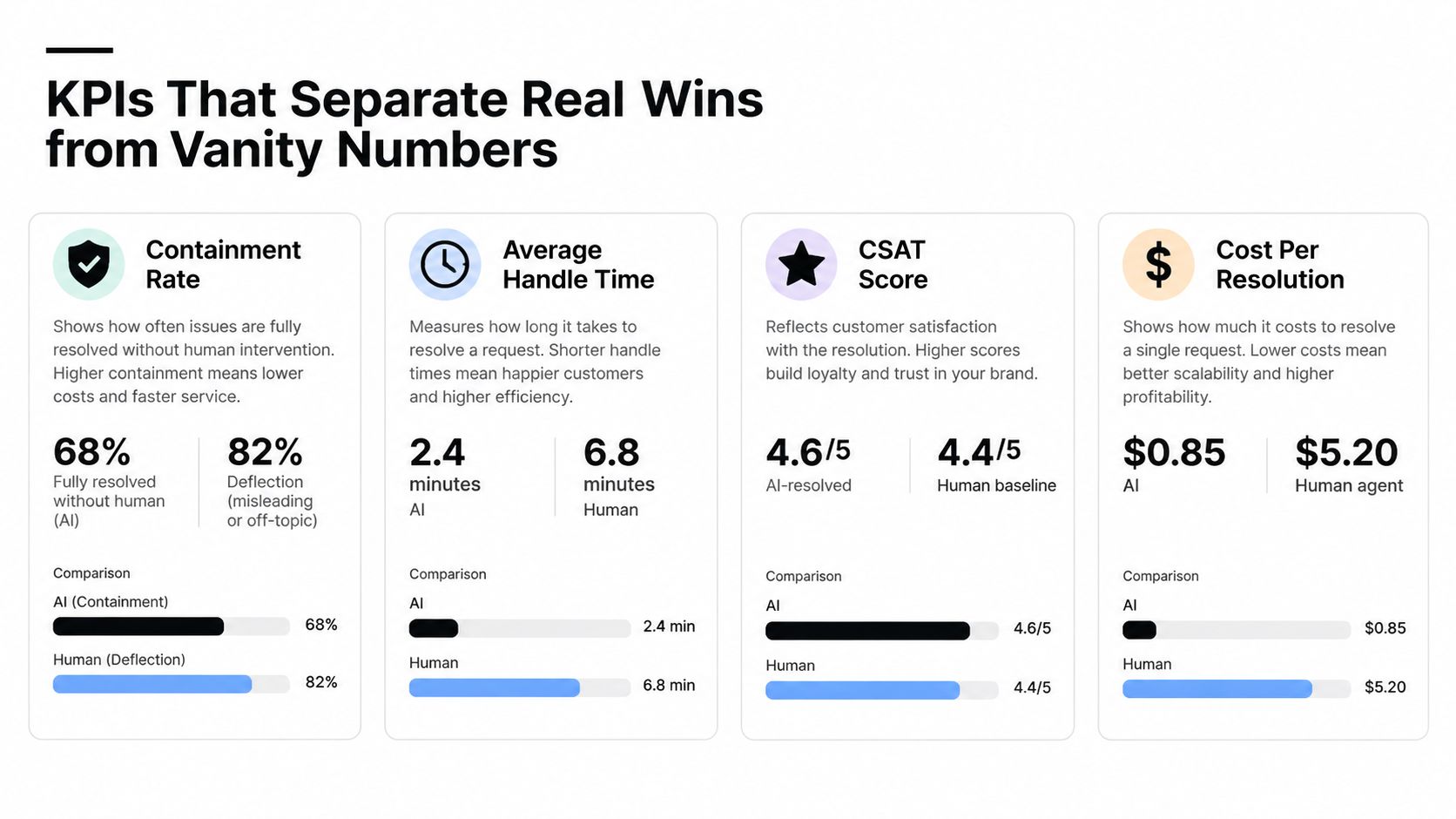
Deflection is the most cited and least reliable conversational AI KPI. It counts “no transfer” as success even when the customer leaves without an answer. Report it for capacity planning, but never make it the primary outcome.
Containment means the session ended without human escalation. Resolution rate means the underlying problem closed. Instrument those events directly. A customer who receives a policy article and contacts support again has not been resolved.
Track outcomes by intent because autonomy should follow workflow risk. Gartner-reported data found that chatbot journeys resolved only 17% of billing disputes, compared with 58% for return and cancellation flows (Gartner survey release). Returns often follow deterministic steps. Disputes require evidence, judgment, policy interpretation, and a deliberate human handoff. Use the metric gap to set routing rules, not to judge automation as a single category.
Measure the customer outcome
Pair containment and resolution with:
- First-contact resolution: Whether the customer needed another interaction.
- Post-resolution CSAT: Whether the customer accepted the outcome.
- Customer effort: The repetition, navigation, and clarification the journey required.
- Repeat contact: Whether the same issue returned through another channel.
- Escalation accuracy: Whether the AI handed off at the right point and supplied usable context.
Measure the operating system
Agents need a separate scorecard. Track assisted handle time, escalations per shift, and CSAT differences between AI-routed and human-routed cases. If AI sends agents only the hardest cases without context, average handle time can rise while total volume falls.
Protect production performance with intent drift rate, retrieval miss rate, p95 latency, tool failure rate, and policy-violation incidents. Gartner's 2025 survey found that 60% of customer service agents fail to promote self-service, while only 35% of customers who last interacted by phone were willing to adopt a GenAI digital assistant (Gartner survey findings). Adoption depends on workflow incentives and channel trust, not model quality alone.
A leadership dashboard that reports only deflection can reward the wrong autonomy boundary and hide repeat work. Judge AI by closed customer problems, accurate escalation, and safer operating performance.
Governance, Compliance, and the Human Handoff Boundary
More automation does not guarantee better support. Independent coverage reports that 75% of respondents had experienced a fast AI response that still left them frustrated (coverage of customer reactions and Gartner projections). Speed without a useful outcome creates repeat work and weakens trust.
Governance starts with intent classification and a defined autonomy boundary. Let AI close low-risk, deterministic requests without review. For material consequences, it can prepare a transaction or explain a policy, then require customer confirmation or human approval. Escalate interactions involving clinical judgment, financial hardship, contested liability, safety, vulnerability, or exceptions outside approved policy.
Build controls into the workflow
Treat the boundary as a permission model, not a paragraph in a policy document:
- Action permissions: Separate read access from write access, and require explicit approval for sensitive transactions.
- Data controls: Apply PII redaction, retention limits, deletion workflows, and regional processing rules.
- Security defenses: Test for prompt injection, unauthorized data retrieval, identity failure, and instruction conflicts.
- Auditability: Log source documents, tool calls, policy decisions, confirmations, escalations, and final outcomes.
- Human handoff: Transfer the full transcript, detected intent, customer identity state, attempted actions, and reason for escalation.
Compliance requirements shape the architecture. GDPR can affect residency and deletion design. PCI DSS matters when payment-adjacent conversations touch sensitive transaction data. HIPAA applies in clinical contexts. The EU AI Act can affect risk classification for high-stakes use cases, while CCPA creates deletion-rights considerations.
Set escalation service levels by risk class. A low-risk knowledge question can tolerate asynchronous review. A suspected fraud event, medication concern, utility safety issue, or vulnerable-customer interaction needs a faster, explicitly owned human path. The handoff should preserve context, prevent repeated verification, and make the next action clear to both the customer and the agent.
Treat the human as part of the designed resolution system, not a fallback button.
Where Conversational AI Wins and Where It Breaks
Conversational AI creates value when the agent operates inside a defined autonomy boundary. Select intents with stable policies, reliable data, and reversible actions for autonomous resolution. Escalate requests that require judgment, exceptions, or consequences the system cannot safely assess.
| Industry | High-fit intents | Human-required intents | Pilot measurement focus |
|---|---|---|---|
| Banking | Account locking, card replacement, dispute intake | Credit decisions, hardship programs, complex fraud review | Measure resolution by intent and risk class |
| Healthcare | Appointment scheduling, prescription refill status, FAQ-heavy triage | Diagnosis, symptom assessment, clinical documentation | Separate administrative completion from clinical escalation |
| Retail | Order status, returns, loyalty questions | Fit and style complaints, emotional recovery | Track policy-compliant completion and recovery outcomes |
| Utilities | Outage reporting, consumption insights | Field dispatch, life-safety escalations | Measure reporting completion and escalation speed |
Banking and financial services
Account locking and card replacement usually follow deterministic identity and fulfillment workflows. Dispute intake can also perform well when the agent gathers structured evidence and creates a complete case for a specialist. Credit decisions and hardship programs should remain human-led because they depend on broader context, policy exceptions, and consequences beyond a simple information exchange.
Set the boundary clearly: AI may collect and verify information, but it should not make an unreviewed judgment about eligibility, hardship, or contested financial responsibility. Escalation must preserve the evidence already gathered, so the customer does not repeat the conversation.
Healthcare
Scheduling, appointment changes, prescription refill status, and general policy questions suit automation when the system uses current records and enforces identity controls. FAQ-heavy triage can route a patient, but it must not become diagnosis by another name.
Symptom assessment, clinical recommendations, and clinical documentation belong with qualified clinicians or authorized staff. AI can gather structured information and identify escalation triggers. The clinical decision stays with a human owner.
Retail and utilities
Retail teams can automate order status, returns, cancellations, and loyalty support when order and policy systems are connected. Fit complaints, style dissatisfaction, damaged goods with emotional impact, and service recovery require experienced agents who can balance policy with relationship repair.
Utilities can automate outage reporting and consumption questions. Field-dispatch coordination becomes harder as schedules, crews, geography, and changing conditions interact. Life-safety issues should move immediately to a human-led escalation path with clear instructions and operational ownership.
A practical 90-day action plan
Days 1 to 30: Instrument the contact center, mine transcripts for the top 20 intents, and score each for volume, handle time, policy stability, and risk. Select three high-volume, low-risk, policy-stable intents.
Days 31 to 60: Deploy a RAG-backed assistant against a closed knowledge base. Connect CRM and ticketing systems, run in shadow mode, and compare containment and resolution signals with human-handled baselines. Measure results by intent rather than relying on one overall resolution figure.
Days 61 to 90: Expand to two channels, activate human handoff with complete transcript context, instrument resolution and CSAT, and complete security and compliance review.
Before signing a platform contract, document three decisions: the autonomy boundary, the escalation latency budget, and the data retention policy. If the vendor cannot support them as configurable controls, the platform does not fit the operating model.
Yellow.ai provides an enterprise agentic AI platform for customer support across chat, voice, email, and messaging, with orchestration, knowledge retrieval, integrations, analytics, and human handoff controls. Visit Yellow.ai to evaluate whether its architecture fits your highest-volume intents and required autonomy boundary.



