













Monday morning in a large contact center rarely starts with a clean improvement brief. CSAT has slipped, average handle time keeps rising, the VP wants a transformation program, and QA, operations, product, and the AI team have each launched a workstream with a different definition of success. By the time the first review meeting begins, everyone has activity to report, but nobody has a shared hypothesis to test.
That pattern is especially dangerous in AI-enabled CX operations. A human process may tolerate a quarterly review cycle. An AI agent can drift as its knowledge, prompts, traffic, and customer behavior change. The operating model must learn continuously, while still protecting customers from poorly governed experiments.
Table of Contents
- Why Most Improvement Programs Stall Before They Start
- What Continuous Improvement Cycles Really Are
- Comparing PDCA, DMAIC, and OODA
- Applying Cycles to CX, EX, and AI Agent Lifecycles
- Metrics and KPIs That Prove the Cycle Works
- Tooling, Governance, and Enterprise Guardrails
- Implementation Roadmap and Enterprise Examples
Why Most Improvement Programs Stall Before They Start
The first failure usually happens before anyone runs an experiment. Leaders label the effort a transformation, assign a program manager, open a project tracker, and assume momentum will follow. The contact center then returns to its normal rhythm of escalations, staffing gaps, calibration meetings, and urgent product fixes.
A program stalls when improvement has a finish line. Once the launch date passes, teams treat the new workflow as complete even though customer behavior, agent behavior, and system conditions continue to change. A completed project may produce a useful intervention, but it doesn't create the operating habit required to detect the next source of variation.
The ownership problem
In practice, ownership gets divided across functions. QA identifies a defect, operations changes a script, product modifies a workflow, and analytics publishes a dashboard. Each group may perform its role correctly, yet nobody owns the full loop from signal to tested change to standardization.
The result is familiar:
- QA owns findings: The team can describe what went wrong but lacks authority to change the process.
- Operations owns execution: Supervisors can coach behavior but may not control tooling, policy, or knowledge content.
- Product owns the platform: Product teams can ship changes but may not see how those changes affect live conversations.
- Leadership owns urgency: Executives request movement, then priorities shift before the feedback mechanism becomes durable.
Metrics can make the situation look healthier than it is. Teams report completed coaching sessions, reviewed conversations, launched automations, or published dashboards. Those measures show activity, not whether the process is becoming more predictable or whether customers are receiving better outcomes.
Practical rule: If a metric doesn't help the team decide what to test next, it belongs in an activity report, not the improvement scorecard.
The most durable programs create a named owner for each cycle, a baseline, a decision date, and a feedback channel that survives leadership changes. A structured Plan, Do, Check, Act loop turns a vague transformation request into a sequence of observable decisions. The team states a hypothesis, runs a bounded test, checks the evidence, and either standardizes the change or learns why it failed.
That rhythm matters because continuous improvement is a management system, not a motivational campaign. The discipline has roots in statistical process control and postwar quality management, and its formal history spans roughly 70+ years of global practice, including Deming's introduction of the PDCA cycle in Japan in the 1950s and JUSE's adaptation of the familiar loop in 1951 (historical background on continuous improvement cycles).
What Continuous Improvement Cycles Really Are
A continuous improvement cycle is a repeatable operating loop that converts observed variation into a testable hypothesis. The team defines the problem, changes one meaningful part of the process, measures the result against a baseline, and embeds the change only when the evidence supports it.
The core loop is simple:
- Plan: Describe the problem, identify a likely cause, define the expected outcome, and decide how the team will measure it.
- Do: Run a controlled change in a scope small enough to manage and broad enough to generate a useful signal.
- Check: Compare results with the baseline, inspect unintended effects, and determine whether the hypothesis held.
- Act: Standardize the improvement, revise the test, or abandon the idea and plan the next experiment.
The value comes from the discipline between those steps. “We changed the script and people liked it” isn't a sufficient Check phase. A useful cycle records what changed, where it ran, which outcomes moved, what risks appeared, and what the team will do next.
A statistical idea with a long operating history
The framework didn't begin as a modern agile ritual. Walter A. Shewhart described an earlier repeating cycle as Specify, Produce, Inspect, and later quality practice evolved through statistical process control and industrial methods developed in the late nineteenth and early twentieth centuries. W. Edwards Deming introduced the PDCA or Deming Cycle in Japan during the 1950s, while JUSE adapted it into the familiar Plan, Do, Check, Act loop in 1951 (the documented history of the cycle).
That lineage matters because the intellectual core is measurement. Continuous improvement isn't the same as asking employees to “find small wins.” It asks leaders to distinguish signal from noise, understand process variation, and avoid standardizing a change merely because it feels promising.
One published Kaizen case demonstrates the mechanism clearly. Across eight PDCA cycles completed over six months, the defect rate reached 1.52%, below the company target of 1.60%, while the specific process fix reduced scrap plate by 38% (published Kaizen case study). The lesson isn't that every team should reproduce those figures. It's that repeated, documented cycles can connect root-cause analysis to measurable operational decisions.
Continuous doesn't mean permanent chaos
“Continuous” doesn't mean every employee is changing the process every day. It means the organization maintains a reliable rhythm of short, time-boxed experiments, reviews, and standardization. Teams may run several improvement streams in parallel, but each stream needs a clear problem statement and a learning gate.
Continuous improvement also differs from continuous innovation. Innovation may seek a new product, channel, or business model. Improvement strengthens an existing workflow by reducing friction, defects, delay, or inconsistency. A new AI agent can be an innovation. Improving its escalation rules after reviewing live conversations is continuous improvement.
One-off Kaizen events still have value when a team needs concentrated attention. They don't replace a system that preserves learning. Simulation research in flow-shop environments found that small improvements across multiple stations can reduce cycle time as much as, or sometimes more than, one large improvement at a single point. The same research highlights process variability as a key concern because variation can propagate downstream and damage overall flow (flow-shop simulation research on improvement and variability).
Comparing PDCA, DMAIC, and OODA
A contact center trying to lower average handle time can choose the wrong cycle and waste weeks. If the cause is unclear, a quick PDCA change to scripts may shift work between agents without reducing effort. DMAIC is better for separating agent behavior, customer complexity, system latency, transfers, and policy constraints. OODA fits a live outage or sudden routing failure, where waiting for a complete analysis creates greater operational risk.
PDCA, DMAIC, and OODA all connect observation, decision, action, and learning. Their differences are practical: the evidence required, the governance burden, the speed of response, and the cost of an incorrect decision. Those trade-offs matter even more when an AI agent can change behavior across many conversations before a human reviewer notices drift.
| Dimension | PDCA | DMAIC | OODA |
|---|---|---|---|
| Typical cycle time | Short and lightweight | Longer and structured | Fast and decision-oriented |
| Data intensity | Enough data to test a focused hypothesis | High, with a defined baseline and root-cause analysis | Real-time or near-real-time signals |
| Governance overhead | Moderate | High | Depends on the decision risk |
| Best-fit use case | Incremental process tuning, coaching, and small AI changes | Persistent defects, AHT or FCR diagnostics, and control plans | Triage, routing, escalation, and live guardrails |
| Concrete contact-center example | Test a revised knowledge article for one intent group | Analyze a high-AHT queue, then validate a change to transfers or system steps | Reroute contacts during a platform incident while monitoring failure signals |
| Risk profile | Lower-risk experiments | Controlled changes with formal validation | Faster action with greater tolerance for incomplete information |
PDCA for clear, bounded changes
PDCA suits a problem the team understands well enough to test a focused intervention. A supervisor might revise a knowledge article, change a coaching prompt, or adjust an AI agent's response for one defined intent group. The team plans the hypothesis, runs the change in a limited setting, checks the outcome, and either standardizes or revises it.
Its strength is accessibility. Operations leads can run PDCA without turning a small workflow adjustment into a statistical project. The weakness appears when the Plan stage is casual. Without a clear baseline, target, owner, and review window, the Check phase becomes opinion rather than evaluation.
DMAIC for defects that need diagnosis
DMAIC, Define, Measure, Analyze, Improve, Control, fits persistent defects where the baseline matters and the organization must show that gains will hold. For an AHT reduction effort, analysts may segment calls by intent, tenure, transfer path, authentication steps, latency, and policy exception before selecting an intervention. The team can then test the change and establish controls that detect regression.
DMAIC provides stronger analytical discipline and a formal Control phase. That structure supports enterprise programs and high-impact changes, but it adds time and coordination. A minor knowledge-base issue rarely needs the same burden when a contained PDCA test can answer the question safely.
OODA for decisions under pressure
OODA, Observe, Orient, Decide, Act, fits live escalation routing, incident response, and AI-agent guardrails that must react to emerging failure patterns. It favors a bounded, reversible decision supported by current signals, followed by review and adjustment.
OODA does not remove governance. Teams still need predefined thresholds, escalation paths, approval rights, and an audit trail. Leaders comparing operating conditions can also consult this guide on decision-making frameworks from Acheloa Wellness.
Use PDCA for a focused adjustment, DMAIC for a measurable defect with complex causes, and OODA when conditions change faster than a conventional analysis cycle can respond. In AI programs, the choice may change by stage: DMAIC can diagnose drift, PDCA can tune a prompt or workflow, and OODA can contain a live failure while the longer analysis continues.
Applying Cycles to CX, EX, and AI Agent Lifecycles
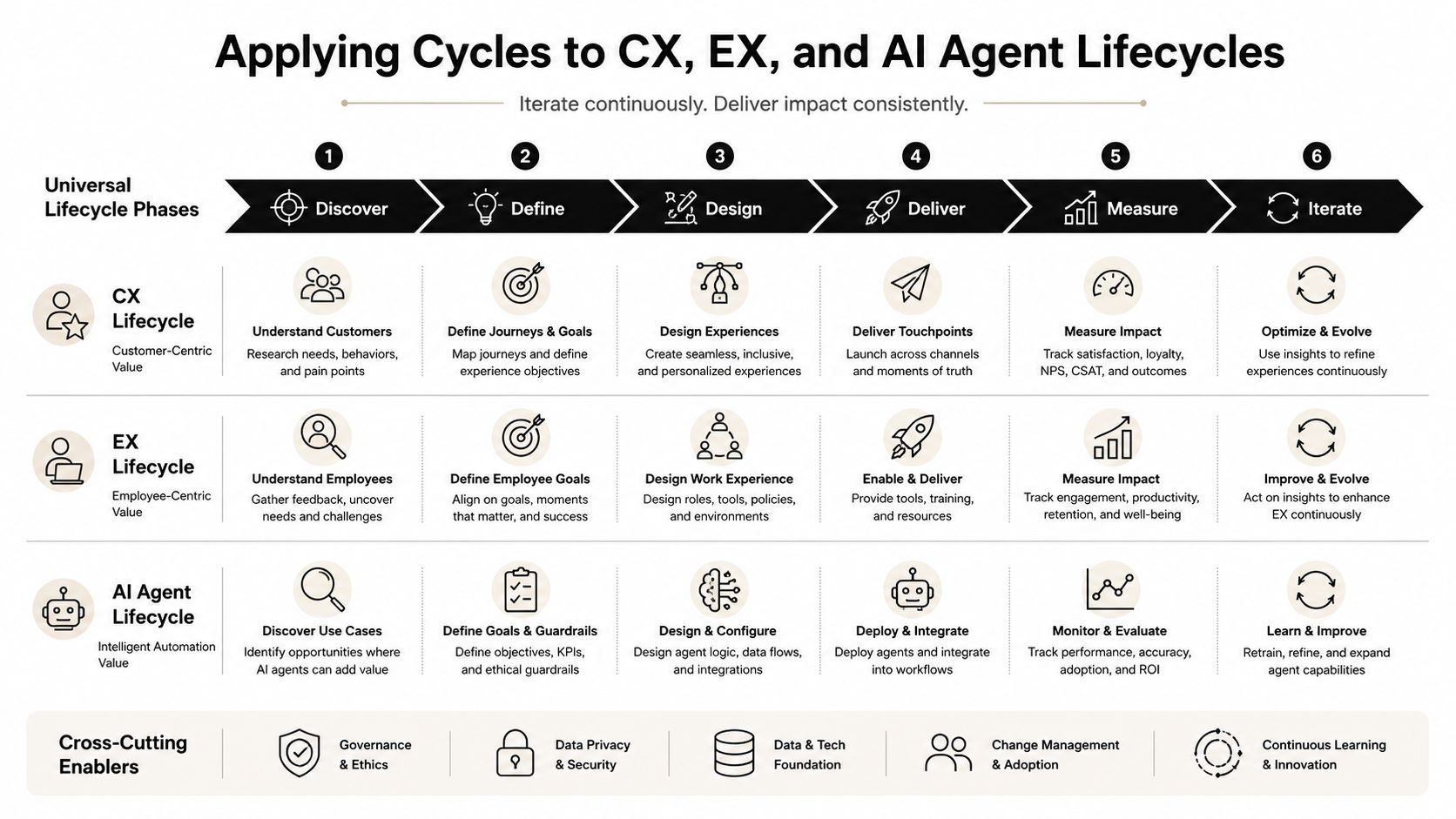
A cycle becomes operational only when each phase has a real owner, a real signal, and a real decision. The same logic can support customer experience, employee experience, and AI agent management, but the evidence and cadence differ across each domain.
CX workflows
For CX, the Plan phase begins with a customer signal. That might come from conversation reviews, contact-driver analysis, journey analytics, survey comments, or escalation patterns. The team then defines a narrow hypothesis, such as changing the authentication handoff for one contact reason to reduce avoidable transfers.
During Do, the change runs in a controlled workflow, queue, channel, or customer segment. Check combines outcome data with qualitative review. A shorter interaction isn't automatically better if it creates repeat contacts, lower resolution quality, or more escalations. Act means updating the knowledge base, coaching material, routing rule, or product requirement and assigning an owner to monitor the new baseline.
EX workflows
Employee experience cycles use the same structure, but the frontline employee becomes a primary source of evidence. An onboarding survey may reveal that new hires understand policy but struggle to find the right system workflow. The Plan phase turns that observation into a specific intervention, such as a revised learning path or supervisor-led practice session.
Do happens through coaching, calibration, training, or a shift-level huddle. Check looks at quality results, adherence, employee feedback, and operational friction together. If the change works, Act embeds it in onboarding, coaching templates, or supervisor routines. If it doesn't, the team should treat that outcome as diagnostic information rather than blaming adoption.
The following video provides a visual introduction to the operating logic behind these cycles.
AI agent lifecycles
AI agents need a more active loop because their performance can change as prompts, retrieval content, traffic, policies, and customer language change. In Plan, the team identifies intents, reviews the corpus, defines the desired behavior, and sets acceptance criteria for both successful answers and safe handoffs.
Do can include a shadow launch, a limited traffic allocation, or a human-reviewed deployment. Check examines containment, customer satisfaction, escalation quality, answer accuracy, policy adherence, and failure clusters. Act may involve prompt tuning, guardrail updates, knowledge corrections, retraining, or retirement of an unsafe behavior.
The difficult handoff sits between Check and Act. An AI system can surface thousands of candidate improvements, but a human owner still needs to decide which changes are safe, testable, and worth deploying. Recent research argues that traditional Six Sigma logic doesn't fully fit machine-learning cycles, while a newer PDCA framework still describes organizational improvement through assessment, improvement work, and progress reporting. The gap is practical: AI-enabled teams need adaptive controls that operate faster than a human-paced quarterly review (research on AI and continuous improvement).
Higher education literature also identifies a scaling gap, and a healthcare review found that only 10 of 34 studies reported the number of cycles, showing how often guidance describes the steps without specifying cadence, stopping rules, or standardization (academic review of PDCA implementation and cycle depth). For AI agents, the answer can't be a fixed universal number. The team needs explicit thresholds for drift, safety, quality, and rollback.
Metrics and KPIs That Prove the Cycle Works
A cycle proves its value through two measurement layers. Leading indicators show whether the operating rhythm works. Lagging outcomes show whether changes improve customer, employee, or business performance.
Track cycle completion, time in each phase, time from hypothesis to controlled test, and the share of actions reviewed before the next iteration. These measures expose friction early. If teams produce ideas but few reach a controlled test, investigate approval queues, unclear ownership, weak test tooling, or risk controls that arrive too late.
Outcome metrics must match the workflow. CX leaders may monitor FCR, AHT, CSAT, NPS, repeat contact rate, and cost per contact. EX leaders can examine attrition, quality scores, coaching adherence, and movement in the engagement index. AI agent teams should review containment rate, deflection quality, escalation accuracy, hallucination rate, and satisfaction for interactions handled without an escalation.
The measurement design also needs to account for model drift. A cycle that runs once per quarter may miss a quality decline caused by changing intents, policies, or retrieval results. AI programs need recurring evaluation, clear retraining or prompt-change triggers, and human approval for actions that affect customers or agent autonomy.
Track stability, not just movement
A single KPI snapshot can make a weak program look successful. CSAT may rise because the contact mix changed, while the underlying process remains unstable. Compare variance across successive periods and across relevant customer segments. Reducing variation can matter more than lifting the average at one point in the flow, as shown by research on variance and system flow.
Set targets as baseline-plus-improvement bands, rather than universal benchmarks. Record the current level, define the desired direction, and set a tolerance for side effects. For an AI agent, the target might pair higher containment with preserved escalation quality and safety exceptions below an agreed threshold. The band should reflect process risk and the customer promise.
| Domain | Leading, cycle health | Lagging, business outcome |
|---|---|---|
| CX | Hypotheses tested, review completion, time in phase | FCR, AHT, CSAT, NPS, repeat contact rate |
| EX | Coaching actions completed, calibration participation, feedback response | Quality scores, attrition, engagement movement |
| AI agents | Evaluation coverage, drift review, human approvals, rollback readiness | Containment, escalation accuracy, hallucination rate, CSAT with deflection |
Analytics should connect conversation evidence to an approved action, not create another passive dashboard. Teams can review Yellow.ai's AI analytics capabilities to examine interaction patterns and identify improvement opportunities.
Measurement discipline: Do not declare success from one favorable number. Require the owner to explain what changed, what else moved, and whether performance remains stable.
Tooling, Governance, and Enterprise Guardrails
Enterprise cycles need more than a workshop board and a monthly slide. The toolchain should support each phase without turning the process into administrative theater.
Process mining and journey analytics help teams understand the current state during Plan. Workflow and test management tools make Do traceable. Business intelligence dashboards and statistical process control charts support Check. Feature management, prompt management, knowledge versioning, and approval workflows make Act safer and easier to reverse.
AI agents add several essential controls:
- Evaluation harnesses: Run repeatable tests against known intents, policies, edge cases, and expected handoffs.
- Red-team suites: Probe for unsafe, misleading, adversarial, or noncompliant behavior before deployment.
- Drift monitors: Detect changes in intent patterns, answer quality, retrieval performance, or escalation behavior.
- Conversation review queues: Route uncertain or high-risk interactions to trained reviewers who can label failures and approve learning actions.
Automated testing should sit before production traffic, not after customers discover the regression. Teams can examine automated testing for AI agents when designing that part of the control environment.
Governance needs equal specificity. Assign a RACI for every cycle, preserve an audit trail for data and changes, align model governance with the organization's risk framework, and control access to training corpora containing personal or sensitive information. Any autonomous decision that can affect eligibility, money, safety, or a customer escalation needs a human checkpoint or a clearly defined fallback.
The trade-off is unavoidable. More automation shortens the cycle, but it can increase the cost of a bad iteration because a flawed change can spread quickly. Guardrails should therefore scale with cycle frequency, decision impact, and reversibility, not merely with model size.
Implementation Roadmap and Enterprise Examples
Start with one workflow where the outcome, owner, and risk are clear. The first cycle should be visible enough for operators to inspect, challenge, and repeat.
The first 30 days
Build the operating foundation. Name the process owner, establish the baseline, map the workflow, define decision rights, and choose the framework. Use PDCA for a bounded issue, DMAIC for a complex defect, and OODA for a fast-moving operational risk. For distributed teams, document decisions and communication norms early. Guidance on managing change in remote teams can support that part of the rollout.
The first 90 days
Run the first cycle and review its evidence. A contact center might use DMAIC to investigate a handle-time problem, while an HR team applies PDCA to improve an onboarding step. An AI team can use OODA when prompt drift appears, then decide whether to adjust a prompt, knowledge source, guardrail, or routing rule.
The operating brief uses three planning scenarios: a contact-center initiative moves average handling time from 8.2 to 5.9 minutes, an HR program raises onboarding satisfaction from 3.4 to 4.6 CSAT, and an AI team responds to prompt drift and containment-rate drops through OODA loops. Treat these as scenario inputs, not universal benchmarks. Establish your own baseline, target, and risk-adjusted improvement band before judging the result.
The first 180 days
Scale after the team can show that the cycle works. Standardize successful changes, assign cross-functional ownership, connect leading indicators to business outcomes, and set a review rhythm that does not depend on one executive sponsor.
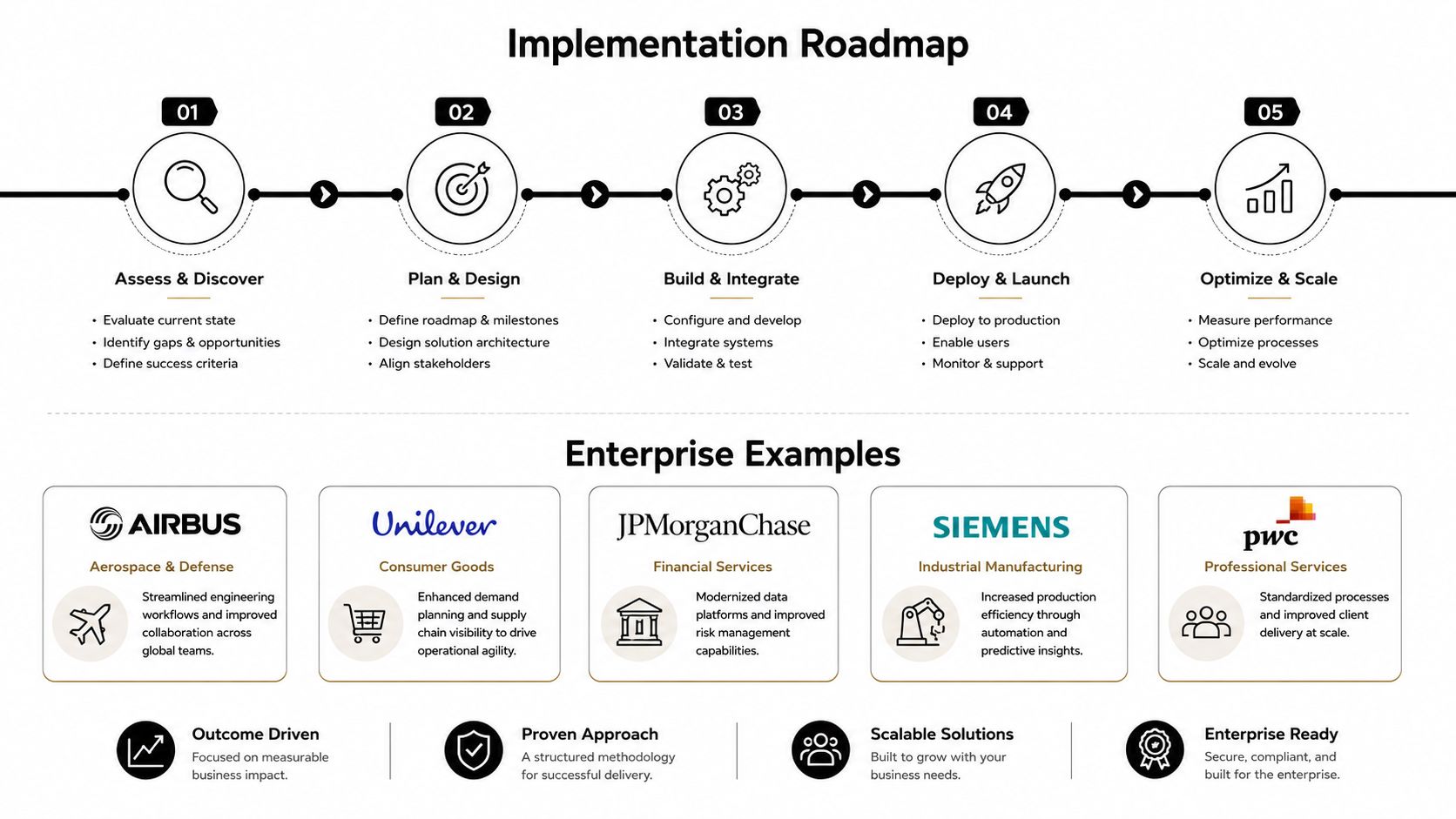
For an AI agent program, scale means more than adding channels. Evaluation, conversation review, knowledge management, prompt changes, human escalation, rollback, and retraining must operate as one controlled learning system. The VIPdesk case study on automation and human touch illustrates the balance leaders need to protect as automation expands.
Start with one CX or AI workflow, one hypothesis, and one 14-day PDCA loop. Instrument outcomes, review the evidence, and then decide whether the issue requires DMAIC depth or a broader cadence. The first pass may barely shift the baseline. Repeated cycles improve decisions because each result informs the next change.
Yellow.ai provides enterprise agentic AI for CX and EX, including agent building, automated testing, conversational analytics, knowledge retrieval, and omnichannel orchestration. Its platform supports teams that need to test, monitor, retrain, and improve AI agents while retaining human oversight. Visit Yellow.ai to evaluate the available capabilities.



