










Your team probably knows the symptoms already. Agents are toggling between the phone system, CRM, ticketing tool, knowledge base, and internal chat just to answer one customer question. Customers start in IVR, move to chat, then repeat themselves to a live agent. Leaders keep asking why service costs are rising while customer satisfaction barely moves.
That's the point where most organizations call this a technology problem. It usually isn't. It's an operating model problem with a technology expression.
Contact center modernization matters now because the market has already moved. The global Contact Center as a Service market was valued at $7.08 billion in 2025 and is projected to reach $8.33 billion in 2026, with projections of about $30 billion by 2030, according to CMSWire's contact center market coverage. The same coverage notes that 88% of contact centers are deploying AI, but only about 25% have operationalized it. That gap is where most modernization programs stall.
The question isn't whether cloud, automation, and AI belong in the contact center. They do. The hard part is turning those investments into better routing, cleaner handoffs, faster resolution, and less agent thrash.
The organizations getting this right aren't just replacing an aging phone stack. They're redesigning the contact center as a proactive system that can resolve, guide, predict, and escalate with context. That means moving from a reactive service queue to an autonomous experience engine built on cloud platforms, agentic AI, retrieval-augmented generation (RAG), and tightly managed workflows.
Table of Contents
- Introduction The End of the Waiting Game
- Defining Modernization Beyond the Buzzwords
- Key Business Drivers and Strategic Benefits
- The Architectural Pillars of a Modern Contact Center
- Your Phased Implementation Roadmap
- Measuring True ROI and Modern Success Metrics
- Modernization Use Cases by Industry
- Frequently Asked Questions on Modernization Strategy
Introduction The End of the Waiting Game
A legacy contact center rarely fails all at once. It degrades in layers.
First, wait times creep up because routing logic can't keep up with product complexity. Then agents start relying on tribal knowledge because the official knowledge base is outdated. Then digital channels get bolted on, one by one, until the operation looks omnichannel on paper but feels fragmented in practice. Customers notice it immediately. Agents feel it every shift.
That's why contact center modernization has to be treated as business transformation, not a telecom refresh. The center isn't just handling inbound demand anymore. It's one of the few enterprise functions that sees customer friction, product gaps, policy confusion, billing issues, and retention risk in real time.
Practical rule: If your contact center can't carry context across channels and systems, you don't have modern service. You have multiple queues that happen to share a brand name.
The best modernization programs start with a blunt assessment. Where does customer effort spike? Which workflows force agents to swivel between systems? Which calls should never have reached a person in the first place? Which interactions need a human because empathy, judgment, or compliance matter?
A modern operation answers those questions with architecture, not slogans. It uses cloud delivery for flexibility, AI for containment and assistance, analytics for visibility, and orchestration for continuity. Beyond these technological advancements, it changes the job of the contact center itself. The center stops being the place where unresolved problems accumulate and starts becoming the place where intent gets understood and resolved at the right level, whether that level is self-service, AI-guided support, or a skilled human.
Defining Modernization Beyond the Buzzwords
From queue management to experience orchestration
Modernization is often still described as a move from on-premises telephony to cloud software. That's only part of the story.
The bigger shift is philosophical. Older call centers were built like manual assembly lines. A customer entered one channel, usually voice. An agent handled the request with limited context. Supervisors optimized for throughput. The system was designed to manage queues.
TechTarget traces the broader evolution differently. The contact center expanded from phone-based service into text messaging, email, web chat, social media, and video, with milestones such as IVR, self-service chatbots, hybrid on-premises and cloud deployments, conversational analytics, and AI routing, as described in TechTarget's guide to contact center modernization. That progression changed the operating model itself.
Now the target state is closer to a smart factory. Every interaction produces context. Every channel shares state. AI doesn't just answer questions. It helps determine intent, retrieve relevant knowledge, decide the next best action, and hand off with memory.
What modern actually looks like
A modern contact center does four things consistently:
- Understands intent early: It identifies why the customer is reaching out before the interaction gets expensive.
- Preserves context across channels: Chat, voice, email, and agent actions connect into one journey.
- Uses automation selectively: It automates routine work but escalates exceptions cleanly.
- Improves through feedback loops: Routing, content, and workflows change based on actual outcomes.
That's why the telephony layer still matters, but it no longer defines the center. Voice remains critical, especially in regulated and high-emotion interactions, yet it's one part of a broader service fabric. For leaders comparing legacy phone architecture with hosted models, Hosted Telecommunications' business phone system analysis is useful because it clarifies where old PBX assumptions still create friction in a cloud-first environment.
Modernization works when customers experience one conversation, not a series of disconnected contacts.
A practical test helps. If a customer starts with self-service, moves to voice, and ends in a back-office workflow, can your system carry identity, intent, prior steps, and recommended actions all the way through? If not, you may have newer tools, but you don't yet have a modern operating model.
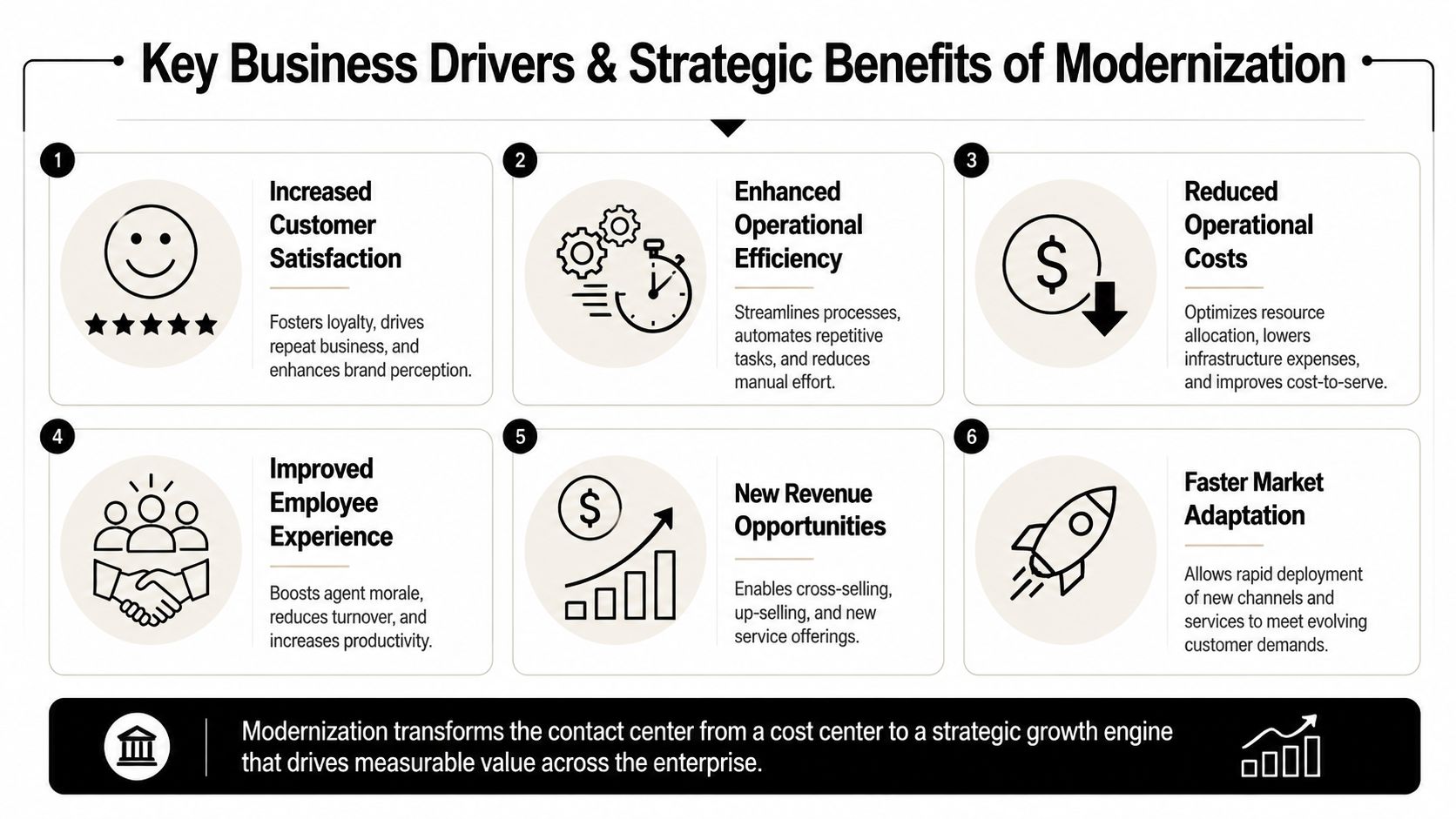
Key Business Drivers and Strategic Benefits
The strongest business case for contact center modernization doesn't start with features. It starts with enterprise pressure.
CFOs see service costs rising without a clear path to efficiency. CIOs see brittle integrations and aging infrastructure. CX leaders see customers abandoning journeys because the handoff between channels is poor. Operations leaders see agents losing time to repetitive work, fragmented desktops, and manual after-call tasks.
Why boards fund modernization
The investment gets approved when modernization is linked to three business outcomes.
First, it lowers the cost of serving routine demand. Not by cutting corners, but by moving low-complexity interactions to better self-service and faster automation.
Second, it protects and improves customer relationships. When customers can move across channels without losing context, resolution gets easier and brand trust improves.
Third, it gives the enterprise a more adaptable service layer. New products, policy changes, seasonal demand spikes, and remote staffing models are all easier to support when the platform isn't tied to rigid infrastructure.
A narrow workflow often proves the economics faster than a broad transformation deck. NTT DATA notes that AI agents, intelligent IVR, and real-time agent assist can shorten wait times and automate backend work. In the same modernization pattern, DXC reports that automating password-reset calls can reduce those call volumes by 30–60%, as referenced in NTT DATA's modernization discussion.
Where the first value usually appears
Leaders often expect the first payoff to show up in topline customer metrics. In practice, the earliest gains usually appear in operational friction.
Consider the patterns that improve first:
- Repetitive contacts disappear: Password resets, status checks, simple account tasks, and policy lookups stop consuming trained agent time.
- Agent effort drops: One workspace and in-flow guidance reduce the hunt for answers.
- Supervisors gain control: Real-time visibility into routing, containment, and escalation quality makes the operation more manageable.
- Back-office lag shrinks: When workflows trigger automatically, fewer customer issues stall between teams.
The mistake is trying to justify modernization only as “cost savings.” That undersells it. A modern center can also support cross-sell, retention, service consistency, and faster launch of new customer journeys. The strategic benefit isn't just spending less on support. It's using service operations to protect revenue and surface growth opportunities.
The Architectural Pillars of a Modern Contact Center
A modern contact center stack isn't one product category. It's a coordinated system. The architecture matters because weak seams between tools create the same customer pain you were trying to remove.
A useful way to think about the stack is as four pillars. Each one solves a different problem. Together, they turn a queue-driven operation into an experience engine.
Cloud and CCaaS as the operating foundation
The first pillar is the cloud platform itself. This is the layer that replaces rigid infrastructure with configurable capacity, centralized administration, and easier support for distributed teams.
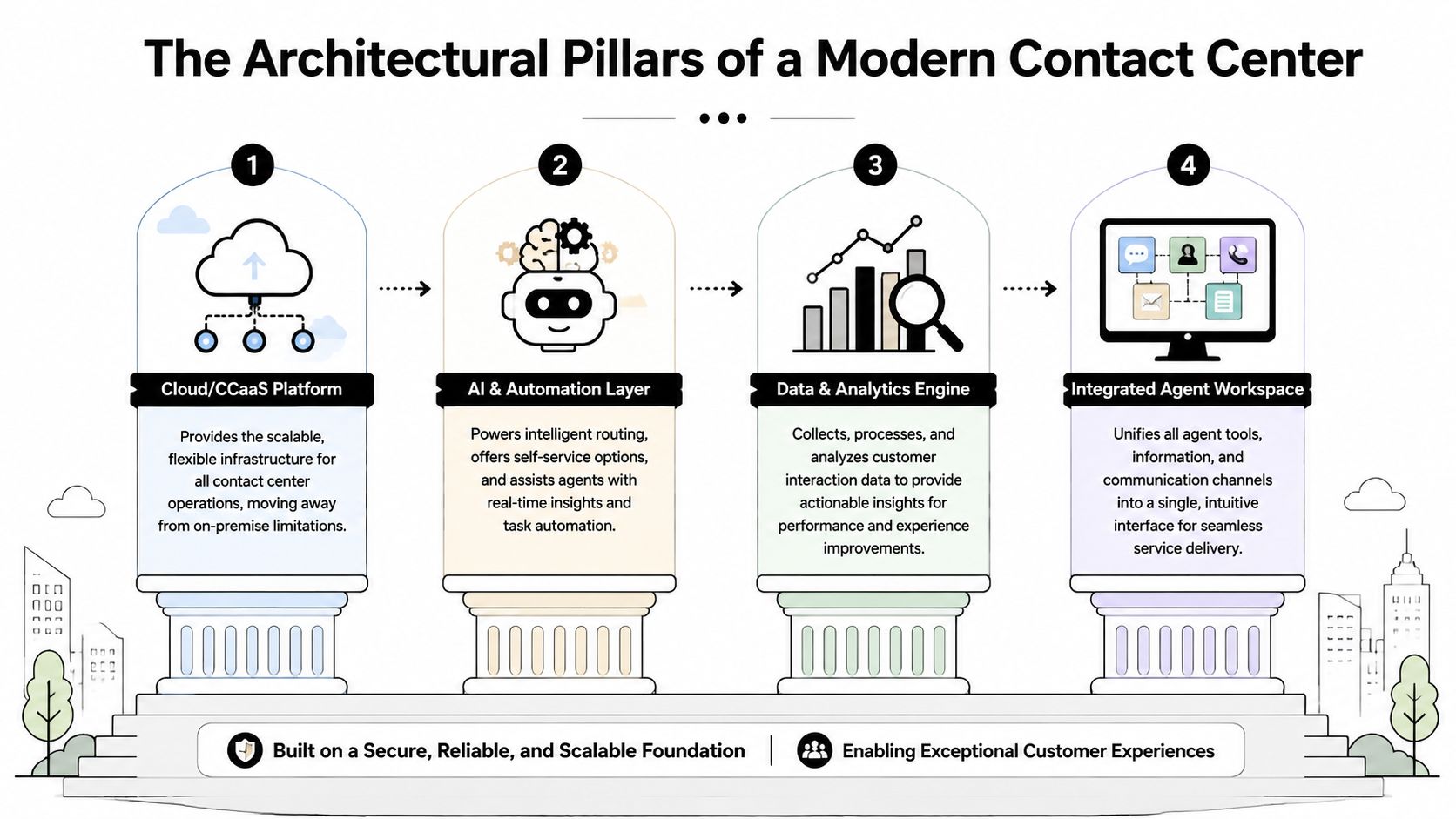
A solid CCaaS foundation should handle voice, messaging, routing, recording, reporting, and policy controls without forcing you into brittle custom work for every change. It also needs to coexist with reality. Many enterprises still run hybrid environments, especially where telephony, compliance, or regional infrastructure constraints remain.
What doesn't work is treating cloud migration as the finish line. Moving voice to a hosted platform without fixing data, workflows, and agent tooling relocates the old problems.
Conversational AI as the front door
The second pillar is conversational AI, the starting point for modern self-service.
Voicebots and chatbots should do more than deflect volume. They need to identify intent, authenticate where appropriate, gather missing information, and route with precision. Good conversational AI reduces customer effort before the interaction reaches an agent. Bad conversational AI adds a new layer of friction on top of an already broken flow.
If the bot can't help, it should accelerate the handoff. It should never become a gatekeeper that slows humans down.
This is also where design discipline matters. High-performing self-service flows are narrow enough to be dependable and smart enough to know when to escalate. Overly ambitious bots that try to answer everything usually fail because the underlying knowledge, integration, and workflow logic aren't ready.
A walkthrough of how integration depth shapes these experiences is worth reviewing in Yellow.ai's integrations library, especially for teams evaluating how AI, CRM, ticketing, and contact center systems need to connect in production.
A short overview helps illustrate how these capabilities come together in practice.
Agentic AI and RAG as the reasoning layer
This is the layer many teams are now moving toward, and it changes what automation can achieve.
Traditional automation follows scripts. Agentic AI can pursue a goal within defined rules. Combined with retrieval-augmented generation, it can pull from approved enterprise knowledge, reason through the customer's situation, and generate a grounded response or action path. That matters in environments where policies change, product catalogs are large, or answers depend on multiple systems.
RAG is especially important because large language models alone aren't enough for enterprise service. They need access to current documents, structured data, and workflow context. Otherwise, they'll sound fluent while missing the policy nuance that your operation depends on.
The practical value shows up in scenarios like these:
- Knowledge grounding: The system retrieves the latest refund policy, claims process, or onboarding rule before responding.
- Decision support: AI proposes next actions for the agent based on interaction history and current eligibility.
- Workflow execution: An AI agent gathers information, updates records, triggers downstream actions, and confirms the outcome.
Integrations and orchestration as the glue
The fourth pillar is the connective tissue. It's less glamorous, but it determines whether the rest of the stack works.
Integrations link the contact center to CRM, identity, order management, ticketing, billing, workforce tools, and internal knowledge. Orchestration ensures the right action happens in the right channel at the right time with the right context. Without that, every improvement stays local. A good bot hands off badly. A smart agent desktop still lacks complete history. Analytics report on fragments rather than journeys.
Modernization succeeds when these four pillars are designed as one system. It fails when each is bought separately and expected to cooperate later.
Your Phased Implementation Roadmap
Most failed modernization programs have one thing in common. They tried to change the platform, channels, workflows, reporting model, and operating culture at the same time.
A phased approach is slower on paper and faster in practice. It gives teams room to clean up architecture, prove value, and build trust with operations. For organizations mapping the broader infrastructure side of this journey, cloud modernization services offers a useful framing for how application, data, and platform changes often need to move together.
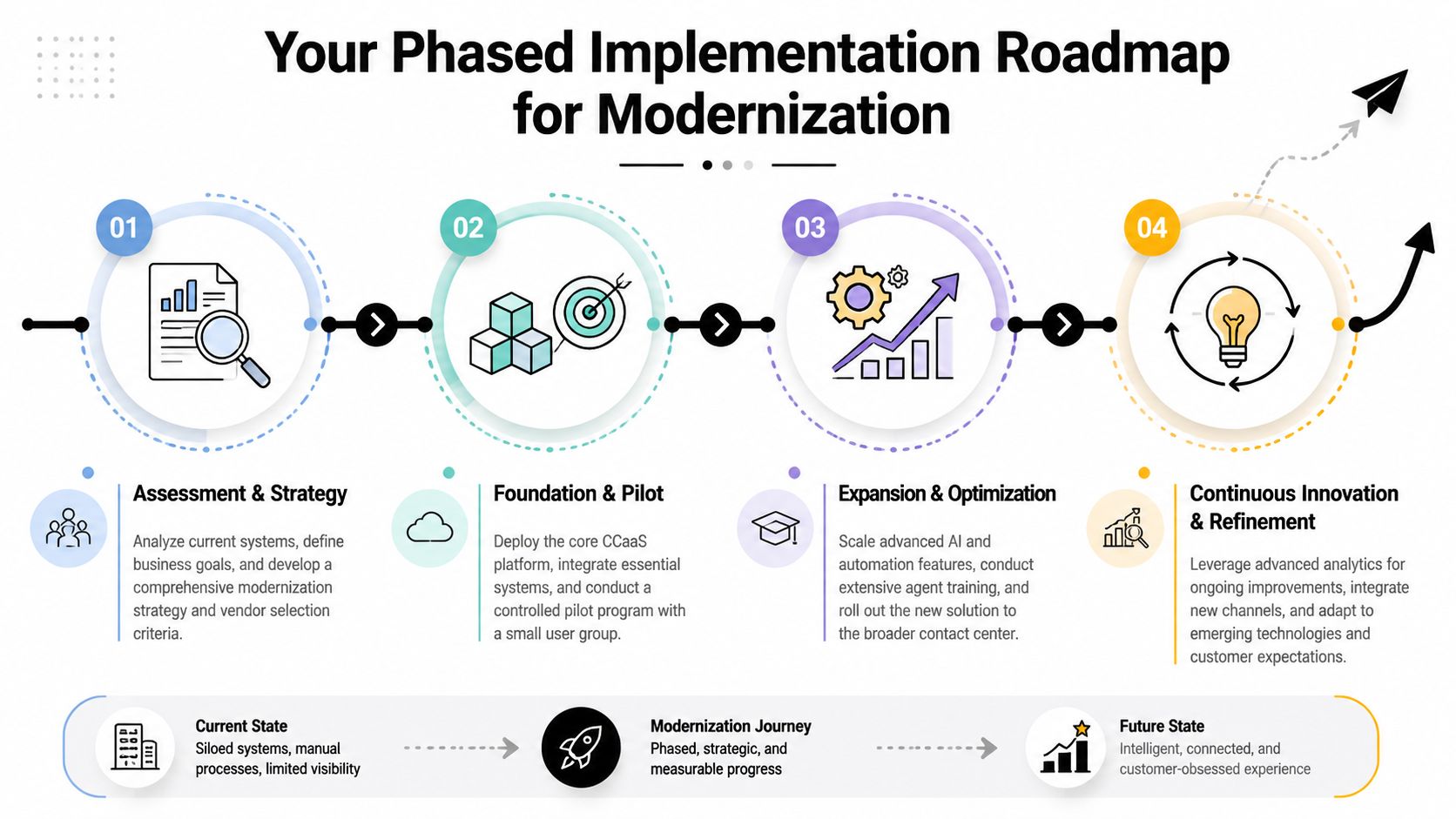
Phase one foundation
Start with the parts nobody wants to celebrate and every successful program needs.
Audit channel volumes, current routing logic, integration points, knowledge assets, authentication flows, and baseline performance. Identify where customer effort is highest and where agents lose time. Map the systems of record for each common journey.
This phase usually includes:
- Data cleanup: Remove duplicate knowledge, outdated policy content, and inconsistent naming.
- Journey selection: Pick a small set of high-volume or high-friction use cases.
- Platform decisions: Confirm what stays, what moves, and what integrates.
- Benchmarking: Capture baseline service and workflow metrics before anything changes.
Organizations often skip this phase because it feels slow. That's a mistake. Programs that modernize tools before cleaning data and defining benchmarks usually struggle to prove what improved and why.
Phase two augmentation
Once the foundation is stable, augment the human operation before trying to automate it away.
Deploy agent copilots, guided knowledge retrieval, conversation summaries, and narrowly scoped self-service for repetitive tasks. Keep humans in the loop. At this stage, AI should assist agents, improve routing, and handle straightforward requests that have clean logic and reliable data behind them.
A good pilot has clear boundaries. It uses a limited group, a defined workflow, and specific escalation rules. The goal isn't to impress the organization with futuristic demos. The goal is to prove that the new flow resolves faster, transfers cleaner, or reduces manual effort.
Start where the logic is stable and the pain is obvious. Don't begin with your most politically sensitive or operationally messy workflow.
Phase three automation
In this context, many teams overreach. The right move is to automate end-to-end journeys one by one.
Pick workflows where intent is identifiable, data access is available, and the resolution path is repeatable. Examples include identity checks, account updates, appointment management, claims status, and service requests. Add agentic logic only when the underlying process is well understood.
During this phase, the operating model changes:
| Focus area | Earlier state | Modernized state |
|---|---|---|
| Routing | Queue and skill based | Intent, context, and outcome aware |
| Agent work | Manual lookup and re-entry | Guided actions with summarized context |
| Self-service | Static scripts | Dynamic flows tied to enterprise systems |
| Supervision | Lagging reports | Near real-time optimization |
The trap here is assuming more automation always means better service. It doesn't. Automation only works when escalation paths, exception handling, and policy controls are built in from the start.
Phase four autonomy
The final phase is where the center becomes proactive.
At this stage, the system can identify likely customer needs, trigger outreach, monitor unresolved intents, and continuously tune flows using performance data. Human agents still matter, especially for judgment-heavy or sensitive interactions, but the center no longer waits passively for every issue to arrive through voice.
Autonomy also raises the bar for governance. You need stronger controls around knowledge freshness, prompt behavior, approval rules, auditability, and channel-specific compliance. The more capable the system becomes, the more disciplined the enterprise has to be about boundaries.
That's what mature contact center modernization looks like. Not one migration weekend. A managed sequence from cleanup to augmentation, then automation, then autonomy.
Measuring True ROI and Modern Success Metrics
The easiest way to undervalue a modernization program is to judge it with old metrics alone.
Average Handle Time is the classic example. In a legacy environment, shorter calls often looked efficient. In a modern environment, a longer interaction can be the right outcome if it resolves a complex issue cleanly, avoids repeat contacts, and preserves the customer relationship.
Why old metrics distort modern performance
Legacy scorecards were built for queue efficiency. They emphasize speed, occupancy, and volume because older platforms gave leaders limited visibility into anything else.
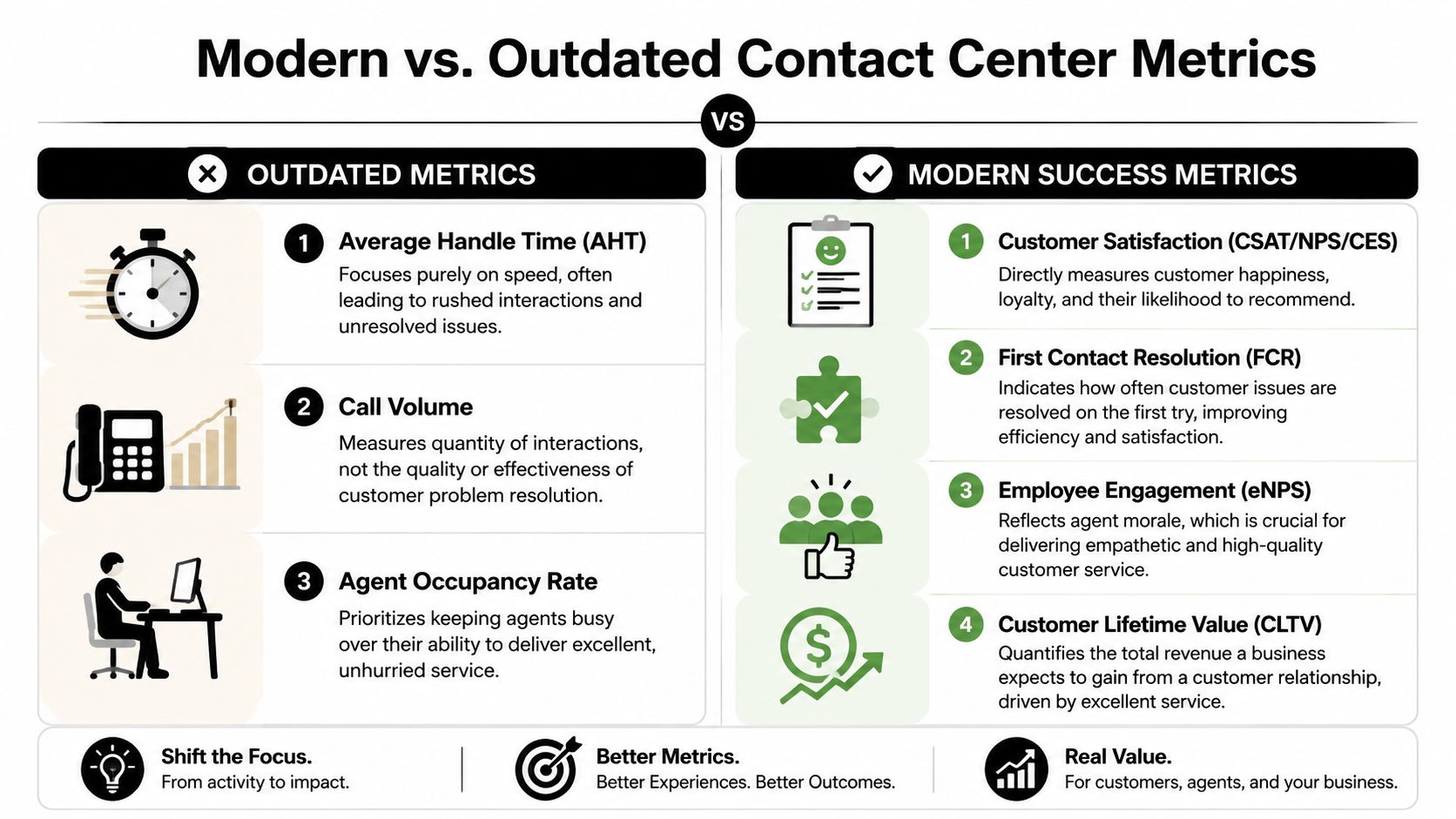
Those metrics still have operational value, but they're incomplete. If AI resolves routine requests before they reach an agent, raw call volume may fall while service quality rises. If copilots help agents solve tougher issues, average handle time may hold steady or even increase while first-contact resolution improves.
Analytics 365 highlights a core measurement problem in its discussion of modernization ROI. Many teams track familiar KPIs but still can't answer which indicators move first in a phased rollout or how to separate the impact of AI from broader process redesign.
A better scorecard for AI enabled service
A more useful framework blends operational, customer, and financial signals.
Focus on metrics like these:
- Containment rate: How often AI resolves the issue fully without creating hidden recontact.
- First-contact resolution: Across both automated and human-assisted journeys.
- Customer effort: Whether customers had to repeat information, switch channels, or chase updates.
- Agent productivity with AI: Whether copilots and grounded knowledge reduced manual work.
- Escalation quality: Whether handoffs carried the right context and next steps.
- Workflow completion: Whether the issue was closed in the downstream system.
One tool teams can use when thinking through the economics is Yellow.ai's ROI calculator, which helps model the value of automation and agent assistance against current service operations.
The practical rule is simple. Don't ask only whether the contact center got cheaper. Ask whether it became easier for customers to get answers, easier for agents to do good work, and easier for leaders to identify where service breaks. That's the stronger proof.
Modernization Use Cases by Industry
Contact center modernization gets real when it touches an industry workflow that customers and agents deal with every day. The technology pattern may be similar across sectors, but the constraints aren't.
A broad catalog of sector patterns is available in Yellow.ai's industry solutions overview. The common thread is orchestration. The difference lies in what the system needs to know, what it's allowed to do, and when a human must take over.
BFSI
In banking and financial services, the hard part isn't just volume. It's trust, verification, and policy precision.
A customer may call about a blocked card, a disputed transaction, or a portfolio question that spans multiple products. A modern center can authenticate, gather context, surface the right knowledge, and route by intent instead of generic queue. Agentic workflows can support fraud review or service requests, but the design has to respect approval paths and auditability.
The winning pattern is usually narrow autonomy with strong controls. Let AI collect, verify, summarize, and recommend. Let humans handle judgment-heavy decisions.
Healthcare
Healthcare service operations deal with urgency, privacy, and fragmented systems.
A patient may need to book an appointment, verify coverage, ask about a refill, or follow up on a referral. Legacy flows often force them across disconnected departments and long hold times. A modernized center can guide intake, collect required details, route to the right clinical or administrative team, and maintain continuity across channels.
What works here is careful scope control. Administrative workflows are often good candidates for automation. Clinical interpretation usually isn't. The center performs better when it distinguishes those boundaries clearly.
Retail
Retail contact centers live in the gap between promise and fulfillment.
Customers don't reach out because they enjoy support. They reach out when an order is split, a return is confusing, delivery timing changes, or a promotion didn't apply. A modern stack can connect order data, return rules, shipping status, and loyalty context so the customer gets one coherent answer instead of three partial ones.
This is also where proactive service matters. If the system already knows a shipment is delayed or incomplete, it can notify the customer before the inbound contact arrives. That changes the experience from reactive damage control to managed expectation.
BPOs and service providers
BPO environments add another layer. They don't just support one brand. They support many, each with its own workflows, service rules, and reporting expectations.
Modernization in this model depends on configurability. Teams need reusable orchestration patterns, tenant-aware knowledge, flexible routing, and governance that can separate one client's policy from another's. AI can help standardize quality and speed ramp-up, but only if the underlying content and controls are segmented properly.
The biggest gains usually come from making complexity manageable. Agents get a cleaner workspace, new accounts go live faster, and supervisors can monitor service quality across multiple client programs without stitching together disconnected tools.
Frequently Asked Questions on Modernization Strategy
Should you rip and replace
Usually, no.
A full rip-and-replace approach makes sense only when the current platform is so brittle, unsupported, or isolated that integration isn't practical. Most enterprises are better served by phased modernization. Keep what still works, replace what creates drag, and design for coexistence during transition.
How should you choose a platform partner
Start with architecture, not demos.
Ask whether the platform can support your channel mix, identity model, routing complexity, knowledge architecture, and compliance requirements. Then test integration depth, observability, and workflow control. You want a partner that can handle real production conditions, not just polished use cases.
If agentic AI and RAG are on your roadmap, ask harder questions. How is enterprise knowledge retrieved and grounded? How are prompts, tools, and actions governed? How are handoffs audited? How quickly can nontechnical teams update flows safely?
What derails programs most often
Three things show up repeatedly.
- Poor data quality: If knowledge is stale and systems disagree, AI will expose the mess faster.
- Weak change management: Agents and supervisors need new behaviors, not just new screens.
- Bad attribution: If you don't baseline workflows and outcomes early, you won't know what created value.
Contact center modernization works when leaders treat it as a redesign of service delivery, operating metrics, and enterprise knowledge flow. It fails when they treat it like a feature upgrade.
Yellow.ai provides an enterprise platform for building agentic AI experiences across voice, chat, and other channels, with support for RAG, orchestration, analytics, and contact center integrations. If you're evaluating how to modernize service operations without treating AI as a bolt-on, explore Yellow.ai.