














The surprising part of contact center automation is that adoption no longer proves readiness. Eighty-eight percent of contact centers use some form of AI-powered solution, yet only 25% have fully integrated AI automation into daily operations, according to a 2025 IBM-related industry summary. Enterprises aren't short of tools. They're short of an operating model that connects automation to channels, knowledge, human handoff, latency, and measurable resolution.
That distinction matters because a chatbot purchase rarely changes the economics of a contact center on its own. The serious decision is whether your organization can orchestrate voice, messaging, email, self-service, agent assist, and back-office work around a shared understanding of customer intent. This guide takes that position directly. Evaluate contact center automation tools as infrastructure for an omnichannel service model, not as isolated AI features.
Table of Contents
- What Contact Center Automation Really Means in 2026
- Core Capabilities Every Modern Stack Must Cover
- Why Adoption Is High But Operationalization Is Still Low
- Deployment Architectures and How to Choose Between Them
- Integration, Security, and Compliance Essentials
- KPIs and ROI Models That Actually Hold Up
- A Buyer-Friendly Evaluation Framework for Enterprise CX
- A 90-Day Migration and Value Realization Plan
What Contact Center Automation Really Means in 2026
Contact center automation is the coordinated use of AI and workflow software to resolve customer needs across channels, support human agents when judgment is required, and complete the operational work that follows an interaction. A chatbot is one component. It isn't the operating model.
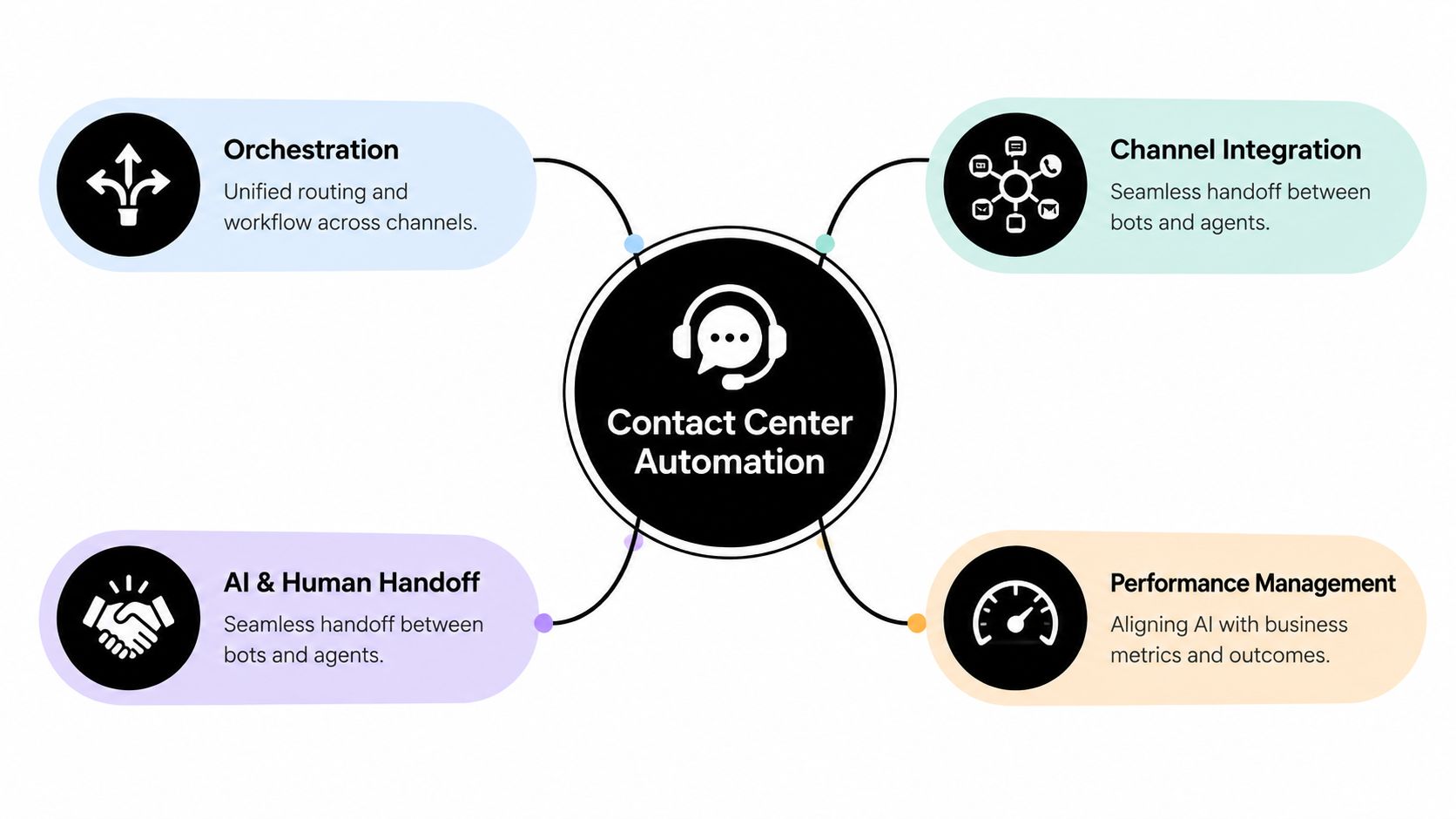
The capability stack has four practical layers:
- Front-door self-service: Virtual agents, conversational IVR, and digital bots identify intent, answer governed questions, authenticate customers, and complete routine requests.
- Agent assistance: Real-time transcription, knowledge retrieval, next-best-action guidance, compliance alerts, and automated summaries help human agents handle complex interactions.
- Workflow execution: Integrations update CRM records, open or close tickets, schedule appointments, trigger notifications, and pass structured outcomes to downstream systems.
- Performance management: Analytics connect intent, containment, transfers, latency, quality, sentiment, resolution, and customer feedback.
The shift in 2026 is from separate tools to an orchestrated runtime. A customer might start with voice, continue through messaging, receive an email confirmation, and return to a human agent later. The system should preserve context and policy across those transitions. If each channel maintains its own bot, knowledge source, and analytics, the customer experiences the seams.
The production boundary
Marketing demos typically optimize for a clean path. Production systems must handle interruptions, authentication failures, ambiguous requests, unavailable systems, policy exceptions, and customers who change their minds halfway through a conversation.
A production-grade platform therefore needs explicit handoff rules. It should transfer the interaction with the transcript, verified identity, intent, collected fields, attempted actions, and reason for escalation. Sending a customer to an agent without that context moves automation failure into the queue.
For a practical overview of the broader service-automation field, the F1Group automation guide is useful background. Buyers comparing omnichannel architectures can also examine Yellow.ai's omnichannel AI automation approach to see how channel orchestration is framed beyond a standalone bot.
Practical rule: If the tool can't show what happens after the bot fails, it isn't ready for an enterprise evaluation.
Core Capabilities Every Modern Stack Must Cover
Start with the customer journey, then map capabilities to the moments where work repeats, waits, or gets transferred. Don't begin with a vendor feature list.
Conversational IVR replaces rigid menu trees with intent-aware routing. It should understand natural language, collect essential context, authenticate where appropriate, and route based on both intent and operational conditions. It belongs at the front door, but its value depends on what the receiving queue can see.
Voice AI agents handle spoken interactions end to end. They need reliable turn-taking, interruption handling, structured data capture, tool use, and a clean escalation path. Voice automation is appropriate for repeatable requests with clear policies. It becomes risky when the organization hasn't defined what the agent may promise or change.
Digital bots handle chat, messaging, and asynchronous service. They work well for status requests, document collection, scheduling, and guided troubleshooting. The maturity trap is treating every digital conversation as a short FAQ exchange. Customers often return later through another channel, so the bot must preserve state and pass it forward.
Retrieval-augmented knowledge grounds responses in approved sources rather than relying on unconstrained model memory. Governance matters more than volume. Owners need to define which documents are authoritative, how updates are approved, what happens when no answer exists, and how citations or source references are exposed internally.
Workflow automation turns a conversation into an operational result. It can create a case, update an order, request a refund, schedule service, or notify another team. A workflow that only drafts text but still requires manual re-entry isn't full automation.
Analytics reveal which intents are contained, escalated, repeated, delayed, or abandoned. Analytics should also expose where knowledge fails and where agents compensate for weak self-service.
| Capability | What It Actually Does | Where It Fits in the Journey | Common Maturity Trap |
|---|---|---|---|
| Conversational IVR | Identifies intent and routes with context | Entry point for voice | Recreating menu trees with a voice interface |
| Voice AI agent | Resolves eligible spoken requests | Inbound, outbound, and after-hours service | Automating exceptions without policy controls |
| Digital bot | Handles chat and asynchronous tasks | Web, messaging, and authenticated service | Measuring conversations instead of completed outcomes |
| RAG knowledge | Retrieves governed answers | Self-service and agent assist | Indexing stale or contradictory content |
| Workflow automation | Executes actions in business systems | During and after the interaction | Leaving agents to re-key every result |
| Analytics | Connects interaction behavior to outcomes | Across the operating model | Reporting activity without containment or resolution |
The most overlooked capability is case orchestration. A useful case management workflow guide from AI Video Detector illustrates why intake, routing, status, ownership, and closure need to work as one process. For teams building or extending agent experiences, Yellow.ai's AI Agent Builder provides another reference point for connecting conversational design with deployable workflows.
Why Adoption Is High But Operationalization Is Still Low
The market has moved past experimentation, but many contact centers still treat automation as a collection of pilots. Fortune Business Insights estimated the global Contact Center as a Service market at $7.08 billion in 2025, rising to $8.33 billion in 2026 and projected to reach $30.15 billion by 2034, with a 17.40% CAGR over the forecast period, according to this market summary. North America held 39% of the market in 2025, the same summary reported.
Demand for virtual agents, intelligent routing, self-service, and agent assist is clear. Adoption alone says little about operational value. Telephony, digital channels, CRM, knowledge, compliance, and workforce operations often sit with different owners, so automation works inside channel silos instead of one omnichannel operating model.
The failure pattern is predictable. Knowledge teams publish material without preparing it for retrieval. Product teams optimize bot completion while operations teams track transfers and repeat contacts. Engineering teams report average latency even though customers experience the slowest responses. Procurement funds a pilot, but no owner manages model changes, escalation review, failed intents, or production controls.
Operationalization requires a control loop
Treat automation as a managed service with stage gates:
- Observe: Capture intent, transcript, workflow outcome, transfer reason, latency percentile, and customer response.
- Diagnose: Separate model failure, missing knowledge, unavailable systems, policy restrictions, and poor routing.
- Change: Update content, prompts, policies, integrations, or escalation logic under version control.
- Validate: Test production-like conversations and inspect tail latency, containment, handoff quality, and cost.
- Scale: Expand only when those measures remain stable against agreed percentile targets and ROI assumptions.
The commercial pressure is substantial. Conversational AI was projected to cut contact center labor costs by $80 billion in 2026, while automated agent interactions were projected to reach 10% by the end of 2026, up from 1.6% in 2023, as reported in the industry summary. Buyers should treat those projections as a reason to establish ownership and measurement, not as a business case by themselves. A license creates capacity only when the control loop converts it into reliable customer outcomes.
Deployment Architectures and How to Choose Between Them
Enterprise buyers usually face three architecture choices. None is universally correct, and each creates a different cost and governance profile over a 36-month planning horizon.
| Architecture | Best-Fit Buyer | Integration Tax | Lock-In Exposure | Speed-to-Value |
|---|---|---|---|---|
| Point solution | One dominant channel or narrowly defined use case | High if multiple workflows and channels are added | Moderate, often concentrated in the selected component | Fast |
| CCaaS add-on | Existing platform owner that wants minimal disruption | Lower because routing and telephony already exist | High within the incumbent ecosystem | Moderate |
| Unified agentic platform | Enterprise rationalizing routing, voice, knowledge, workflow, and analytics | Higher migration effort initially, lower ongoing fragmentation | Varies, depending on open models and connectors | Slower initially |
Point solutions
A standalone voice agent, knowledge layer, or agent-assist overlay can deliver fast value without replacing the contact center stack. This is the right answer when one channel dominates and the use case has clear boundaries. The weakness appears when the enterprise adds separate tools for chat, email, QA, analytics, and workflow. Telemetry fragments, handoff logic diverges, and the integration tax grows through CRM connectors, middleware, identity mapping, and duplicated policy work.
Native CCaaS add-ons
Native modules minimize architectural risk. Routing, reporting, telephony, and user administration usually remain familiar. The trade-off is model and workflow choice. Buyers may accept the incumbent's AI roadmap because replacing the stack is politically or operationally off the table. That can be sensible, but contract terms should account for automation reducing human-seat demand.
Unified agentic platforms
A unified platform consolidates more of the runtime. It can make shared context, knowledge governance, analytics, and handoff easier to manage. It also demands a heavier migration and stronger internal ownership. The payoff is operational simplification, not merely another feature.
Choose point-led architecture when one channel dominates. Choose a CCaaS add-on when stack replacement isn't realistic. Choose unified agentic architecture when you're redesigning the operating model.
Integration, Security, and Compliance Essentials
Security review should begin with evidence, not vendor assurances. Ask for architecture diagrams, data-flow descriptions, retention controls, subprocessors, incident procedures, audit logs, and clear ownership of configuration changes.
Integration checkpoints
For CRM and ticketing, require certified connectors where available, plus event-driven webhooks for state changes that can't wait for batch synchronization. Test read and write permissions separately. A bot that can retrieve an account but can't safely update a case creates a partial workflow, not automation.
Telephony decisions also need clarity. Compare SIP trunking, bring-your-own-carrier arrangements, and provider-managed carriers against your requirements for recording, number ownership, failover, geographic coverage, and call-transfer behavior. Run tests through the same carrier path used in production. A sandbox that bypasses carrier behavior tells you very little.
Identity federation should support SAML, SCIM, and just-in-time role mapping. Tie permissions to job function, environment, and data sensitivity. Administrators shouldn't receive broad access because the platform's default role model is convenient.
Data and model governance
Require explicit commitments for data residency and sovereignty, encryption in transit and at rest, key-management ownership, transcript retention, and deletion workflows. PII redaction must cover recordings, transcripts, logs, prompts, evaluation sets, and vector stores. Payment interactions need a documented PCI DSS design, while clinical workloads require a HIPAA review and appropriate contractual controls.
Map controls to the frameworks your legal and security teams already use, including SOC 2 Type II, ISO 27001, HIPAA, PCI DSS, GDPR, and applicable EU AI Act requirements. Don't accept a certification badge as a substitute for understanding the deployed configuration.
Use Yellow.ai's enterprise-grade security information as a reference point for the types of controls an enterprise platform should document, then validate every requirement against your own risk register.
A final governance review should cover:
- Change control: Who approves model, prompt, policy, and connector changes?
- Evaluation: How are hallucinations, unsafe actions, and failed handoffs sampled?
- Red teaming: How often are adversarial and edge-case scenarios tested?
- Human escalation: Can supervisors intervene, inspect context, and override automation?
- Auditability: Can investigators reconstruct what the system knew, decided, and executed?
KPIs and ROI Models That Actually Hold Up
A dashboard full of interaction counts can still hide an uneconomic program. CFOs need a model that ties automation to completed resolutions, service capacity, risk, and customer outcomes.
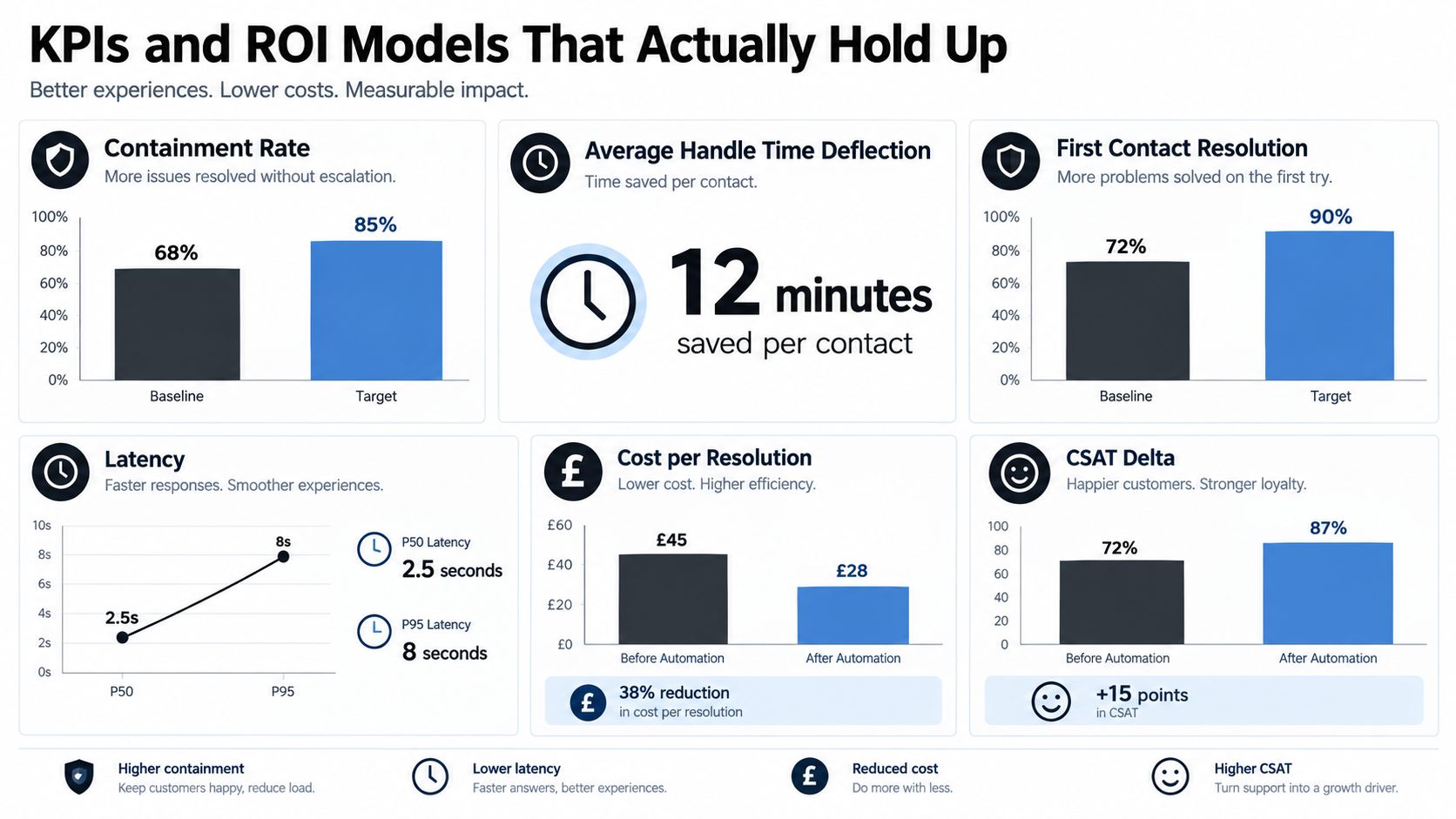
Track containment rate, average handle time deflection, cost per resolution, first-contact resolution, CSAT or NPS delta by intent, and latency percentiles. Use P50, P90, P95, and P99 views rather than relying on averages. For live agent assist and voice automation, end-to-end transcription latency below about 300 milliseconds is a practical threshold, while latency above 500 milliseconds can damage conversational flow, according to Gladia's voice analytics guidance.
Production evaluation should also track time-to-first-word under 500 milliseconds, P90 latency below 3.5 seconds, and streaming transcription latency under 400 milliseconds, with tail monitoring, as recommended in voice-AI dashboard guidance from Hamming. Those targets are not interchangeable. A system can have a strong median and still feel broken during peak load.
Build the model in layers
Start with the baseline cost of the eligible interaction population. Then model:
- Automated resolution cost: Platform, model, telephony, storage, monitoring, and human review.
- Containment value: Resolved contacts that no longer require agent handling, minus repeat contacts and escalations.
- Assisted-channel value: Reduced handle time when agents receive accurate knowledge and summaries.
- Capacity value: Deferred hiring or overtime during seasonal demand, treated separately from hard savings.
- Experience value: Retention or satisfaction effects only where they can be linked to specific intents and measured against a baseline.
The supplied worked example uses 12 million annual voice contacts at an $8.50 blended cost, with 22% deflection and $0.40 per automated resolution. It yields roughly $18 million in gross savings before retraining, change management, and license fees. Treat that as a model illustration, not a forecast. The assumptions need validation in your own contact data.
Finance test: If the model can't show cost per successful resolution and the cost of failed automation, it isn't an ROI model. It's a vendor presentation.
Use sensitivity tables for containment moving between 15% and 35%, and include retraining, quality review, integration support, and governance labor. The strongest measurement path moves from directional reporting to controlled holdout testing, where comparable traffic remains on the existing process while the automated path runs under monitored conditions.
A Buyer-Friendly Evaluation Framework for Enterprise CX
Run procurement from real interactions, not vendor demos. Build the shortlist around the intents you want to automate, the channels customers use, the systems the platform must change, and the escalation conditions it must respect.
Shortlist against operational fit
Require evidence of containment on comparable intents, model and prompt governance, telephony ownership, multilingual ASR and TTS quality, RAG corpus controls, structured post-interaction data, and percentile-based latency reporting. Ask vendors to distinguish results from autonomous resolution, agent assist, and workflow completion. Those are different mechanisms with different economics.
A POC should use sanitized production conversations, real knowledge content, representative integrations, and realistic failure cases. Include interruptions, authentication failure, unavailable back-office systems, ambiguous intent, policy exceptions, and warm transfer. Score the outcome, not the smoothness of the demo.
| Criterion | Weight (%) | Must-Have Threshold | Differentiator Benchmark |
|---|---|---|---|
| Intent resolution and containment | 25 | Clear outcome definition by intent | Evidence from comparable production traffic |
| Handoff quality | 15 | Transcript, context, and reason passed to agent | Agent starts without repeating discovery |
| Latency and reliability | 15 | Percentile reporting under load | Stable tail performance during peak conditions |
| Knowledge governance | 15 | Approved sources, versioning, fallback behavior | Automated freshness and failure analysis |
| Integration depth | 10 | CRM, ticketing, telephony, identity | Event-driven workflows with limited middleware |
| Security and compliance | 10 | Required certifications and control evidence | Granular residency, key, retention, and audit options |
| Analytics and ROI | 10 | Cost, resolution, transfer, and experience metrics | Holdout testing and intent-level attribution |
Reference checks and red flags
Ask references what happened after go-live. Did supervisors own tuning? How often did workflows fail because a system was unavailable? Could the team explain why customers escalated? Did the vendor expose raw interaction data for independent analysis?
Walk away from black-box models with no evaluation controls, dual pricing that combines per-seat and per-resolution charges without a clear denominator, and brittle handoff rules that rely on a narrow set of trigger phrases. Also challenge “unlimited” usage language. It often excludes telephony, model calls, storage, premium connectors, or review labor.
Your week-one discovery should produce a baseline and an intent inventory. By the final decision, every shortlisted vendor should have a scored POC, an integration plan, a security disposition, a run-state owner, and a commercial model tied to successful outcomes.
A 90-Day Migration and Value Realization Plan
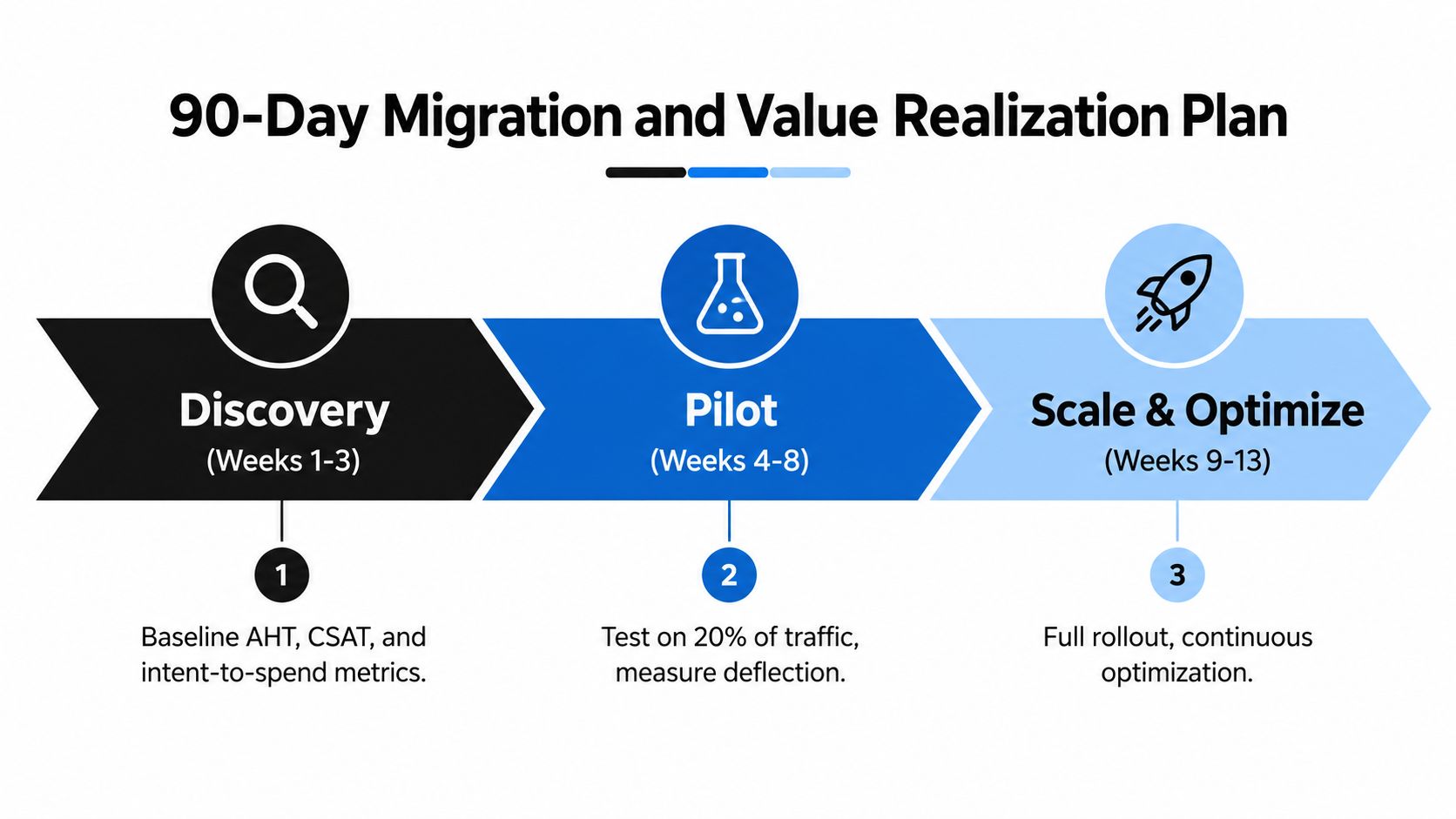
A credible migration has gates. It doesn't treat the pilot as a marketing milestone or expand because the first conversations sound natural.
Days one through three weeks
Lock the business case and operational baseline. Identify eligible intents, current containment, average handle time, first-contact resolution, CSAT, transfer reasons, abandonment, and cost per resolution. Confirm data ownership, channel scope, telephony path, CRM actions, knowledge sources, and human escalation policy.
Weeks four through eight
Run a controlled POC on two high-volume, low-complexity intents. Use production traffic shadowing where possible, test the complete workflow, and compare automated outcomes with the existing process. Validate transcription, retrieval, authentication, CRM writes, transfer context, and percentile latency under realistic load.
Weeks nine through twelve
Harden integrations, expand only where the evidence supports it, and assign run-state ownership to operations. Establish a 30-60-90 KPI cadence for containment, cost per resolution, latency, repeat contacts, escalation quality, CSAT, and model review workload. Train agents and supervisors before volume expands, not after customers encounter failures.
Expansion gate: Freeze rollout until containment and percentile latency targets hold across two reporting periods, with no unresolved security, policy, or handoff defects.
Model retraining needs a feedback loop. Supervisors should label failed intents, agents should flag poor context or unsafe recommendations, and the product team should version every material change. The 90-day plan succeeds when the contact center can operate the system without depending on a vendor engineer for every adjustment.
Yellow.ai offers enterprise automation across voice, chat, email, and other interaction channels, with agent handoff, workflow execution, conversational knowledge, integrations, and analytics in the same platform. If you're evaluating contact center automation tools as an omnichannel operating-model decision, visit Yellow.ai to assess whether its architecture fits your channels, governance requirements, and value-realization plan.



