














The contact center goes dark during a peak shopping day. The IVR queue grows, agents start calling customers from personal phones, and screenshots of error pages spread across social media. Meanwhile, employees can't reset credentials, supervisors can't see conversation history, and service leaders are forced to choose which customers receive help first.
That minute is where business continuity either pays for itself or exposes years of unfinished planning. A backup may protect data, but it doesn't automatically keep a conversation open, preserve agent context, or tell a customer what to do next.
For CX and EX leaders, continuity means keeping the experience usable while the underlying estate is degraded. It requires clear recovery targets, tested operating procedures, resilient integrations, and intelligent automation that can make bounded decisions when people and systems are under pressure.
Table of Contents
- What Business Continuity Really Means for Customer Experience Platforms
- Core Objectives That Drive Every Continuity Decision
- Risk Assessment and Business Impact Analysis
- Continuity Strategies From Backups to Multi-Region
- Testing, Runbooks, and Proving Recovery Works
- Governance, Compliance, and Continuity as a Management System
- How AI Agents Strengthen Continuity and Resilience
- Practical Next Steps and Common Questions
What Business Continuity Really Means for Customer Experience Platforms
Business continuity planning matured from ad hoc disaster response into a structured discipline during the 1990s. The introduction of ISO 17799 in 1995 helped standardize continuity and information-security practices, while later programs connected continuity with disaster recovery, operational resilience, and enterprise risk management. The transition is documented in this history of business continuity planning.
CX platforms expose the difference between infrastructure recovery and experience continuity. A database can be available while the customer journey remains broken because the telephony carrier is unavailable, the CRM cannot load, authentication is failing, or the knowledge source has stale information. Employees face the same problem when an HR assistant can answer a question but can't complete the workflow because the identity or case-management integration is down.
Three questions should guide every continuity design:
- Can customers still reach you? Voice, chat, messaging, email, and self-service channels need a deliberate degraded-mode experience.
- Can agents still resolve the issue? They need identity context, approved knowledge, escalation paths, and a way to record actions when core applications are unavailable.
- Can the platform still learn and adapt? It should preserve interaction records, classify demand, identify failure patterns, and support recovery decisions without depending on one fragile system.
The economic consequences justify treating these questions as board-level concerns. A 2016 industry analysis reported an average data-center outage cost of $740,357, compared with $505,502 in 2010, and estimated average partial downtime at $8,851 per minute. The same analysis estimated maximum outage costs at $2.4 million in 2016, with some organizations facing costs of up to $17,244 per minute. Those figures appear in this business continuity statistics analysis.
Practical rule: If a customer or employee experiences the failure, the customer or employee journey belongs in the continuity plan.
A resilient CX platform therefore does more than fail over servers. It preserves access, context, decision quality, and trust while recovery proceeds.
Core Objectives That Drive Every Continuity Decision
Business continuity is the capability to keep critical products and services operating during disruption. Business continuity management, or BCM, is the governance and management system used to identify priorities, assign ownership, set recovery requirements, and improve preparedness. Resilience is broader. It describes the organization's ability to absorb disruption, adapt its operation, and continue pursuing business outcomes.
Those terms overlap, but they aren't interchangeable. A continuity plan may define how a support journey recovers after a platform outage. A resilience program also examines supplier dependencies, workforce availability, operating-model changes, and the organization's ability to adjust when the disruption doesn't match a named scenario.
ISO 22301 defines the international standard for a business continuity management system, while ISO 22313 provides implementation guidance based on international good practice. The standards frame continuity around scope, risk assessment, business impact analysis, continuity objectives, and measurable recovery requirements. See the ISO 22301 standard overview for the formal management-system context.
The three numbers that control recovery
- Recovery time objective, or RTO: The maximum acceptable time to restore a function. A tier-one support conversation may need recovery in minutes, while a back-office report may tolerate a longer interruption.
- Recovery point objective, or RPO: The maximum acceptable amount of data loss, expressed as time. Active chat state may require near-continuous protection, while archived conversation history may accept a less frequent copy.
- Maximum tolerable period of disruption, or MTD: The longest period the business can survive without the function before the consequences become unacceptable.
MTD sets the outer business limit. RTO must fit inside it, and RPO determines how much recent information the organization can afford to lose. Independent continuity guidance makes the same point: recovery targets should come from business impact, then determine the required backup, replication, and site-recovery design. The relationship is discussed in this continuity recovery-target study.
| Workload Tier | RTO | RPO | MTD |
|---|---|---|---|
| Tier-one customer access and urgent employee service | Minutes | Minimal recent-data loss | Shortest tolerance |
| Core assisted-service workflows | Minutes to hours | Low recent-data loss | Short tolerance |
| Knowledge access and case context | Hours or less, based on journey impact | Limited history loss | Moderate tolerance |
| Reporting, analytics, and administrative work | Hours or longer | Larger recovery window may be acceptable | Longer tolerance |
These aren't universal targets. They're negotiation points between CX, operations, finance, compliance, and technology. Assign each workload its own triple before selecting architecture, vendor commitments, or recovery procedures.
Risk Assessment and Business Impact Analysis
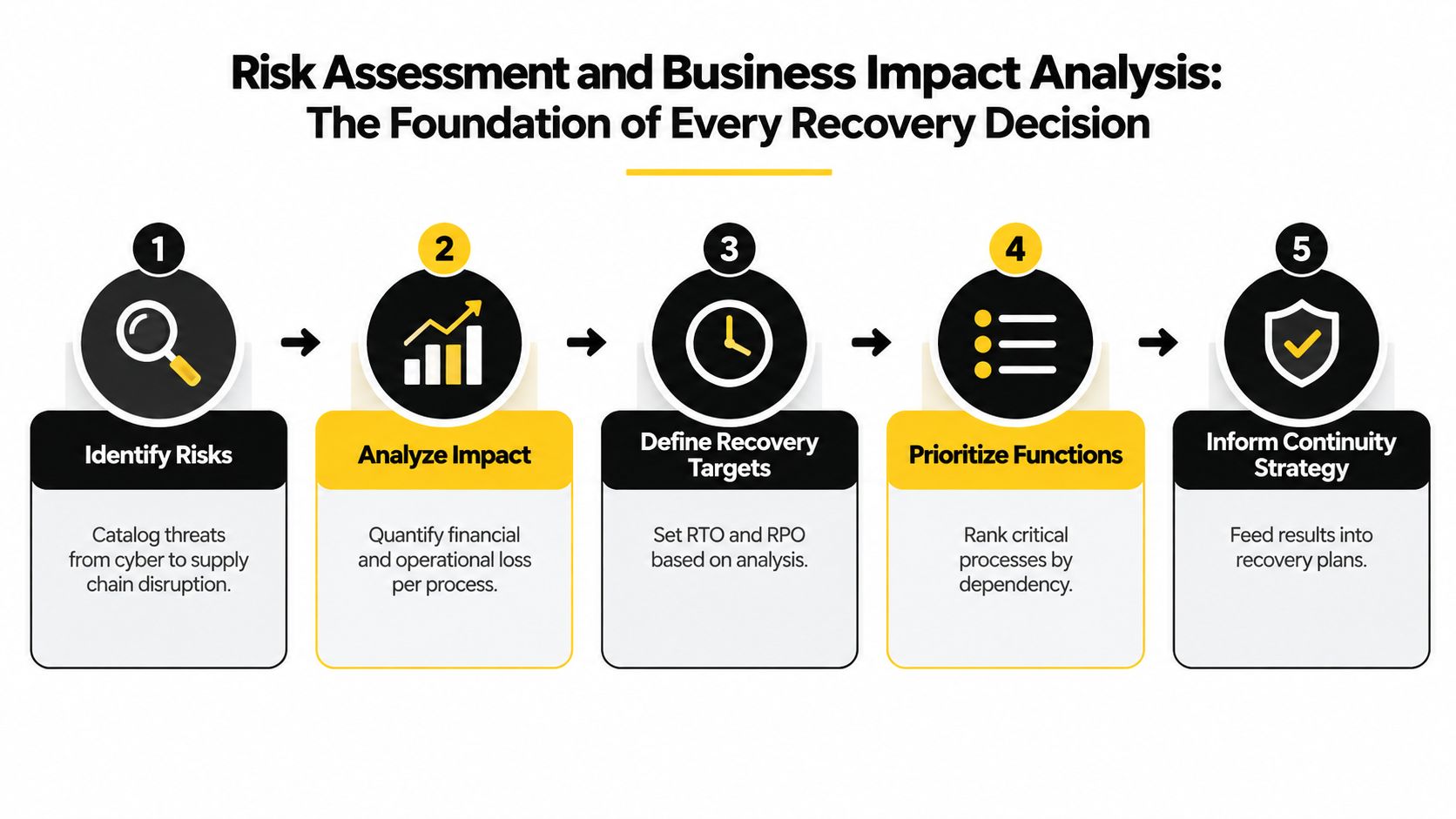
Recovery targets aren't credible until someone can explain why they exist. Risk assessment identifies what could disrupt a service, while a business impact analysis, or BIA, determines what that disruption would do to customers, employees, revenue, compliance, operations, and trust.
Start by separating three ideas that teams often combine:
- Threat: A carrier outage, ransomware event, identity-provider failure, supplier interruption, or corrupted knowledge source.
- Vulnerability: A single voice route, undocumented integration, missing backup validation, weak access control, or an unowned recovery step.
- Impact: Abandoned conversations, missed payroll deadlines, regulatory exposure, incorrect advice, lost revenue, or reputational damage.
A voice-carrier outage may leave web chat available but remove the channel used by customers with urgent needs. A corrupted knowledge base may not stop the bot from responding, but it can increase incorrect answers and force agents to compensate manually. An HR portal outage may appear operationally modest until it blocks a payroll-dependent process or prevents employees from completing a time-sensitive task.
A lightweight BIA you can complete in one week
Days one and two, map journeys. List the customer and employee outcomes your platform supports, not merely the applications in the architecture diagram. Include authentication, payment-adjacent assistance, order status, returns, password reset, benefits questions, case updates, and escalation.
Days three and four, trace dependencies. For each journey, record the required channels, APIs, data stores, identity services, vendors, human teams, and fallback methods. Mark any dependency that has no documented owner or tested alternative.
Day five, score impact. Assess financial, operational, regulatory, customer, employee, and reputational consequences. A function that runs on a small server may still deserve the highest priority if its failure blocks a regulated or revenue-critical journey.
Days six and seven, agree targets. Assign the MTD first, then set RTO and RPO, document assumptions, and obtain approval from the business owner. The result should be a prioritized recovery queue, not a catalog of technology risks.
The server count doesn't define criticality. The interrupted business outcome does.
Continuity Strategies From Backups to Multi-Region
Continuity architecture is a layered toolkit, not a binary choice between backup and failover. A snapshot, a replicated database, a redundant application zone, and an active-active conversational layer solve different problems and carry different costs.
| Strategy | Typical RTO | Typical RPO | Relative Cost | Best Fit Workload |
|---|---|---|---|---|
| Snapshot backup | Longer recovery | Point-in-time copy | Lower | Archived knowledge and noncritical records |
| Incremental backup | Moderate recovery | More frequent copy than snapshots | Low to moderate | HR case data and administrative workflows |
| Cross-region replica | Shorter recovery | Low recent-data loss | Moderate to high | Shared conversation state and operational data |
| Active-passive failover | Short recovery after cutover | Depends on replication | High | Cost-sensitive employee services |
| Active-active deployment | Minimal interruption when healthy | Near-continuous synchronization requirements | Highest | Tier-one CX routing and critical digital journeys |
High availability protects against component or zone failure inside a region. It typically combines redundant zones, load balancers, stateless application tiers, durable queues, and carefully managed session state. It doesn't protect you from a regional event, a flawed release deployed everywhere, or a shared identity provider failure.
Disaster recovery extends protection beyond the primary environment. Multi-region designs add geographic separation but also introduce replication lag, data-residency constraints, traffic-shift decisions, latency trade-offs, and more complicated ownership. Infrastructure spending can rise sharply as teams duplicate services, data stores, observability, security controls, and operational coverage.
Choose the tier by workload:
- A knowledge repository may operate with a longer recovery window if approved cached content remains available.
- An HR case workflow may use backup and manual fallback when employee urgency is limited and data can be reconciled later.
- A payment-adjacent bot or live conversation router needs stronger isolation and faster recovery because an unavailable interface can interrupt a customer's immediate intent.
- A queue-based workflow needs durable messages and replay validation, not merely a restored application server.
For customer journeys involving shipment visibility, an order-tracking reference such as Premier Broadband order tracking illustrates why status access should be treated as a customer-facing capability, with a clear fallback when an upstream system is unavailable.
Agentic automation sits above these layers. It can keep the front door open, explain degraded service, collect intent, and defer actions that require an unavailable system. Teams evaluating that layer should examine Yellow.ai platform integrations against their actual dependency map, rather than assuming one platform-wide recovery tier fits every journey.
Testing, Runbooks, and Proving Recovery Works
A recovery plan that hasn't been exercised is an assumption. Teams discover weaknesses during rehearsal, when they find stale diagrams, expired credentials, missing secrets, unowned services, or rollback procedures that nobody has executed.
Build testing intensity in stages
Begin with a document review. Confirm that the runbook names the trigger, service owner, incident commander, escalation path, communication channel, dependencies, decision thresholds, recovery steps, rollback steps, and success criteria.
Move to a tabletop walkthrough. The incident commander narrates a scripted outage while CX, EX, IT, security, communications, and vendor contacts explain what they would do. This exposes ambiguous authority and missing decisions without putting production traffic at risk.
Next, run a simulation in an isolated environment, then conduct a controlled failover. Validate that data is present, queues replay correctly, sessions behave as expected, and the customer-visible journey works from beginning to end.
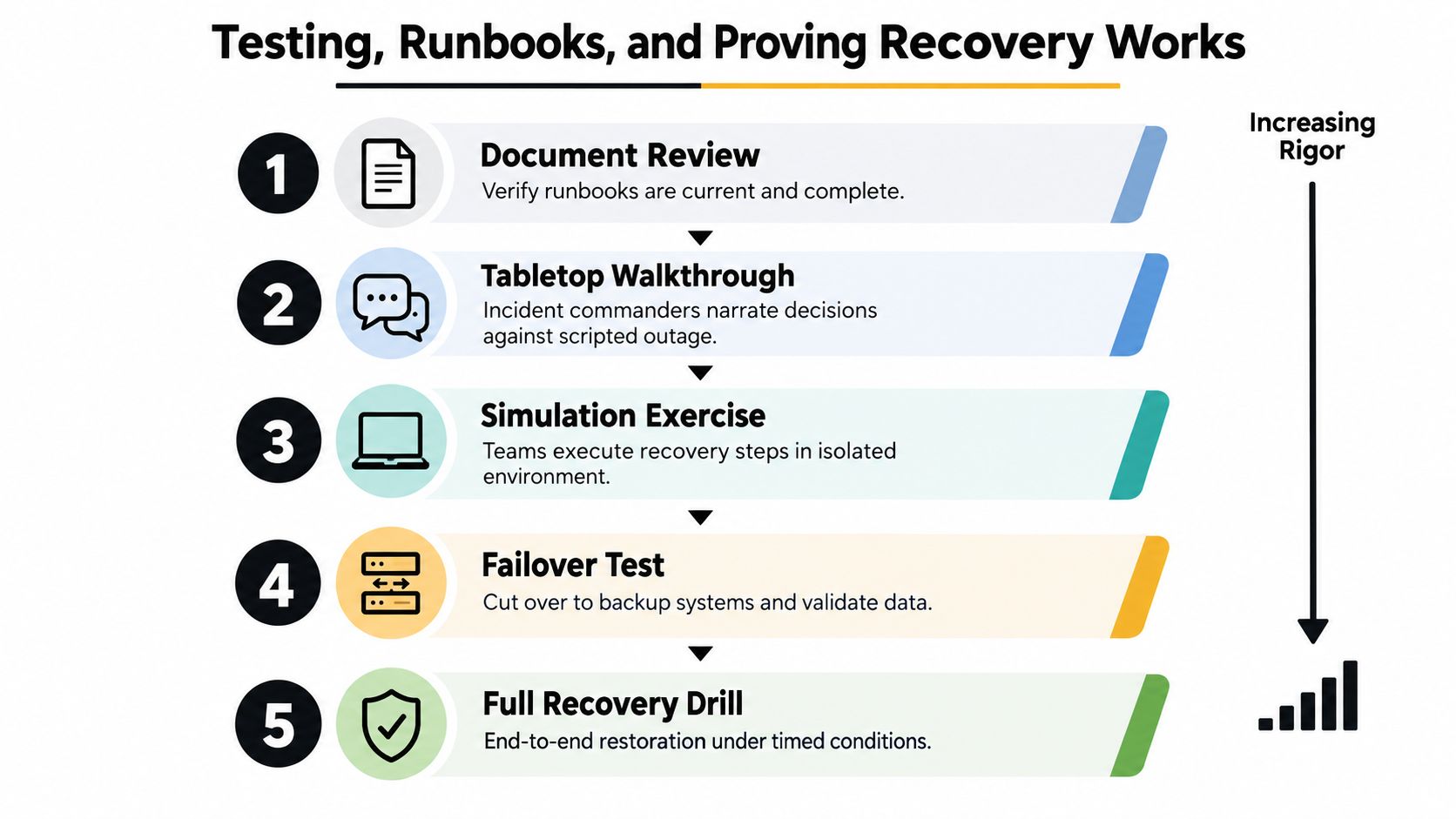
A full recovery drill should test the operating model, not just the infrastructure. Can a customer complete the intended transaction in degraded mode? Can an employee get help when the HR system is down? Can the bot preserve context, provide approved answers, and route only the cases that require human intervention?
Teams can use automated testing for conversational platforms to harden agent behavior before a live exercise, but automated checks don't replace an end-to-end recovery drill.
The pre-change checklist
- Restore validation: Recover a backup into a clean environment and verify that the application can use it.
- Traffic-shift rehearsal: Practice moving users to the recovery environment and confirming that the customer path remains functional.
- Queue replay: Submit test events, interrupt processing, restore the service, and verify that messages aren't lost or duplicated.
- Human escalation: Confirm that agents receive context and know which actions remain safe during degradation.
- Retrospective: Record failures, assign owners, set due dates, and update the risk register.
The following video can support a team discussion about testing discipline and recovery execution:
Paper recovery time has no operational value until a team has delivered it under pressure.
Governance, Compliance, and Continuity as a Management System
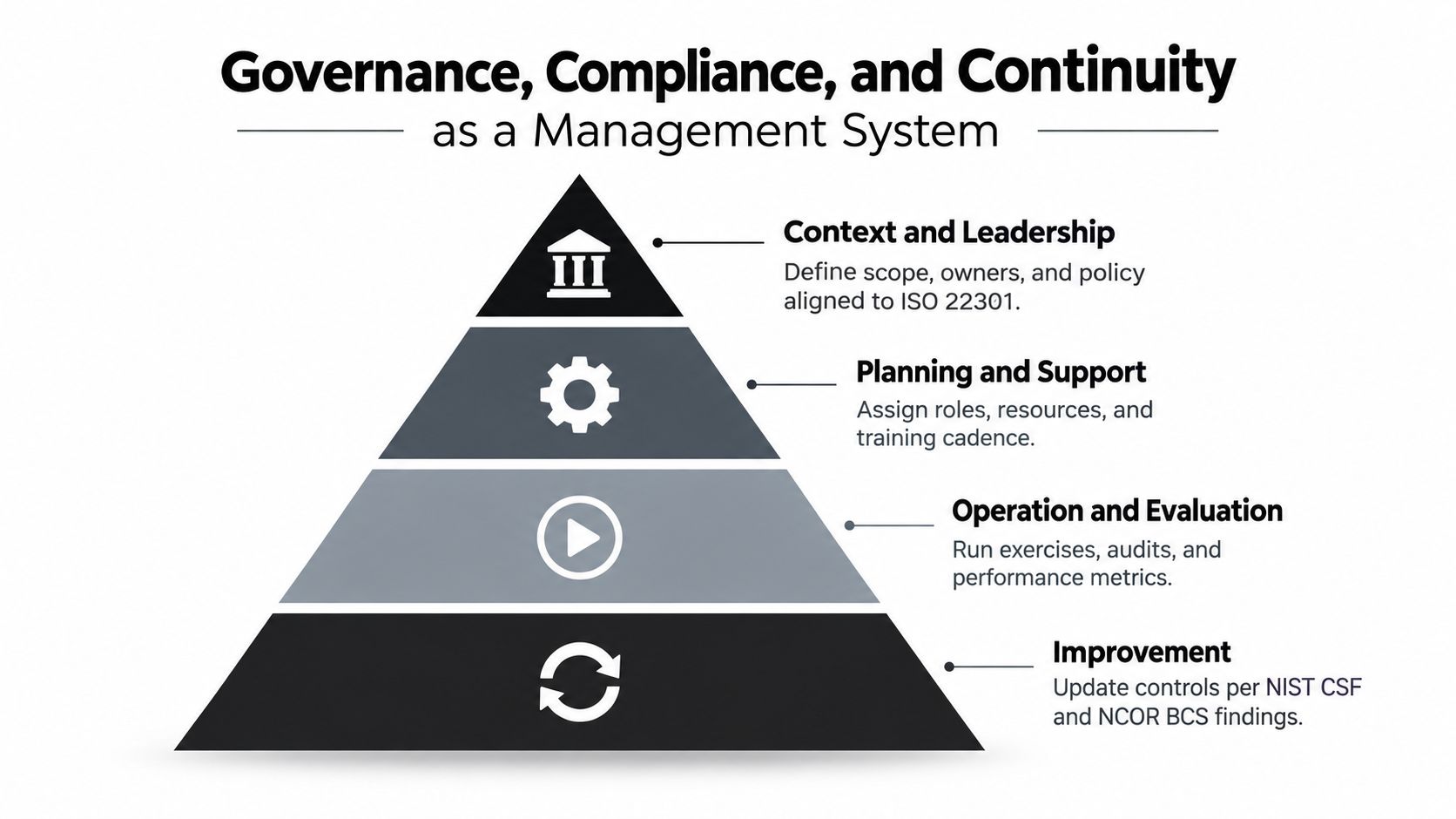
A continuity binder can't compensate for unclear ownership. Effective BCM operates as a management system with leadership accountability, documented objectives, trained participants, evidence of testing, performance review, and corrective action.
ISO 22301 provides the formal continuity-management frame. In practice, a CX or EX platform team translates that frame into operating routines:
- Context and leadership: Define the services in scope, name executive and operational owners, and approve a continuity policy.
- Planning and support: Maintain the BIA, fund recovery capabilities, train participants, and document dependencies.
- Operation: Execute runbooks, coordinate suppliers, manage communications, and protect customer and employee data during disruption.
- Performance evaluation: Review test results, recovery performance, unresolved risks, and evidence required by auditors.
- Improvement: Convert every exercise and incident into owned corrective actions with visible status.
Compliance changes the evidence required, but it doesn't replace good engineering. Financial-services teams may need to demonstrate operational resilience. Healthcare organizations must account for HIPAA safeguards. Global teams need to consider GDPR data residency, while payment journeys may bring PCI-DSS scope into the design.
The core artifacts are straightforward:
- A leadership-approved continuity policy.
- A current BIA with service tiers and recovery objectives.
- Tested runbooks with named owners.
- Vendor and dependency records.
- Exercise evidence and post-incident reports.
- A living risk register with tracked remediation.
Use Yellow.ai enterprise-grade security as one input when assessing platform controls, but keep accountability with the organization that owns the customer or employee outcome. Governance turns a technical failover into a defensible program that can survive audits, leadership changes, and the next incident.
How AI Agents Strengthen Continuity and Resilience
Conversational and agentic AI should be treated as a continuity control, not merely a productivity feature. In CX and EX, the interface is part of the business. If customers can't ask questions, authenticate, receive status, or start a case, the organization has lost an operating capability even when its databases remain intact.
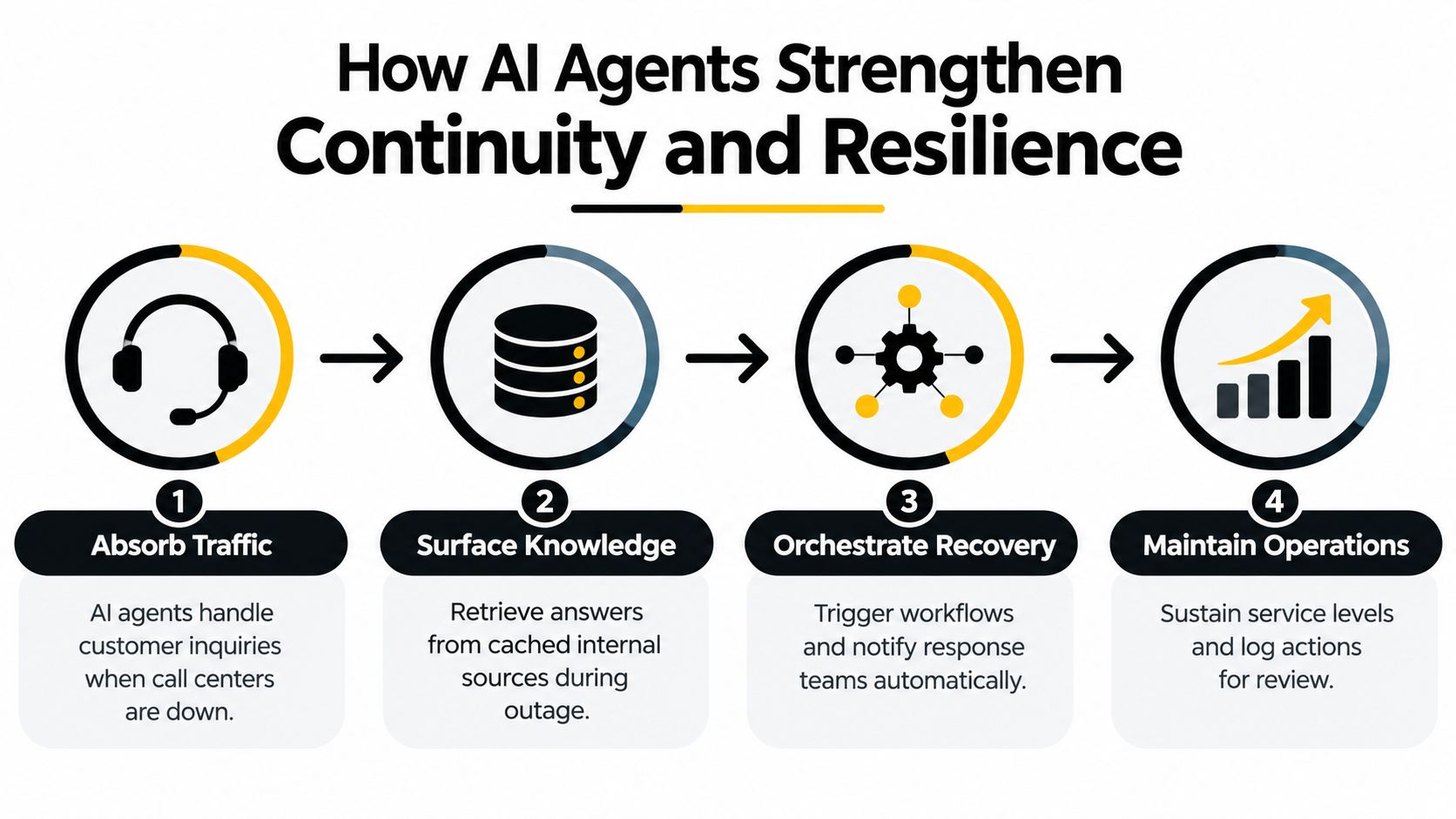
An agentic platform can absorb demand when a contact center is unavailable, present approved knowledge from resilient or cached sources, collect information for later completion, and route exceptions to the people who can act. It can also trigger bounded workflows through APIs, notify response teams, and preserve a record of decisions for review.
Design the degraded experience deliberately
A brittle FAQ bot returns static answers until its knowledge source or integration fails. A more capable agent needs explicit rules for degradation:
- Answer safely: Use approved, versioned knowledge and disclose when live data isn't available.
- Collect intent: Capture the customer's request, identifiers, and preferred follow-up path without pretending the transaction completed.
- Route intelligently: Escalate only cases that require human judgment or an unavailable backend action.
- Record actions: Preserve the conversation and decisions so recovery doesn't force the customer to start over.
- Trigger response: Open a case, notify an owner, or start an approved recovery workflow when the relevant API remains available.
Yellow.ai is one example of this approach. Its enterprise agentic AI platform supports autonomous conversations across CX and EX, with voice and chat capabilities, a conversational knowledge base, automated testing, analytics, and integrations with enterprise systems. Its published product information also describes omnichannel orchestration and agent context retention, capabilities that should be assessed against a specific continuity design rather than accepted as a substitute for testing.
The important architectural boundary is control. Agents should not invent recovery actions or bypass authorization because a backend system is unavailable. Give them a constrained toolset, approved fallback content, clear escalation rules, and observable logs.
Continuity value comes from preserving a useful conversation, not from making an unavailable system look healthy.
The BCI's 2025 report found that 45.5% of organizations distinguish business continuity and resilience as separate functions, while 95.0% expect incident-agnostic planning to matter most over the next five years. Those findings are reported in the BCI 2025 continuity and resilience update. For CX leaders, incident-agnostic planning means designing around effects and tolerances, then using agents to maintain service across unfamiliar failure patterns.
Practical Next Steps and Common Questions
Start with a focused 90-day program. Don't begin by buying another recovery tool. Begin with the customer and employee journeys that create the most exposure.
A practical 90-day roadmap
Weeks one and two: Inventory critical journeys and agree the MTD for each. Include the channel, business owner, data required, integrations, human fallback, and customer communication path.
Weeks three to six: Run the BIA, assign service tiers, and negotiate RTO and RPO with operations, finance, compliance, and technology. Document which targets are funded, which depend on vendors, and which remain gaps.
Weeks seven to ten: Write runbooks, name incident owners, create communication templates, and conduct a tabletop exercise. Fix the failures the exercise reveals before expanding scope.
Weeks eleven to thirteen: Pilot an AI agent on one high-volume deflection path. Test normal operation, degraded mode, escalation, knowledge availability, audit logging, and recovery handoff.
Questions leaders should answer
How often should recovery be tested? Use a cadence that matches change and risk. Test after material architecture changes, major vendor changes, and incidents, not just when an audit is approaching.
Does cloud adoption remove the need for disaster recovery? No. Cloud can improve redundancy, but shared dependencies, configuration errors, identity failures, regional events, and provider outages still require business-owned recovery decisions.
Who owns continuity when CX and IT both claim it? The business owner owns the outcome. IT owns many controls and recovery mechanisms, while CX or EX owns the journey, customer promise, and acceptable degradation.
Do AI agents create new failure modes? Yes. They can provide incorrect answers, invoke an unsuitable tool, expose sensitive information, or conceal an outage through overconfident language. Apply access controls, approved knowledge, testing, monitoring, and human escalation.
How do we fund resilience without adding headcount? Tier the journeys, automate repeatable checks, reuse platform capabilities, and spend first on the failures that threaten revenue, compliance, safety, or trust. A large undifferentiated program is harder to operate than a smaller one with clear priorities.
Business continuity is built during calm periods and judged during the disruption that follows. Inventory the journeys, set the tolerances, rehearse the fallbacks, and make the customer-facing layer part of the recovery architecture.
Yellow.ai provides agentic AI capabilities for CX and EX, including conversational automation, knowledge access, testing, analytics, and enterprise integrations that can support deliberately designed degraded-mode experiences. Visit Yellow.ai to evaluate how an agentic layer could keep customer and employee conversations moving while core systems recover.



