














The most important question when choosing among the best AI voice agents isn't which demo sounds most human. Customer support automation already represented 44.2% of AI voice agent market revenue in 2025, according to Grand View Research's market analysis. That concentration points to the real buying test: whether an agent can handle repetitive but consequential conversations inside a live contact-center environment.
A production evaluation should cover latency and turn-taking, language coverage, transaction complexity, human handoff, integrations, deployment effort, pricing transparency, security, and compliance review. The right answer depends on your existing CCaaS and CRM stack, call volumes, operating regions, and how much control your technical team wants over models, telephony, and orchestration. This comparison places Yellow.ai alongside six distinct alternatives, from voice-first managed services to configurable cloud building blocks.
Table of Contents
- 1. Voice AI Agents for Customer Service | Yellow.ai
- 2. PolyAI
- 3. Replicant
- 4. Interactions Intelligent Virtual Assistant
- 5. Five9 Intelligent Virtual Agent and AI Agents
- 6. Google Cloud Dialogflow CX and Contact Center AI
- 7. Kore.ai SmartAssist
- Top 7 AI Voice Agents, Feature Comparison
- Choose the Platform That Fits Your Operating Model
1. Voice AI Agents for Customer Service | Yellow.ai
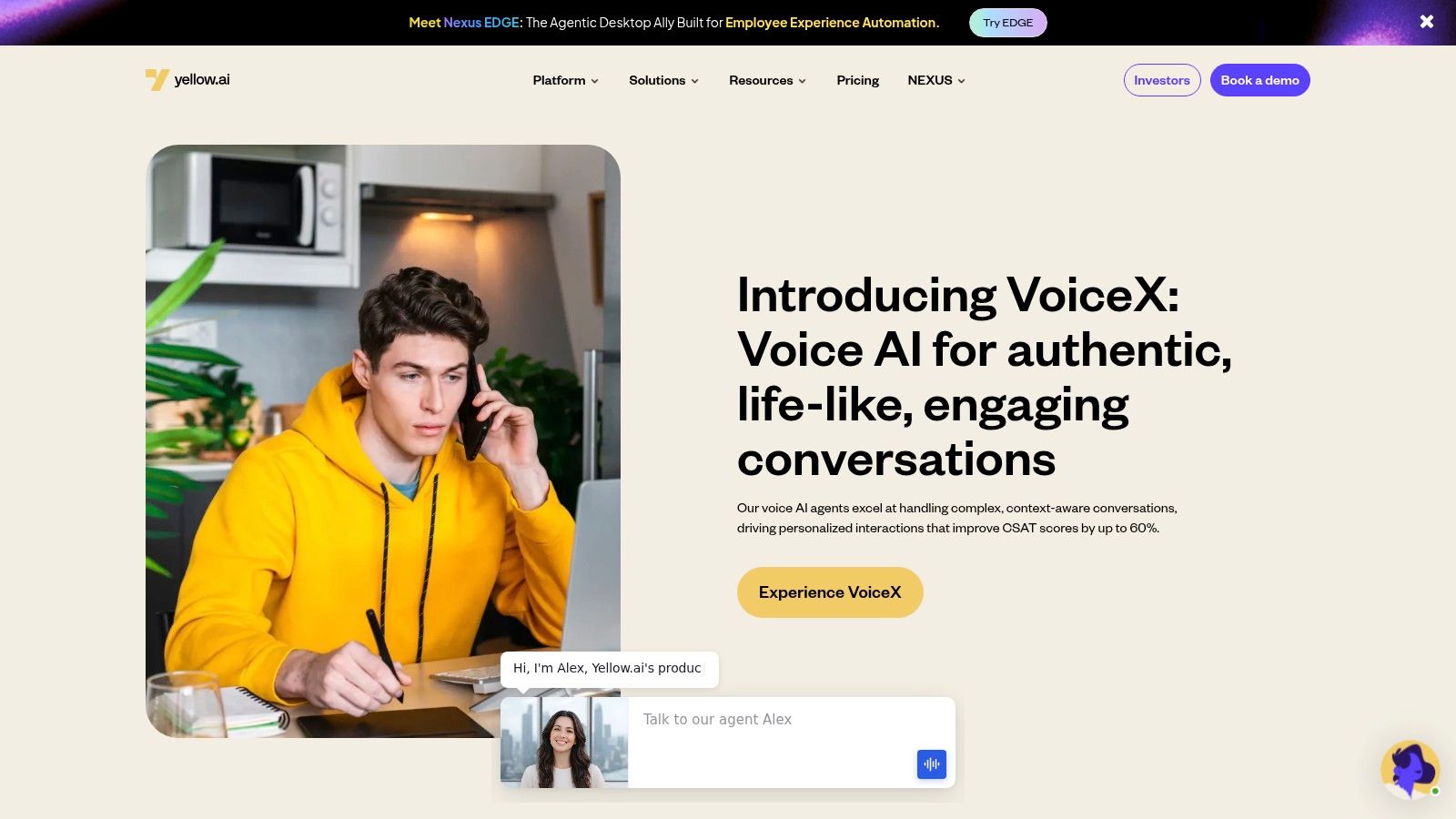
Yellow.ai's VoiceX is built for enterprises that want voice automation to sit inside a broader customer-service operating model, rather than function as an isolated phone bot. Its strongest proposition is orchestration. The platform combines conversational voice agents with integrations, real-time agent assistance, escalation to human staff, and tooling for testing and continuous improvement.
That matters because a voice agent rarely fails only at speech recognition. It fails when it loses context during a transfer, can't retrieve the right customer information, or gives the live agent no useful summary. Yellow.ai's approach connects voice automation with contact centers, CRMs, help desks, knowledge sources, and broader omnichannel workflows. The result is a better fit for organizations that need the same customer context to persist across voice and digital channels.
The platform also uses a multi-LLM architecture, which gives enterprise teams more flexibility than a closed, single-model deployment. Buyers can evaluate accuracy, speed, cost, and resilience across model choices instead of treating the underlying model as fixed infrastructure. Its AI Agent Builder, conversational knowledge base, agentic retrieval, automated testing, and AI Copilot support the operational work that begins after launch.
Where Yellow.ai fits best
Yellow.ai is a strong candidate for global customer-service organizations, employee-service teams, and regulated enterprises that need multilingual conversations, controlled escalation, integration depth, and centralized governance. Its broader platform can support voice, chat, email, and other interaction types, which reduces the risk of building separate automation silos.
The trade-off is implementation breadth. A large platform can be more complex than a focused voice API, and the best results may require conversation design, integration work, testing, and ongoing tuning. Smaller teams with simple call flows may not need that operational surface area.
Practical rule: Don't judge Yellow.ai only by the first call. Test knowledge retrieval, interruption recovery, transfer context, and post-call analytics together.
2. PolyAI
PolyAI takes a voice-first approach to customer service. Its agents are designed for transactional conversations such as authentication, routing, payments, and other contact-center workflows where callers need to complete a task without navigating rigid menus. The platform combines proprietary speech components with dialog models and audio-aware interaction design.
That architecture is important for organizations where natural turn-taking matters more than visual bot-building flexibility. PolyAI's audio-native approach is intended to detect conversational cues such as hesitation and emotion, allowing the agent to respond to how a caller speaks, not just to the transcribed words. Its Agent Studio supports design, testing, analytics, and iteration, while production pricing is based on usage rather than a simple seat model.
The trade-off is control. A cloud-first, voice-specialist platform can reduce the burden of assembling speech recognition, language models, telephony, and orchestration yourself. It can also require more diligence from organizations with strict data-residency, deployment, or model-governance requirements.
The enterprise trade-off
PolyAI is most compelling when voice quality, fast responses, and contact-center task completion are the central requirements. Its industry packaging and managed support can help teams avoid building a voice stack from components.
However, buyers shouldn't treat usage-based pricing as automatically predictable. Ask for a model that includes call duration, transfers, support, integration work, environments, and expected traffic patterns. Also verify how the service handles regional hosting and data processing before involving sensitive customer information.
For context, independent voice-agent guidance recommends testing end-to-end processing against strict percentile targets, while a benchmark of real phone calls found leading platforms with materially slower median time-to-first-audio than ideal targets. The Hamming evaluation guide therefore supports a practical conclusion: latency should be tested under representative calls, not inferred from a polished demonstration. The Yellow.ai customer-service automation platform is worth comparing when the evaluation needs broader omnichannel orchestration rather than voice specialization alone.
3. Replicant
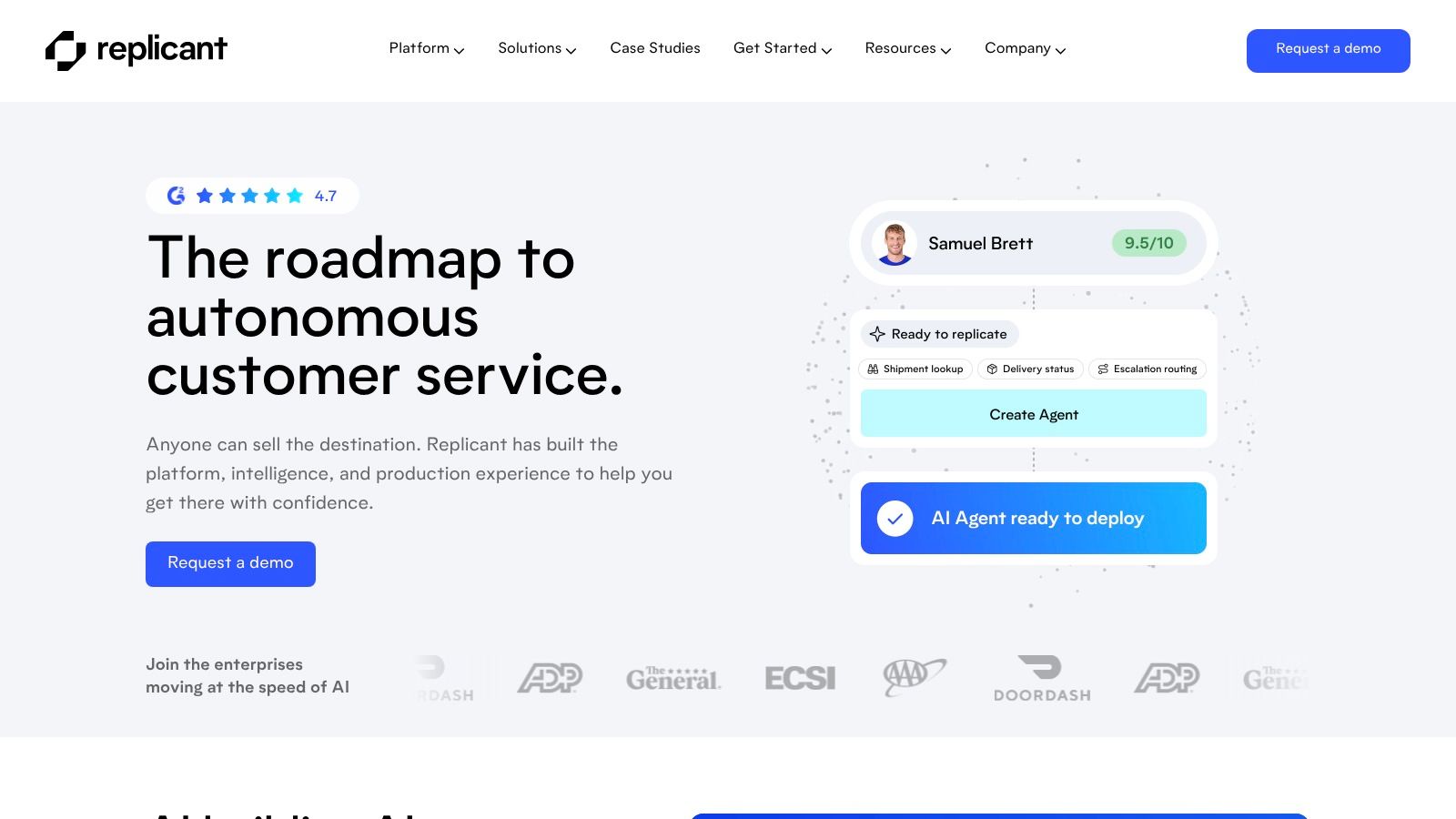
Replicant is aimed at high-volume contact centers that need a managed path from use-case selection to production optimization. Its architecture combines language models with deterministic guardrails, a useful distinction for workflows where the agent must follow policy, collect required information, or avoid improvising beyond its authority.
The platform supports inbound and outbound voice, with SMS follow-up available in the same operating model. That makes it relevant to service teams whose workflows don't end when a caller hangs up. An outbound agent may need to handle voicemail or an IVR, while an inbound agent may need to transfer a conversation with the customer's context intact. Treating these as connected operations can simplify follow-up and reporting.
Replicant's embedded enterprise services are a major part of the proposition. Teams that want a vendor to help with deployment, optimization, and operational tuning may value that support. Teams that want to configure every model, prompt, and integration internally may find the managed approach restrictive.
Guardrails over demo freedom
Replicant's main advantage is that it treats policy control and deployment discipline as core product requirements. That makes it a sensible option for payment-related service, collections, account support, and other Tier-1 workflows where the business would rather constrain the agent than maximize open-ended conversation.
Its custom-quote model means buyers need a detailed commercial scope. Include configuration, professional services, outbound attempts, SMS, transfer costs, monitoring, and ongoing optimization. The right comparison isn't just platform fee versus platform fee. It's the total cost of operating a controlled service across the intended call journeys.
Teams assessing Replicant should also review the evidence behind deflection and accuracy claims, then test failure paths directly. The Yellow.ai Waste Connections case study provides a useful example of the kind of operational evidence buyers should request from every shortlisted vendor, even when the underlying workflows differ.
4. Interactions Intelligent Virtual Assistant
Interactions approaches enterprise voice automation through a hybrid model. Its Adaptive Understanding capability combines conversational AI with real-time human understanding for difficult utterances, noisy audio, and conversations that don't fit neatly into a predefined path.
That model changes the buying question. A fully automated agent may be cheaper for simple status questions, but difficult calls often create the highest operational cost when the system misunderstands the caller, repeats itself, or transfers without context. Interactions is designed for cases where preserving accuracy is more important than maximizing automation at every moment.
The platform supports identity verification, payments, appointments, and complex transactions. Its professional-services orientation also makes it relevant to enterprises that need help mapping existing workflows, integrating back-office systems, and designing the experience around business outcomes instead of deploying a generic bot.
When human understanding is a feature
Interactions is a strong fit when utterance complexity, noisy audio, and successful completion matter more than a pure self-service architecture. Its success-based commercial model can align vendor incentives with business outcomes, but buyers should define those outcomes precisely before negotiating. Resolution, transfer, containment, repeat calls, and customer satisfaction can produce very different commercial results.
The cost trade-off is straightforward. Human-assisted understanding may be unnecessary for a narrow FAQ flow, but it can be valuable when failed automation creates compliance, revenue, or customer-retention risk. Ask the vendor to demonstrate ambiguous requests, interruptions, authentication failures, payment exceptions, and escalation to a live agent.
Also test whether the human-in-the-loop element is visible to the caller, how information is shared, and how the interaction is audited. A hybrid design can improve resilience, but only if the handoff is operationally clear and privacy controls apply to every participant in the conversation.
5. Five9 Intelligent Virtual Agent and AI Agents
Five9 is the most obvious choice on this list for organizations already invested in the Five9 contact-center ecosystem. Its Intelligent Virtual Agent and newer AI Agent capabilities sit alongside the broader Intelligent CX Platform, which can simplify routing, workflow design, and handoff to human representatives.
The platform offers visual tools, prebuilt tasks, templates, multimodal interactions, and a selection of human-sounding voices. Its integration with Google Cloud services adds another route for organizations already using that ecosystem. The central advantage isn't merely that Five9 has an IVA. It's that the IVA can be designed as part of the same environment that manages agents, queues, workflows, and customer interactions.
The stack decision
Five9 reduces integration friction when the contact center already runs on Five9. Teams can create a more direct path between automated intent handling and human-agent workflows, rather than joining separate vendors through custom telephony and event pipelines.
That benefit weakens in a mixed environment. If your organization uses another CCaaS provider, adding Five9 primarily for voice automation may create parallel administration, duplicated reporting, and a more complicated commercial model. Line-item IVA pricing is not publicly clear, so the evaluation should model the entire bundle rather than a standalone bot.
Use Five9 when contact-center continuity is more valuable than provider neutrality. During testing, compare automated and human journeys in the same queue. Measure whether the human receives the transcript, collected fields, authentication state, and recommended next action without forcing the caller to repeat information.
6. Google Cloud Dialogflow CX and Contact Center AI
Google Cloud Dialogflow gives technical teams configurable building blocks rather than a single turnkey voice-service opinion. Dialogflow CX uses visual flow and state-machine design for complex conversations, while Contact Center AI adds contact-center capabilities, routing, SDKs, and bring-your-own-carrier telephony.
The architecture suits organizations standardizing on Google Cloud. Teams can connect conversational agents with Vertex AI, Gemini, marketplace partners, and other Google services. That ecosystem depth can be powerful when the enterprise already has cloud engineers, identity controls, observability practices, and procurement relationships in place.
It also creates responsibility. A configurable platform gives architects more control over flows, integrations, IAM, environments, and deployment patterns. It doesn't automatically produce a well-designed customer conversation. Teams must define interruption behavior, fallback states, transfer rules, data retention, monitoring, and release governance.
Flexibility requires cost discipline
Google Cloud's usage-based structure can work well for teams that want granular consumption tracking, but pricing across conversational-agent and contact-center components requires careful modeling. Separate telephony, model, storage, support, and integration costs can make an apparently simple flow difficult to forecast.
Dialogflow CX is best for engineering-led organizations that need configurable building blocks and Google ecosystem alignment. It is less attractive for a buyer seeking a managed outcome with minimal internal platform ownership.
Security controls are a strength, but breadth increases the review burden. Validate IAM design, logging, data residency, model access, third-party connectors, and change management. The platform should be evaluated as cloud infrastructure plus conversation tooling, not as a finished contact-center replacement.
7. Kore.ai SmartAssist
Kore.ai SmartAssist combines voice automation with the Kore.ai XO Platform and an integrated agent desktop. It can automate voice and digital interactions, pair with an existing IVR, preserve context across channels, and escalate to live staff when the automated path reaches its limits.
Its voice gateway gives technical teams granular control over telephony details such as speech engines, SIP transfers, and call-handling utilities. That makes Kore.ai particularly relevant to enterprises with complex phone environments, legacy routing requirements, or a need to control how calls move between automated and human queues.
The low-code and no-code tooling is designed to let operations teams build and monitor agents without making every change dependent on engineering. Real-time analytics and AgentAssist add another layer for human representatives, helping the organization treat automation and augmentation as parts of the same service model.
Control versus change management
Kore.ai stands out when telephony control, omnichannel context, and an integrated agent desktop are more important than a minimal setup. It can be a better fit than a narrowly focused voice API for teams that need to manage IVR coexistence, transfers, agent assistance, and digital channels together.
The main concern is governance. A platform with frequent capability updates demands controlled releases, regression testing, documentation review, and ownership for production changes. Ask how features are versioned, how environments are separated, and how administrators can prevent an update from altering a critical call journey.
Pricing requires a sales engagement, so build a scenario-based request. Include existing IVR integration, carrier connectivity, agent seats, analytics, support, and expected automation growth. The platform's flexibility is valuable only when the organization can operate it consistently.
Top 7 AI Voice Agents, Feature Comparison
| Solution | Implementation Complexity 🔄 | Resource Requirements ⚡ | Expected Outcomes ⭐📊 | Ideal Use Cases 💡 | Key Advantages |
|---|---|---|---|---|---|
| Voice AI Agents for Customer Service | Yellow.ai | Medium–High 🔄 Enterprise integrations, customization and tuning often needed | Moderate–High ⚡ Dev/Ops, integration work, multilingual/support & compliance overhead | High ⭐📊 Reported up to 90% self‑service, +60% CSAT, large cost/efficiency gains | Global CX at scale, multilingual contact centers | DynamicNLP (~97% intent), multi‑LLM, real‑time agent assist, deep connectors |
| PolyAI | Medium 🔄 Voice‑first design with builder and iteration tooling; faster on voice flows | Variable ⚡ Per‑minute pricing; requires voice infra and low‑latency ops | Strong ⭐📊 Lifelike, sub‑second conversations that improve CX metrics | Transactional voice tasks: auth, routing, payments, high volume calls | Proprietary ASR/TTS, audio‑native cues, Agent Studio for rapid iteration |
| Replicant | Medium 🔄 Managed deployment with embedded services; less DIY control | Moderate ⚡ Managed services reduce internal ops but need integration & custom quote | Reliable ⭐📊 Improved accuracy, call deflection, collections outcomes | High‑volume contact centers, compliance‑sensitive workflows | Multi‑model orchestration, code guardrails, unified inbound/outbound/SMS |
| Interactions (IVA) | High 🔄 Hybrid AI + human‑in‑loop; professional services and tuned deployments | High ⚡ Ongoing human oversight/services; success‑based commercial engagement | High ⭐📊 Very accurate on complex/ambiguous utterances and noisy audio | Complex transactions, identity/payments, noisy audio environments | Adaptive Understanding (human assist), broad IVA capability library, outcome‑aligned pricing |
| Five9 Intelligent Virtual Agent & AI Agents | Low–Medium 🔄 Code‑free visual design and templates; streamlined if using Five9 stack | Moderate ⚡ CCaaS bundle dependencies; benefits from Five9/Google integrations | Good ⭐📊 Rapid time‑to‑value and smooth IVA→agent handoffs | Organizations on Five9 CCaaS seeking quick automation | Visual tooling, prebuilt templates, multimodal voices and tight CCaaS integration |
| Google Cloud Dialogflow CX & CCAI | Medium–High 🔄 Powerful flow/state design; needs careful dialogue & cost planning | High ⚡ GCP resources, BYOC telephony, Vertex AI/Gemini integrations | Strong ⭐📊 Scalable, low‑latency omnichannel agents with enterprise controls | Teams standardizing on Google Cloud and complex omnichannel needs | Deep Google ecosystem, SDKs, mature docs, partner marketplace |
| Kore.ai SmartAssist (XO Platform) | Medium 🔄 No/low‑code platform but requires governance for frequent updates | Moderate ⚡ Platform hosting, agent desktop integration, SIP/voice controls | Good ⭐📊 End‑to‑end automation with agent assist and preserved context | Organizations needing integrated bot + agent desktop or IVR replacement | Granular voice controls, omnichannel routing, AgentAssist and analytics |
Choose the Platform That Fits Your Operating Model
There isn't one universal winner among the best AI voice agents. Each platform solves a different enterprise constraint.
Choose Yellow.ai when you need broad multilingual orchestration, deep business integrations, human handoff, and multi-LLM flexibility across voice and other channels. Choose PolyAI when voice-first naturalness and low-latency conversational performance are the primary buying criteria. Select Replicant when your contact center wants a managed high-volume operation with deterministic guardrails and vendor-supported optimization.
Interactions is better suited to complex utterances and workflows where human-assisted understanding can protect completion quality. Five9 makes the most sense for organizations already committed to its contact-center stack and looking for a unified path from IVA to live agent. Google Cloud Dialogflow CX and CCAI fit teams standardizing on GCP that want configurable building blocks and direct control over architecture. Kore.ai is a strong candidate when granular voice controls, omnichannel routing, and an integrated agent desktop matter most.
The shortlist should come from your operating model, not a voice demo. Start by defining the highest-priority call journeys, including the transactions the agent must complete and the situations it must refuse. Then test representative audio, interruptions, accents, noisy lines, authentication failures, transfers, callbacks, and escalation paths.
Validate integration, data residency, retention, auditability, and regulatory requirements before discussing rollout. Model usage, telephony, professional services, support, and human-transfer costs together. Finally, require evidence for every latency, language coverage, security, and compliance claim, and repeat the evaluation under realistic production load rather than relying on a scripted demonstration.
Yellow.ai offers enterprise voice agents that connect natural conversations with knowledge, business systems, agent assistance, testing, and human escalation. If your team is comparing platforms for complex customer-service operations, visit Yellow.ai to explore how its agentic AI approach can support a controlled voice deployment.



