














Agent builders stopped being a niche tooling category faster than most enterprise buyers expected. Gartner projects that by 2028, 33% of enterprise software applications will include agentic AI, up from less than 1% in 2024. That's not a feature trend. It's an infrastructure shift.
The practical implication is simple. Choosing among the best AI agent builders isn't just about prompt quality or a clean drag-and-drop canvas anymore. It's about whether your platform can survive procurement, security review, integration sprawl, contact-center complexity, and the messy reality of production operations. Buyers are also no longer comparing one or two isolated vendors. Third-party 2026 roundups from Rasa's overview of AI agent builders show a crowded field that spans enterprise platforms, workflow automation vendors, and general-purpose builders, which is why “best” now depends heavily on use case.
That shift matters because the category is still early. Independent market research places the global AI agent builder market at USD 1.78 billion in 2025, rising to USD 6.21 billion by 2034 at a 14.6% CAGR. Fast growth usually creates noise. More products claim agentic capability than can support governance, testing, observability, and safe action-taking across core systems.
If you're trying to build a shopping agent, modernize service automation, or deploy employee support agents, the wrong platform won't fail in the demo. It will fail during rollout, when data access, escalation design, approval flows, and model behavior collide with real business processes.
Table of Contents
- 1. Yellow.ai
- 2. Microsoft Copilot Studio
- 3. Google Cloud Vertex AI Agent Builder
- 4. AWS Agents for Amazon Bedrock
- 5. OpenAI Assistants API
- 6. IBM watsonx Assistant
- 7. Kore.ai XO Platform
- 8. Cognigy.AI
- 9. Ada
- 10. boost.ai
- Top 10 AI Agent Builders, Features & Capabilities
- The Future is Agentic Charting Your Course
1. Yellow.ai
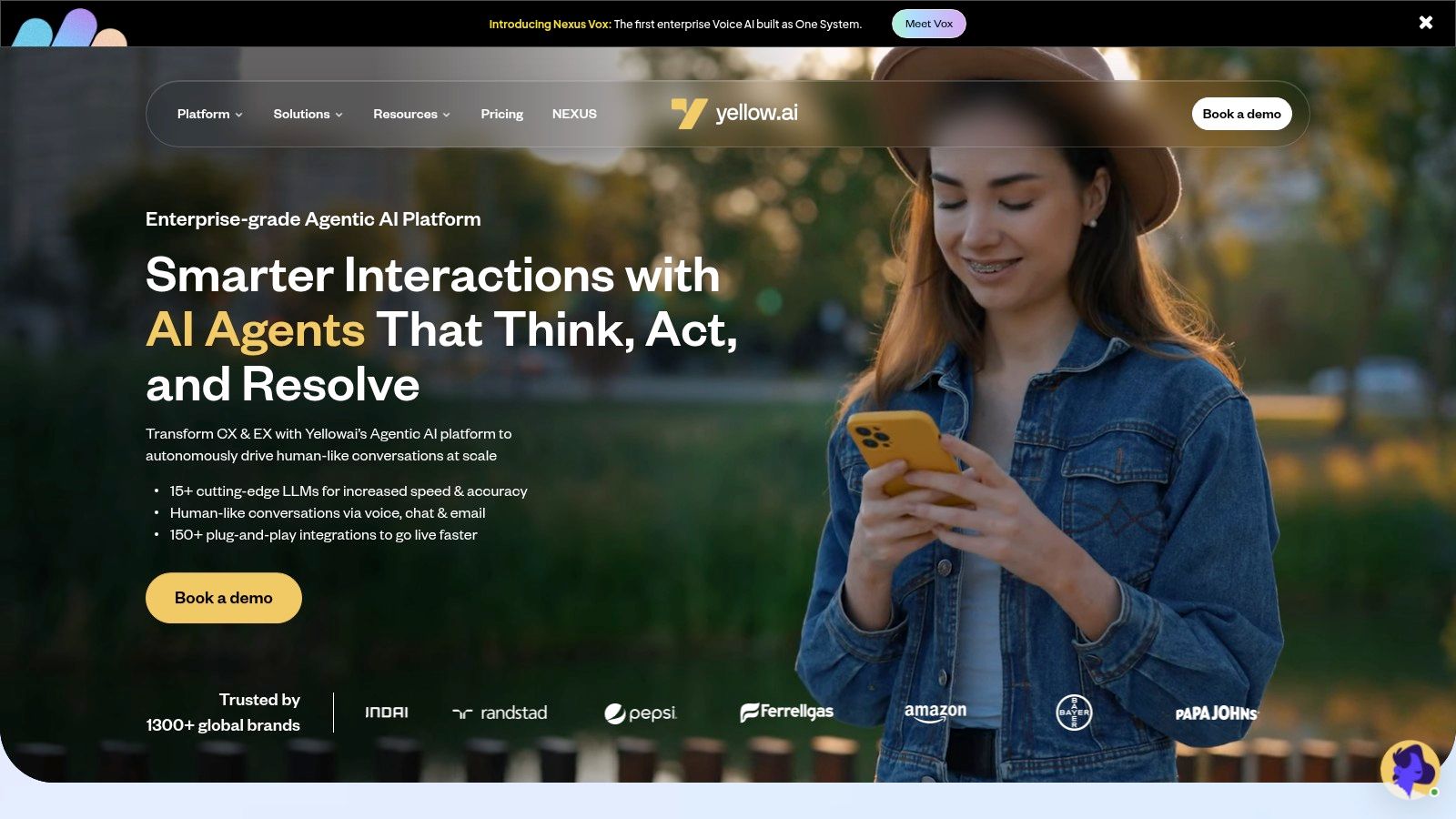
Yellow.ai is the platform I'd put at the top of this list for enterprise CX and EX teams that need more than a chatbot layer. It's built for autonomous, human-like conversations across customer and employee journeys, but it particularly shines due to its operational depth. The platform combines agent building, testing, analytics, agentic RAG, omnichannel deployment, and enterprise compliance in one stack.
That matters because a lot of “best ai agent builders” look good until you ask how they'll handle voice, channel switching, debugging, regulated workflows, and model flexibility in production. Yellow.ai addresses those questions directly. Its architecture is designed for teams that want to deploy multimodal agents quickly without giving up governance or control.
Why Yellow.ai stands out
Yellow.ai's voice stack is unusually strong. Nexus Vox can clone a voice in about 10 seconds, supports 500+ languages, and is designed for ultra-low-latency interactions. If your transformation program includes IVR modernization, outbound reminders, multilingual support, or blended voice-and-chat journeys, that changes the shortlist immediately.
Its AI Agent Builder 2.0 is also practical in the way enterprise platforms need to be practical. Teams can design, test, preview, and debug agents with AI Copilot and Automated Testing instead of treating production as the test environment. The platform's Conversational Knowledge Base uses agentic RAG, which is a better fit for enterprise information retrieval than static FAQ automation. For teams still aligning internally on terminology, Yellow.ai's guide to what AI agents are is a useful framing resource.
Practical rule: If voice is strategic, don't evaluate voice as an add-on. Evaluate it as part of the core agent architecture.
There's also a strong infrastructure story here:
- Multi-LLM flexibility: Yellow.ai supports 15+ models, which helps teams optimize for latency, quality, and cost while avoiding single-vendor dependence.
- Omnichannel execution: Agents can operate across voice, chat, email, images, and video without forcing teams into fragmented orchestration.
- Enterprise integrations: The platform includes 150+ pre-built integrations spanning systems like Salesforce, Zendesk, Genesys, HubSpot, Freshdesk, and NICE.
- Compliance readiness: Yellow.ai supports HIPAA, ISO 27001/27701, SOC 2 Type II, and PCI-DSS requirements.
Where it fits best
Yellow.ai is best for enterprises that want one platform for CX, EX, and contact center automation rather than a patchwork of point products. It's especially strong when the use case requires multilingual voice, complex service orchestration, knowledge-grounded answers, and measurable operations management after launch.
The trade-off is predictable. This is an enterprise platform, not a lightweight team tool. Pricing isn't public, and the best results depend on integration readiness, knowledge design, and cross-functional rollout discipline. Smaller teams that only need a simple workflow assistant may find it heavier than necessary.
Still, for enterprise buyers who care about real deployment conditions, Yellow.ai is one of the few platforms on this list that feels built for the whole journey, not just the demo.
2. Microsoft Copilot Studio
Microsoft Copilot Studio is the safest shortlist inclusion for organizations already standardized on Microsoft 365, Teams, Entra ID, Dataverse, and the broader Power Platform. In those environments, the main advantage isn't novelty. It's adjacency. The builder sits close to where employees already work, which lowers change management friction in a way many competing tools can't match.
Aimultiple notes that in 2026 Microsoft Copilot Studio introduced natural-language agent creation and offers over 1,200 data connectors, reflecting how quickly enterprise agent tooling is converging with workflow automation and app integration. That's one reason Microsoft remains hard to ignore for internal copilots, employee help, and task-oriented line-of-business scenarios.
Best when Microsoft is already the operating layer
Copilot Studio works best when you want secure, low-code agents embedded across Microsoft surfaces. It supports visual authoring, orchestration, and integrations into systems like SharePoint, Salesforce, and ServiceNow while inheriting much of the governance posture buyers expect from the Microsoft stack.
The practical upside is straightforward:
- Lower rollout friction: Teams already using Teams and Microsoft 365 don't need to introduce a completely new work surface.
- Governance familiarity: Identity, access, and compliance align naturally with existing Microsoft administration patterns.
- Broad enterprise integration: It handles many common business workflows without requiring a separate integration strategy from day one.
If you're comparing builder usability, Yellow.ai's overview of using AI Copilot to build and optimize AI agents is a good companion read because it highlights the same buyer pressure point: teams want creation speed, but they also need debugging and optimization discipline.
The downside is that Copilot Studio can become harder to price and scope than buyers initially expect. Standalone licensing, metering, and add-on paths can complicate budgeting. It's also strongest when your enterprise already wants Microsoft to be the default control plane. If your stack is more heterogeneous, other platforms may give you better cross-channel and cross-model neutrality.
Microsoft Copilot Studio is often the right organizational choice before it's the perfect product choice. That's a real advantage in enterprise buying.
3. Google Cloud Vertex AI Agent Builder
Google Cloud Vertex AI Agent Builder is one of the most balanced options for organizations that need both low-code access and real developer extensibility. It gives product teams a visual builder while also supporting code-first work through an Agent Development Kit. That combination makes it useful when business teams and engineering teams both need ownership in the same program.
Its biggest strength is grounding. For enterprise agents, retrieval quality often matters more than flashy autonomy. Vertex AI Agent Builder benefits from Google's search and retrieval capabilities, which makes it a strong candidate for knowledge-heavy service, internal support, and research-driven use cases.
Strongest for grounded agents and mixed builder teams
The platform supports low-code design, code-first development, built-in grounding, and code execution tooling. Google is also consolidating more of its agent capabilities under the Gemini Enterprise Agent Platform, with Agent Builder remaining central to creation workflows. Buyers should understand that this consolidation is strategically sensible, but it can create some branding and enablement ambiguity during evaluation.
The practical fit is strongest in a few situations:
- Knowledge-intensive deployments: Grounded answers are central to support quality, policy guidance, or internal operations.
- Mixed user groups: Business teams need no-code speed, while engineers need room to tune orchestration and tooling.
- Google Cloud alignment: Security, deployment, and procurement already run through Google Cloud.
For teams still sorting out the difference between conventional bots and more autonomous systems, Yellow.ai's explainer on agentic AI and how it differs from AI agents helps clarify the maturity model behind these platform choices.
The main caution is complexity. Google's tooling can be powerful, but the commercial model often spans several services, and platform transitions can confuse non-technical buyers. This isn't the builder I'd recommend for an organization seeking the fastest no-code pilot with minimal enablement effort. It is one I'd recommend when grounded retrieval, developer flexibility, and cloud-scale operations matter more than immediate simplicity.
4. AWS Agents for Amazon Bedrock
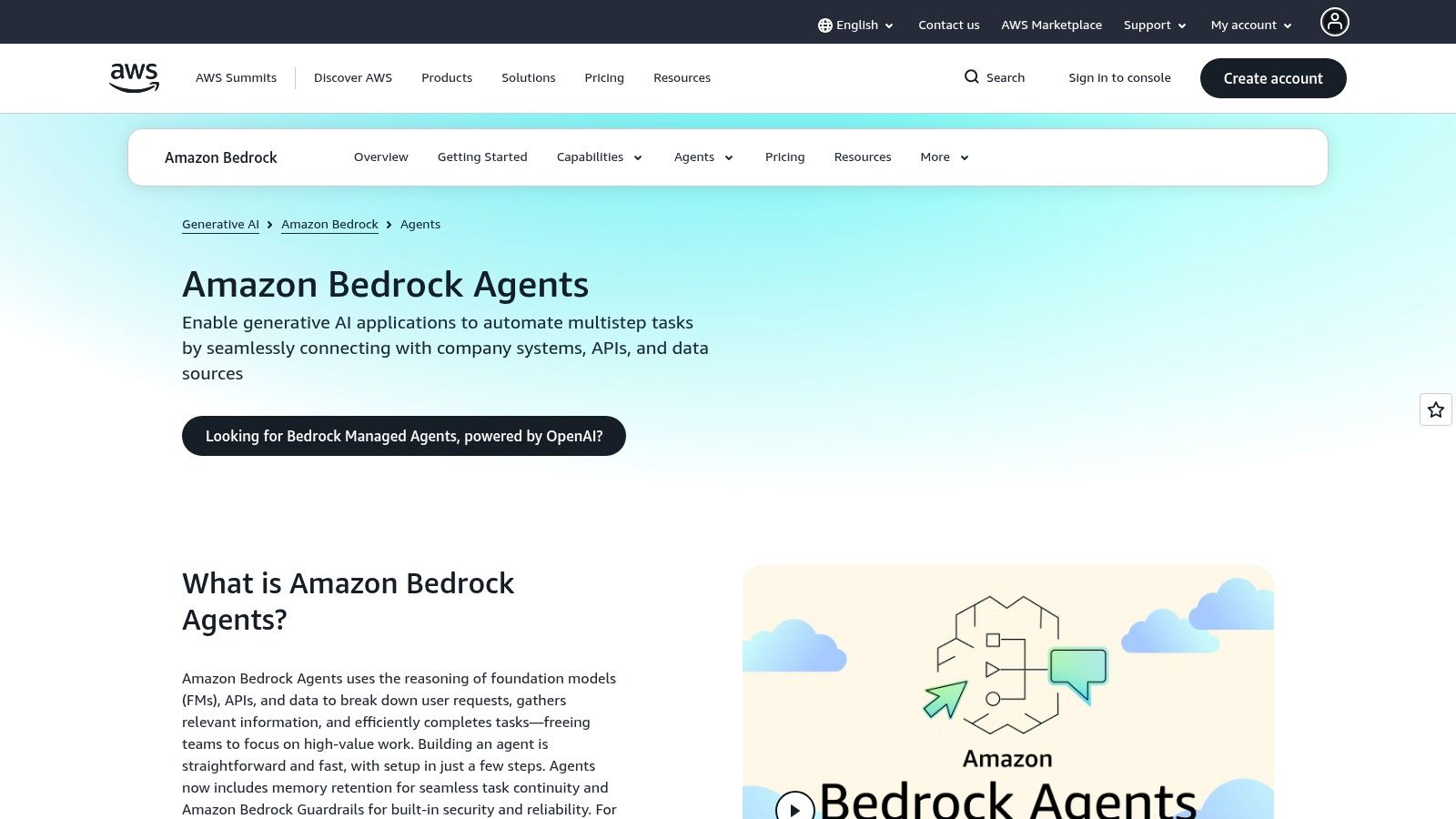
AWS Agents for Amazon Bedrock is less about visual elegance and more about control. If your security model, networking standards, and application estate already live in AWS, Bedrock's agent framework fits naturally into that environment. That's why it tends to resonate with cloud platform teams more than with business-led automation teams.
This option is strongest when agents need to orchestrate across APIs, collaborate across steps, and operate within strict IAM, VPC, and governance boundaries. It also benefits from Bedrock's access to multiple model providers under one umbrella, which is useful for enterprises that don't want to commit their entire agent strategy to a single model vendor.
Best for AWS-native control
AWS offers multi-agent collaboration, action groups for connecting to business systems, knowledge integration, and native controls aligned with AWS security practices. In practical terms, that means platform teams can keep agent operations close to the rest of their infrastructure and policy stack rather than bolting on a separate control plane.
That's a strong fit when:
- Security architecture leads the decision: IAM, VPC isolation, and native AWS controls are essential.
- Engineering owns the rollout: Teams want deep access to cloud primitives and service integrations.
- Model optionality matters: Bedrock helps reduce dependence on one model provider.
The trade-off is familiar. AWS gives you strong foundations, but it also expects organizational maturity. Costs can spread across model usage, orchestration, retrieval, and surrounding services. If the business team wants a fast no-code operating console for CX leaders, this won't feel as turnkey as specialized enterprise conversational platforms.
Use Bedrock when your cloud platform team is the product team for AI. Don't use it when you're secretly hoping the contact center will self-implement it.
5. OpenAI Assistants API
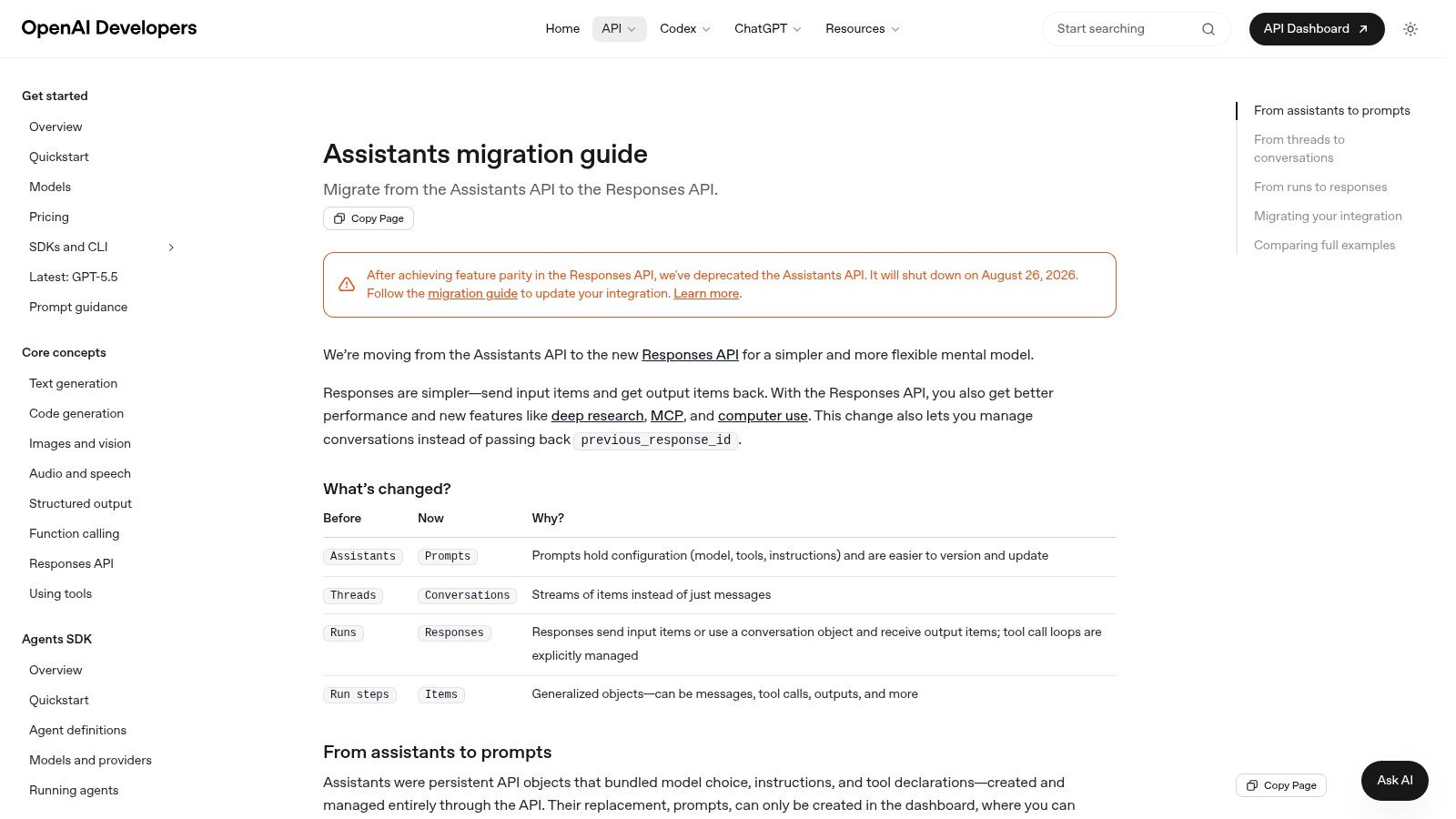
OpenAI Assistants API belongs in this list because many enterprises don't want a full packaged builder. They want a reasoning core they can embed inside their own applications, service channels, or internal tools. That's where Assistants API makes sense.
It gives developers stateful assistants with persistent threads, file search, code interpretation, and function calling. For product teams building differentiated experiences, that's often a better starting point than adopting an opinionated enterprise platform too early.
Best for teams that want to build their own runtime
The upside is speed for developers. You can create complex agent behavior without hosting your own models or building every primitive yourself. File Search supports retrieval patterns. Function Calling helps the assistant act on systems and workflows. Persistent threads help with continuity across longer-lived interactions.
The downside is just as important. OpenAI gives you the reasoning engine, not the operating environment. You still need to build or buy the rest:
- Channels: Web, mobile, voice, helpdesk, and messaging deployment layers.
- Governance: Approval flows, role boundaries, auditing, and policy controls.
- Observability: Session analytics, failure monitoring, testing, and replay analysis.
- Operational safeguards: Human escalation, business-rule enforcement, and cost controls.
This is why many enterprise teams start with APIs and then realize they've signed up to build a product platform, not just an agent. That can be the right move if AI is a strategic differentiator. It's the wrong move if your actual goal is to automate service operations this quarter.
OpenAI Assistants API is best for engineering-led programs with strong internal platform capabilities. It's less attractive for business teams that need a managed environment with deployment controls already built in.
6. IBM watsonx Assistant
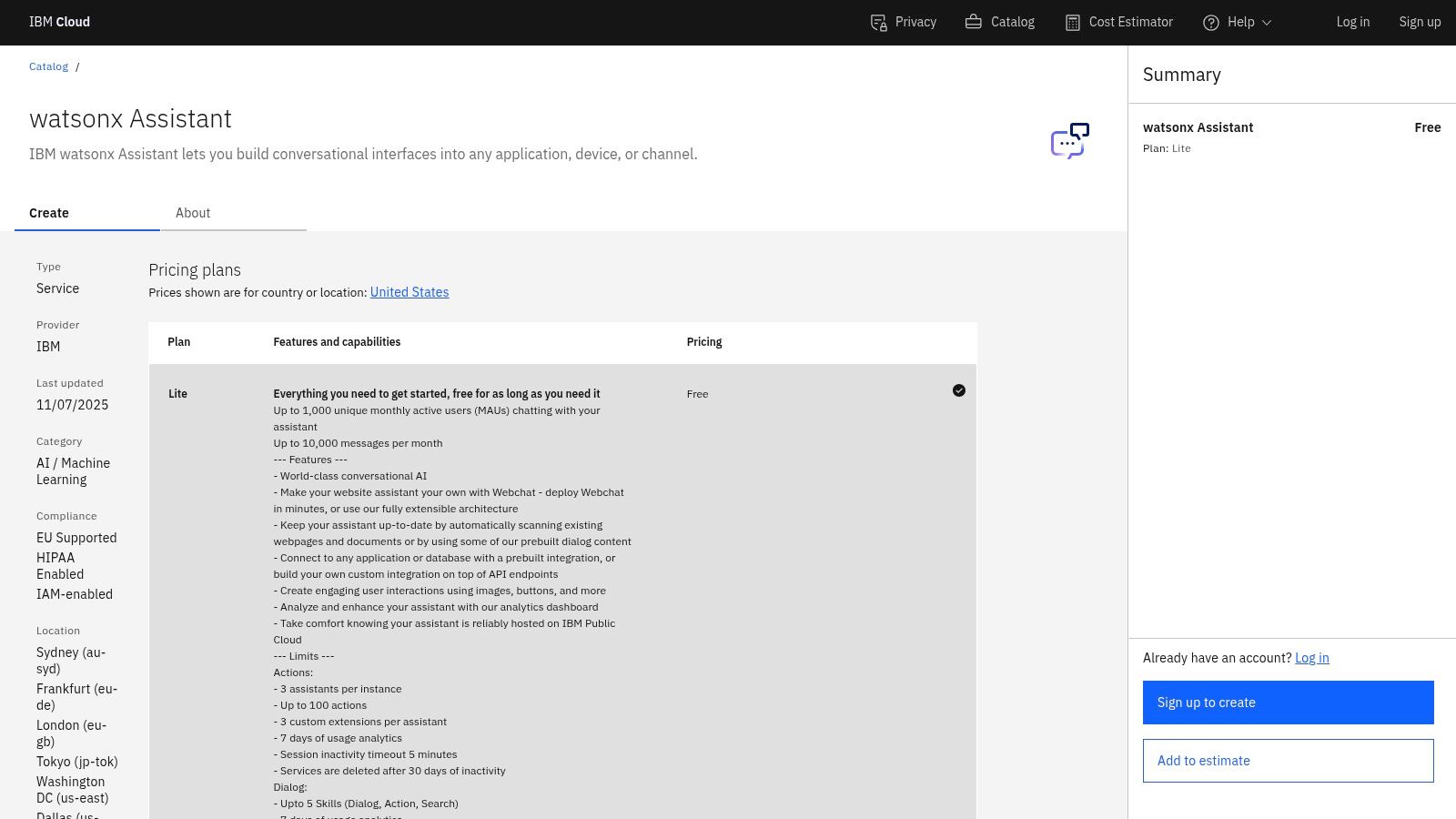
IBM watsonx Assistant remains relevant because not every enterprise wants the newest ecosystem. Some want a vendor with a long enterprise security history, hybrid deployment credibility, and a tighter connection to governance-heavy environments. IBM continues to appeal in those cases.
The product is well suited to customer self-service and employee support, especially where hybrid cloud, internal search, and enterprise policy controls matter as much as front-end conversational polish. Organizations with a meaningful IBM footprint will often find the surrounding platform story easier to justify than a clean-sheet migration to another vendor.
Best for regulated enterprise environments
watsonx Assistant combines visual dialog design with search integration, voice enablement through IBM speech services, and alignment to the broader watsonx portfolio for models, governance, and data. That combination is particularly relevant for regulated sectors where teams care about where systems run, how they're governed, and how tightly they connect to existing enterprise infrastructure.
Its practical strengths are clear:
- Hybrid deployment options: Useful when cloud posture is selective or constrained.
- Governance alignment: Better fit for organizations already investing in watsonx and IBM data infrastructure.
- Enterprise familiarity: Procurement, security review, and architecture teams often know how to work with IBM.
The limitation is pace. IBM can feel slower and more sales-led than cloud-native rivals, both in packaging and in ecosystem energy. For teams that want broad grassroots builder adoption or the fastest release cadence, other vendors may feel more modern. For teams that prioritize control, continuity, and enterprise architecture alignment, watsonx Assistant still deserves serious evaluation.
7. Kore.ai XO Platform
Kore.ai XO Platform is one of the stronger choices for enterprises that want an end-to-end platform spanning customer experience, employee experience, search, and agent assist. It has the feel of a product built by people who understand that deployment discipline matters as much as model intelligence.
Where it tends to stand out is lifecycle control. Features like maker-checker workflows and selective publishing speak directly to enterprise release management. That's important in large support environments where one bad automation change can affect thousands of interactions.
Best for structured enterprise CX and EX programs
Kore.ai combines low-code design, omnichannel deployment, search capabilities, and integrations into business systems and contact center environments. It's a good fit for companies that want more than a chatbot tool but don't want to assemble every part of the stack themselves.
The platform is particularly compelling when you need:
- CX and EX on one foundation: Customer service and employee service often converge operationally.
- Governed release processes: Enterprise teams need approval structures, staged publishing, and operational discipline.
- Contact-center alignment: Integrations with common enterprise systems and CCaaS environments matter.
The trade-off is breadth. Kore.ai covers a lot of surface area, and that means enablement can take time. Teams that only need a narrow use case may find the platform heavier than a focused specialist. But for larger enterprises building a structured multiyear program, that weight is often exactly the point.
8. Cognigy.AI
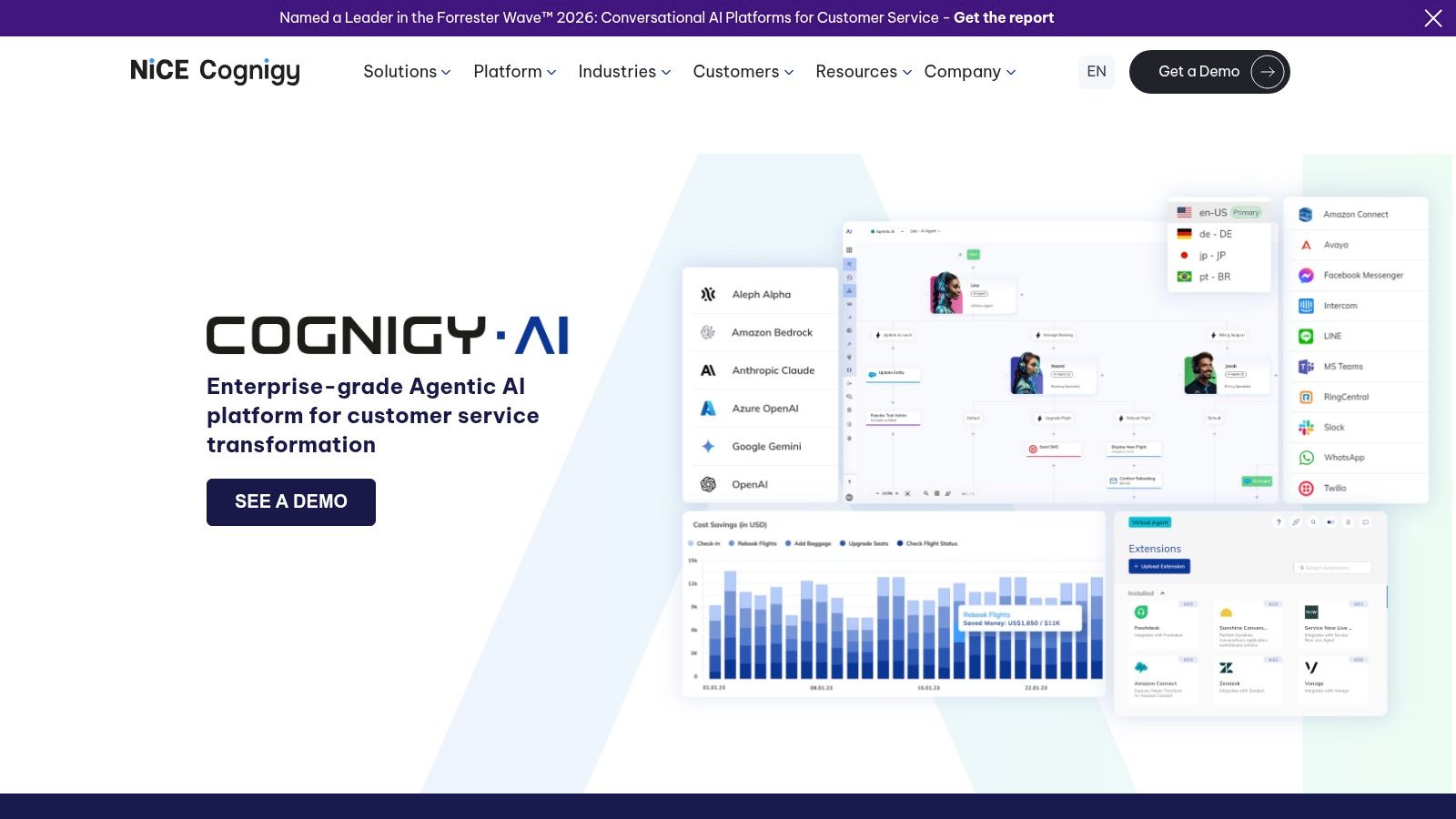
Cognigy.AI has earned its reputation in enterprise contact-center automation. If your primary problem is orchestrating voice and digital journeys at scale, Cognigy is one of the most credible options on the board. It doesn't try to win by being the simplest builder for everyone. It wins by handling demanding service environments well.
That distinction matters. Many agent builders can answer questions. Fewer can coordinate telephony, contact-center integrations, LLM choice, and analytics in a way service operations leaders can run.
Best for contact center voice and digital orchestration
Cognigy offers a no-code and low-code flow builder, model choice across multiple LLMs, a Voice Gateway, and extensive contact-center integrations. For enterprises balancing latency, cost, and answer quality, that multi-LLM strategy is practical rather than cosmetic. Different service workflows often require different trade-offs, and Cognigy gives teams room to tune them.
Its strengths are easiest to see in environments with:
- Complex voice estates: Telephony and voice orchestration aren't side requirements.
- Digital plus voice convergence: Customers switch channels, and the platform has to keep up.
- Agent assist and automation together: Frontline augmentation matters alongside self-service.
In contact centers, voice quality and orchestration quality usually matter more than how quickly a bot builder can produce a first draft.
The trade-off is implementation depth. Full adoption often requires specialist enablement, and pricing tends to be modular. Still, for enterprise service organizations that treat the contact center as a strategic operating function, Cognigy is one of the stronger specialist bets.
9. Ada
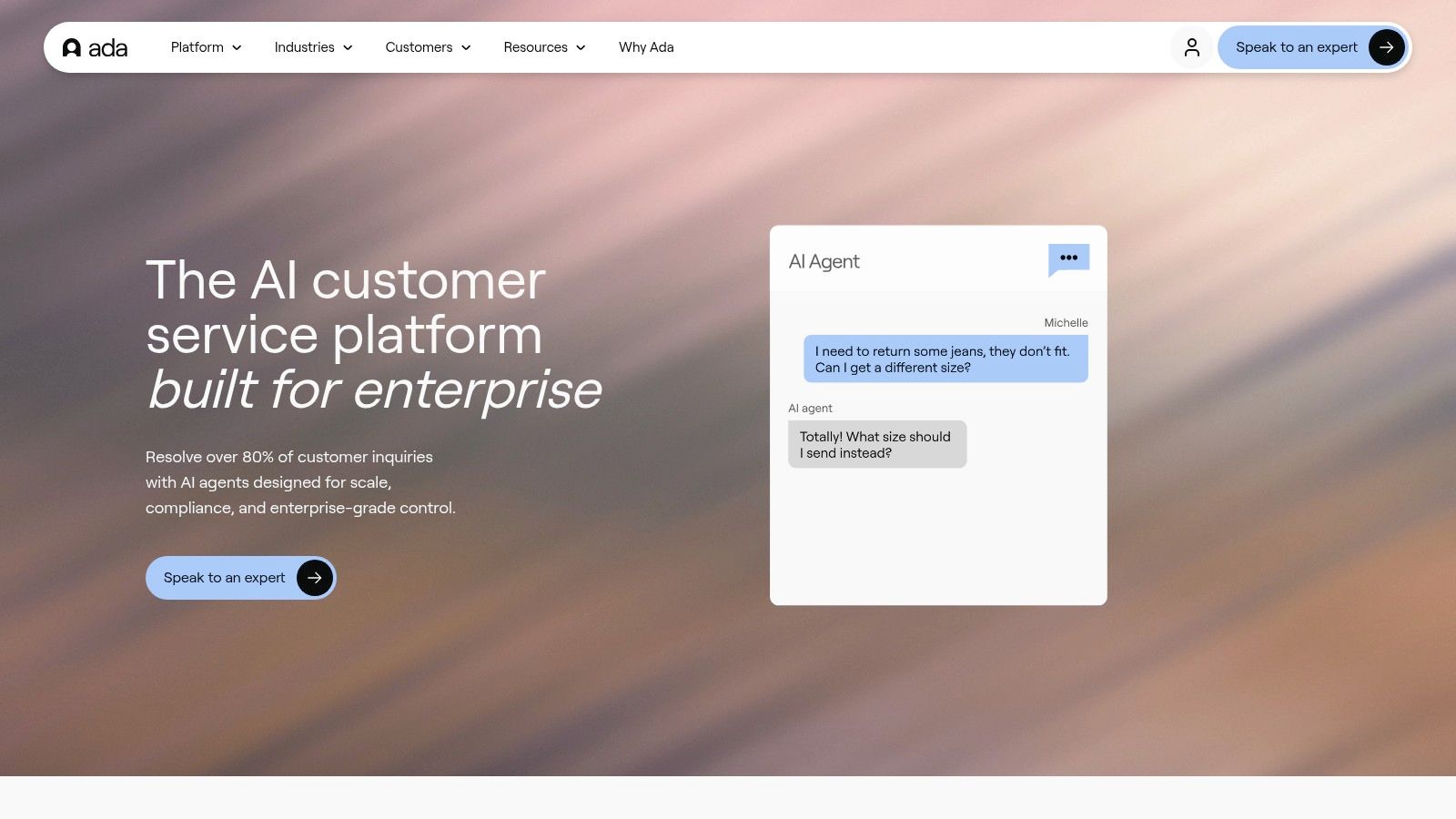
Ada is a practical choice for customer support leaders who care less about AI theater and more about service operations. Its positioning is straightforward. Build AI agents that resolve customer inquiries across digital channels, connect them to the systems of record, and improve them through operational playbooks and analytics.
That focus makes Ada useful for enterprises that want a CX-first platform rather than a broad enterprise automation environment. If your main stakeholders are support, service operations, and digital care teams, Ada often feels closer to the workflow they already understand.
Best for customer support leaders who want operational focus
Ada supports omnichannel customer interactions across chat, voice, email, and social, with integrations into systems like Zendesk, Salesforce, and Twilio. Its value is less about raw technical flexibility and more about giving support organizations a way to operationalize AI around service outcomes and continuous improvement.
Ada tends to fit best when:
- Support owns the business case: The program is measured through service operations rather than broad IT transformation.
- CRM and helpdesk integration already exist: Ada gets better when connected to the core support stack.
- Operational discipline matters: Teams want playbooks, measurement, and iterative improvement instead of pure experimentation.
The main trade-off is scope. Ada is strong in CX, but enterprises looking for deeper employee experience coverage, cloud platform control, or highly customized multi-agent orchestration may prefer a broader platform. For support leaders who want to move with focus, that narrower orientation can be an advantage.
10. boost.ai
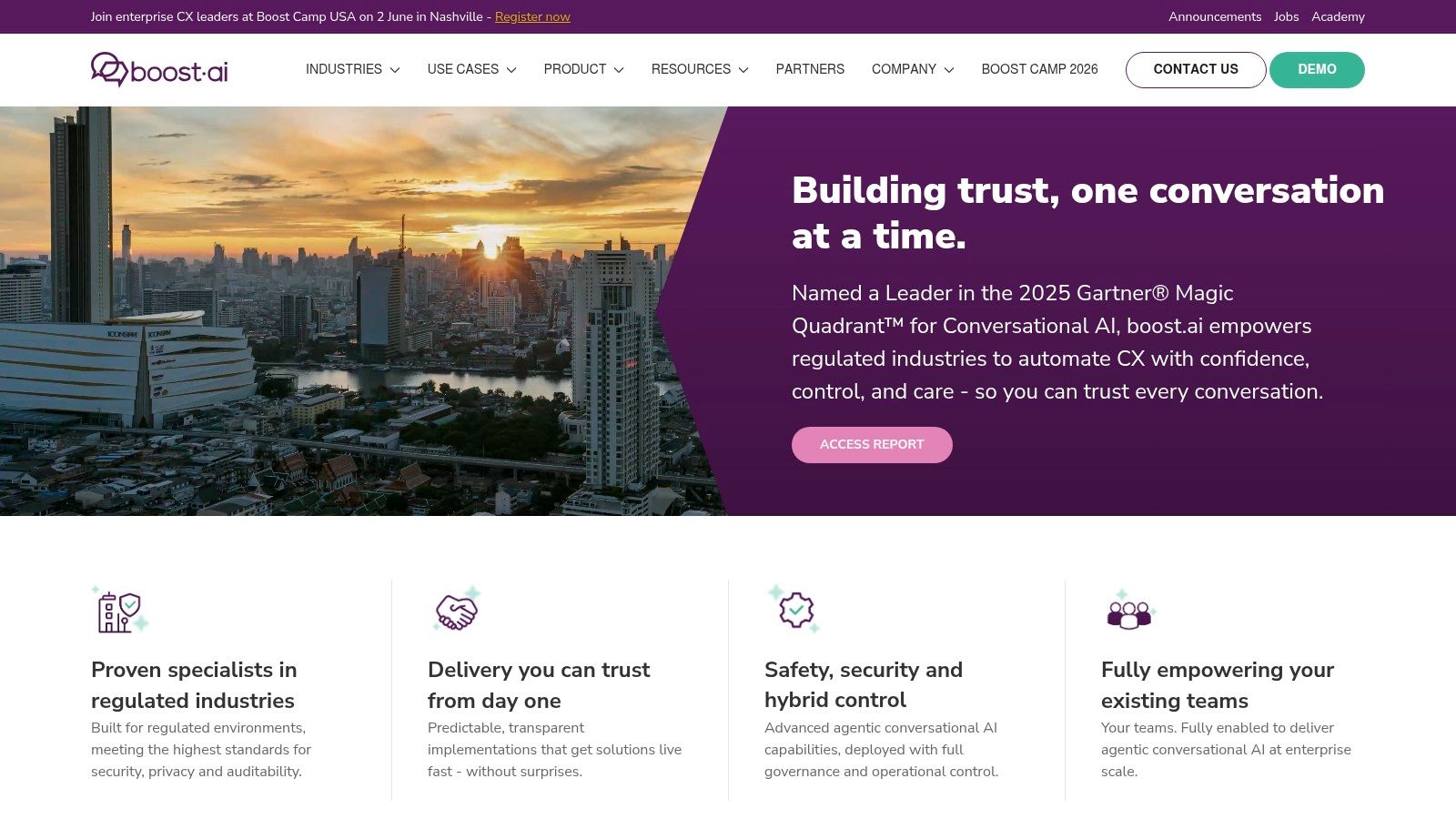
boost.ai is a strong fit for enterprises in sectors like banking, insurance, and telecom where service complexity, compliance sensitivity, and implementation discipline matter more than trendiness. The platform has long been associated with enterprise conversational AI, and that heritage shows in how it approaches deployment.
It's a good reminder that not every buyer needs the broadest ecosystem. Some need a vendor that understands high-stakes service operations and has a partner model that supports large rollouts.
Best for enterprise service teams in complex industries
boost.ai offers virtual agent tooling across chat and voice, analytics, agent assist, and multi-agent orchestration patterns. It also supports large-enterprise implementations through guidance assets and partner-led delivery. That combination can be valuable when internal teams want proven operating structure, not just product access.
The platform is most compelling when:
- Industry complexity is high: BFSI, insurance, and telecom service environments often require disciplined conversation design.
- Implementation support matters: Some enterprises prefer guided delivery over pure self-serve adoption.
- Voice and customer service are central: The toolset aligns with service-led transformation programs.
The limitation is ecosystem gravity. Compared with hyperscalers and broad automation vendors, boost.ai has a smaller community footprint. Buyers should be comfortable with a more vendor-led enablement model. For organizations that want that level of partnership, boost.ai remains a credible option.
Top 10 AI Agent Builders, Features & Capabilities
| Product | Core capabilities | UX & quality | Pricing & value | Target audience | Standout / USP |
|---|---|---|---|---|---|
| Yellow.ai 🏆 | Agentic AI, Nexus Vox voice (500+ langs), multi-LLM, agentic RAG, omnichannel | ★★★★★, ultra-low latency, fast TTV | 💰 Enterprise pricing (custom), proven ROI (70%+ automation) | 👥 Large enterprises, CX/EX teams, regulated orgs | ✨ Voice cloning (~10s), AI Agent Builder 2.0, 150+ integrations, strong compliance |
| Microsoft Copilot Studio | Low-code agent builder, M365/Teams orchestration, connectors | ★★★★, seamless MS365 UX | 💰 Copilot Credits & add-ons; metered | 👥 Microsoft-centric enterprises, Teams-first orgs | ✨ Deep M365 identity & governance, native Teams integration |
| Google Cloud Vertex AI Agent Builder | Low-code + ADK, grounding (Search/Vertex), code execution | ★★★★, strong dev & grounding tools | 💰 Multi-service billing (models, retrieval, hosting) | 👥 Cloud-native dev teams, data-rich enterprises | ✨ Gemini models, strong retrieval/grounding to reduce hallucinations |
| AWS Agents for Amazon Bedrock | Multi-agent orchestration, action groups, Bedrock model access | ★★★★, scalable with AWS controls | 💰 Distributed costs (models + orchestration) | 👥 AWS-first enterprises, scalable ops teams | ✨ Native IAM/VPC controls, multi-model access under Bedrock |
| OpenAI Assistants API | Stateful assistants, tool calling, RAG, code interpreter | ★★★★, powerful tooling; flexible models | 💰 Usage-based (token costs), pay-as-you-go | 👥 Developers building custom agents & channels | ✨ Mature tool-calling, persistent threads, rapid prototyping |
| IBM watsonx Assistant | Visual dialog, speech services, hybrid deployment | ★★★, enterprise-grade stability | 💰 Sales-led pricing; hybrid options | 👥 Regulated industries, IBM estates | ✨ Hybrid cloud, Watson speech + Discovery integration |
| Kore.ai XO Platform | Low-code design, omnichannel, lifecycle controls | ★★★, strong governance & lifecycle | 💰 Sales-led; modular pricing | 👥 Contact centers, enterprises needing strict release controls | ✨ Maker-checker workflows, domain accelerators |
| Cognigy.AI | Visual flow builder, multi-LLM, Voice Gateway, analytics | ★★★★, mature voice + digital UX | 💰 Sales-led; component licenses may apply | 👥 Contact centers, voice-heavy CX teams | ✨ Flexible model strategy, strong telephony integrations |
| Ada | CX-focused AI agents, omnichannel, ops playbooks | ★★★, outcome-driven (deflection, AHT) | 💰 Enterprise/sales-led | 👥 Support orgs, high-volume CX teams | ✨ Operational playbooks, continuous improvement analytics |
| boost.ai | Virtual agents for banking/insurance, analytics, partner ecosystem | ★★★, industry-focused effectiveness | 💰 Sales-led pricing | 👥 Financial services, telecom, large CX teams | ✨ Industry templates, partner-led large deployments |
The Future is Agentic Charting Your Course
The best AI agent builders aren't winning because they generate impressive demos. They're winning because enterprise buyers now expect production discipline. That means governance, observability, knowledge grounding, integration depth, model flexibility, and channel orchestration all matter before an agent touches a customer, employee, or core system.
That shift is happening for a reason. PwC reports that among organizations adopting AI agents, 66% say they are delivering measurable productivity gains, 57% report cost savings, 55% faster decision-making, and 54% improved customer experience. Those outcomes explain why agent builders are moving from innovation labs into board-level operating plans. But they also raise the bar. Once buyers expect business impact, they stop tolerating fragile architecture and disconnected tooling.
There's another strategic reality worth keeping in view. Opsima's 2026 comparison, referenced in broader market coverage, notes that industrial end-use is the fastest AI-agent segment, projected at a 49.2% CAGR through 2033, while also stating that less than 10% of organizations have scaled AI broadly. I'm not repeating those figures elsewhere because the important takeaway isn't the novelty of the numbers. It's the maturity gap they describe. Most enterprises are still early in real scale-up. That creates room for thoughtful buyers to establish an internal platform standard now instead of inheriting a fragmented agent estate later.
The hardest mistake I see in evaluations is treating all agent builders as if they solve the same problem. They don't.
Some platforms are strongest for CX transformation. Yellow.ai, Cognigy.AI, Ada, Kore.ai, and boost.ai all make sense when service automation, omnichannel engagement, and contact-center operations are the center of gravity. Among those, Yellow.ai stands out when you need the broadest blend of voice, multimodal deployment, agentic RAG, testing, compliance, and CX plus EX coverage in one enterprise-grade environment.
Some are better for employee productivity and internal workflow orchestration. Microsoft Copilot Studio is compelling when Microsoft is already the operating layer. IBM watsonx Assistant fits buyers who prioritize regulated deployment and hybrid control. Google Cloud Vertex AI Agent Builder is especially strong when grounded retrieval and mixed no-code plus developer ownership are central requirements.
Others are more like agent foundations than finished operating systems. AWS Agents for Amazon Bedrock and OpenAI Assistants API are powerful, but they assume you're ready to build and run more of the surrounding platform yourself. That can be the right choice for engineering-led organizations. It's often the wrong one for service leaders who need a managed path to production.
There's also a question too few vendor comparisons answer clearly: do you need an agent builder at all? In some workflows, a structured automation platform or lightweight copilot is cheaper, faster, and safer. If the job is deterministic and approvals are strict, full autonomy may be unnecessary. Use an agent builder when the work requires reasoning, tool use, knowledge retrieval, and adaptation across messy real-world inputs. Don't use one just because the market has shifted its language from “workflow” to “agent.”
The right buying motion is focused. Pick one or two high-value use cases. Run a proof of concept that tests not just answer quality, but also integration effort, escalation design, observability, security review, and operational ownership after go-live. That's where significant platform differences appear.
The future is agentic, but the winning strategy isn't to buy the loudest platform. It's to choose the one that can keep your business safe while doing useful work at scale.
If you're evaluating platforms for customer support, employee service, or contact center transformation, Yellow.ai is worth a close look. It combines enterprise-grade voice AI, multimodal agent building, agentic RAG, testing, analytics, multi-LLM flexibility, and strong compliance coverage in a platform designed for real production deployment.



