













Most enterprise leaders still treat support like an operating expense to minimize. That's backwards. In B2B, service quality now decides whether revenue stays, expands, or walks out the door. 89% of B2B customers cite service quality as a primary reason for staying with a vendor, while 50% switched vendors in the past year because of poor service experiences, according to this B2B customer service statistics roundup.
That number should change how you think about b2b customer service. You're not managing tickets. You're managing retention risk, expansion potential, and the credibility of your brand after the sale. The companies that win in 2026 won't be the ones with the biggest support teams. They'll be the ones that build an autonomic service engine that can detect intent, understand account context, orchestrate across channels, and intervene before frustration becomes churn.
Table of Contents
- The Strategic Shift From B2B Support to Experience
- Defining Success with B2B Specific Goals and Metrics
- Architecting the Modern B2B Service Technology Stack
- Designing Intelligent Workflows and Channel Strategies
- Your Phased Roadmap to an AI Powered Service Engine
- From Cost Center to Revenue Driver Real World ROI
- Leading the Future of Autonomic B2B Service
The Strategic Shift From B2B Support to Experience
B2C support can survive on convenience. B2B customer service can't. In enterprise relationships, a support failure doesn't just create a bad interaction. It delays onboarding, stalls implementation, frustrates power users, weakens executive confidence, and gives procurement a reason to reopen the market.
That's why the old support model is obsolete. Queue management, average handle time, and reactive ticket closure were acceptable when service was treated as a back-office function. They're dangerous when buyers expect enterprise vendors to act like strategic partners.
B2B service now sits inside the retention equation
A buyer doesn't renew because your help desk was polite. They renew because your service motion reduced friction, preserved momentum, and protected their business outcome. That's a much higher bar.
In B2B, every interaction carries account context. A billing question from a small commercial account isn't the same as a product issue raised by a strategic customer during rollout. The same ticket category can carry radically different revenue risk depending on customer stage, channel, product dependency, and internal sponsor sentiment.
Practical rule: If your service team only reacts after a ticket is created, you're already late.
The deeper problem is organizational. Many companies still separate customer support, customer success, professional services, and account management into different systems and workflows. Customers don't experience those as separate functions. They experience one vendor. When those teams operate without shared context, service feels fragmented and trust drops fast.
Reactive support creates hidden churn long before renewal
Most churn decisions don't begin in procurement. They begin in moments of friction. A user can't find an answer. An integration issue sits unresolved. A strategic account posts in Slack and waits too long. An executive sponsor sees repeated effort for basic outcomes and starts to question fit.
Enterprise leaders need a sharper view of service. B2B customer service isn't a post-sale utility. It's a control layer for revenue protection.
Consider what a modern service organization has to do:
- Protect adoption: Resolve blockers before usage patterns weaken.
- Preserve trust: Give customers confidence that your team understands their environment, not just your product.
- Support expansion: Surface service insights that expose unmet needs and growth opportunities.
- Reduce operational drag: Eliminate repetitive work that slows both customers and agents.
The winning model is experience orchestration
The strongest teams are moving from case handling to experience orchestration. They don't wait for a customer to explain everything from scratch. They identify intent, pull context from CRM and knowledge systems, route intelligently, and keep humans focused on judgment-heavy work.
That's the shift enterprise leaders need to lead. Not better ticketing. Better system design.
Service in B2B is no longer the department that cleans up problems. It's the function that proves your company is safe to buy from again.
If you still budget support like a cost center, you're underinvesting in retention. If you still measure it like a call center, you're missing the strategic value entirely.
Defining Success with B2B Specific Goals and Metrics
Most service dashboards are packed with numbers that look operationally useful and strategically empty. They tell you how busy the team was. They don't tell you whether the service model protected the account, reduced effort, or improved the odds of renewal.
That's the first correction to make. In B2B customer service, success metrics must map to business outcomes first and workflow efficiency second.
Stop measuring activity and start measuring account outcomes
If you run service for enterprise accounts, your core question isn't “How fast did we close the case?” It's “Did we resolve the issue in a way that preserved confidence and momentum?”
That changes the measurement stack. Start with business-facing goals such as retention protection, customer effort reduction, and resolution quality. Then align operational metrics underneath them.
A clean way to structure this is:
| Business goal | Service metric that matters | Why it matters |
|---|---|---|
| Protect renewals | Resolution quality on high-impact issues | Fast but incomplete answers create repeat contact and distrust |
| Reduce customer effort | Friction across support journeys | Enterprise buyers judge vendors by how hard they make problem-solving |
| Scale efficiently | Tier-1 containment for repeatable intents | Automation should absorb repetitive work, not complex judgment |
| Prioritize valuable accounts | SLA adherence by segment and channel | Not every account should receive the same service motion |
This is where analytics maturity matters. Leaders need instrumentation that connects conversation data, journey friction, and resolution patterns back to business risk. A generic dashboard won't do it. A stronger model uses AI analytics for customer experience operations to identify where effort spikes, where containment fails, and which intents create unnecessary escalations.
Build SLA logic around customer value and channel reality
Most SLAs are too flat. Enterprise service isn't flat.
Response expectations should vary by account value and by channel because urgency and intent vary by channel. Strategic accounts on Slack expect under 5 minutes, enterprise email within 2 to 4 business hours, commercial email within 12 to 24 hours, and web chat under 1 minute for optimal AI handling, based on B2B customer support response time benchmarks.
Those aren't just service targets. They're design constraints. If a strategic account uses Slack as a collaboration channel, routing that interaction into a generic queue is a leadership failure. If web chat can't respond immediately, the customer experience degrades before the conversation even starts.
Use a tiered model:
- Strategic accounts: Near-real-time collaboration, named ownership, fast escalation paths.
- Enterprise accounts: Strong SLA discipline, intelligent triage, issue-based routing.
- Commercial accounts: High-quality automation first, efficient human escalation when needed.
What to remove from your scorecard
Some common service metrics do more harm than good when they dominate executive review.
- Average handle time: Useful in narrow contexts, but dangerous when it drives rushed interactions.
- Raw ticket volume: It shows demand, not value. Volume can rise for good reasons or bad ones.
- Agent occupancy alone: High utilization can signal overload, not efficiency.
Measure whether customers got unstuck with minimal effort. Don't reward teams for ending conversations quickly if the problem survives the conversation.
Strong B2B customer service leaders treat metrics as decision tools, not vanity reporting. The dashboard should tell you which accounts need intervention, which workflows should be automated, and where service design is creating avoidable churn risk.
Architecting the Modern B2B Service Technology Stack
Most support stacks were assembled, not architected. A ticketing tool here. A chatbot there. Separate knowledge systems. Separate channels. Separate reporting. That patchwork can process volume, but it can't deliver context-rich enterprise service at scale.
That's why so many AI deployments disappoint. The model isn't the main problem. The architecture is.
Why most support stacks break under enterprise complexity
Enterprise service demands more than answer retrieval. It requires channel continuity, account awareness, workflow memory, compliance controls, and smooth collaboration between automation and humans.
A generic bot fails when it treats every question as a standalone interaction. B2B customers don't ask standalone questions. They ask questions inside an account relationship, a contract context, a product configuration, and often a business-critical timeline.
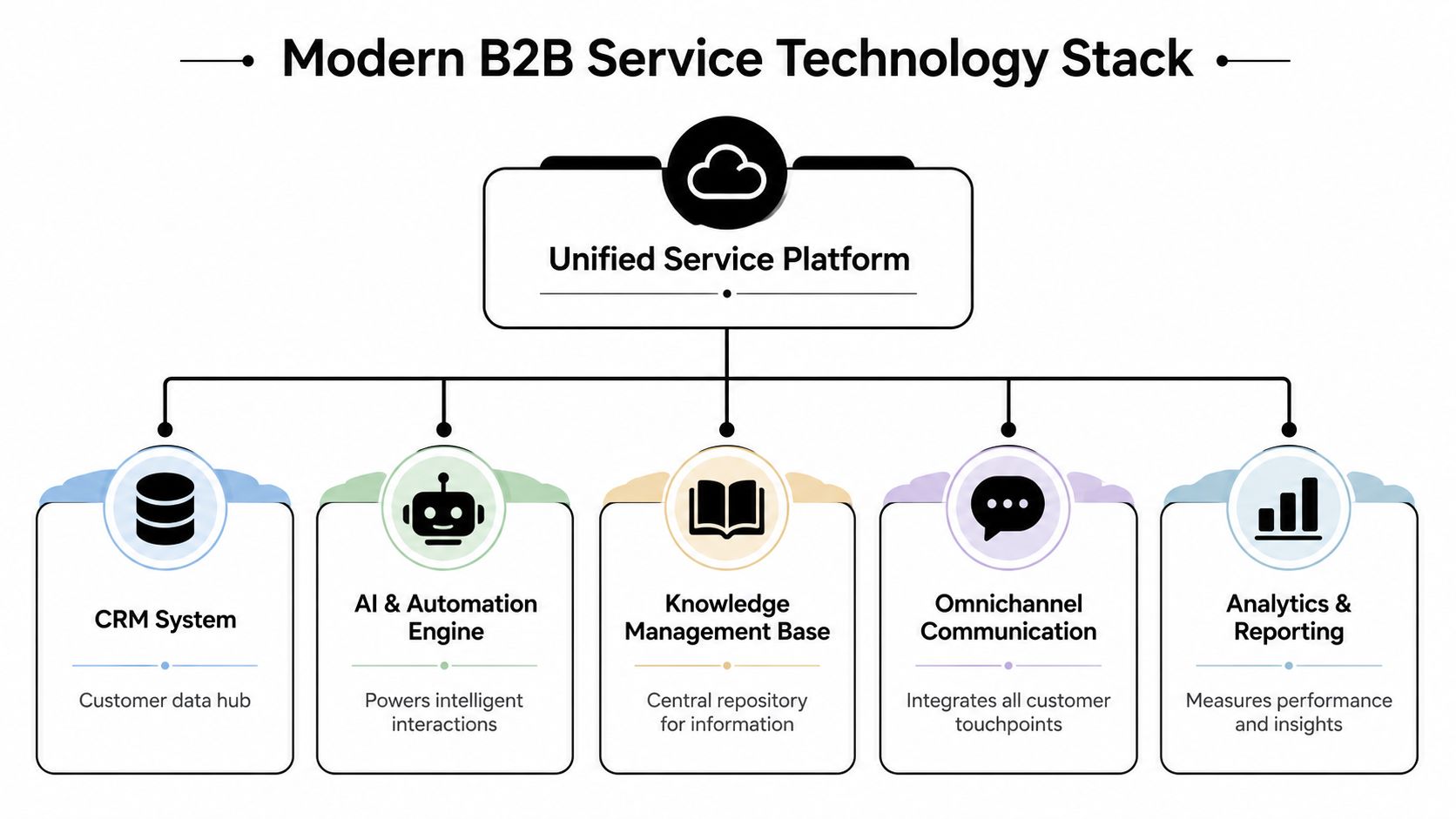
A modern stack has to solve for one issue most vendors still underplay: business-context empathy. That means the system doesn't just understand language. It understands what the issue means for that customer's business environment. That's especially important because a key challenge is embedding deep industry knowledge into agentic AI workflows that must handle 500+ languages and complex multimodal interactions without human latency, as discussed in this analysis of B2B customer service and AI context.
The stack that actually supports business-context empathy
A strong architecture has three tightly connected layers.
Omnichannel orchestration
This is the control plane. It manages entry points across Slack, chat, email, voice, portals, and messaging channels, then routes each interaction according to account priority, intent, customer history, and escalation rules.
Without orchestration, channel choice becomes chaos. With it, channel becomes strategic. The system can preserve context between touchpoints, enforce SLA logic, and prevent customers from repeating themselves.
Agentic AI with RAG
This is the reasoning and knowledge layer. Retrieval-augmented generation only becomes useful in enterprise service when it pulls from the right sources and applies the right boundaries. That means product docs, implementation notes, past cases, policy content, CRM records, and approved process guidance need to be available in a governed knowledge framework.
A stronger enterprise approach uses a conversational knowledge base with agentic RAG so AI agents can retrieve grounded answers, resolve intent with better precision, and stay anchored to enterprise-approved data. That's the difference between a fluent bot and a trustworthy one.
AI copilot for human agents
Some issues will always require human judgment. Product edge cases. Contract nuance. Multi-team coordination. Executive escalations. The goal isn't to automate all service. The goal is to automate the predictable and augment the complex.
A copilot layer should summarize history, recommend next steps, surface relevant knowledge, and reduce manual searching. It should make the human faster and sharper, not turn the human into a script reader.
What leaders should standardize now
The stack only creates value if leadership imposes architectural discipline. Standardize these decisions early:
- Single orchestration layer: Don't let every channel run its own logic.
- Governed knowledge model: Approved sources only. Clear ownership. Version control.
- Escalation contract: Define exactly when AI resolves, when AI assists, and when humans own the interaction.
- Shared customer context: Service, success, and account teams need the same operational view.
- Feedback loop: Resolved conversations should improve routing, knowledge, and workflow design.
The winning architecture doesn't ask whether AI or humans should handle service. It decides which system should act first, which context they share, and how the experience stays coherent.
That's what an autonomic service engine looks like in practice. It senses, routes, resolves, learns, and escalates with purpose.
Designing Intelligent Workflows and Channel Strategies
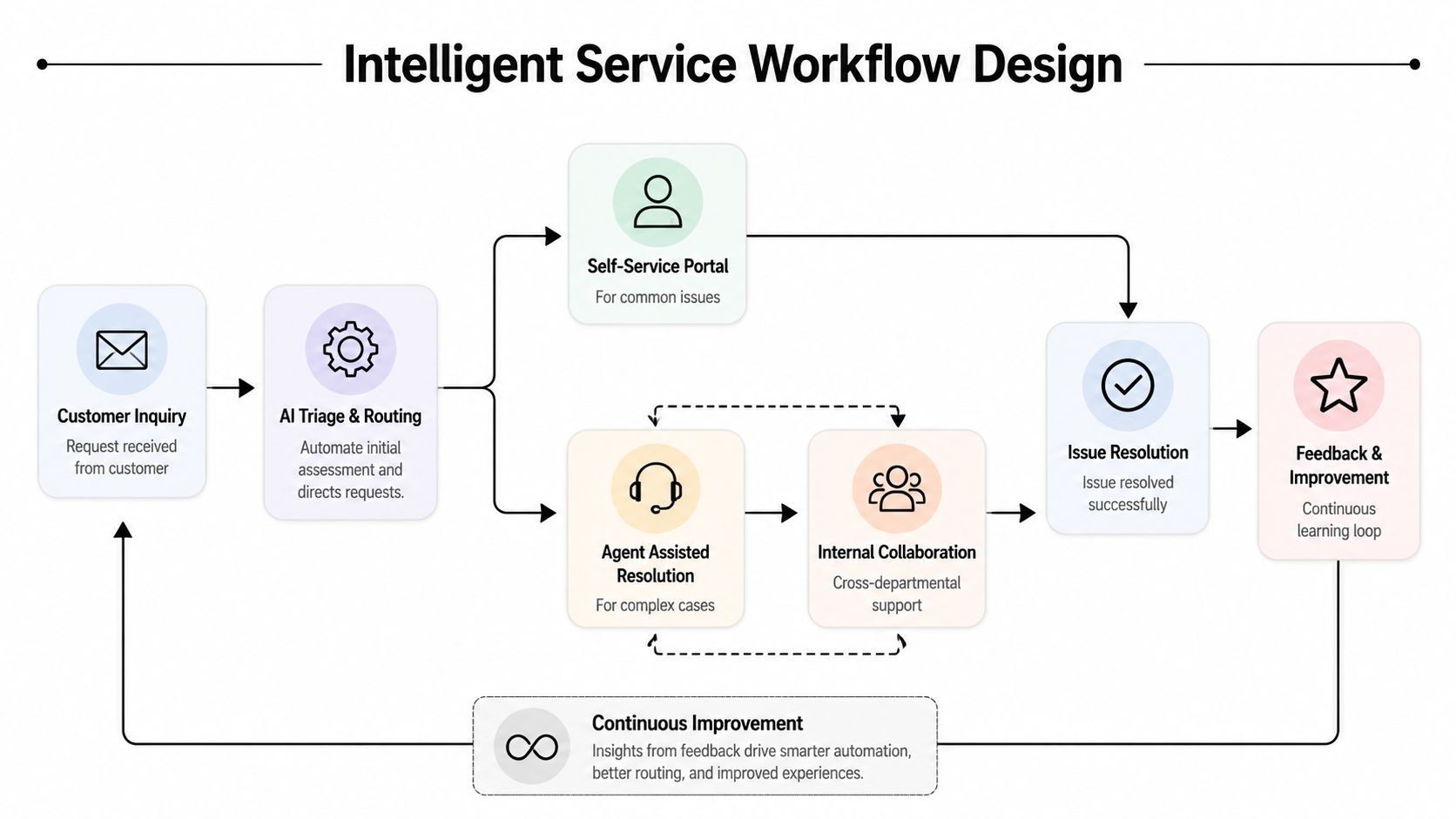
The best service organizations don't automate by channel. They automate by intent, complexity, and account value. That distinction matters because a password reset and an API failure shouldn't enter the same journey, even if they arrive through the same interface.
Workflow design is where enterprise strategy becomes visible to customers.
Automate the predictable and escalate the ambiguous
The right automation target is the structured intent. In enterprise B2B customer service programs, the median tier-1 deflection rate is approximately 41%, top-quartile performers achieve 59%, and structured intents such as password resets resolve autonomously at rates between 65% and 80%, according to enterprise B2B customer service deflection benchmarks.
That tells you something important. Automation works best when the intent is explicit, the workflow is repeatable, and the system can complete the task without interpretation gaps.
Use this split:
| Workflow type | Best handling model | Typical examples |
|---|---|---|
| Structured and repetitive | Full automation | Password reset, invoice status, account unlock |
| Structured but sensitive | Automation with guardrails | Billing changes, entitlement questions |
| Unstructured and technical | AI triage plus human expert | Integration failures, data issues, configuration conflicts |
| Strategic and consultative | Human-led with AI support | Rollout guidance, executive escalations, roadmap discussions |
A mature service design uses omnichannel AI automation for support operations to classify intent early, route by complexity, and preserve context as the issue moves between systems and people.
Channel strategy should reflect account strategy
Too many teams define channels by what's operationally convenient. Customers define them by urgency and working style.
A strategic account using Slack expects collaborative problem-solving. A commercial user sending email often accepts a slower, more asynchronous motion. Web chat is ideal for rapid triage and self-service entry. Voice still matters when urgency, ambiguity, or trust repair requires direct conversation.
That means channel playbooks should differ.
- Slack for strategic accounts: High visibility, fast acknowledgment, coordinated ownership.
- Web chat for guided self-service: Immediate response, strong containment for repeatable intents.
- Email for documented workflows: Clear updates, case continuity, less interruption-based handling.
- Voice for critical exceptions: Human reassurance, rapid clarification, escalation management.
Don't treat channels as interchangeable inboxes. Each one signals a different customer expectation.
The strongest workflow designs also watch for failure patterns. If customers repeatedly abandon a self-service path, loop through multiple articles, or bounce from bot to agent, the workflow needs redesign. Those are not edge cases. They're evidence that the service engine is creating work instead of removing it.
Your Phased Roadmap to an AI Powered Service Engine
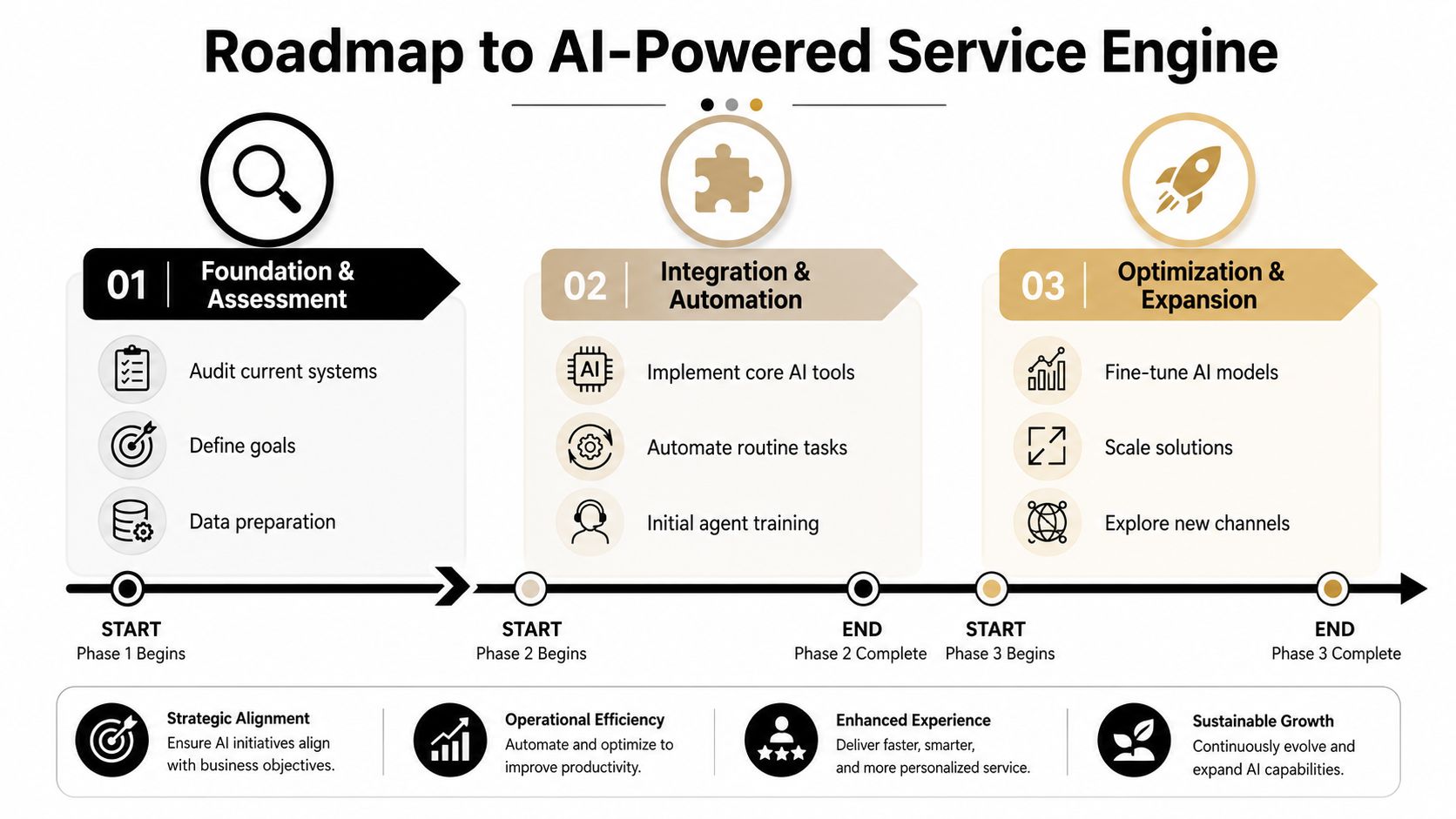
Most AI service transformations fail because leaders try to modernize everything at once. That creates confusion, weak governance, and internal resistance. The better route is phased, disciplined, and tied to operational milestones.
Start with control. Then build intelligence. Then let the system optimize itself within clear boundaries.
Phase one foundation and control
Your first phase is not about flashy AI. It's about readiness.
Audit channels, intents, knowledge quality, escalation patterns, and system fragmentation. Most enterprises discover they have multiple versions of the same answer, inconsistent routing logic, and no reliable ownership for knowledge maintenance. Fix that before scaling automation.
Set governance early:
- Data access rules: Decide what the AI can retrieve, summarize, and act on.
- Compliance boundaries: Align architecture with enterprise requirements such as HIPAA, SOC 2, and other applicable controls.
- Workflow ownership: Assign business owners for each major service journey.
- Human override paths: Make escalation easy and visible.
This is also the stage to identify high-volume, low-complexity intents for initial automation. Go after the repetitive work first. It creates room for agents and proves value without exposing the organization to unnecessary risk.
A practical example comes from logistics and supply chain environments, where service delays often affect live operations. Teams evaluating operational friction around appointments, scheduling, and coordination may find useful context in this overview of Felixstowe container booking systems, because it shows how service complexity rises when digital workflows intersect with physical operations.
Later in the rollout, executive teams usually benefit from seeing how voice automation fits into the broader model. This short walkthrough is a useful reference point:
Phase two proactive intelligence
Once core automation is stable, move beyond ticket response and into signal detection.
The service engine starts listening for precursors, not just incidents. Search failures in the knowledge base. Abandoned troubleshooting flows. Repeated contact on the same issue. A user clicking toward support and backing out. These behaviors often show friction before a formal complaint appears.
Build playbooks for those moments. If a high-value account shows repeated failure signals around integration content, the right action may be immediate outreach from support or the account team. If a customer encounters repeated dead ends in billing self-service, trigger guided assistance before frustration compounds.
Phase three autonomic optimization
The final phase is where service starts behaving like an adaptive system.
At this point, the platform should continuously learn from outcomes. Failed containment updates routing rules. Repeated escalations expose knowledge gaps. Account-level patterns influence priority logic. Agent behavior improves recommendation quality. Leaders don't need to manually inspect every weak point because the system can surface them.
That doesn't mean removing human governance. It means focusing human attention where judgment matters most.
A mature autonomic service engine should do four things reliably:
- Detect friction early: Not just open tickets, but pre-ticket failure signals.
- Choose the right responder: AI, human, or blended resolution.
- Adapt workflow logic: Improve based on actual outcomes, not assumptions.
- Protect enterprise trust: Operate within policy, auditability, and compliance controls.
This phased approach keeps transformation credible. It also makes budget conversations easier because each stage delivers a visible operational improvement before the next investment decision.
From Cost Center to Revenue Driver Real World ROI
The financial argument for modernizing b2b customer service no longer needs exaggeration. The stakes are already large enough.
The financial case is already settled
Poor service is expensive at a systemic level. Inadequate service experiences put $3.8 trillion in global revenue at risk in 2026, and businesses globally lose an estimated $3.7 trillion annually due to poor customer experiences, according to this customer service statistics analysis.
Those numbers matter because they reframe the decision. Enterprise service investment is not a soft CX initiative. It is risk mitigation and revenue protection.

If your service model creates friction, you pay twice. First in operating inefficiency. Then again in lost trust, delayed expansion, and avoidable churn conversations. Leaders who wait for obvious churn signals usually discover the problem after customer sentiment has already hardened.
Where proactive ROI actually shows up
The clearest ROI often appears in places finance teams initially overlook.
Take silent churn signals. A customer searches the help center repeatedly, gets weak results, starts a support flow, then abandons it. No ticket exists, so most dashboards treat that as invisible. A better service engine treats it as an intervention opportunity.
Here's the pattern a modern team should operationalize:
- Signal capture: Detect zero-result searches, repeated article loops, and abandoned support initiation.
- Account enrichment: Match those events to account tier, lifecycle stage, product usage context, and open issues.
- Playbook trigger: Route a predefined action to the right team. Support, success, or account management.
- Outcome review: Feed the result back into workflow design and knowledge quality.
That's where service becomes a revenue driver. Not because it “delights” in an abstract way, but because it prevents small failures from becoming commercial problems.
Revenue protection in B2B often starts before the customer ever opens a case.
There's also a second ROI path. Better automation removes repetitive work from skilled teams, which lets human experts spend more time on adoption blockers, technical diagnosis, and strategic conversations. That improves the quality of the human layer, which matters most in high-value accounts.
An enterprise leader should expect service modernization to produce value across three fronts:
| Value area | What improves |
|---|---|
| Cost discipline | Less manual effort on repeatable intents |
| Retention protection | Earlier intervention on friction and risk |
| Competitive differentiation | Faster, more context-aware service for complex accounts |
The companies that treat service as a revenue lever will build stronger post-sale economics than the companies still trying to shave cost from a reactive support queue.
Leading the Future of Autonomic B2B Service
The future of b2b customer service isn't a bigger support team or a smarter chatbot in isolation. It's an operating model where service behaves like an intelligent system. It senses friction, understands customer context, chooses the right resolution path, and improves with every interaction.
That's the shift leaders need to own now.
The old model was built around intake and response. The next model is built around prediction and orchestration. Instead of asking how many tickets your team closed, ask how many moments of friction your service engine prevented. Instead of forcing customers to move between channels and functions, design the system so context follows them automatically.
Leadership priorities for the next era
The enterprise leaders who get ahead will focus on a few hard decisions.
- Unify the stack: Fragmented tools create fragmented experiences.
- Govern enterprise knowledge: AI is only as reliable as the systems and policies behind it.
- Design for escalation, not just containment: Human expertise is a strategic asset. Use it where it matters most.
- Treat pre-ticket signals as a board-level retention concern: Hidden friction is commercial risk.
The payoff is larger than service efficiency. An autonomic model improves post-sale confidence across support, success, operations, and account management. It turns customer experience from a lagging indicator into an active control system.
The most valuable service organizations won't just solve problems faster. They'll prevent the right problems from reaching the customer at all.
That is where competitive advantage starts to compound. Buyers remember whether your company was easy to work with when the stakes were high. They remember whether your systems understood their business context. They remember whether your teams had to scramble, or whether your operation felt composed and intelligent.
Enterprise leaders should stop asking whether AI belongs in service. It already does. The key question is whether your architecture, workflows, and governance are strong enough to turn AI into a durable operating advantage.
Yellow.ai helps enterprises build that advantage with agentic AI for CX and EX across voice, chat, email, and more. If you're ready to move from reactive support to an autonomic service engine, explore Yellow.ai to see how enterprise-grade orchestration, agentic RAG, analytics, and AI copilots can support that transformation.



