














Average handle time stopped being a simple productivity stat a long time ago. It nearly doubled from a median of 220 seconds in 2004 to 426 seconds in 2022, according to CX Today's summary of SQM Group benchmarks. That shift changes how CX leaders should read the metric.
Longer interactions don't automatically mean agents are underperforming. In many enterprise environments, they mean the work itself is harder. Customers arrive later in the problem cycle, product stacks are wider, verification is stricter, and every interaction carries more documentation. If you still manage average handle time as a number to crush, you'll often cut speed in the wrong place and pay for it later in recontacts, poor quality, and agent fatigue.
The better approach is to treat average handle time as a strategic tool. It sits at the intersection of cost, customer effort, workforce planning, and service quality. AI makes that advantage more useful, not less, because it lets leaders remove waste without stripping out the human judgment that complex service still needs.
Table of Contents
- The New Reality of Average Handle Time
- What Is Average Handle Time and How to Calculate It
- Current AHT Benchmarks and Performance Distribution
- The Strategic Balance Between AHT and Customer Experience
- How Agentic AI Delivers AHT Optimization
- Best Practices for Measuring and Reporting AHT
The New Reality of Average Handle Time
73 percent of customers expect better personalization as technology improves, according to Salesforce. That expectation changes what average handle time represents at the enterprise level. AHT is no longer just a speed metric. It reflects how much work your operation must do to resolve higher-stakes, less routine issues while still delivering a service experience customers will accept.
The shift behind AHT is straightforward. Simple contacts have moved to self-service, bots, FAQs, and digital containment. What reaches a live agent now is more likely to involve exceptions, multiple systems, identity checks, policy interpretation, or a customer who has already tried and failed to solve the problem elsewhere.
That changes the management question.
For years, many contact centers treated AHT as a number to push down. The cost logic is real. Lower handle time can improve occupancy, reduce queue pressure, and cut labor expense. But in mature service operations, aggressive AHT reduction often creates failure demand. Agents rush. Documentation gets thin. Follow-up work moves downstream. Customers contact you again because the first interaction ended fast, not well.
A healthier target is optimized handle time. That means giving each interaction the time it requires, while removing avoidable effort around it. The distinction matters. Long AHT caused by duplicate data entry, weak routing, or poor knowledge access is waste. Long AHT caused by careful diagnosis or complete resolution may be the right operational choice.
In practice, rising handle time usually comes from a mix of factors:
- Contact mix has changed: Live agents handle fewer simple requests and more edge cases.
- Service journeys are fragmented: Customers often arrive after unsuccessful self-service or channel switching.
- Operational overhead is heavier: Compliance, authentication, and system updates add work outside the core conversation.
- Resolution standards are higher: Leaders expect better documentation, clearer next steps, and fewer repeat contacts.
That is why AHT works best as a strategic lever, not a verdict on agent performance. Used well, it shows where effort is justified and where the operation is creating its own drag. Used poorly, it drives the wrong behavior.
Agentic AI changes the equation further. The goal is not to force every interaction into a shorter box. It is to remove unnecessary handling time, contain the work that never needed a human, and help agents complete the contacts that do need judgment with less friction. That is a very different operating model from the old call-center playbook, and it is the reason AHT now sits at the center of cost, experience, and agent effectiveness at the same time.
What Is Average Handle Time and How to Calculate It
Average handle time is the total time required to complete a customer interaction, divided by the total number of interactions. The key point is “complete.” It doesn't stop when the customer stops talking.
A good way to think about it is a pit stop. The visible part is the car in the lane. Actual performance depends on everything around it: the stop itself, any waiting, and the work needed before the team is ready for the next lap.
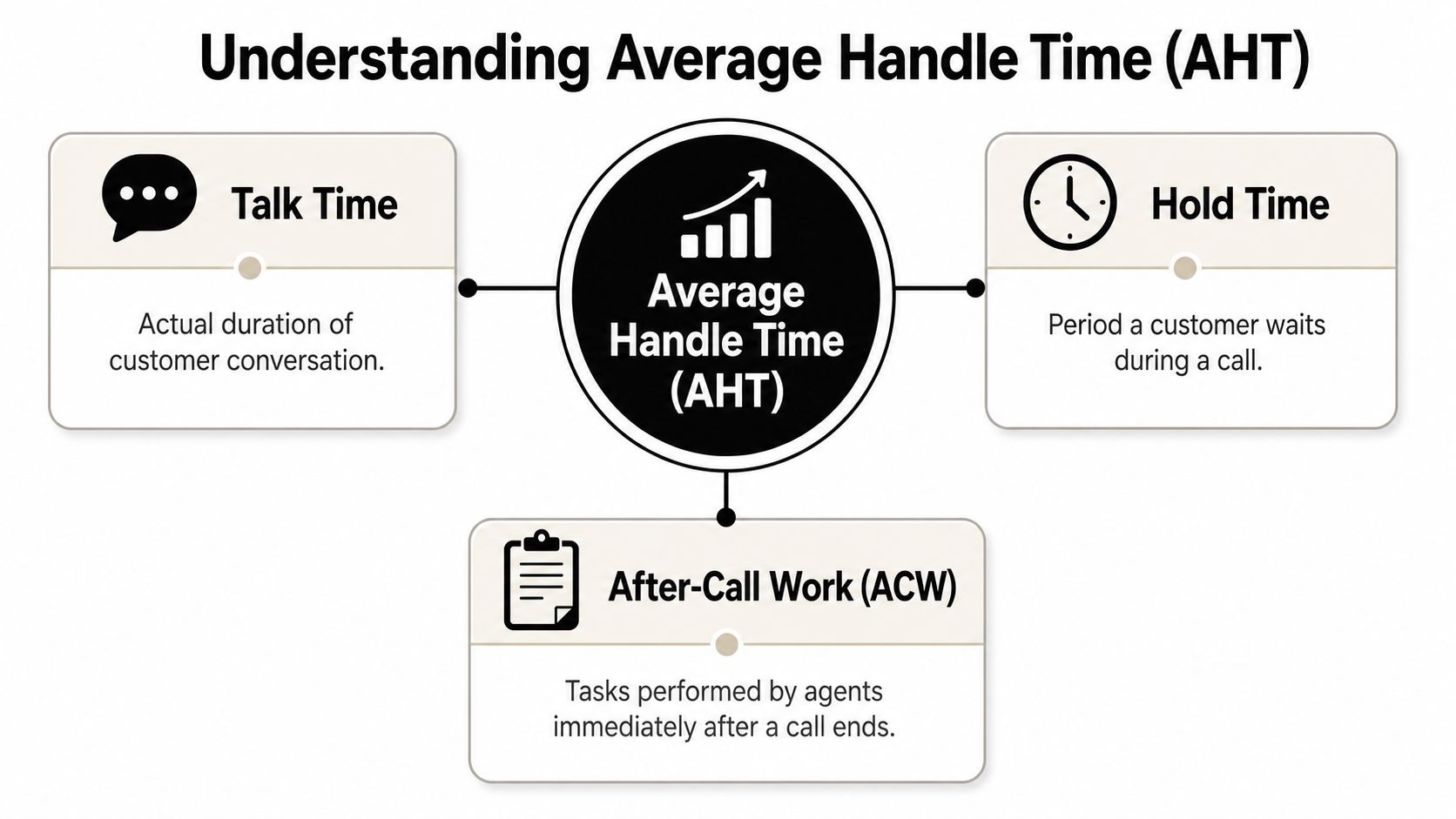
The three components that matter
The technical definition is straightforward, but leaders often misread one of its parts.
Talk time
This is the live interaction itself. On voice, it's the active conversation. On digital channels, it's the time spent handling the exchange.Hold time
This captures the waiting built into the interaction. It usually points to one of two things: either the issue requires additional steps, or the agent doesn't have what they need fast enough.After-call work or after-contact work
Many reports go wrong during this phase. Documentation, CRM updates, dispositions, and follow-up entries are part of the work. They aren't optional overhead.
If your dashboard excludes wrap-up time, it's not showing handle time. It's showing a partial conversation metric.
The formula and the operational trap
The formal calculation is:
AHT = (Talk Time + Hold Time + After-Contact Work) / Total Interactions
Zendesk's definition makes the operational point clearly: Average handle time includes talk, hold, and after-contact work, and excluding ACW can understate true workload. That matters because post-call work often looks small in isolation but becomes material when multiplied across a queue.
Here's what leaders should look for in each component:
| Component | What it often reveals |
|---|---|
| Talk time | Product complexity, weak call control, knowledge gaps |
| Hold time | Search friction, transfers, approval dependency |
| ACW | Poor workflow design, duplicate systems, manual admin burden |
The mistake isn't using average handle time. The mistake is using only the final blended number. If talk time is stable but hold time rises, that's a systems problem. If hold time is low but ACW keeps climbing, your agents are doing too much clerical work after the resolution.
That's also why AI can improve AHT without forcing agents to rush. It can target the exact component creating waste.
Current AHT Benchmarks and Performance Distribution
Benchmarks are useful, but only if leaders apply them with context. A single “good AHT” target across channels, issue types, and sectors creates the wrong incentives almost immediately.
What the benchmark says
For 2026, the overall cross-sector AHT benchmark is 6 minutes and 10 seconds, or 370 seconds, according to Kayako's benchmark summary. That same benchmark shows meaningful variation by channel. Tier-1 phone support averages 4 to 6 minutes, live chat runs 3 to 5 minutes, and email support typically takes 8 to 15 minutes.
AHT also shifts by sector and interaction type. Financial services sits lower in some benchmark sets, while healthcare and technical support run longer because verification, compliance, and troubleshooting add more work to every contact.
Here's a practical view of the distribution using the verified benchmark ranges.
| Channel/Industry | Average Handle Time (AHT) |
|---|---|
| Overall cross-sector benchmark | 6 minutes 10 seconds |
| Tier-1 phone support | 4 to 6 minutes |
| Live chat | 3 to 5 minutes |
| Email support | 8 to 15 minutes |
| Financial services | 4 minutes 45 seconds |
| Healthcare | 6.6 minutes |
| Technology support | 7 to 10 minutes |
| Complex technical issues | 8 to 12 minutes |
| Phone median by channel | 7.5 minutes |
Why the distribution matters more than the average
The benchmark table is only the starting point. The operational lesson is that channel modality and issue complexity reshape AHT.
Phone interactions tend to run longer because they combine live explanation, pauses, verification, and hold events in a single uninterrupted stream. Chat is shorter on a pure interaction basis. Email takes longer because agents need to compose a complete response and often manage asynchronous back-and-forth.
AHT should be benchmarked against similar work, not blended work.
That's especially true in regulated and technical environments:
- Healthcare carries documentation and verification rigor.
- Financial services often benefits from structured workflows that compress handling time.
- Technology support expands quickly when agents need diagnostic logic, system checks, or multi-step troubleshooting.
The benchmark can also hide operational variance inside your own business. New product launches, outages, and onboarding waves change what “normal” looks like. That's why using a single blended AHT number across the whole contact center usually leads to bad management decisions. It rewards the wrong teams, penalizes the hard work, and makes real improvement harder to see.
A useful target is contextual. It accounts for channel, issue type, and the level of expertise required to solve the problem correctly.
The Strategic Balance Between AHT and Customer Experience
AHT becomes dangerous when leaders treat every extra minute as waste. Some minutes are expensive because the process is broken. Others are the reason a customer gets a complete answer, stays loyal, and does not contact you again next week.
The job is to separate productive time from avoidable time.
Why lower is not always better
Teams that chase AHT in isolation usually get the wrong behaviors. Agents cut discovery short, rush customers off the line, transfer sooner, or avoid the harder cases that need judgment. The dashboard improves. Resolution quality, trust, and agent confidence often decline.
That is why AHT belongs next to first contact resolution, CSAT, repeat contact rate, and quality scores. A six-minute interaction that solves the problem cleanly is often cheaper than a four-minute interaction that creates another call, another handoff, and more frustration.
As noted earlier, handle times have risen over time in many environments because the work itself has changed. Product portfolios are broader, support journeys cross more systems, and customers often arrive after self-service has already failed. Older AHT targets do not always fit that reality.
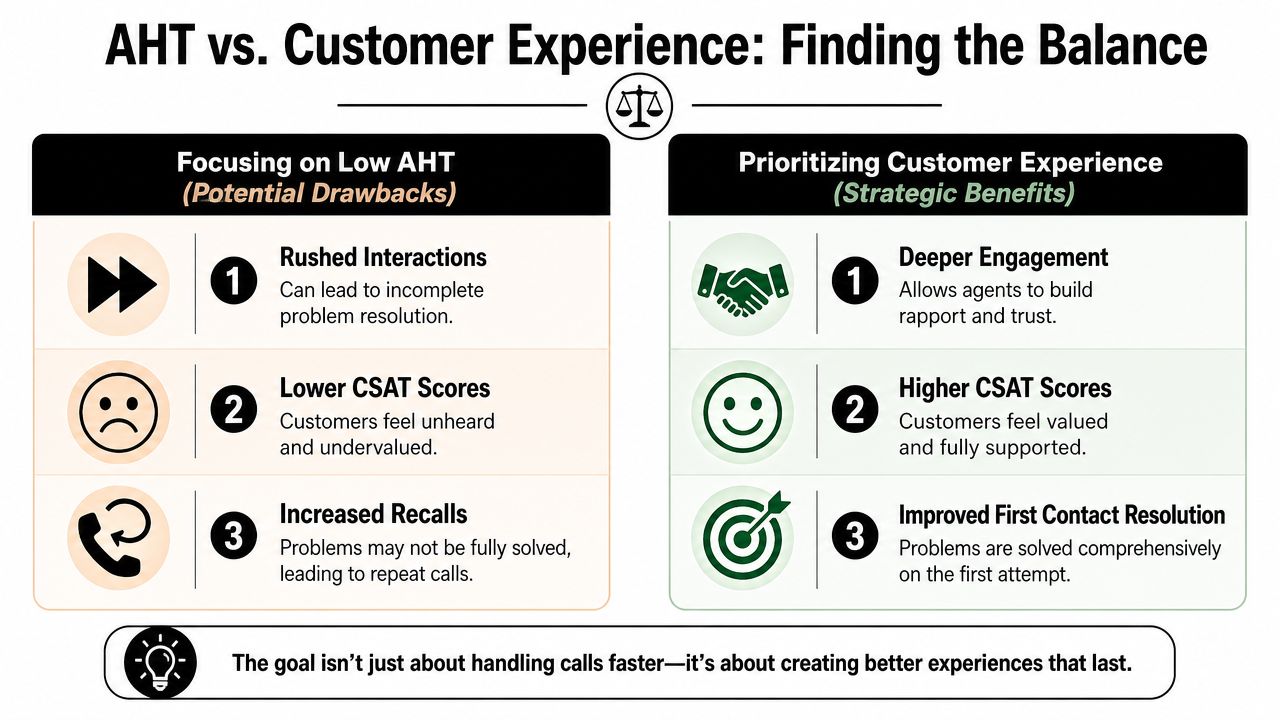
A better operating lens is simple:
| AHT pattern | What it usually means |
|---|---|
| Low AHT with weak resolution or low CSAT | Agents are rushing, deflecting, or skipping needed steps |
| Higher AHT with strong FCR and QA | Agents are spending time where it improves the outcome |
| High AHT with low QA and long holds | The process, tools, or routing model is creating waste |
That distinction matters at the executive level. Cost pressure is real, but cutting handling time blindly often shifts cost into repeat demand, escalations, compliance exposure, and attrition.
What usually drives high AHT
High AHT usually comes from one of three places, and each one needs a different response.
Agents are working too hard to find the answer
Knowledge is fragmented, systems are slow, or the next step is unclear. Time goes into searching, not solving.The interaction does require more time
Troubleshooting, emotionally charged complaints, exceptions, and policy-sensitive cases need explanation and judgment. Shortening them can damage the outcome.The operating model adds friction
Re-authentication, duplicate data entry, transfers, after-call admin, and poor routing add minutes that the customer does not value.
The minute to remove is the one spent on friction, not the one spent on resolution.
This is also why workforce decisions matter to AHT strategy. During spikes, understaffed queues push agents toward shorter, weaker interactions and managers toward blunt targets. A practical guide to overflow call handling can help protect service levels without forcing agents to trade quality for speed.
Channel strategy matters too. Reducing avoidable live contacts gives skilled agents more capacity for the conversations that should stay human. Yellow.ai's webinar on how omnichannel virtual assistants are reducing call volumes is useful context for leaders redesigning that balance.
The strategic objective is not minimum AHT. It is the right AHT for each interaction type, with AI used to remove wasted effort, preserve human attention for higher-value work, and improve both economics and experience at the same time.
How Agentic AI Delivers AHT Optimization
Agentic AI changes average handle time because it changes where work happens. Some contacts never reach a human. Some reach an agent with context already assembled. Others end with the wrap-up completed automatically. That's optimization in the literal sense: not making every interaction shorter, but shifting effort to the lowest-cost, highest-quality path.
A platform view matters here because fragmented AI usually creates a new layer of friction. Teams need orchestration across self-service, agent assist, and post-contact workflows.
Start with segmentation, not automation volume
The first discipline is analytical, not technical. A single blended AHT metric is misleading, and segmentation by call type, channel, and agent experience is a prerequisite for deciding what AI should automate versus what humans should handle, according to Kayako's analysis of AHT segmentation.
That's exactly how mature teams approach AI deployment. They don't ask, “What can we automate?” They ask:
- Which contacts are repetitive and rules-based?
- Which ones need empathy, judgment, or negotiation?
- Which interactions are short but expensive because of ACW?
- Where does agent effort spike because systems are fragmented?
If you're mapping that decision in a B2B context, this guide on how to learn to automate B2B customer support is a practical companion because it focuses on workflow suitability rather than generic bot adoption.
Autonomous resolution removes avoidable work
The cleanest AHT reduction comes from eliminating the need for live handling in the first place. Routine balance checks, order status, appointment confirmation, password resets, policy lookups, and standard eligibility questions don't need an agent if the AI can authenticate, access the right systems, and complete the task.
This changes the queue mix. Human teams stop spending time on the top layer of repetitive demand and spend more of their capacity on exceptions and complex cases.
That matters strategically because average handle time often rises as simple contacts leave the queue. Leaders should expect that. A better self-service layer can increase the average complexity of the remaining human interactions while still lowering total service cost and improving access.
Don't evaluate AI only by whether human AHT falls. Evaluate whether low-value human work disappears.
One enterprise option in this category is Yellow.ai's agentic AI platform, which supports autonomous agents across voice and digital channels, along with orchestration into business systems. In AHT terms, the value is less about “making calls shorter” and more about deciding which contacts never needed a live queue at all.
AI copilots compress the live interaction
The second lever is augmentation. For interactions that do need a person, AI copilots can reduce the waste inside the conversation.
The impact usually shows up in three places:
- Talk time falls when agents get real-time knowledge suggestions instead of searching manually.
- Hold time falls when the system surfaces answers, workflows, or next steps during the interaction.
- Consistency improves because prompts and summaries reduce dependence on memory.
The best copilots behave less like a script and more like a live operating layer. They pull account context, recommend resolution paths, generate response suggestions, and keep the agent anchored in policy and process.
A short demo helps make that operating model concrete.
The practical caution is that copilots only work when the knowledge base is governed well. If the source content is stale, contradictory, or fragmented across tools, AI returns bad answers faster.
Post-contact automation clears the hidden backlog
The third AHT lever is the least glamorous and often the highest yield. After-contact work absorbs agent capacity. Notes, dispositions, CRM updates, summary drafting, ticket tagging, follow-up creation, and internal handoff documentation all count as handling effort.
Agentic workflows earn their keep. They can:
- Generate summaries from the interaction.
- Populate required fields based on the transcript or chat log.
- Trigger downstream tasks or routing steps.
- Package the record for QA and analytics without manual cleanup.
The strategic value goes beyond shaving seconds. It frees the agent to move directly to the next customer while preserving the record quality leaders need for compliance, reporting, and coaching.
When teams combine these three layers, autonomous resolution, copilot support, and post-contact automation, average handle time becomes a design variable. Leaders stop arguing about one target number and start engineering the service model interaction by interaction.
Best Practices for Measuring and Reporting AHT
Most AHT reporting fails for one reason. It collapses too much operational reality into one blended average and then asks managers to act on it.
A better reporting model starts with segmentation and then puts average handle time in context with adjacent quality signals. If leaders want a number they can manage, it has to reflect the work as it's performed.
Build a reporting model leaders can actually use
The reporting unit should align to real operating differences. That usually means breaking average handle time out by:
- Channel such as voice, chat, and email
- Interaction type such as billing, claims, onboarding, troubleshooting, or complaints
- Agent profile including tenure or proficiency band
- Business condition such as launch periods, outages, or seasonal surges
A dashboard also needs neighboring metrics. AHT in isolation creates pressure. AHT with resolution and customer outcome data creates judgment. Teams using AI analytics platforms typically have an easier time here because they can track conversation patterns, escalation paths, and operational bottlenecks in one place.
Use AHT as a diagnostic, not a verdict
The practical habit that separates strong operators from weak ones is simple. They ask what changed inside the interaction, not whether the number alone went up or down.
Review AHT like a symptom. Then find the cause in routing, knowledge, process, tooling, or contact mix.
That mindset produces better interventions:
- rising hold time points to search and system friction
- rising ACW points to documentation burden
- rising talk time may point to issue complexity or coaching needs
- falling AHT with worsening outcomes usually means service quality is being traded away
The leaders who handle this well don't worship low AHT. They use average handle time to identify where AI should automate, where agents need better support, and where the customer journey still creates unnecessary work.
Yellow.ai helps enterprises operationalize that approach with agentic AI across voice and digital channels, AI copilots for live agent support, workflow automation for after-contact work, and analytics that make AHT more actionable in context. If you're redesigning service operations around optimization instead of blunt reduction, Yellow.ai is worth evaluating.



