














Most automation programs still celebrate the wrong win. They report containment, deflection, or bot-handled volume while ignoring a simpler truth: if customers have to repeat themselves, the system has failed. That blind spot matters more now because a majority of consumers will repeat themselves only once before leaving an automated attempt, according to Customer Experience Dive's coverage of a Parloa survey.
That's why automated customer service in 2026 can't be framed as a chatbot project. It's an operating model decision. The question isn't whether software can answer FAQs. The question is whether your service stack can resolve real customer problems, preserve context across channels, and hand off to humans without friction when judgment is needed.
Table of Contents
- The Inevitable Shift to Autonomous Customer Service
- Calculating the True Business Value and ROI
- Anatomy of an Enterprise Automation Platform
- A Practical Implementation Roadmap for Enterprises
- Measuring Success Beyond Deflection Rates
- Industry Use Cases with Measurable Outcomes
- How to Evaluate and Integrate an AI Platform
The Inevitable Shift to Autonomous Customer Service
Customer service used to be treated as a cost center staffed to absorb demand. That model is breaking. Enterprises now expect service operations to protect revenue, improve retention, and scale without adding friction every time volumes spike.
The market signal is hard to ignore. The global AI for customer service market was valued at USD 12.58 billion in 2024 and is projected to reach USD 73.99 billion by 2032, with a 24.92% CAGR, according to SNS Insider's AI for customer service market report. That isn't incremental tooling spend. It reflects a structural shift in how enterprises want service delivered.
What's changing isn't just channel automation. It's the move from scripted bots to autonomous systems that can authenticate a user, understand intent, retrieve policy or order data, complete a workflow, and decide when a human should step in. In ecommerce, that same shift is reshaping buying journeys as well as support journeys. Teams exploring agentic commerce should look at Zinc's perspective on AI agents for ecommerce, because it captures how service and commerce are starting to converge.
Automated customer service becomes strategic when it stops acting like a front-door filter and starts acting like an operator inside the business.
The old service stack forced humans to work around software limitations. Agents copied data between systems, customers repeated context, and leaders accepted queue time as normal. That setup won't hold. In 2026, customers expect software to do the administrative work and leave people to handle exceptions, trust-building, and complex judgment.
Autonomous customer service is the practical expression of that shift. It doesn't remove humans. It raises the bar for when human attention is used.
Calculating the True Business Value and ROI
A weak business case for automated customer service usually starts and ends with labor savings. That's too narrow. The stronger case combines cost reduction, service capacity, agent productivity, and experience quality.
The headline ROI is already compelling. Companies implementing AI support are realizing returns ranging from 3.5x to 8x, and while 88% of contact centers report some form of AI usage, only 25% have fully integrated it into daily workflows, according to ChatMaxima's 2026 AI customer support statistics. That gap tells you something important: many enterprises have bought AI, but far fewer have operationalized it.
Where the value actually shows up
Leaders should model ROI across four buckets:
- Interaction cost reduction: Routine requests such as order tracking, password reset, appointment confirmation, and ticket triage don't need the same staffing profile as complex disputes or regulated conversations.
- Agent productivity: When automation collects context, pre-fills fields, summarizes prior interactions, and routes correctly, agents spend less time on administrative recovery.
- Revenue protection: Faster issue resolution reduces abandonment and prevents support friction from turning into churn.
- Always-on availability: Automated service covers after-hours demand without forcing customers to wait until the next staffed shift.
A lot of teams underestimate the second and third buckets because they're harder to measure than headcount efficiency. In practice, they're often where the strategic value sits.
Build the model from operational flows
Start with your highest-volume intent groups. Then separate them into three categories:
| Interaction type | Best handling model | Why it matters |
|---|---|---|
| Simple and repetitive | Fully automated | Low risk, high frequency, easy to standardize |
| Multi-step but structured | Autonomous with system access | Strong ROI if the AI can retrieve data and complete tasks |
| Sensitive or exception-heavy | Human-led with AI assist | Preserves trust and compliance |
Then quantify impact using your own service economics. Look at cost per interaction, average handling effort, transfer rates, recontact patterns, and after-hours demand. This is also where leaders can pressure-test assumptions with a practical ROI calculator for conversational AI investments.
Practical rule: Don't fund automation because a vendor demo looked impressive. Fund it because you know which contact drivers are expensive, repetitive, and fixable.
Maturity matters more than experimentation
Many organizations are stuck in pilot mode. They've launched a chatbot, maybe added some auto-routing, and concluded that “AI works for FAQs.” That conclusion usually says more about implementation maturity than platform potential.
Significant ROI appears when automation is tied to live systems and accountable metrics. If the AI can't verify identity, read a CRM record, trigger a workflow, update a case, and pass the full interaction history to an agent when needed, you won't capture enterprise-grade value. You'll just add another layer between the customer and resolution.
The most effective programs don't ask, “How many conversations can we deflect?” They ask, “Which parts of our service operation should be autonomously resolved, which should be assisted, and which should remain human-led?” That framing produces a much cleaner investment case.
Anatomy of an Enterprise Automation Platform
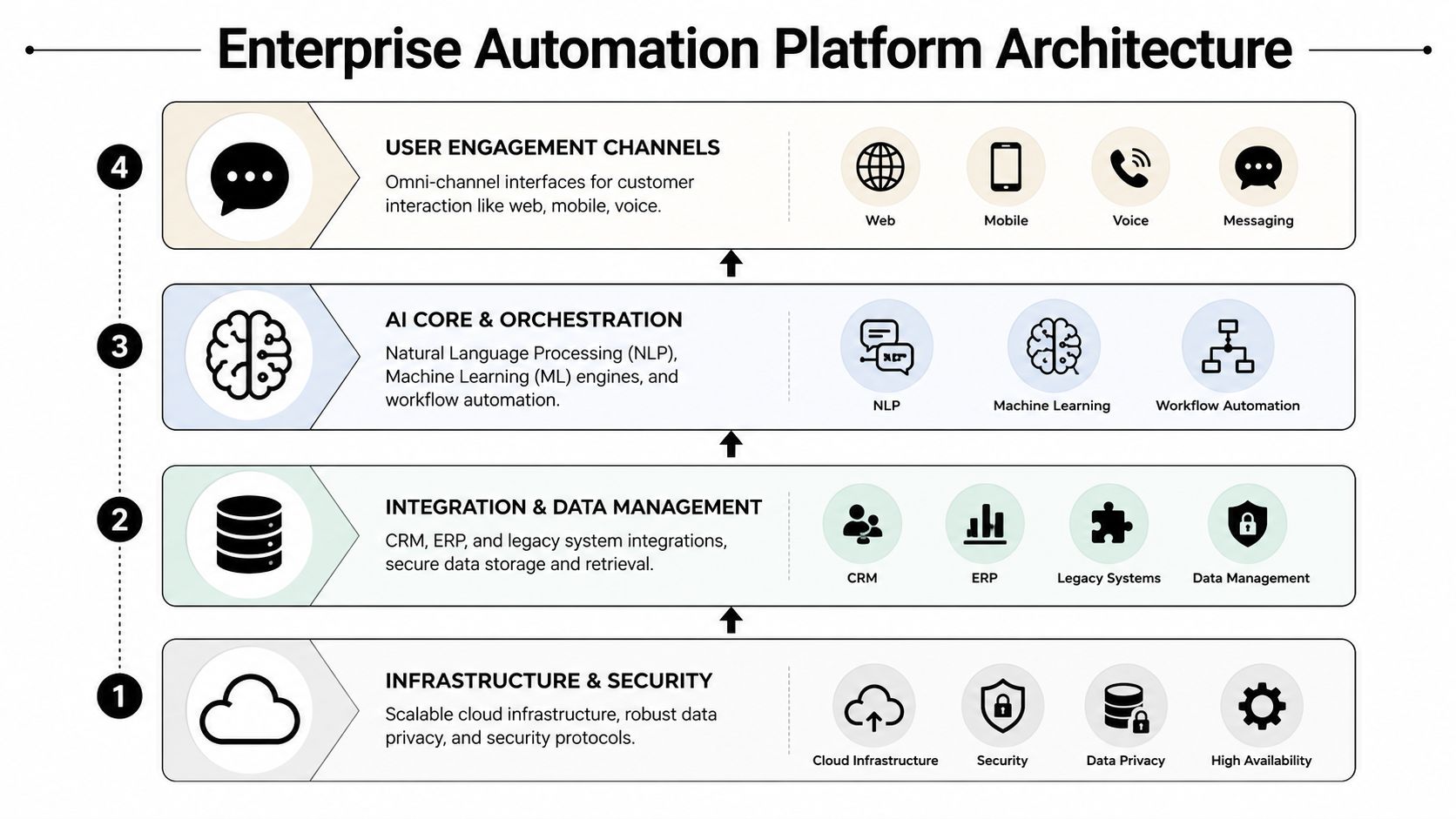
Enterprise automated customer service isn't one model wrapped in a chat widget. It's a stack. If any layer is weak, the customer feels it immediately through delays, contradictions, broken handoffs, or loss of context.
What sits inside the platform
At the top are the engagement channels. This includes web chat, mobile app chat, email automation, messaging apps, voice, and IVR. Omnichannel matters, but not in the marketing sense. It matters because customers don't care which channel your org chart owns. They expect the conversation to continue without restarting.
Below that is the AI orchestration layer, where intent detection, dialog management, workflow logic, policy handling, summarization, and escalation rules come together. In mature systems, this layer also decides which model should handle which task. A short lookup request doesn't need the same model behavior as a nuanced billing dispute.
Then comes knowledge and data retrieval. Many deployments often fail at this stage. If your system can generate polished language but can't reliably retrieve the right policy, case detail, or account record, it will sound competent while producing weak outcomes. A conversational knowledge layer with retrieval-augmented generation is what turns enterprise content into actionable answers instead of static help-center text.
Finally, there's the integration and infrastructure layer. CRM, ERP, ticketing, telephony, identity systems, analytics, and security controls sit here. If this layer is brittle, every elegant conversation flow eventually breaks in production.
Why architecture matters more than demos
A good demo proves the model can talk. A good architecture proves the system can operate.
That means looking for capabilities such as:
- Voice AI and conversational IVR: Useful when callers want to speak naturally rather than follow rigid menus.
- State management: Essential for preserving context across long, multi-turn interactions.
- RAG with controlled enterprise knowledge: Needed to ground responses in approved content and current business rules.
- Multi-LLM orchestration: Important for balancing latency, accuracy, and cost while avoiding dependence on one provider.
- Testing and observability: Required to catch failures before customers do.
For industries that deal with financially sensitive workflows, adjacent automation disciplines can also sharpen the design approach. Healthcare and revenue teams, for example, often face similar orchestration problems across payer rules, handoffs, and back-office exceptions. That's why pieces like Happy Billing's guide to mastering RCM automation are useful reading even outside pure billing teams. The operating lesson is the same: automation only works when process, data, and exception handling are designed together.
One platform, not a pile of disconnected tools
A common enterprise mistake is assembling separate products for bot building, voice, analytics, testing, knowledge retrieval, and handoff. Teams can make that work, but the integration tax is real. Every boundary creates more failure points.
One practical option in this category is Yellow.ai's AI agent builder, which combines agent design, testing, deployment, and orchestration in one environment. Whether you choose a unified platform or compose your own stack, the architectural question stays the same: can this system resolve customer requests across channels, systems, and workflows without losing control?
That's the standard. Not whether it can answer a canned question in a sandbox.
A Practical Implementation Roadmap for Enterprises
Most enterprise automation programs fail for a mundane reason. They start too wide. Leaders try to transform the whole contact center at once, then hit integration delays, conversation edge cases, and internal resistance.
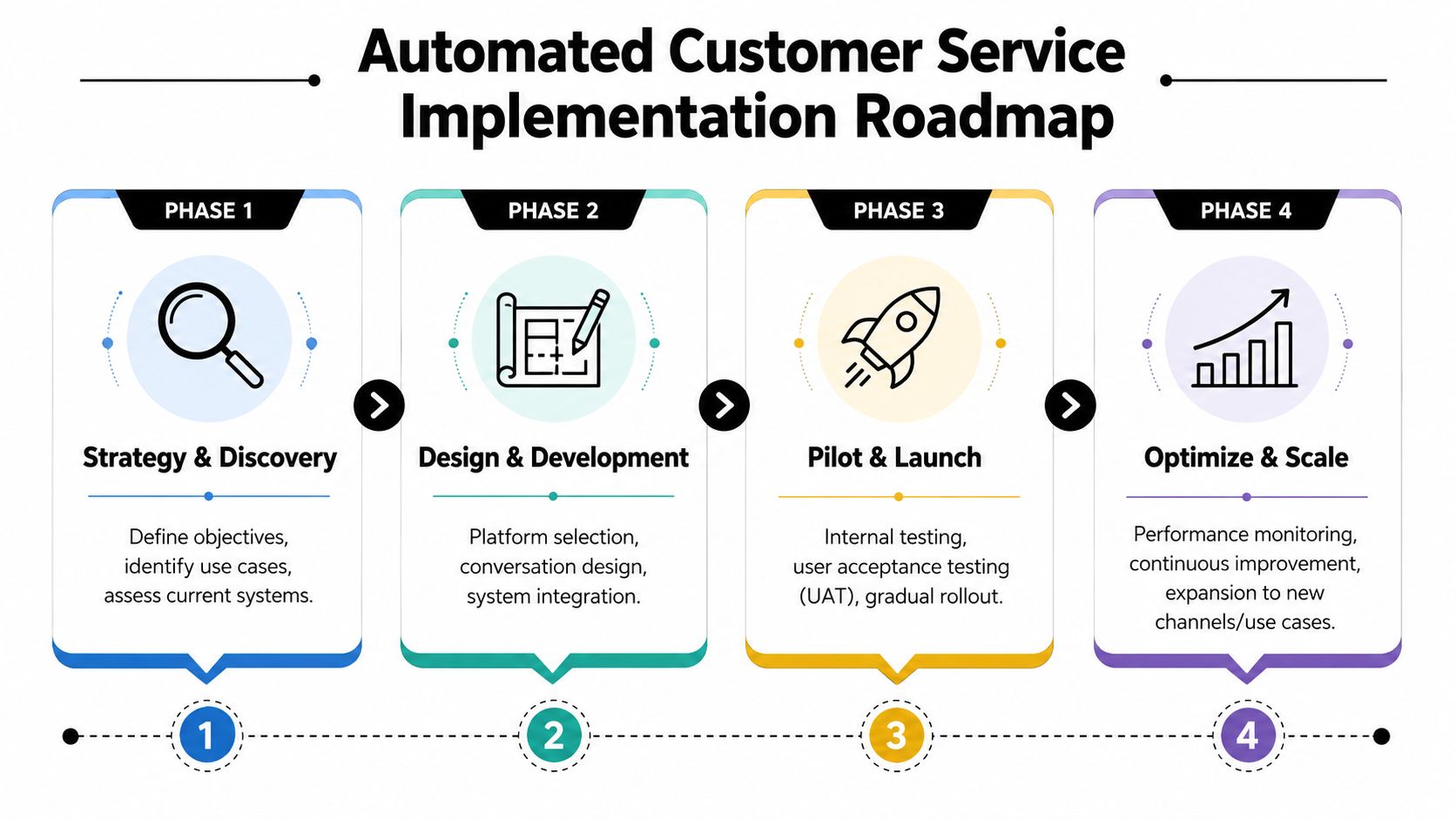
A better roadmap is staged. It narrows risk early and broadens scope only after the operation has learned how the system behaves in production.
Phase one starts with narrower ambition
Begin with a use-case portfolio, not a platform-first rollout. Look for intents with clear success criteria, stable policy logic, and enough volume to matter. Order status, account updates, appointment changes, password assistance, and tier-one troubleshooting often make strong pilot candidates.
At this stage, teams should define:
- Resolution boundaries: What can the AI fully complete on its own?
- Escalation rules: Which triggers require a human immediately?
- Source systems: Where does the truth live for customer identity, status, and policy?
- Success measures: Which outcomes indicate actual resolution rather than interaction completion?
Keep the pilot operationally real. Use live knowledge, real integrations where possible, and a constrained audience. Synthetic proofs create false confidence.
Phase two connects automation to the real business
Programs move beyond experimental stages. The AI needs access to the systems that move work: Salesforce, Zendesk, Genesys, policy repositories, order platforms, scheduling systems, and identity services.
The design work here is less glamorous than prompt engineering, but more important. Teams need canonical customer identifiers, reliable error handling, role-based permissions, and clear workflow ownership. If an API fails or a backend returns conflicting data, the conversation shouldn't collapse. It should recover gracefully or transfer with context.
This phase also demands discipline around conversation design. A strong flow doesn't just answer. It confirms, clarifies, handles ambiguity, and knows when to stop pretending it can help.
The handoff is part of the product. If the AI transfers without context, your customer experiences two broken interactions, not one.
Phase three is where most programs either mature or stall
The largest technical risk in current models is accuracy in complex state tracking, which is essential for multi-step conversations. When state tracking fails, the AI can lose context and drive re-contact rates. Industry best practices therefore require rigorous QA and monitoring of confirmed resolution rate to identify where automation breaks down, as outlined in this benchmark analysis on AI learning in customer service.
That has direct implementation implications. Enterprises need test suites that cover branching logic, interruptions, channel switching, and exception paths. They also need review cadences for failed conversations, not just successful ones.
Three operating practices matter here:
Monthly transcript review
Review abandoned flows, repeated questions, and human takeovers. Friction often hides in these areas.A center of excellence
Someone has to own standards for conversation design, testing, governance, and knowledge updates across business units.Closed-loop optimization
Product, support, and operations teams should all see where automation fails. Many “support” problems are broken policy, missing content, or upstream process issues.
A mature roadmap doesn't end at launch. It creates an operating system for continuous refinement.
Measuring Success Beyond Deflection Rates
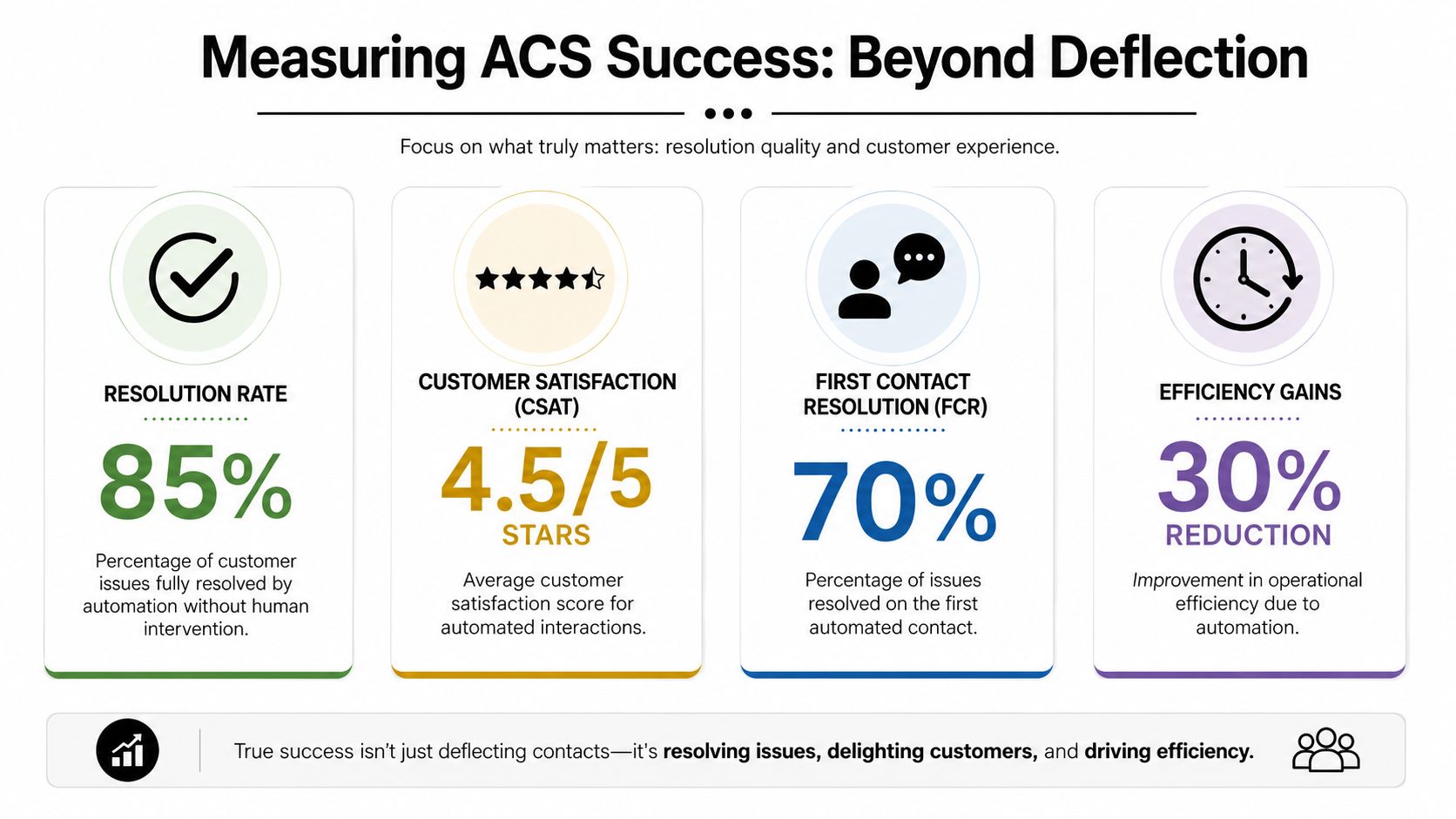
Deflection rate became the default KPI because it is easy to count, easy to present, and easy to celebrate. It is also too shallow to tell an enterprise whether automation is actually reducing service effort.
The metric breaks down the moment a customer stays inside an automated flow but leaves without an answer. That customer may retry in another channel, call the contact center, or arrive at an agent already frustrated. The cost did not disappear. It shifted downstream and usually became more expensive to resolve.
Why deflection creates false confidence
Teams that optimize for containment often miss the thing customers value. Resolution with the least possible friction.
A bot that answers quickly but forces a customer to repeat an account number, re-explain the issue after transfer, or restart after a failed authentication step is not performing well. It is creating hidden work. I have seen programs report healthy automation numbers while agent handle time rises because escalations arrive with more confusion, not less.
That is why mature teams stop asking, "How many contacts did the bot absorb?" and start asking, "How many issues did the system fully resolve, with context preserved, in one attempt?"
What strong teams measure instead
A useful scorecard weights quality and effort together:
- Confirmed resolution rate: Did the interaction end with the customer's issue solved?
- First-contact resolution: Was the matter completed in one journey, even if channels changed?
- Re-contact rate: Did the customer come back for the same issue within a defined window?
- Customer friction signals: Where do users repeat themselves, abandon flows, or request a human?
- Escalation quality: Does the agent receive the conversation history, customer identity, and the next relevant action?
- Time to resolution: Did automation shorten the path to an answer, or just add one more layer before human support?
This is the shift from automation volume to automation quality.
The distinction matters because poor automation can improve dashboard optics while worsening the customer experience. Good automation removes effort from both sides. Customers get to an answer faster. Agents inherit cleaner cases. Operations teams see fewer avoidable contacts.
How to operationalize measurement
Start with failure demand, not vanity metrics.
Review the contacts that come back within a few days. Examine conversations that escalated after multiple turns. Look for intents with high abandonment, repeated authentication attempts, and transfers where the agent asks questions the bot already collected. Those patterns expose friction in conversation design, knowledge retrieval, and handoff logic.
Manual tagging is fine at the start. Enterprises do not need a perfect analytics stack on day one. They need a disciplined way to separate true resolution from delayed resolution.
An automated interaction creates value when it closes the issue. If it adds another step before the customer reaches help, it increases cost.
Governance is part of service quality
Measurement also has to cover trust, access, and consistency. An autonomous service program cannot be called successful if it works well for simple cases in one language but breaks for vulnerable customers, regulated requests, or edge-case journeys.
A useful governance lens includes:
| Governance area | What to check |
|---|---|
| Human escalation | Can customers reach a person when the issue is sensitive, confusing, or high stakes? |
| Transparency | Do users understand when they're interacting with AI and what data is being used? |
| Validation | Has the system been tested across diverse customer populations and edge cases? |
| Compliance | Are controls aligned with your sector's privacy and security obligations? |
Enterprise leaders should treat these checks as operating metrics, not audit paperwork. Resolution quality, low friction, and responsible governance belong on the same scorecard because customers experience them as one service, not three separate programs.
Industry Use Cases with Measurable Outcomes
The most useful way to understand automated customer service is to look at where it changes work, not where it generates headlines. The pattern is consistent across industries: the best deployments remove repetitive effort, preserve context, and shorten the path to resolution.

Banking and financial services
In banking, routine service demand is large, but trust requirements are high. Customers contact support for card controls, payment status, loan servicing questions, dispute initiation, and account access issues. These flows are structured enough for automation, but only if identity, auditability, and escalation are handled correctly.
What works:
- Authenticated self-service for routine requests
- Structured intake for disputes and servicing changes
- Agent assist for sensitive or regulated exceptions
What doesn't work is pretending every financial interaction should remain inside the bot. Escalation design matters more here than flashy conversational range.
Healthcare and patient access
Healthcare teams often struggle with appointment scheduling, referral status, benefits questions, paperwork reminders, and follow-up communication. Automation helps most when it reduces administrative burden without creating clinical or compliance risk.
The strongest healthcare use cases tend to involve operational coordination rather than diagnostic advice. Scheduling, reminders, intake guidance, location details, and insurance-related navigation fit well. Cases involving ambiguity, distress, or treatment interpretation usually need immediate human involvement.
In healthcare, the safest automation strategy is simple. Automate coordination. Escalate judgment.
This is also where equity matters sharply. If a system only works well for digitally fluent users or narrow language patterns, it can exclude the very populations that need easier access.
Retail and ecommerce operations
Retail produces the clearest automation opportunities because demand clusters around order status, delivery changes, returns, exchanges, product availability, and payment questions. During peak periods, automated customer service can absorb routine contacts while preserving agent capacity for damaged shipments, fraud concerns, and complex order exceptions.
Strong retail deployments usually combine three things:
- Transactional visibility: The AI can see order, shipping, and return status in real time.
- Policy grounding: Return windows, refund rules, and carrier constraints are current.
- Smooth handoff: If a case turns into a loyalty, retention, or exception scenario, the human picks up with full context.
These industry patterns don't prove that every use case should be automated. They show where automation creates measurable operational value because the workflow, data, and customer expectation are aligned.
How to Evaluate and Integrate an AI Platform
Enterprise buyers usually get impressed by the wrong things first. A polished demo, smooth language generation, and a good-looking bot builder can all matter. None of them tells you whether the platform will hold up inside a complex service environment.
The right evaluation framework tests architecture, integration depth, governance controls, and operating fit. If a vendor can't answer clearly on those dimensions, the rest doesn't matter.
Start with the checklist leadership actually needs
| Category | Key Evaluation Criteria |
|---|---|
| Architecture | Support for chat and voice, orchestration flexibility, state handling, model control, knowledge grounding |
| Integrations | Pre-built connectors, API maturity, CRM and ticketing compatibility, identity support, workflow execution |
| Governance | Human handoff controls, auditability, role-based access, privacy controls, compliance alignment |
| Knowledge | RAG capability, content governance, source transparency, update workflows |
| Operations | Testing tools, analytics, failure monitoring, versioning, rollback controls |
| Build environment | Low-code options, developer extensibility, reusable components, collaboration workflows |
| Commercial model | Pricing clarity, usage visibility, implementation requirements, long-term operating cost |
A serious evaluation should include both business and technical reviewers. Support leaders care about resolution quality. Security teams care about access and data flow. IT cares about maintainability. Procurement cares about commercial clarity. If one group evaluates in isolation, bad platform decisions follow.
The vendor questions that expose real fit
Ask direct questions such as:
- How does the platform preserve context in long, multi-step conversations?
- What happens when a backend system fails mid-workflow?
- How are knowledge sources approved, updated, and cited internally?
- Can the platform support multiple models and route tasks by need?
- How is handoff handled across channels, not just within one?
- What analytics are available for confirmed resolution, re-contact, and drop-off?
- What controls exist for testing, rollback, and change management?
Those questions shift the conversation from “Can it converse?” to “Can it operate safely at enterprise scale?”
Integration is where value gets proven
A platform with weak integrations forces your team to compensate through manual workarounds, brittle middleware, or disconnected reporting. That's why buyers should examine native connectors, workflow execution options, data synchronization behavior, and admin controls in detail.
If your team is comparing vendors, a structured buyer's guide to evaluating conversational AI solutions can help frame the process more rigorously. The goal isn't to buy the platform with the most features. It's to choose the one your teams can govern, integrate, and improve over time.
The best platform decision usually looks less exciting in the room and much better six months later in production.
Yellow.ai offers an enterprise platform for autonomous customer and employee conversations across voice, chat, email, and other channels, with agent building, testing, analytics, and governance capabilities in one stack. If you're evaluating how to move from basic bot automation to resolution-focused service operations, explore Yellow.ai as one option in your platform shortlist.



