














A legal team sends a diligence checklist late in the deal cycle. Procurement wants your security packet. The partner's question looks simple: send your PCI Attestation of Compliance.
For many executives, that request lands at an awkward moment. The business already chose the cloud contact center, the AI platform, the payment gateway, and the BPO partner. Now someone has to prove that the entire stack handles cardholder data appropriately, including the places where voice, chat, IVR, and workflow automation intersect.
That's why attestation of compliance PCI work matters far beyond audit season. The AoC is often the document that turns “we believe our environment is under control” into “we can prove it to banks, partners, and customers.” In a modern enterprise, that proof depends as much on vendor boundaries and data flows as it does on firewalls and policy binders.
Table of Contents
- Your Partner Is Asking for a PCI AoC Now What
- What Is an Attestation of Compliance for PCI DSS
- AoC vs RoC vs SAQ A Practical Comparison
- The Path to Obtaining Your PCI AoC
- Understanding Merchant and Service Provider Responsibilities
- Assessing Vendors The AoC in Your Modern Tech Stack
- Maintaining Compliance An Enterprise Readiness Checklist
Your Partner Is Asking for a PCI AoC Now What
When a partner asks for your AoC, they're not asking for marketing collateral. They're asking for formal evidence that your organization validated its PCI DSS obligations through the right assessment path.
That distinction matters. Executives often hear “certificate” and assume one document settles the issue. In practice, the AoC is the concise proof artifact that reflects a larger compliance process. It tells the outside party that your payment security controls were assessed and formally attested.
Here's the practical sequence to follow when the request comes in:
- Confirm what they want. Some partners ask for an AoC but really need your latest assessment package, your scope summary, or vendor responsibility details.
- Check whether your current AoC matches the service in question. A document tied to one payment environment may not answer diligence questions about a newly launched channel.
- Validate your outsourced dependencies. If card data touches a telephony platform, chatbot workflow, payment processor, or BPO operation, your response has to reflect those boundaries.
- Route the request through compliance, security, and business ownership together. Legal alone can't answer where card data flows. Security alone may not know what the contract promises.
Practical rule: If your team has to argue about whether a system is in scope after the partner asks for the AoC, the real problem is governance, not paperwork.
This shows up often in contact center transformation projects. A company moves card payments into voice bots, agent assist tools, chat workflows, and back-office case queues, then learns too late that compliance evidence wasn't designed for the new operating model. If that sounds familiar, it helps to align customer operations and security requirements early, especially in environments shaped by contact center compliance obligations.
The AoC is the official handshake. But the business value is broader. It supports contract velocity, reduces diligence friction, and gives leadership a cleaner answer when someone asks whether the organization can safely support payment interactions at scale.
What Is an Attestation of Compliance for PCI DSS
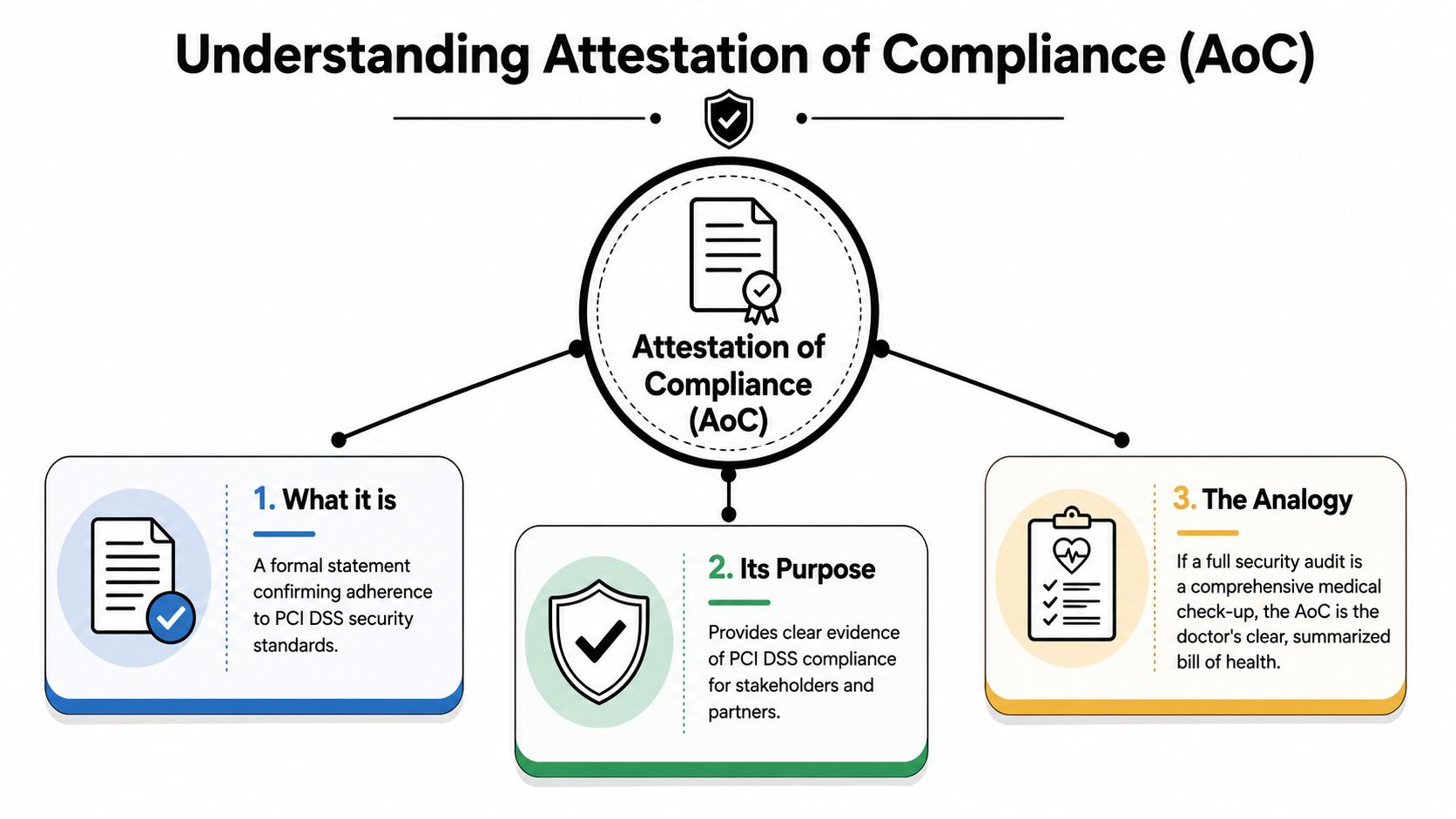
An Attestation of Compliance for PCI DSS is the formal declaration that follows a validated PCI assessment. It isn't the full audit itself, and it isn't a standalone control. It's the signed summary that says the organization completed the required assessment path and is attesting to the result.
A useful way to explain it to non-specialists is this: if the full assessment is the medical exam, the AoC is the doctor's signed note. The exam contains the detailed findings. The note is what you hand to the party that needs confirmation.
Why executives should care
The AoC sits at the intersection of compliance, commercial trust, and operational discipline. For many organizations, it's completed after either a Report on Compliance from a Qualified Security Assessor or a Self-Assessment Questionnaire, then submitted to the acquiring bank or payment brands as evidence of compliance, as described in this overview of PCI Attestation of Compliance validity and assessment paths.
The important business implication is that the AoC is typically valid for one year in that same source. That means leaders shouldn't think of PCI as a one-time hurdle cleared during procurement or before launch. It's an annual control cycle that affects budgeting, vendor reviews, architecture decisions, and operating procedures.
For enterprises deploying conversational AI, workforce tools, and omnichannel service platforms, the annual nature of the AoC has another consequence. Every material platform change can reshape your evidence story for the next cycle. That's one reason many teams now evaluate AI and automation tools partly through the lens of enterprise-grade security controls, not just feature fit.
What the AoC actually proves
The AoC proves that the organization followed the right documentation path for its level and environment. It does not prove that every system in the company is secure. It does not replace architecture review. It does not automatically cover adjacent services that touch the same customer journey.
That's where leaders often get burned. They hold a valid AoC, then add a new chat channel, cloud recording tool, or AI summarization service that changes the flow of cardholder data or related evidence. The document remains real, but the scope assumptions underneath it may no longer match the business.
The strongest AoC programs don't treat the form as the finish line. They treat it as the visible output of disciplined scoping, evidence collection, and vendor governance.
If you remember one thing, remember this: attestation of compliance PCI work is a declaration backed by assessment, not a badge that floats above your environment independent of how the environment operates.
AoC vs RoC vs SAQ A Practical Comparison
Most confusion around PCI documentation comes from mixing up three different things: the detailed assessment record, the self-assessment mechanism, and the formal declaration. Once those are separated, the reporting model becomes much easier to manage.
Public guidance describes PCI DSS reporting through a 12-requirement framework and a 4-level merchant classification model, with Level 1 merchants often defined as those processing 6 million or more card transactions per year, and those merchants must complete an annual RoC by a QSA and also provide an AoC, while smaller merchants in Levels 2, 3, and 4 generally complete an SAQ, obtain passing vulnerability scans where applicable, and submit the relevant AoC with supporting evidence, according to Square's overview of PCI compliance levels and reporting.
PCI Compliance Documents Compared AoC vs RoC vs SAQ
| Attribute | Attestation of Compliance (AoC) | Report on Compliance (RoC) | Self-Assessment Questionnaire (SAQ) |
|---|---|---|---|
| Primary purpose | Formal declaration of PCI DSS assessment outcome | Detailed audit report of PCI DSS controls | Structured self-assessment for eligible organizations |
| Typical depth | Concise summary document | Extensive, detailed assessment record | Guided questionnaire with evidence support |
| Who usually prepares it | Merchant or service provider, often with assessor involvement depending on path | Qualified Security Assessor for applicable entities | Internal team for eligible organizations |
| Who receives it | Acquiring bank, payment brands, partners, customers in diligence contexts | Typically provided where full assessment evidence is required | Used to support self-validation and related submission requirements |
| When it appears | After validated assessment work is complete | As part of a full on-site assessment path | When an organization qualifies for self-assessment |
| Best way to think about it | The signed declaration | The full exam record | The guided self-review |
Which path usually applies
The practical question isn't “Which document is better?” It's “Which path applies to our operating model?”
For large enterprises with broad payment exposure, the RoC is usually the heavy-lift document. It captures the detailed testing and control review. The AoC then acts as the concise attestation tied to that result.
For smaller or lower-complexity environments that qualify for self-assessment, the SAQ becomes the operating vehicle. But even there, the AoC still matters because it's the formal declaration that accompanies the assessment path.
A few decision points help:
- High transaction volume or high risk profile: expect a more formal path and deeper assessor involvement.
- Smaller merchant environments: expect self-assessment options, assuming the architecture fits the relevant criteria.
- Outsourced payment handling: don't assume this removes your own reporting duty. It may reduce scope, but it doesn't erase responsibility.
- Mixed-channel environments: voice, chat, agent desktops, and back-office workflows often create enough complexity that document selection deserves early review.
What doesn't work is choosing the easiest document first and trying to force the environment to fit it later. Teams do this when they want the simplicity of self-assessment while running a payment stack that clearly involves broader dependencies and operational touchpoints.
Executive test: Ask your team to explain, in plain language, why your organization is on its current assessment path. If the answer is mostly acronym recitation, push deeper.
The AoC, RoC, and SAQ are not competing artifacts. They are related outputs in a reporting system built to align validation effort with organizational scale and payment risk.
The Path to Obtaining Your PCI AoC
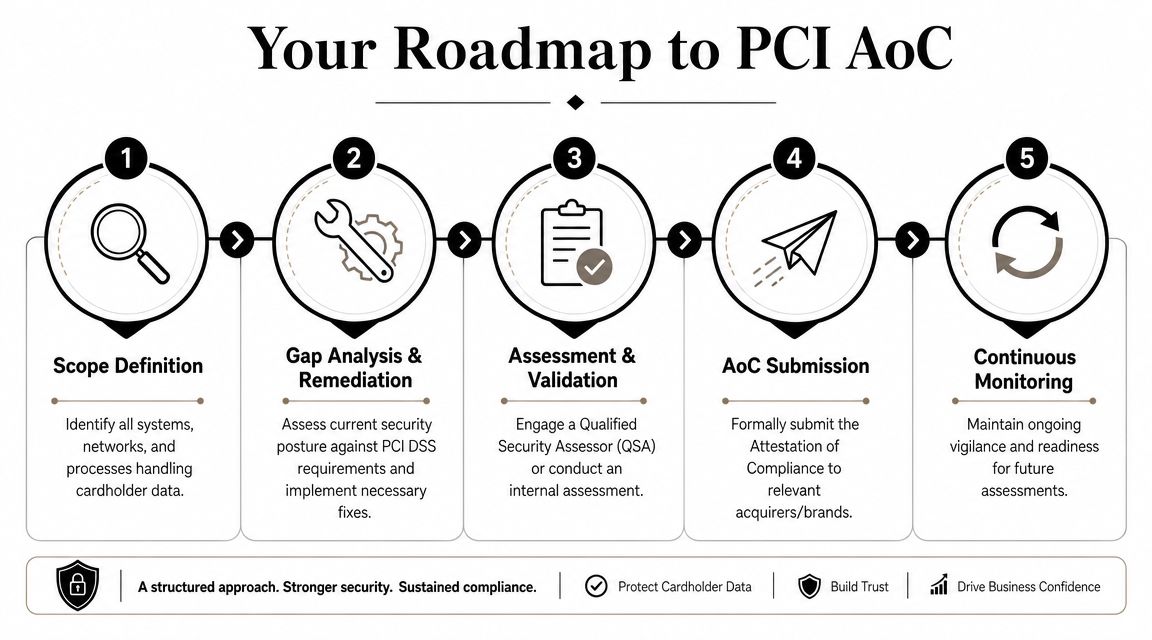
Organizations often start with the form because it looks tangible. That's backward. The essential work begins with scope.
Start with scope not paperwork
A technical PCI AoC process is primarily a scope-and-evidence exercise. Organizations must identify all systems that process, store, or transmit cardholder data, define the Cardholder Data Environment, and preserve evidence such as network diagrams, data-flow charts, configuration settings, logs, and third-party processor agreements, as outlined in Exabeam's explanation of the PCI AoC process.
That's the most important sentence in this article from an operating perspective. If your scope is wrong, the rest of the exercise becomes theater.
In modern environments, scope errors usually come from one of four places:
- New channels added. A digital team launches payment support in chat or messaging without routing the change through PCI review.
- Telephony assumptions. Leaders think DTMF masking, call recording controls, or IVR segmentation were handled by a vendor, but no one verified exact boundaries.
- Cloud sprawl. Logs, backups, analytics exports, and workflow automations create hidden copies or pathways tied to cardholder processes.
- AI feature drift. Summarization, transcription, or model-adjacent tooling touches sensitive conversations in ways that weren't in the original design.
A short prep exercise can prevent expensive rework. Many teams use an internal audit worksheet for assets, evidence, owners, and dependencies. If you need a practical starting format, this IT security audit checklist is useful for organizing the inventory and review process before formal PCI validation begins.
Build the evidence before the form
Once scope is defined, the next phase is gap analysis, remediation, and evidence assembly. The teams that move smoothly here don't just collect screenshots. They build a defensible proof set tied to actual controls and ownership.
That usually means gathering:
- Architecture artifacts such as network and data-flow diagrams.
- Control records including configurations, logs, and access evidence.
- Third-party documentation for payment processors and any vendor with in-scope responsibility.
- Remediation tracking so exceptions don't disappear into email threads.
This video gives a useful visual primer on the broader PCI process and where attestation fits in the workflow.
Submit it and treat it as an operating cycle
After the assessment work is complete, the organization completes the correct AoC and submits it through the required channel. That step sounds administrative, but it's where inaccurate scoping, unresolved remediation, and weak vendor documentation tend to surface.
The best programs make one strategic choice early: they actively try to shrink the Cardholder Data Environment. Fewer in-scope systems mean fewer control owners, fewer evidence gaps, and a cleaner reassessment next cycle.
What works is disciplined reduction of where card data can appear. What fails is allowing card data to drift into recordings, transcripts, workflow notes, exports, and convenience integrations merely because those tools were already licensed and easy to connect.
Understanding Merchant and Service Provider Responsibilities
The most dangerous myth in PCI is that a compliant vendor makes the merchant compliant by association. It doesn't.
Outsourcing changes how responsibilities are divided. It does not remove the merchant's obligation to understand, validate, and attest to its own environment. That's especially relevant when the business uses payment processors, cloud platforms, contact centers, and AI vendors together.
Outsourcing changes the control map
The AoC is the formal document used by merchants and service providers to confirm the outcome of a PCI DSS audit. Visa's security program requires participants to demonstrate compliance on a regular basis, and states that entities storing, processing, or transmitting Visa cardholder data must complete an annual on-site PCI assessment and submit an executed AoC signed by the service provider and the acquiring bank, according to Strike Graph's discussion of PCI Attestation of Compliance and Visa program expectations.
The business lesson is straightforward. Service providers attest to the controls in their domain. Merchants attest to the controls and obligations in theirs. Those two facts coexist.
If your company uses a hosted payment page, outsourced contact center, or managed voice system, your scope may narrow. But your due diligence burden rises because you now depend on external evidence, contract language, and service descriptions to prove where responsibility begins and ends.
A vendor can reduce your PCI burden. A vendor cannot erase your need to understand your own payment environment.
What leaders should require from internal teams
C-level leaders don't need to know every testing procedure. They do need a crisp operating model. Ask internal teams to produce three things:
- A responsibility map. Which PCI controls are owned internally, which are assigned to service providers, and which are shared?
- A service inventory. Which vendors touch payment-related workflows, directly or indirectly?
- A review cadence. How often are vendor attestations, contracts, and architectural assumptions revisited?
What works is explicit shared-responsibility documentation tied to specific services. What fails is relying on generic vendor security language that never names the workflows your business operates.
That failure pattern shows up most often in omnichannel CX programs, where cardholder interactions may begin in one channel, shift to another, and end in a back-office process owned by a different team. If responsibility isn't mapped at that level, the annual attestation becomes much harder than it needs to be.
Assessing Vendors The AoC in Your Modern Tech Stack
A vendor AoC is important. It is not the end of diligence. It is the start of informed questioning.
That matters more now because enterprise payment handling no longer sits in one obvious system. Customer interactions pass through cloud infrastructure, conversation platforms, recording tools, workforce systems, analytics pipelines, and AI features that generate summaries or automate actions.

What to check in a vendor AoC
The PCI Security Standards Council's merchant Attestation of Compliance is explicitly tied to the merchant's own assessment path and documentation set, not a blanket pass-through from a vendor. Merchants may still need to complete the relevant SAQ or AoC even when parts of card handling are outsourced, and that gap is especially important in omnichannel operations that split card data flows across telephony, chat, IVR, and back-office tools, as shown in the PCI SSC merchant AoC documentation.
So when a vendor sends an AoC, check more than the presence of the PDF. Ask:
- Is it current? A stale attestation creates commercial and audit friction immediately.
- What exact service does it cover? An AoC tied to one hosted payment component may not cover adjacent AI services, analytics features, or recordings.
- What environment is in scope? Regional hosting differences, product modules, and deployment models matter.
- What assumptions does it make about the customer? Some vendors secure their platform well but place key control obligations on the customer configuration.
Questions for AI cloud and contact center vendors
In this context, practical diligence separates mature programs from box-checking.
Ask pointed questions such as:
- Where can card data appear in voice transcripts, chat logs, agent notes, or ticket exports?
- Is payment data redacted before storage, or only masked in the user interface?
- Are recordings paused, segmented, or suppressed during card capture?
- Is any customer conversation data used in model training, tuning, or quality workflows?
- Which integrations can move payment-adjacent data into CRM, analytics, or warehouse systems?
- If the vendor uses sub-processors, which ones are relevant to payment workflows?
For example, if an enterprise is evaluating conversational automation, it should inspect whether the platform supports PCI-aligned capture controls and how those controls apply across channels. One option in this category is Yellow.ai, which states that it supports PCI-compliant data capture across channels and has PCI-DSS validation as a service provider for its scoped environment. That kind of statement is useful, but the diligence still has to continue into product scope, deployment model, logging behavior, and integrations.
Due diligence standard: If a vendor answer sounds broad enough to apply to any product in their catalog, it probably isn't specific enough for your payment workflow.
What works is service-specific review. What fails is accepting enterprise-wide security claims when the risk sits in one narrow workflow, such as payment handling through voice AI, chat escalation, or agent desktop handoff.
Maintaining Compliance An Enterprise Readiness Checklist
The organizations that handle PCI well don't scramble once a year. They build rhythms that keep scope, evidence, and vendor oversight current as the tech stack changes.
The operating disciplines that prevent drift
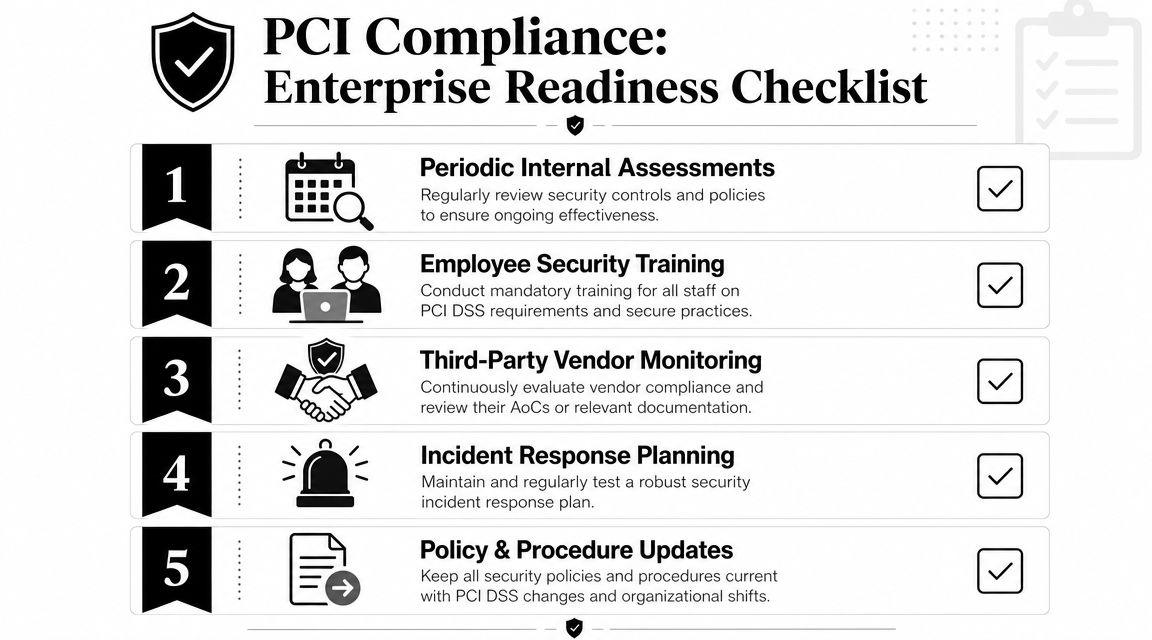
Use this as an executive readiness checklist:
- Recheck scope whenever the stack changes. New bots, routing flows, speech tools, CRM integrations, and cloud logging paths can alter PCI exposure quickly.
- Review vendor evidence on a defined cadence. Don't wait for procurement or a partner questionnaire to discover that a critical provider's documentation is outdated.
- Keep diagrams and data flows current. If your architecture deck doesn't match production reality, your attestation effort will slow down fast.
- Require evidence owners, not just shared folders. Every control area should have a named team responsible for producing and defending proof.
- Tie PCI operations to broader data governance. A solid guide to robust data protection can help teams align payment-specific controls with enterprise data handling discipline.
- Run readiness reviews before annual filing pressure starts. Mature teams use recurring operating checklists rather than rediscovering control gaps late in the cycle. For teams building that cadence, structured security and operations checklists can help standardize review points across functions.
The practical goal isn't perfection. It's readiness. If leadership can ask, “Where does card data touch our CX stack, who owns the controls, and what evidence supports that answer?” and get a clear response, the annual AoC becomes manageable instead of disruptive.
If your enterprise is modernizing payment-related customer interactions across voice, chat, and automation, Yellow.ai is one platform to evaluate as part of that architecture. Review it the same way you should review any vendor in this space: confirm the scoped PCI posture, validate how card data is captured and protected across channels, and map those capabilities to your own responsibility model before you rely on them in production.



