













A voice clone can be created from just three seconds of audio, with McAfee's 2023 research later summarized as achieving about an 85% voice match from that short sample (StationX's deepfake statistics overview). For enterprise leaders, that threshold changes the buying question. AI voice cloning software is no longer only a creative production tool. It can shape customer experience, employee experience, identity workflows, operational cost, and fraud exposure at the same time.
Table of Contents
- Introduction Why AI Voice Cloning Matters Now for Enterprises
- How AI Voice Cloning Software Works Today
- Detailed Comparison of Voice Cloning Approaches and Deployment Models
- Key Capabilities and Security Criteria Every Buyer Should Evaluate
- Real World Use Cases for AI Voice Cloning in CX and EX
- Pricing Models and Total Cost Considerations for Large Organizations
- How to Choose the Right AI Voice Cloning Software for Your Enterprise
Introduction Why AI Voice Cloning Matters Now for Enterprises
Voice cloning now belongs in the same procurement discussion as other enterprise AI capabilities. CX leaders may seek recognizable voices for automated service, global organizations may require wider language coverage, and operations teams may want voice agents with more natural responses than older text-to-speech systems. CIOs must assess whether those benefits can be delivered with consent controls, data protection, monitoring, and reliable integration.
The risk is scaling alongside adoption. One independent security summary reported that voice deepfakes rose 680% year over year in 2024 (Bright Defense's deepfake statistics research). It also cites Pindrop's 2025 Voice Intelligence and Security Report, which reported a 1,300% increase in deepfake fraud attempts across industries in 2024, from about one attempt per month to seven per day. These figures do not establish that every enterprise deployment is unsafe. They do show why a convincing voice is only one procurement criterion.
Risk depends on the workflow. A brand voice for outbound notifications carries a different exposure from a voice used in account recovery. A multilingual employee assistant has different latency and privacy requirements from a public support agent. A BPO may need to create and refresh many approved voices quickly, while a regulated institution may prioritize documented consent, access controls, and auditable handling of audio assets.
Selection should therefore connect product capability to operating conditions. Buyers need to evaluate voice quality, latency, language coverage, setup speed, fraud resistance, compliance, integration, and total cost together. Latency affects customer patience and agent productivity. Language coverage affects regional consistency and maintenance. Fraud resistance and compliance determine whether a voice can enter identity-sensitive workflows.
The right choice is the architecture that fits the organization's risk tolerance, scale, and governance model, rather than the platform that produces the most convincing isolated sentence.
How AI Voice Cloning Software Works Today
AI voice cloning combines a reference recording with speech synthesis. The system analyzes pitch, cadence, accent, resonance, and pronunciation, then represents those characteristics in a form that can generate new speech from text. For enterprise buyers, the workflow has four operational stages:
- Collect reference audio. The organization records or uploads a sample from the voice owner.
- Clean and process the recording. The platform removes silence and distracting background noise before analysis.
- Extract the speaker identity. A voice encoder or related model converts vocal characteristics into a reusable representation.
- Synthesize and deploy speech. The system applies that representation to new text and connects the output to an application, agent, or contact-center workflow.
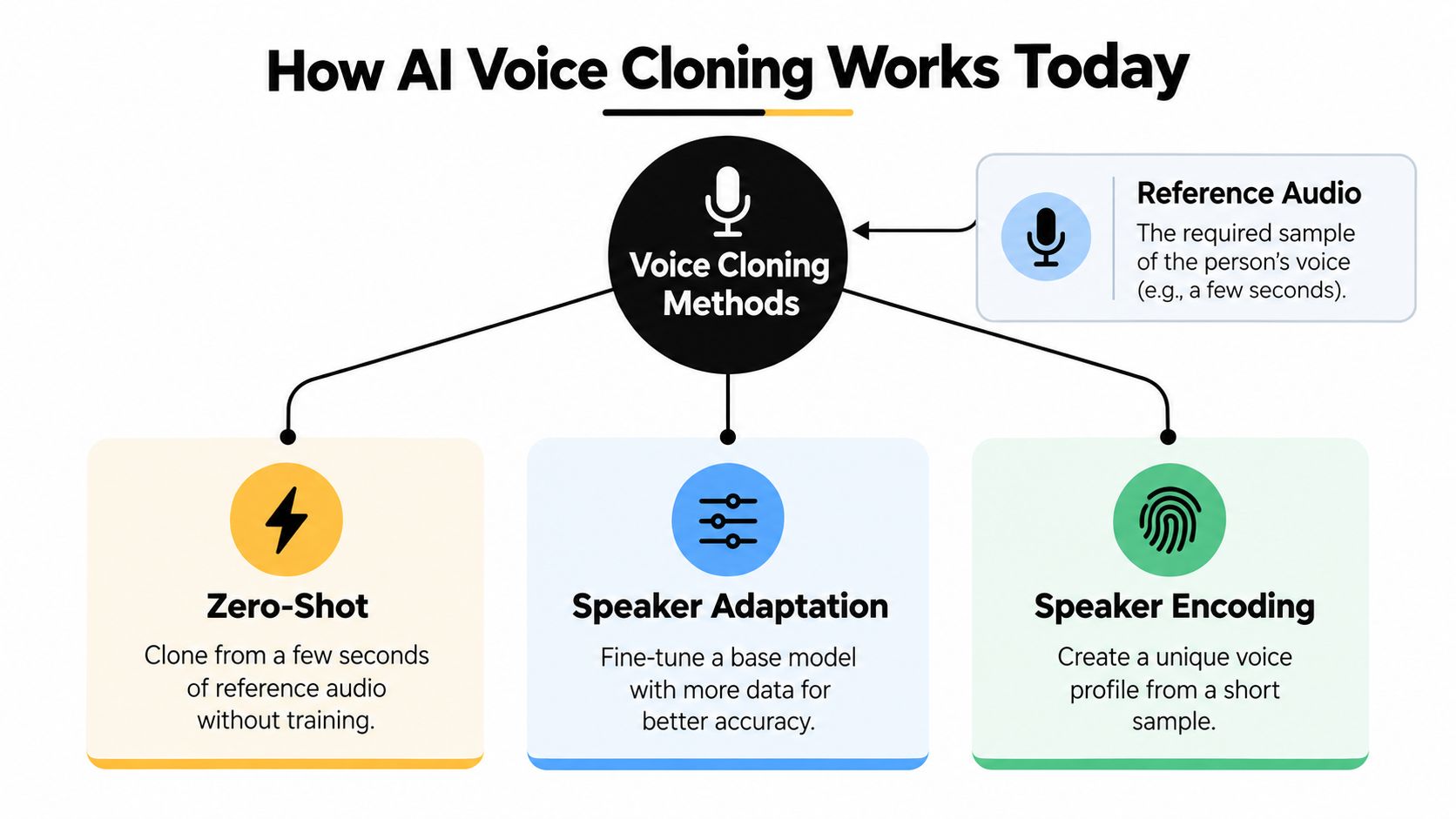
The main architectural difference is the amount of model-specific training required after enrollment. Zero-shot cloning uses a pretrained model to generate a voice from a small reference sample, without a separate training cycle for each speaker. A University of Groningen thesis found that 6 to 10 seconds of clean audio can support most uses, while 20 seconds approached maximum quality and further data added little benefit (University of Groningen thesis). That lower enrollment burden supports rapid pilots, but it also increases the need for verified consent and controlled voice provisioning.
Three methods create different operating burdens
Speaker adaptation fine-tunes a base model for a particular voice. It can provide detailed control, but training and refreshes require more time and operational support. Speaker encoding creates a speaker representation from a short sample and uses that identity with a synthesis model, making it better suited to rapid creation and repeated iteration.
Comparative research shows the deployment difference. The Neural Voice Cloning with a Few Samples paper reported speaker-adaptation methods taking roughly 8 hours, while speaker-encoding methods completed cloning in about 0.5 to 5 minutes (NeurIPS paper on neural voice cloning). For a contact center, that affects how quickly approved voices can be created, refreshed, tested across languages, and connected to production workflows. It also changes the control burden: faster creation requires stronger approval gates, asset inventories, and monitoring.
Low enrollment friction makes governance part of the technical design. Buyers should require consent verification, role-based access, retention rules, audit logs, and controls for detecting unauthorized or manipulated speech. Audio quality determines whether a voice is usable. Governance determines whether it can be used safely at enterprise scale.
Detailed Comparison of Voice Cloning Approaches and Deployment Models
The right method depends on how often the enterprise creates voices, how much control it needs over the output, and how quickly the voice must reach production. A single brand voice for a controlled notification library doesn't have the same requirements as a BPO supporting many clients and languages.
| Approach | Setup Time | Data Needed | Best For | Trade Off |
|---|---|---|---|---|
| Zero-shot cloning | Short workflow using reference audio | A short, clean sample can be sufficient | Fast pilots, agent prototyping, accessible voice enrollment | Output quality can vary with audio quality, language, and context |
| Speaker adaptation | Roughly 8 hours in the cited comparison | More data and a model-specific training process | Stable voice identity where fine control matters | Slower creation and more effort when voices need frequent refreshes |
| Speaker encoding | About 0.5 to 5 minutes in the cited comparison | A short reference sample | High-volume voice creation and rapid iteration | Requires careful evaluation of prosody, pronunciation, and policy controls |
| Cloud deployment | Vendor-hosted processing and delivery | Audio and runtime data handled under vendor terms | Fast rollout, elastic capacity, broad integrations | Less direct infrastructure control and greater diligence around data handling |
| Hybrid deployment | Workloads divided between enterprise and vendor environments | Defined data-routing and retention design | Organizations balancing control with managed AI capability | More architecture, monitoring, and integration complexity |
| On-premise deployment | Dependent on internal infrastructure and model operations | Enterprise-managed audio, models, and runtime assets | Strict control requirements and highly constrained environments | Higher operational burden and potentially slower access to model updates |
The setup-time comparison is especially relevant for multi-voice environments. Speaker encoding can support fast experimentation and operational replacement, while adaptation may be justified when a particular voice needs more extensive tuning and will remain stable for a long period. The buyer shouldn't interpret faster cloning as automatically better. Faster creation expands the need for approval gates, version control, and voice inventory management.
Deployment affects the risk boundary
Cloud models typically reduce infrastructure work and can simplify access to vendor-managed speech capabilities. Hybrid designs can keep selected data or systems under enterprise control while using managed synthesis services. On-premise designs may provide the strongest infrastructure control, but they place more responsibility on the enterprise for model performance, capacity, patching, monitoring, and disaster recovery.
Latency should be tested across the entire conversation path, not only at the synthesis endpoint. Speech generation, telephony, orchestration, retrieval, authentication, and handoff all contribute to the caller's experience. A highly realistic clone that pauses unpredictably can still make an agent feel artificial, while a less distinctive voice may perform better if it responds consistently and supports a clean escalation path.
Procurement rule: Treat cloning method and deployment model as separate decisions. A fast speaker-encoding workflow can run in a tightly governed environment, while a carefully adapted voice can still create unacceptable exposure if the runtime controls are weak.
Key Capabilities and Security Criteria Every Buyer Should Evaluate
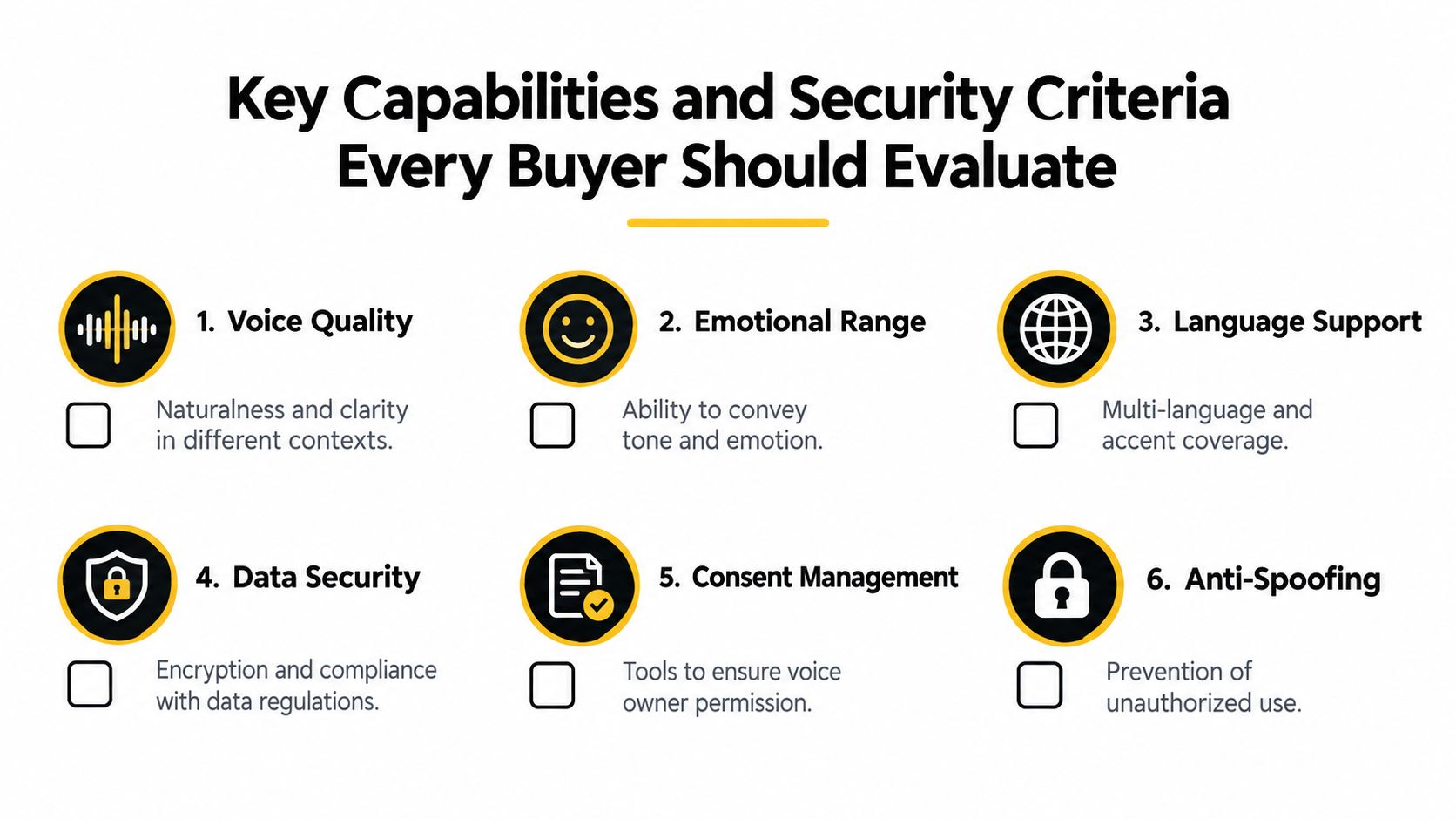
A polished demonstration says little about production readiness. Enterprise buyers should test AI voice cloning software with real scripts, noisy caller conditions, multilingual exchanges, interruptions, authentication flows, and human handoff. The assessment must cover the controls around the voice, because audio quality alone cannot show whether the system is safe to operate at scale.
Voice quality and emotional range
Test pronunciation for customer names, product terms, abbreviations, addresses, and business-specific numbers. Evaluate prosody in an apology, a service delay, a billing explanation, and a safety warning. A voice that sounds natural in a prepared greeting may still fail when it must change pace, emphasize a critical phrase, or recover after an interruption.
Emotional range should support the interaction rather than perform for it. Customer support generally needs calm, clear, empathetic delivery. Ask vendors how they define acceptable tone and how reviewers approve changes to prompts, scripts, and voice settings. Those review steps matter when one voice is reused across high-volume customer and employee workflows.
Language coverage and latency
Language count is only a starting point. Validate regional pronunciation, code-switching, names, local date conventions, and escalation behavior. Global CX teams should involve native speakers and compare the same workflow across markets, since a voice that performs well in one language may lose its intended character in another.
Latency requires testing across the full call path. Measure barge-in, clarification, knowledge retrieval, authentication, and transfer, not only synthesis speed. The operational question is whether the caller receives a timely, intelligible response while the agent completes the necessary work. In a contact center, unpredictable pauses can reduce trust even when the generated voice sounds highly realistic.
Security and fraud resistance
A cloned voice is an identity asset that attackers may misuse. Governance should specify who can submit samples, who can approve a clone, where recordings are stored, how access is revoked, and how suspicious output is investigated. Synthetic voices already appear at measurable scale in enterprise call traffic. One security roundup reported that synthetic voices represented 0.33% of Q4 2024 contact-center calls, up 173% from Q1 2024 (Bright Defense's deepfake statistics research).
Security differentiator: Treat authenticity as only one quality dimension. Require evidence that the platform can prevent unauthorized cloning, detect misuse, maintain audit records, and support rapid response.
Compliance and integration
Consent should be explicit, recorded, time-bounded where appropriate, and tied to approved use cases. Legal and privacy teams should determine whether a voice sample qualifies as personal data in relevant jurisdictions. They should also review retention, deletion, and cross-border processing against internal policy.
Integration determines whether the voice can operate within the enterprise stack. Inspect connectors for telephony, CRM, workforce systems, knowledge bases, identity services, analytics, and human escalation. Yellow.ai's enterprise-grade security approach offers one reference point for reviewing governance, compliance, and protected enterprise deployment. Compare those controls with internal requirements, rather than treating a compliance page as proof of deployment readiness.
Real World Use Cases for AI Voice Cloning in CX and EX
A branded support voice can create continuity across automated calls, self-service, and outbound notifications. The use case works best when the organization controls the scripts, labels automated interactions clearly, and provides a straightforward path to a human. It becomes less suitable when the voice could be mistaken for a real employee during a sensitive decision or when the business lacks an approval process for changing customer-facing language.

A global retailer might use a consistent voice identity across markets, but language coverage must be validated rather than inferred from a vendor's language list. Native reviewers should check whether the cloned voice preserves the brand's intended character in each language and whether the agent can switch languages without confusing the caller. A short enrollment process helps, but it doesn't remove the need for local quality assurance.
Employee experience offers a different pattern. An HR assistant can use a familiar voice for policy navigation, benefits questions, or internal IT guidance. Because employees may disclose sensitive information, the deployment needs access controls, data minimization, and clear boundaries around what the assistant can reveal. A cloned executive voice should be avoided for approvals, payment instructions, or other workflows where voice familiarity could create undue authority.
BPOs and service providers may gain operational flexibility from rapid voice creation, especially when supporting multiple brands or campaign types. They also inherit a larger governance problem: each client needs documented rights, isolated assets, approval records, and a defined retirement process. The Waste Connections voice AI case study illustrates how voice AI can be evaluated in a customer-support context, but buyers should still test whether the same operating model fits their own call types and risk controls.
A useful pilot should include one low-risk customer workflow, one multilingual path if relevant, and one sensitive escalation scenario. Record failure modes, not just successful conversations.
Pricing Models and Total Cost Considerations for Large Organizations
Enterprise quotes for AI voice cloning software often combine several pricing mechanisms. Per-minute pricing links cost to generated or connected audio volume, which can suit variable contact-center demand. Per-seat pricing is easier to forecast for employee-facing tools, but it may not reflect heavy usage differences. Per-clone pricing ties cost to the number of approved voices, while a platform bundle may combine voice, orchestration, analytics, integrations, and governance.
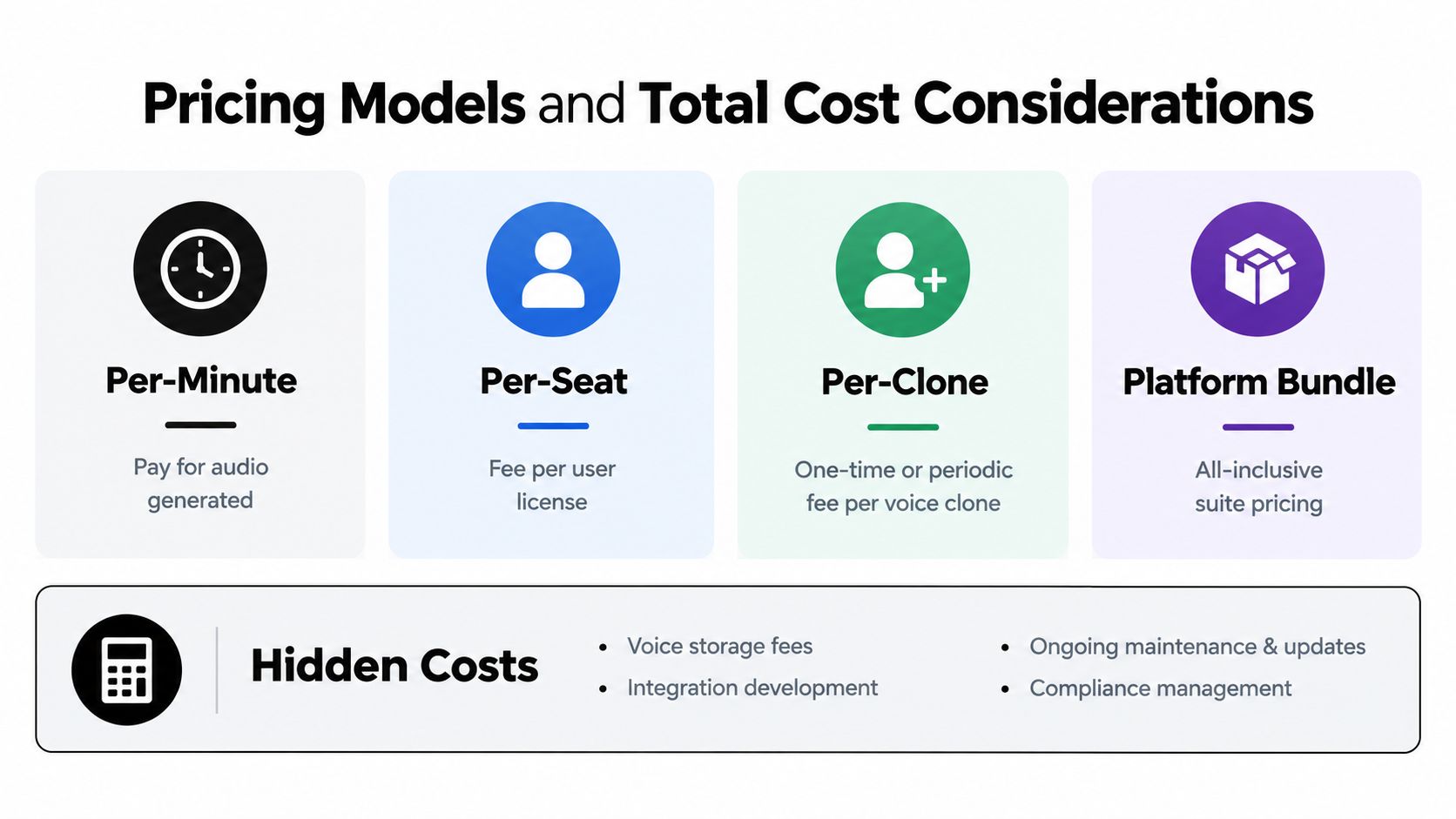
The quoted unit price isn't the total cost. Finance and procurement should model voice enrollment, sample review, storage, testing, integration work, monitoring, compliance evidence, fraud detection, support, and voice retirement. A low per-minute rate can become unattractive if every new language requires custom engineering or if the platform charges separately for routing, recording, analytics, and human transfer.
Build an apples-to-apples forecast
Ask each vendor to price the same operating scenario:
- Traffic profile: Include expected interaction volume, call duration, peaks, retries, and transfers.
- Voice inventory: Count brand voices, employee voices, campaign voices, and client-specific voices.
- Language scope: Include translation, pronunciation review, and local quality assurance.
- Control requirements: Price consent workflows, audit logs, access management, retention, and detection.
- Change frequency: Estimate how often scripts, models, voices, and integrations require testing or refreshes.
Industry context changes the cost pattern. BFSI buyers may spend more effort on fraud controls and auditability. Healthcare teams may prioritize privacy and sensitive-data handling. Retail and logistics may care more about seasonal capacity, multilingual coverage, and integration with order or delivery systems.
Before accepting a bundle, ask what happens when usage grows, when a voice is withdrawn, or when the organization needs to export records. Yellow.ai's pricing information can be used as a starting point for questions about packaging, but every enterprise should request a workload-specific proposal with assumptions documented.
How to Choose the Right AI Voice Cloning Software for Your Enterprise
Start with the workflow, not the voice. Define the caller, the information exchanged, the consequence of an error, the required languages, the response-time target, and the human fallback. Then select the cloning and deployment model that fits those constraints.
A global CX leader should prioritize language validation, orchestration, monitoring, and rapid voice governance over a single-market quality demo. A CIO focused on compliance should require documented consent, data controls, audit trails, retention management, and flexibility across models and integrations. An operations leader focused on fast interactions should test end-to-end latency under realistic load, including interruptions and transfers.
Use a pilot scorecard that records:
- Experience: Naturalness, pronunciation, emotional appropriateness, and accessibility.
- Operations: Setup effort, change control, analytics, handoff, and support.
- Risk: Consent, permissions, fraud resistance, detection, and incident response.
- Economics: Usage assumptions, implementation work, storage, governance, and renewal terms.
Run the pilot with real business terminology and representative users. Involve security, privacy, legal, contact-center operations, and frontline agents before production approval. The strongest choice may be a zero-shot or speaker-encoding approach for rapid scale, or speaker adaptation for a stable, tightly controlled voice. Neither is universally correct.
The enterprise standard should be voice quality plus operational control. If the vendor can't explain how a voice is authorized, monitored, refreshed, and retired, the realism of the output shouldn't determine the purchase.
Yellow.ai provides enterprise voice capabilities for cloning an approved voice from a short sample, deploying voice agents across broad language coverage, and connecting conversations with enterprise workflows and integrations. Visit Yellow.ai to evaluate how its voice AI platform could fit your CX or EX pilot, governance model, and scale requirements.



