














Most advice on an AI voice agent platform is backward. Buyers get told to compare language counts, demo latency, and voice quality first, then hope compliance and scale work out later. That's exactly how teams end up with a polished pilot that can't survive outbound legal review, load spikes, or the messier reality of production handoffs.
The decision is simpler and harsher. First, decide which lane you're buying into, developer-first, enterprise contact center, or no-code orchestration. Second, decide whether the platform can legally and operationally support outbound calling. Third, decide whether it stays responsive when the conversation gets messy and concurrency rises.
Everything else is secondary. A platform can sound great in a sandbox and still fail the only test that matters, live calls with real customers, real systems, and real risk.
Table of Contents
- Why Most AI Voice Agent Platform Comparisons Miss the Critical Decision
- What an AI Voice Agent Platform Is
- Latency, Voice Cloning, and the Multi-LLM Architecture Trap
- Choosing the Right Lane for Your Stack
- Compliance Architecture for Outbound and Inbound Voice
- ROI, Metrics, and the Business Case That Holds Up
- Vendor Evaluation Checklist and RFP Questions
Why Most AI Voice Agent Platform Comparisons Miss the Critical Decision
Most comparison pages treat every AI voice agent platform as if it solves the same problem. It does not. A platform for developer-led pilots, a platform inside a contact center stack, and a no-code business tool can all produce the same polished demo, then fall apart once approvals, telephony, compliance, or ownership land on the table.
The three questions that decide whether it ships
The first question is the deployment lane. Are you buying a control layer for engineers, a suite that sits inside CCaaS, or a lightweight tool for business users? RetellAI's buyer guide, summarizing Rasa guidance, pushes buyers to score vendors on P95 latency, telephony and CCaaS support, language coverage, tool integration depth, and pricing at projected 12-month volume, not demo speed, because those factors shape total cost of ownership and the rollout path (Rasa guidance summarized in the buyer guide).
The second question is outbound safety. A platform that can talk is not automatically a platform you can use for outbound calling. Consent capture, disclosure, escalation, and auditability decide whether legal and operations will let the project move at all.
The third question is load behavior. A demo at five concurrent calls tells you almost nothing about what happens when queues spike, a model slows down, or a caller interrupts mid-response. Two vendors can post similar numbers in a sales deck and still behave very differently in production.
Practical rule: If a vendor cannot explain how it behaves when concurrency rises, treat the demo as marketing, not evidence.
What this article covers and what it ignores
This is not a feature checklist. It is a buyer framework for teams that need voice automation to survive real calls, real governance, and real procurement. The focus is on deployment lane, compliance architecture, latency under load, and the architecture choices that create or remove operational risk.
Some things get less attention on purpose. I am not ranking vendor voices by aesthetics, and I am not pretending language count is the main differentiator. The category has already moved past experimentation, with the broader market measured in the low billions and growing quickly, including USD 2.54 billion in 2025 and a projected USD 35.24 billion by 2033 in Grand View Research's estimate (Grand View Research). The question is not whether the category matters. It is which platform will ship in your environment.
For teams comparing vendors that also offer workflow builders, the relevant question is whether the platform can support the operational path you need, as shown in Yellow.ai's AI agent builder.
What an AI Voice Agent Platform Is
An AI voice agent platform is the control plane that coordinates speech, language, routing, orchestration, and integrations so a caller can talk naturally and the system can do something useful with that conversation.
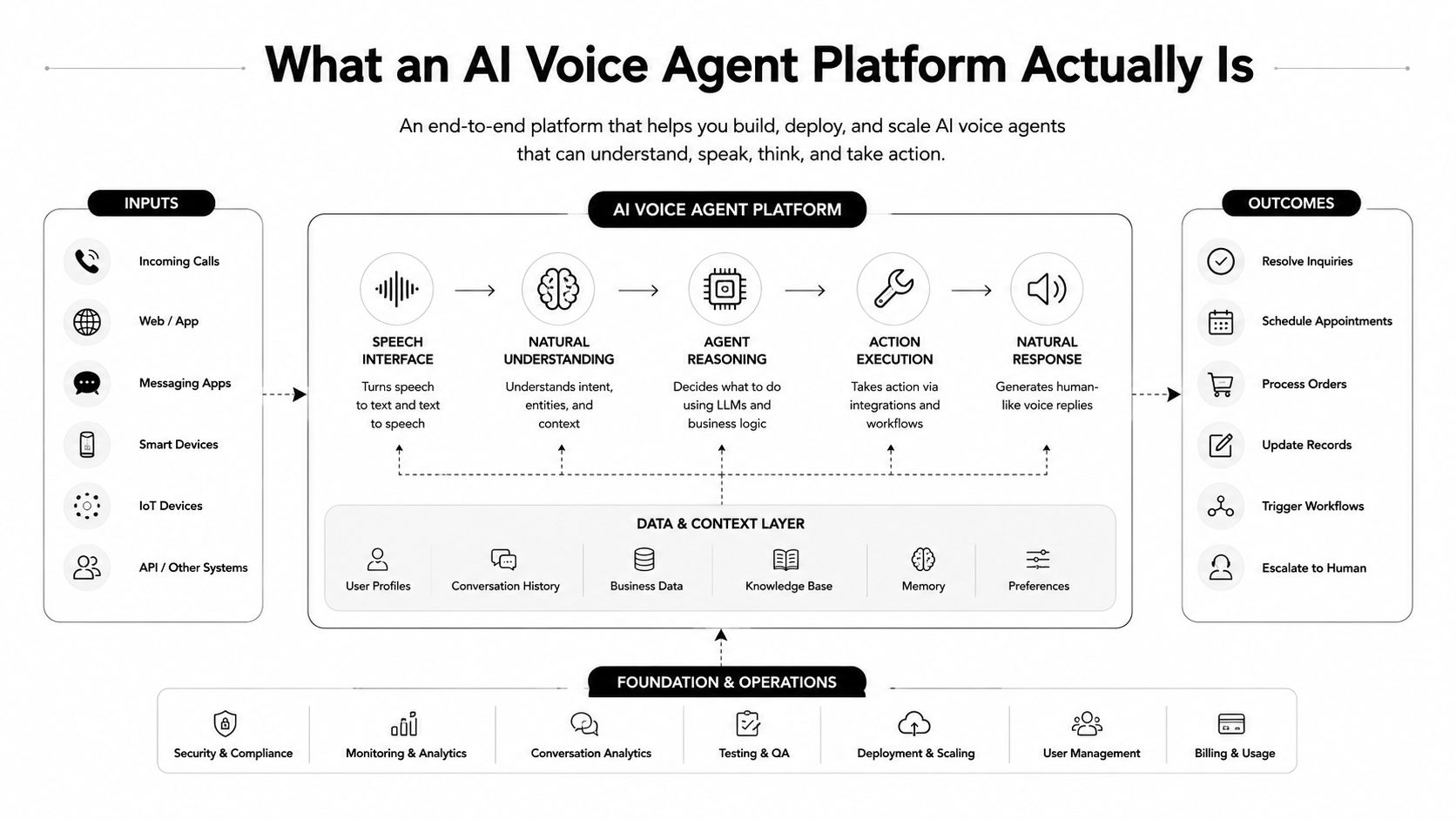
The stack has clear layers. The channel layer is telephony, web voice, or another entry point. The speech layer handles speech recognition and synthesis. The brain layer is where the LLM, tools, and policy logic live. The control plane sits above all of that, deciding what model to call, when to escalate, what data to fetch, and how to log the result.
The platform is the coordination layer, not just the model
A standalone speech API can transcribe or speak. A chatbot can answer text. An IVR can route calls with menus. A production platform has to do all of those things in a coordinated loop, in real time, under enterprise constraints. That is why the category belongs with orchestration software, not with a single model.
The practical use cases are easy to spot. Voice cloning matters when a brand wants a consistent voice identity across regions or products. Multilingual support matters when one contact center serves multiple markets. Low-latency orchestration matters when a customer interrupts, changes topic, or asks for a human. Enterprise integrations matter when the agent needs to check an order, update a ticket, or authenticate a caller without leaving the call.
The internal link worth keeping in mind is the platform builder itself, because that is where orchestration turns into a working workflow, not just a prompt chain. Yellow.ai's AI Agent Builder is one example of that broader control-plane idea.
A voice agent that cannot take action is just a talking FAQ.
The five capability blocks that matter in production
You need speech, reasoning, tools, channels, and governance. If one of those is missing, the system usually falls back to a brittle script or a human handoff. That can still be useful, but it is not a real platform play.
The best mental model is simple. The speech layer makes the call feel natural. The reasoning layer decides what the caller means. The tool layer connects the conversation to backend systems. The channel layer determines where the conversation starts and ends. The governance layer decides whether the whole thing is safe enough to run.
That is the difference between an interesting demo and a deployable system.
Latency, Voice Cloning, and the Multi-LLM Architecture Trap
If the call feels awkward, callers don't blame the architecture. They just feel like they're talking to a machine. That's why production voice work lives or dies on timing, not on feature count.
The 800 ms ceiling is the hard part
A production-grade platform needs an end-to-end latency budget below about 800 ms for natural turn-taking, and the biggest controllable bottleneck is often LLM time-to-first-token, which can consume around 400 ms of that budget (Softcery). That matters because callers notice hesitation instantly. A half-second of dead air can make a good agent feel broken.
The wrong way to think about this is sequentially. Teams often imagine the stack as speech in, model work, speech out. In practice, you have to optimize VAD, streaming ASR, and streaming TTS in parallel. Even if transcription is solid and synthesis is fast, a slow reasoning path makes interruptions and barge-in feel unnatural.
Why one big model is usually the wrong answer
The “one model solves everything” story is convenient for demos and terrible for production. Different tasks need different strengths. One model might be better for retrieval-heavy responses, another for structured tool use, another for fast fallback handling when the primary path is slow.
A multi-LLM architecture gives you routing control. It lets you send simple confirmations down a cheaper, faster path and reserve heavier reasoning for complex cases. It also reduces vendor lock-in, because you're not betting your whole voice stack on one provider's uptime, pricing, or behavior.
The architecture should decide which model speaks, not the sales deck.
This matters even more under load. Once concurrency rises, latency drift shows up fast. A platform that looks crisp in a controlled demo can become sluggish when the model queue backs up or a downstream tool call stalls. That's why I care more about routing policy and fallback behavior than about a vendor's prettiest voice sample.
Voice cloning needs consent, not just quality
Voice cloning gets too much glamour and not enough governance. The technical problem is whether the cloned voice sounds natural. The operational problem is whether you have permission to use it, store it, and prove that permission later.
A good platform separates voice configuration from policy enforcement. That way, teams can keep brand voice consistent without turning every call into a legal risk. It also makes the stack easier to evolve, because swapping a speech model or an LLM doesn't force you to rebuild the whole thing.
The categories that survive production are the ones that treat latency budget, model routing, and consent discipline as core design constraints, not optional tuning knobs.
Choosing the Right Lane for Your Stack
Buying the wrong kind of platform is one of the most expensive mistakes in this category. The market has split into three lanes, and each one wins for a different buyer profile.
Developer-first, enterprise suite, or no-code
Developer-first platforms fit teams that want control. They're good when engineering owns the stack, call flows are custom, and integrations matter more than hand-holding. You get flexibility, but you also inherit more responsibility for observability, release discipline, and telephony design.
Enterprise contact-center suites fit organizations modernizing an existing service operation. They make sense when the work has to sit beside current CX systems, routing policies, and governance processes. The trade-off is that implementation can be heavier, and the product is often opinionated about how the workflow should behave.
No-code tools fit business teams that need speed over depth. They're useful for narrow use cases, prototypes, and smaller operational teams. They break when the workflow gets complex, the routing logic multiplies, or the organization needs deep control over pricing and integrations.
What to score, not what to admire
Don't score vendors on who sounds most advanced. Score them on how they behave in your environment. The shortlist should include real P95 latency under load, telephony and CCaaS compatibility, language coverage, tool integration depth, and pricing at projected 12-month volume, because demo pricing rarely survives scale.
Yellow.ai is one enterprise example in the multi-lane category. It combines Nexus Vox, AI Agent Builder 2.0, a Conversational Knowledge Base with agentic RAG, and 150+ pre-built integrations across systems like Salesforce, Zendesk, Genesys, and Freshdesk, which makes it relevant for teams that need more than a point solution.
| Lane | Best fit | Failure mode |
|---|---|---|
| Developer-first | Custom workflows and product-led teams | Too much platform ownership |
| Enterprise suite | Contact center modernization | Slower implementation and heavier process |
| No-code | Narrow business use cases | Hidden limits at scale |
The point is not that one lane is universally better. It's that the wrong lane creates hidden costs in integrations, latency under load, and all-in pricing. Buyers should pick the lane that matches how they operate, not the one that demos cleanest.
Compliance Architecture for Outbound and Inbound Voice
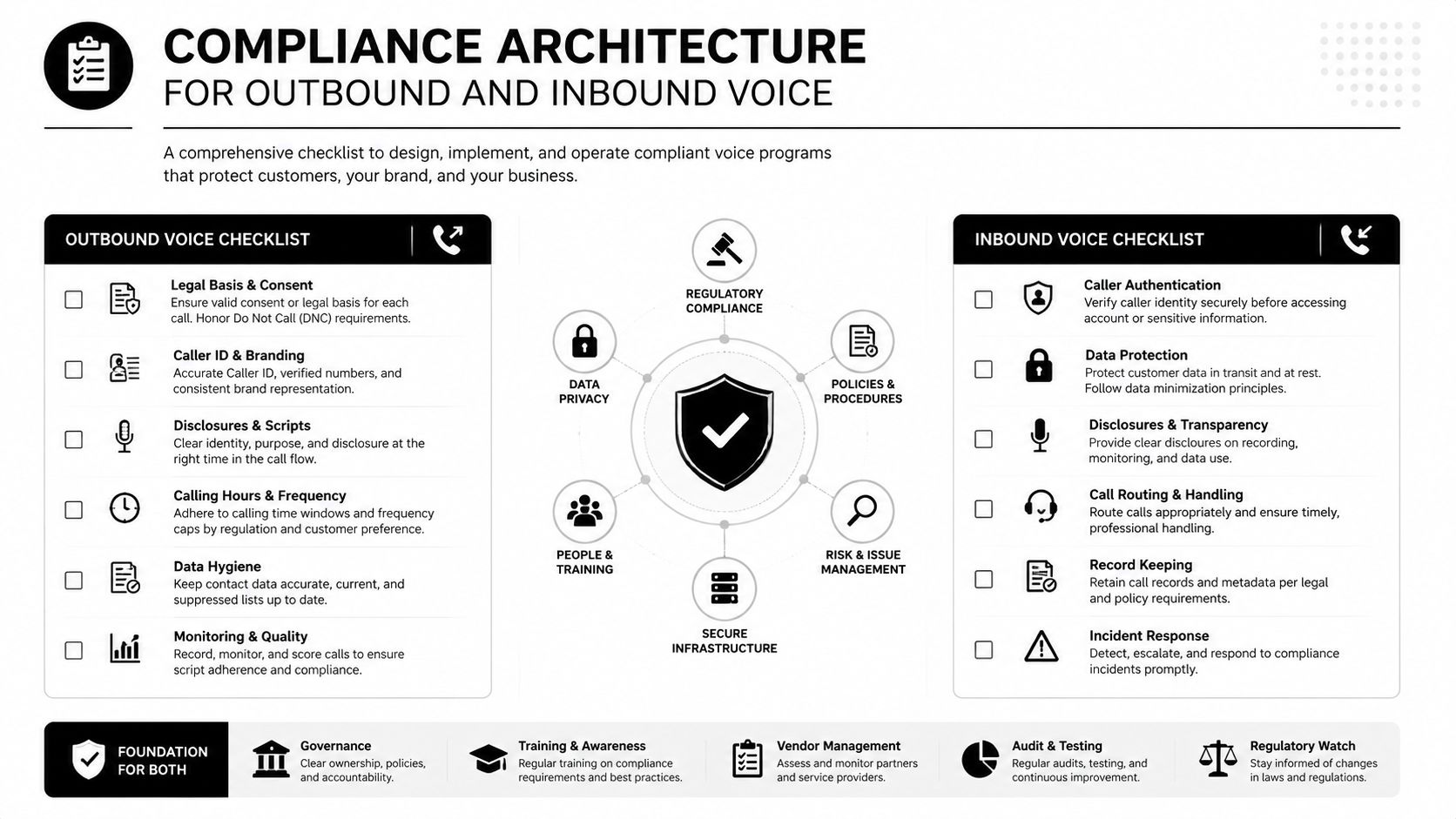
A voice platform that cannot survive legal review is not a platform. It is a prototype. Outbound calling makes that obvious fast, because governance is usually the first blocker, not speech quality.
Consent, disclosure, and the human escape hatch
One practitioner discussion notes that in the U.S., the Telephone Consumer Protection Act restricts automated or AI calls without prior consent, and valid consent has to be captured with date, time, and method stored for auditability. It also says every agent should have an immediate human escape hatch when a caller asks for a person or shows frustration (practitioner discussion on outbound AI calling).
That changes the buying criteria. You are not asking whether the agent sounds human. You are asking whether the platform can prove consent, disclose itself clearly, and hand off safely when a conversation goes sideways. If those controls are not native, the deployment turns into a legal and operational project before it becomes a CX project.
Table stakes in regulated industries
For regulated environments, certifications are not marketing glitter. They are table stakes. Enterprise buyers keep looking for HIPAA, ISO 27001/27701, SOC 2 Type II, and PCI-DSS because those controls matter in workflows that touch identity, payments, or health data.
The details still matter more than the badge. Ask how the platform stores consent records, how long transcripts and recordings are retained, how human handoff is logged, and what happens when a caller requests deletion or account review. Ask whether the system can identify itself as AI when appropriate, because compliance teams care about disclosure as much as the speech path.
Outbound voice automation is not mainly a voice quality problem. It is a governance problem that can block deployment even when the technology works perfectly.
That is the part vendor pages avoid. A platform can pass every audio test and still die in legal review. If you are choosing software for outbound work, treat compliance as a product feature, not a back-office task.
The internal reference that belongs in this conversation is the PCI control layer, because payment workflows force the issue quickly. Yellow.ai's PCI-DSS v4.0.1 compliance overview is relevant as an example of how enterprise platforms surface those controls.
ROI, Metrics, and the Business Case That Holds Up
Executives buy voice automation when it changes unit economics, shortens response times, or strips brittle manual work out of the service model. If it only sounds impressive in a demo, it will not survive budget review.
The three numbers that matter to finance
The first metric is cost per call deflection. If the platform can absorb a call that would otherwise reach an agent, the economics start there. The second is containment rate lift, which shows how many calls the system resolves without escalation. The third is time to value, because a platform that needs quarters to stabilize is too slow for a team under immediate volume pressure.
Market size matters, but only as context. As noted earlier, the category is scaling quickly, and waiting means paying more later for the same capability. That is why finance teams should focus on payback timing, not vendor hype.
| Metric | What it measures | Target range | Leading indicator |
|---|---|---|---|
| Cost per call deflection | Savings versus human-handled calls | Lower is better | Fewer live-agent minutes for the same volume |
| Containment rate lift | How many calls finish inside the agent | Higher is better | More full resolutions without transfers |
| Time to value | How fast the platform reaches useful production | Weeks, not quarters | First live workflow shipped with real traffic |
| Deflection quality | Whether deflected calls still get solved | Stable or improving | Lower repeat-contact behavior |
Who benefits first
BFSI, healthcare, utilities, retail, and logistics all run into the same problem. Rigid decision trees create maintenance debt. Every new policy, product, or exception expands the script, and operations teams end up rewiring branches that should never have been hard-coded in the first place.
That does not justify full autonomy everywhere. It means the platform should take on repetitive first-contact work, validate intent, collect context, and route exceptions cleanly. That cuts pressure on human teams and reduces the constant upkeep static IVR trees demand.
The right business case is removal of low-value repetition, not headcount fantasy. If your pitch depends on “replace agents,” you are framing the project badly.
For teams that want to model the numbers directly, Yellow.ai's ROI calculator is a practical way to force cost and outcome assumptions into the open. Use it to pressure-test call deflection, containment, and payback before anyone signs off on a rollout.
Vendor Evaluation Checklist and RFP Questions
Procurement gets easier when you stop asking vendors to prove that their demos are pretty and start asking them to prove that their system survives your reality.
The checklist to use before you shortlist
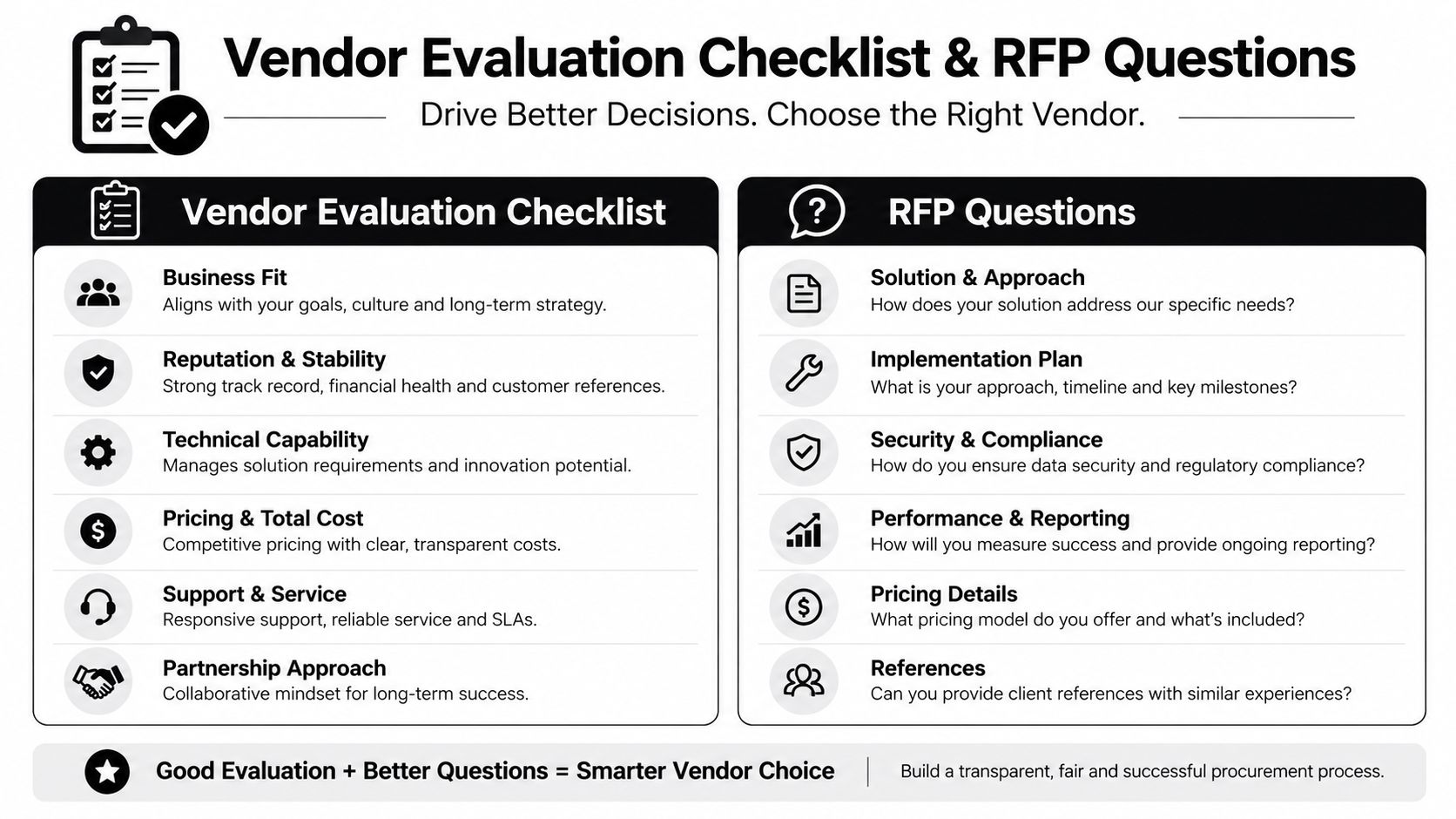
Use a short scorecard and force every vendor onto the same sheet. Score P95 latency under load, telephony and CCaaS support, language coverage, tool integration depth, and pricing at projected 12-month volume. If a vendor won't model cost at your forecast volume, they're not ready for serious procurement.
The other check is operational fit. Does the platform support your telephony stack, connect cleanly to your CRM, and give you enough observability to debug bad calls? Does it support the languages, routing rules, and escalation logic you need, not just the ones that sell well in a demo?
RFP questions that expose hidden risk
Ask how consent records are stored, and whether the platform logs date, time, and capture method for every outbound consent event. Ask what happens when concurrency triples and the model path slows down. Ask how routing behaves when one LLM provider degrades and another has to take over.
Ask how AI Copilot and Automated Testing reduce time to production, because hardening agents manually burns time and creates inconsistent behavior. If the vendor talks only about launch speed and not about testability, you're buying future rework.
If they can't answer the failure cases, they haven't built for production.
One useful answer pattern is a platform with multi-LLM routing across 15+ models, retrieval grounded in an agentic RAG layer, and AI Copilot support for authoring and debugging. That combination matters because it gives teams more control over quality, fallback behavior, and vendor dependency. It fits buyers who are optimizing for resilience, not just the first demo.
If you want a reference point, A checklist and RFP questions guide for evaluating and selecting the right business software vendors. is the kind of artifact that should force these trade-offs into the open.
If you're evaluating an AI voice agent platform for real deployment, don't start with a feature checklist. Start with lane, compliance, and load behavior, because those are the decisions that decide whether the project ships. Explore Yellow.ai if you want to see an enterprise platform that combines voice orchestration, testing, integrations, and compliance controls in one stack, then pressure-test it against your own use case and RFP.



