










An AI agent doesn't become secure because a model passed a pre-launch review. Security has to follow the full lifecycle, from policy and data preparation through training, deployment, integrations, monitoring, and incident response. That matters especially in enterprise CX and EX, where an agent may read customer records, summarize employee requests, retrieve internal policy, update a case, or trigger an action in a connected system.
The urgency is practical. IBM reported that 97% of breached organizations involved in an AI-related security incident lacked proper AI access controls, while 63% of the 600 organizations studied had no AI governance policies for managing AI or preventing shadow AI use. Those findings make identity, permissions, data boundaries, testing, and operational response central to any serious AI program. (IBM's 2025 Cost of a Data Breach analysis)
The ten practices below organize controls by the decisions teams make across the AI lifecycle. Each one connects security work to contact-center workflows, employee experience, customer outcomes, governance evidence, and implementation trade-offs. The aim isn't to create a perfect theoretical architecture. It's to help security, IT, CX, and EX leaders build controls that can be tested, monitored, and explained.
Table of Contents
- 1. Multi-LLM Architecture with Vendor Diversification
- 2. Conversational Knowledge Base with Agentic RAG Security
- 3. Enterprise-Grade Compliance and Certifications
- 4. Omnichannel Data Isolation and Channel-Specific Encryption
- 5. AI Model Testing and Adversarial Attack Simulation
- 6. Real-Time Monitoring, Anomaly Detection, and Incident Response
- 7. Data Minimization, PII Masking, and Privacy-Preserving Techniques
- 8. Secure API Integration and Access Control Management
- 9. Agent Deployment Staging, Testing, and Gradual Rollout
- 10. AI Governance, Model Explainability, and Secure Development Lifecycle
- AI Security Best Practices: 10-Point Comparison
- Turn Controls Into an Operating Checklist
1. Multi-LLM Architecture with Vendor Diversification
A single model provider can simplify procurement and integration, but it also concentrates operational and security risk. A provider outage, compromised credential, material policy change, or unexpected model behavior can affect every customer and employee workflow at once. A multi-LLM architecture gives enterprise teams more control over continuity, routing, and workload fit.
The practical design is not to send every prompt to every model. Map use cases to approved models based on sensitivity, latency, reasoning needs, language coverage, output format, and integration requirements. A contact-center agent might use one model for intent classification, another for policy-grounded responses, and a smaller specialized model for routine extraction. A finance team might separate customer-service summarization from fraud-analysis workflows rather than giving one model unrestricted responsibility.
Yellow.ai describes a multi-LLM architecture using 15+ models, including GPT-4, Claude, and specialized models, as a way to support accuracy and speed while avoiding vendor lock-in. That architecture should still be evaluated through your own security and compliance requirements, not accepted as a substitute for them.
Design the fallback before production
A fallback model is useful only when the team has defined what happens during a failure. Decide whether the system will reroute automatically, reduce functionality to read-only answers, transfer the interaction to a human, or pause the workflow. A customer asking about an order may tolerate a human handoff. An employee-service agent handling payroll information may need to stop rather than switch providers without a documented data-processing assessment.
Maintain a provider-by-provider inventory covering:
- Credentials: Store API keys in a centralized vault, rotate them, and restrict access by environment and service.
- Data flows: Document what prompts, retrieved content, recordings, and outputs each provider receives.
- Model behavior: Track unsafe-output findings, refusal behavior, latency, and resolution quality by use case.
- Continuity: Test fallback routing and verify that permissions, logging, and masking remain active after failover.
Practical rule: Redundancy isn't secure if the backup path bypasses the same authorization, privacy, and audit controls as the primary path.

2. Conversational Knowledge Base with Agentic RAG Security
Retrieval-Augmented Generation can improve contact-center and employee-service answers by grounding responses in approved enterprise content. It also creates a data-plane security problem. The agent may retrieve a document, record, or policy that the requesting person isn't authorized to see, then present it fluently enough that the exposure looks like a normal answer.
Treat the knowledge base as a permissioned application, not as a neutral pile of documents. Classify content before indexing it, preserve source ownership and access metadata, and enforce authorization at retrieval time. A document-level permission check should happen before the model receives content, not after the response has already been generated.
Agentic RAG raises the stakes because the system can decide when to retrieve, which sources to query, and whether another tool is needed. In a healthcare workflow, the agent may answer a general benefits question without opening a patient record. In an HR workflow, it may retrieve department policy while blocking another department's confidential case files. In financial services, identity verification should precede access to customer-specific information.
Make retrieval observable and bounded
For every query, log the requesting identity, business purpose, sources considered, documents returned, authorization result, and final response status. Protect those logs as sensitive data, and redact unnecessary personal information before storage. Review retrieval patterns for unusual access, repeated denied requests, sudden interest in restricted content, and documents that appear in unexpected contexts.
Useful controls include:
- Sensitivity labels: Use categories such as public, internal, confidential, and restricted.
- Least privilege: Give each agent only the repositories and actions required for its assigned workflow.
- PII protection: Mask personal information before indexing when the full value isn't necessary.
- Source governance: Restrict who can add, edit, approve, or remove knowledge content.
- Grounding checks: Require citations or source references for high-impact answers, then route uncertain cases to a human.
A grounded answer can still be unauthorized. The retrieval layer must enforce identity and purpose before generation begins.

3. Enterprise-Grade Compliance and Certifications
Compliance evidence should influence architecture and procurement decisions before an AI agent reaches production. Healthcare, financial services, retail, and employee-service teams need traceable answers about access, encryption, privacy, vendor oversight, incident response, and change management. Those records also affect contact-center operations: clear controls reduce approval delays, support consistent agent workflows, and give CX and EX owners evidence when a customer or employee challenges an automated decision.
Each framework covers a different evidence need. HIPAA applies when protected health information enters the workflow. ISO 27001 addresses an information-security management system, while ISO 27701 focuses on privacy management. SOC 2 Type II documents whether controls operated effectively during a review period. PCI-DSS applies when payment-card data is handled.
Yellow.ai lists enterprise security materials covering ISO 27001/27701, SOC 2 Type II, HIPAA, and PCI-DSS. During due diligence, request the applicable scope, dates, exclusions, control descriptions, and available audit reports. A certification can shorten vendor review, but it does not establish compliance for your prompts, integrations, permissions, retention settings, or business process.
Build evidence into the delivery lifecycle
Create a control matrix before implementation. Map each requirement to an owner, system component, test, evidence artifact, and review cadence. In a healthcare contact center, connect call-recording settings, access logs, retention rules, and workforce training to the relevant policy. In an employee-service deployment, record who may retrieve payroll or benefits information and how access is revoked when roles change.
Use Yellow.ai's enterprise-grade security information during vendor review, then test the listed controls against your own architecture and contact-center workflows.
Keep the evidence current as the agent changes:
- Change records: Record updates to the model, prompt, connector, policy, or data source.
- Access reviews: Track administrators, content approvers, log viewers, and tool permissions.
- Testing records: Retain adversarial, privacy, and authorization test results, including failures and remediation.
- Incident records: Document detection, containment, investigation, and corrective action.
- Third-party evidence: Identify suppliers processing AI data and record their contractual and technical controls.
Product, security, legal, operations, CX, and EX owners should review the same control language. That shared record turns certification claims into decisions teams can verify during deployment, change review, and audit.
4. Omnichannel Data Isolation and Channel-Specific Encryption
Voice, chat, email, images, and video don't create the same security requirements. Voice interactions may produce recordings and transcripts. Email can contain attachments and long-lived customer histories. Images may include embedded metadata. Video can combine identity, environmental information, and spoken content. An omnichannel AI platform should preserve protection as data moves between channels and enterprise systems.
Start with a data-flow map for each contact-center journey. Follow a voice call from telephony ingress to transcription, model processing, agent handoff, recording storage, analytics, and deletion. Then map a chat interaction separately. Don't assume that a control applied to text automatically covers audio, attachments, or media derivatives.
Channel isolation limits blast radius. Separate keys, storage policies, service identities, and access paths can prevent a compromise in one channel from exposing every other channel. Encryption in transit and at rest remains necessary, but encryption doesn't fix excessive access or uncontrolled retention.
Protect the workflow, not only the transport
For voice, review secure media transport, recording access, transcript permissions, and supervisor monitoring. For chat and web, verify TLS, session identity, and browser-side data handling. For email, scan attachments, classify content, and define whether the agent may quote or forward sensitive material. For images and video, remove unnecessary metadata and restrict model access to the frames or fields required for the task.
Retention should match business purpose. Automatically purge recordings, transcripts, attachments, and intermediate artifacts when the approved retention period ends. Test failover paths, because a backup transcription or storage service must not weaken encryption, access controls, or deletion rules.
The CX outcome is continuity with fewer unsafe handoffs. Customers shouldn't have to repeat information because security controls are inconsistent, and agents shouldn't receive more context than their role requires. Measure resolution quality alongside unauthorized-access attempts, masking failures, retention exceptions, and channel-specific incident findings.
5. AI Model Testing and Adversarial Attack Simulation
A model that answers routine questions correctly can still fail when a customer embeds instructions in a ticket, a document contains malicious content, or an employee asks the agent to reveal internal rules. Testing must cover the model, prompts, retrieval layer, tools, identity checks, and downstream actions.
Build a repeatable attack library around the risks that apply to your workflows. OWASP's LLM Top 10 identifies prompt injection, sensitive information disclosure, insecure output handling, and training-data poisoning among important application-layer risks for LLM systems. Use those categories to create both positive tests, where the agent should complete an authorized task, and negative tests, where it must refuse, redact, escalate, or stop.
A retail support agent should reject an instruction hidden in a product-review attachment if that instruction attempts to change refund policy. An employee-service agent should refuse to reveal another worker's case history. A financial-services workflow should block an action when the request lacks the required identity or approval context.
Tune defenses for business impact
Prompt-injection defenses involve trade-offs. A detector that catches more attacks may also block legitimate customer language, increase transfers, or frustrate employees. Independent benchmark data across more than 28,000 prompts and 13 languages found a meaningful precision and recall trade-off. One solution recorded 0.890 precision, 0.857 F1, and a 5.4% false-positive rate, while another reached 0.955 recall with a 77.0% false-positive rate. (The prompt-injection benchmark)
Those figures don't prescribe a universal threshold. They show why teams should test multilingual inputs, define trust boundaries, and tune guardrails against business impact. Track unsafe-output findings, false escalations, successful task completion, and authorization failures by channel and language.
Automate regression tests in CI/CD, run red-team exercises before high-impact releases, and record every failure with its affected model, prompt version, connector, and remediation. Yellow.ai's Automated Testing capability is relevant to this workflow, but your team still needs to define acceptance criteria and deployment gates.
A short demonstration of adversarial testing can help stakeholders understand why ordinary functional testing isn't enough.
6. Real-Time Monitoring, Anomaly Detection, and Incident Response
A production agent needs security telemetry tied to business impact. Monitoring should show whether it accesses unusual records, produces unsafe responses, calls tools outside its approved workflow, or fails in ways that increase customer transfers and employee effort.
Set a behavioral baseline for each agent and customer journey. A password-reset assistant should differ from a case-management agent that reads CRM records. Track identity events, retrievals, tool calls, response classifications, latency, errors, token consumption, escalations, and downstream changes. Correlate those signals across the AI platform, identity provider, CRM, ticketing system, telephony environment, and SIEM.
Use alert tiers with named owners and response targets. An informational event can record a blocked prompt. A warning can flag repeated denied retrievals or an unusual rise in handoffs. A critical alert should start containment if an agent attempts an unauthorized write, exposes sensitive information, or loses policy control. Tie each alert to a workflow owner, customer impact estimate, and governance record.
Measure response capability, not just detection
A 2026 SANS survey of 536 global cybersecurity and IT practitioners found that AI use in cybersecurity rose from 50% to 78% year over year, while AI-related failures also rose sharply. (SANS survey findings) Adoption without tested response procedures leaves security and operations teams exposed.
Write the incident playbook around four actions:
- Contain: Disable the affected tool, revoke credentials, restrict data access, or route conversations to a safe mode.
- Investigate: Preserve prompts, retrieved sources, tool calls, identity events, and output decisions, applying appropriate redaction.
- Recover: Patch the control, restore the approved configuration, and verify the change through regression tests.
- Learn: Add the incident pattern to monitoring rules, test suites, training, and governance review.
Track mean time to detect, mean time to respond, rollback readiness, escalation rates, resolution quality after containment, and evidence completeness. Run drills with CX operations, IT, security, legal, and communications teams. Confirm that containment preserves a usable fallback for customers and employees. A kill switch nobody has tested is a policy statement, not an operational control.
7. Data Minimization, PII Masking, and Privacy-Preserving Techniques
Privacy protection starts before inference. For each contact-center or employee workflow, define the minimum fields the model needs, then remove unrelated data before it enters the prompt or retrieval context. A shipping-status agent may require an order identifier and delivery state, but not a full payment record. An HR policy assistant may need location and employment category, but not an unrelated case history.
Apply masking during ingestion whenever possible. Once sensitive content reaches model context, later redaction may not prevent exposure through generated responses, memory, traces, or analytics. Scan inputs, retrieved documents, conversation memory, outputs, logs, exports, and training or evaluation datasets.
Turn privacy controls into workflow requirements
Generic detectors often miss organization-specific identifiers. Add rules for internal employee codes, customer reference numbers, account formats, and case identifiers. Prefer irreversible anonymization. If a workflow requires re-identification, isolate the mapping service, limit access to approved roles, and record every lookup for governance review.
Test more than whether a detector catches a pattern. Attempt to re-identify masked content and check whether the model can infer sensitive attributes from surrounding context. Masking can reduce personalization and make troubleshooting harder. Define a controlled path for authorized agents and supervisors, with approvals and audit evidence, instead of granting broad visibility.
Use the following lifecycle checkpoints:
- Discover: Inventory where personal and regulated data enters, moves through, and leaves the AI workflow.
- Limit purpose: Document why each field is processed and block secondary use without approval.
- Control retention: Delete prompts, transcripts, embeddings, and outputs when the business purpose ends.
- Govern training: Keep operational conversations out of model training unless approved and protected.
- Prove execution: Record masking rules, exceptions, access decisions, and deletion results.
For CX, the target outcomes are fewer privacy-related escalations, safer personalization, and clearer answers to customer data requests. For EX, agents should receive enough context to resolve cases without seeing unrelated records. Measure exception volume, authorized re-identification, deletion completion, and privacy-related handoffs. Those measures connect technical controls to workflow performance and give governance teams evidence that minimization operates in production.
8. Secure API Integration and Access Control Management
An AI agent becomes more dangerous when it can act in Salesforce, Zendesk, Genesys, payment systems, HR platforms, or internal databases. Every connector expands the attack surface and the consequences of a compromised identity. The correct question isn't whether an integration is encrypted. It's whether the agent can access exactly the records and actions required for one approved workflow.
Create an integration register with the system owner, data fields, service identity, environment, permissions, credential location, expiration date, rotation process, logging destination, and failure behavior. Use separate credentials for development, staging, and production. Store secrets in a vault, not in prompts, source code, tickets, or shared configuration files.
Use field-level and action-level permissions. A Zendesk agent that answers assigned tickets shouldn't browse every ticket. A Salesforce assistant may read account status but shouldn't alter credit terms. A Genesys workflow may need call metadata while restricting access to audio and transcripts. High-impact writes, refunds, payments, employee-status changes, and external messages should require explicit policy checks and, where appropriate, human approval.
Control the connector lifecycle
Monitor failed authentication, unusual access locations, unexpected record volumes, tool-call sequences, and API errors. Rate limits should reflect the business action, not just the number of requests. A loop that repeatedly creates cases is a security and operational incident even if every request is authenticated.
Use Yellow.ai's enterprise integrations as a reference point when assessing connector coverage, then validate each connector against your own data classification and authorization model. Teams can also review practical access-control guidance in the CEFCore secure fund access guide.
Before enabling a new integration, perform a threat model, test denied permissions, verify audit records, and run a rollback exercise. Re-test after platform changes. An integration that worked safely last quarter may expose new fields or actions after an API update.
The measure of success is not the number of systems connected. It's whether the agent completes authorized work while producing no unexplained access, write, or escalation events.
9. Agent Deployment Staging, Testing, and Gradual Rollout
A safe launch limits customer impact before the team has evidence. Separate functional testing from production exposure, then compare model behavior, security findings, resolution quality, and employee workload at each stage.
Build staging to match production security controls. Use production-like traffic patterns and representative, approved data, while choosing synthetic or de-identified records whenever real personal information is unnecessary. Provision environments through repeatable automation so a staging result does not depend on a manual setting absent from production.
Start a contact-center agent with read-only knowledge assistance for internal employees. After authorization and output tests pass, introduce limited customer-facing responses, then enable only approved actions. An employee-service agent can follow the same path, beginning with policy lookup and case-status questions before account changes or workflow submissions.
Set release gates before exposure
Write entry and exit criteria for every stage. A release review should cover:
- Security: Prompt-injection findings, sensitive-data leakage, authorization failures, dependency findings, and tool-call violations.
- CX: Resolution quality, transfer rates, repeat contacts, customer complaints, and unsafe-answer reports.
- EX: Employee adoption, correction effort, time to complete routine requests, and confidence in suggested responses.
- Operations: Latency, error rates, queue impact, integration stability, and fallback performance.
- Governance: Approved model version, signed data-flow review, completed risk assessment, and current audit evidence.
Use canary or percentage-based releases to limit exposure, with the rollout design matched to workflow risk. A read-only FAQ agent can follow a different path from an agent that issues refunds or changes employee records. Define automatic rollback triggers before launch, including security failures, unsafe output, service degradation, and unexpected workload.
Treat each release as a traceable configuration. Version the model, prompt, retrieval source, policy, connector, and evaluation set. CX and EX measures show whether the agent helps customers and employees, while security and governance records show whether it remains authorized. If a release fails, restore the last approved configuration and identify precisely what changed.
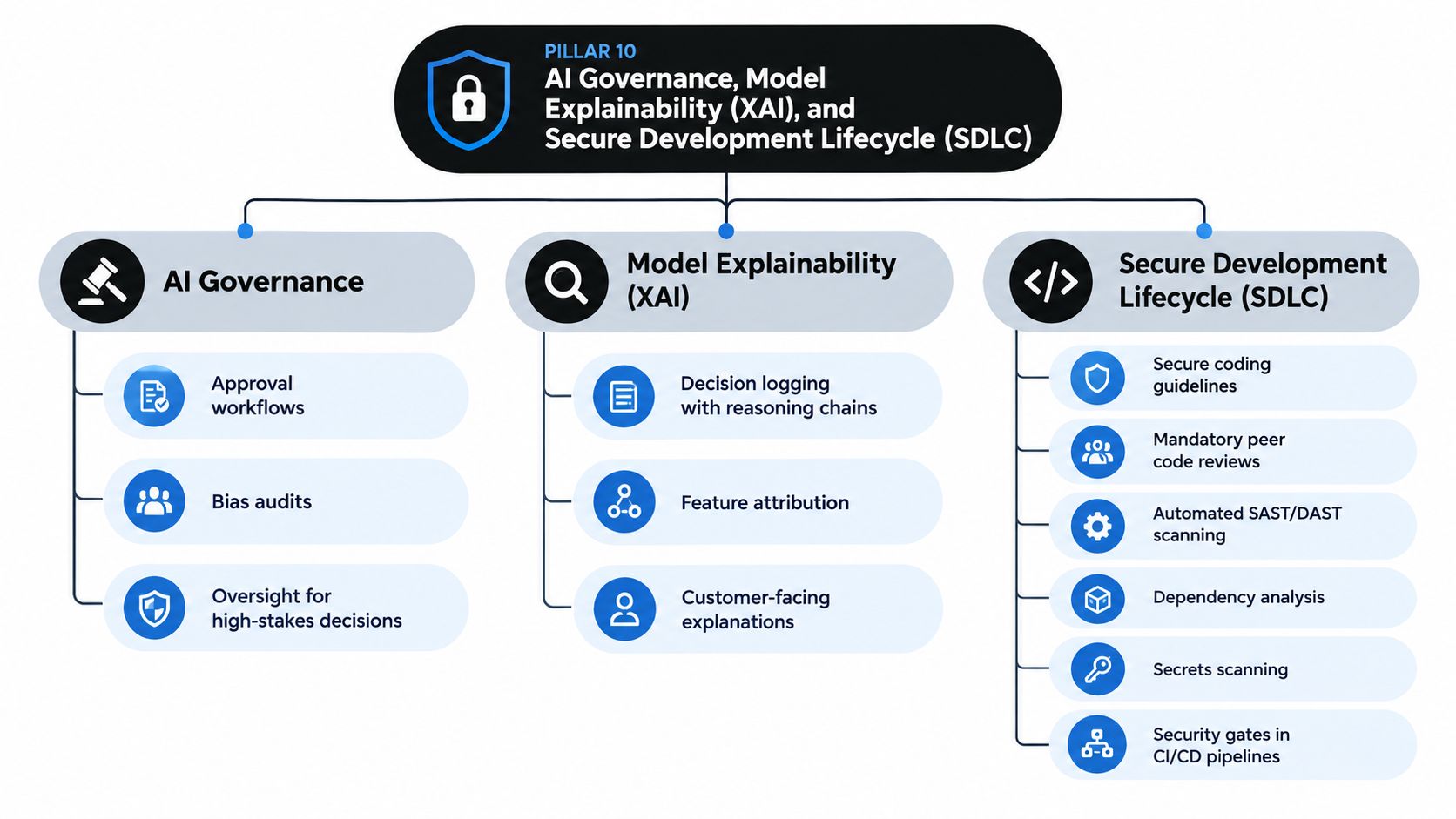
10. AI Governance, Model Explainability, and Secure Development Lifecycle
Governance gives security decisions an owner and a record. NIST released the voluntary AI Risk Management Framework 1.0 on January 26, 2023, after a multi-year consensus-driven process involving public drafts, workshops, requests for information, and broad stakeholder input. Its four functions, govern, map, measure, and manage, provide a useful structure for enterprise AI risk programs. (NIST's AI RMF announcement)
Apply that structure to each agent. Assign a business owner, technical owner, security reviewer, data owner, and escalation contact. Classify the use case by impact, define prohibited actions, document human-approval requirements, and record the rationale for every material change.
Explainability should match the decision. A customer-support response may need a source citation and policy reference. A credit, benefits, hiring, or medical workflow may require a more detailed record of the data used, rules applied, confidence or uncertainty signals, and human review. Avoid treating a private reasoning trace as the only explanation. The evidence should help an authorized reviewer understand and challenge the outcome without exposing hidden system instructions or confidential data.
Build security into delivery
A secure AI SDLC includes threat modeling before development, code review, dependency scanning, secrets detection, prompt and policy review, adversarial evaluation, privacy testing, and deployment approval. Maintain model cards or equivalent records that describe training sources, limitations, known failure modes, evaluation results, and permitted use.
For agentic contact-center workflows, log every significant action and its authorization decision. For EX workflows, retain the policy version and employee permissions that shaped the answer. Conduct bias reviews where the agent affects people differently across demographic or employment groups, and give affected users a meaningful escalation path.
AI Security Best Practices: 10-Point Comparison
| Item | Implementation Complexity 🔄 | Resource Requirements ⚡ | Expected Outcomes 📊 | Ideal Use Cases 💡 | Key Advantages ⭐ |
|---|---|---|---|---|---|
| Multi-LLM Architecture with Vendor Diversification | High 🔄, multi-vendor integrations, routing & fallback logic | High ⚡, multiple model costs, monitoring, vendor management | Improved resilience and comparative accuracy 📊⭐, continuity during provider issues | Mission-critical services, availability-sensitive workloads | Avoids vendor lock-in; best-model per task; reduced single point of failure ⭐ |
| Conversational Knowledge Base with Agentic RAG Security | Medium-High 🔄, RBAC, classification, audit trails, authorization checks | Medium ⚡, KB maintenance, governance, secure retrieval infra | Grounded, auditable responses with fewer hallucinations 📊⭐ | Healthcare, finance, internal secure knowledge retrieval | Fine-grained access control; auditability; reduced info leakage ⭐ |
| Enterprise-Grade Compliance & Certifications (HIPAA, ISO, SOC 2) | High 🔄, continuous audits, policy updates, documented controls | High ⚡, audit costs, compliance staff, control implementations | Regulatory trust and market access; procurement facilitation 📊⭐ | Regulated industries (BFSI, healthcare, utilities) | Demonstrable security posture; simplifies enterprise procurement ⭐ |
| Omnichannel Data Isolation & Channel-Specific Encryption | High 🔄, per-channel protocols, key management, segregation | High ⚡, encryption overhead, storage/purge policies, integration effort | Consistent channel-level protection; reduced cross-channel leakage 📊 | Contact centers, voice/chat/email/video platforms | End-to-end channel protection; prevents cross-channel exposure ⭐ |
| AI Model Testing & Adversarial Attack Simulation | Medium-High 🔄, test harnesses, adversarial scenarios, CI gates | Medium ⚡, compute, red-team expertise, test maintenance | Hardened models; fewer vulnerabilities and regressions 📊⭐ | High-risk agents, pre-production validation, regulatory demos | Early vulnerability detection; regression protection; due-diligence evidence ⭐ |
| Real-Time Monitoring, Anomaly Detection & Incident Response | Medium 🔄, baseline tuning, alerting, correlation logic | Medium-High ⚡, monitoring infra, SOC/analyst resources | Faster detection/response; reduced MTTD/MTTR 📊⭐ | High-volume systems, continuous customer interactions | Real-time alerts, forensic logs, automated response workflows ⭐ |
| Data Minimization, PII Masking & Privacy-Preserving Techniques | Medium 🔄, PII detection rules, retention policies, privacy methods | Medium ⚡, masking tools, privacy engineering, auditing | Reduced breach impact; improved privacy compliance 📊 | Global deployments, GDPR/CCPA-sensitive environments | Lower exposure; compliance alignment; customer trust ⭐ |
| Secure API Integration & Access Control Management | Medium-High 🔄, credential rotation, OAuth, per-integration policies | Medium ⚡, credential vaults, monitoring, partner coordination | Reduced integration attack surface; controlled access 📊 | Platforms with many third-party integrations (CRM, ticketing) | Fine-grained permissions; credential safety; abuse protection ⭐ |
| Agent Deployment Staging, Testing & Gradual Rollout | Medium 🔄, environment parity, canary/A-B pipelines, rollback logic | Medium ⚡, staging infra, CI/CD automation, test data | Safer rollouts; limited blast radius and faster rollback 📊 | Frequent-release agents, A/B experiments, large user bases | Controlled exposure; quick rollback; validated changes ⭐ |
| AI Governance, Model Explainability (XAI) & Secure SDLC | High 🔄, governance workflows, XAI tooling, secure SDLC integration | High ⚡, expertise, tooling, audits, training | Transparent, auditable decisions and more secure development 📊⭐ | High-stakes decisions, regulated sectors, legal/ethical scrutiny | Accountability; bias detection; security-by-design; regulatory compliance ⭐ |
Turn Controls Into an Operating Checklist
AI security best practices become valuable when teams can operate them under pressure. Start by assigning ownership. The AI product owner should own business outcomes and approved use, the security team should own threat controls and response, data owners should approve access and retention, and CX or EX operations should own workflow quality and escalation behavior. Put those responsibilities in a service model with named decision-makers, not only in a policy document.
Next, map the system. Inventory models, providers, prompts, agents, tools, knowledge sources, APIs, identities, logs, media types, and suppliers. Record where sensitive data enters and exits, which systems can be changed, and what happens when a provider, connector, model, or policy fails. The supply chain deserves its own review. A 2026 report found that 87% to 98% of organizations using AI services had not configured customer-managed encryption keys, and it highlighted insecure API-key storage and AI-service sprawl. (The 2026 State of AI Security Report)
Then implement controls in lifecycle order:
- Govern: Approve the use case, impact level, data purpose, decision rights, and escalation path.
- Map: Document data flows, providers, RAG sources, integrations, tools, identities, and retention.
- Measure: Test prompt injection, sensitive-data leakage, authorization, output safety, bias, latency, resolution quality, and fallback behavior.
- Manage: Stage the deployment, monitor runtime behavior, rehearse containment, and keep rollback available.
Runtime control deserves special attention for autonomous agents. Recent reporting found that only 12% of organizations had a documented, regularly tested shutdown or override process, while 56% didn't know how long it would take to halt an AI system during an incident. (ISACA's reporting on AI response capability) Every tool call should pass an authorization gate, produce an immutable audit event, and remain subject to a tested stop mechanism. A human approval step should protect sensitive writes and external communications.
CX and EX leaders should use a scorecard that joins security and service performance. Track authorization failures, unsafe-output findings, mean time to detect, mean time to respond, rollback readiness, escalation rates, resolution quality, repeat contacts, employee correction effort, and audit-evidence completeness. Review the measures by channel, language, model, workflow, and customer or employee segment. A low escalation rate isn't positive if the agent is confidently returning unsafe answers. A high transfer rate may reflect effective containment, or it may signal poorly tuned controls.
Yellow.ai can be one evaluation candidate for this operating model. Its Safe AI capabilities, automated testing, analytics, multi-LLM architecture, omnichannel orchestration, and enterprise compliance materials can help teams assess how a platform supports policy enforcement, testing, observability, and controlled deployment. They don't replace customer governance, data classification, identity design, supplier review, or incident exercises.
Create the first scorecard from one production journey, such as order status, password reset, benefits lookup, or case summarization. Assign owners, define approved actions, test the denial paths, instrument the evidence, and run a response drill. Then expand only after the team can explain what the agent can access, why it can access it, how you'll know when it fails, and how quickly you can stop it.
Yellow.ai provides enterprise agentic AI for CX and EX, with Safe AI capabilities, automated testing, advanced analytics, multi-LLM architecture, conversational knowledge management, and omnichannel integrations. Visit Yellow.ai to evaluate how its platform can fit your AI security controls, governance evidence, and controlled deployment plans.