














Most advice about ai powered customer engagement is stuck in the chatbot era. It treats the problem as FAQ deflection, lower contact volume, and faster responses on a single channel. That's useful, but it's too small for the way large enterprises operate.
The harder problem is orchestration. Customers move across voice, chat, apps, email, branches, field teams, and live agents. Employees do the same across HR systems, IT help desks, knowledge bases, and approval workflows. If your AI can answer a question but can't carry context, trigger action, or support the next step in the journey, it isn't transforming engagement. It's just adding another interface.
That's why the center of gravity is shifting from scripted bots to agentic AI. Not AI that only responds, but AI that can understand intent, retrieve the right knowledge, coordinate across systems, and help complete work across both customer experience and employee experience.
Table of Contents
- The Engagement Gap Why AI Is Now Mission-Critical
- Deconstructing AI Powered Customer Engagement
- High-Value Use Cases Across the Enterprise
- Measuring Success Benefits and Core KPIs
- Your Enterprise Implementation Roadmap
- Choosing a Vendor and Navigating Compliance
- The Dawn of the Autonomic Enterprise
The Engagement Gap Why AI Is Now Mission-Critical
The most important fact in customer engagement today isn't that more companies are deploying AI. It's that many companies think they're already delivering personalization well enough when customers clearly disagree.
According to Twilio's 2025 Customer Engagement Trends report, 84% of businesses say they already provide good or excellent personalized engagement, while only 54% of consumers agree. That gap explains why basic automation no longer feels like progress. Enterprises aren't being judged on whether they launched a bot. They're being judged on whether every interaction feels informed, timely, and connected.

Why the old playbook is breaking
A lot of teams rushed into chatbot and IVR deployments because they felt pressure to keep up. Twilio's report describes that earlier phase as a period when many companies moved quickly out of fear of falling behind, while the next phase is more strategic and centered on systems that learn from every interaction, use NLP and sentiment analysis, and personalize at scale through operational discipline, not novelty.
That distinction matters. A reactive bot can reduce queue pressure. It usually can't fix fragmented journeys, inconsistent answers, or poor handoffs between channels and teams.
Practical rule: If your AI strategy starts with channel automation before data readiness, you'll automate inconsistency faster.
The same pattern is visible in industry planning. Twilio's reporting highlights that AI-powered engagement has moved from experimentation to mainstream operational adoption. In parallel, a growing number of companies are planning for more autonomous conversational systems, but many still lack the shared customer data foundation needed to support them well.
Why this now extends beyond CX
The shift isn't limited to customer service. Large organizations are applying the same engagement logic internally. HR teams want AI to guide employees through policies, onboarding, and benefits. IT teams want AI to resolve routine service requests and route exceptions with context. Operations leaders want fewer dead ends between systems.
That's why the better framing is journey orchestration across CX and EX, not chatbot deployment.
A useful example comes from service-heavy sectors such as hospitality, where engagement spans reservations, staff coordination, guest requests, and operational continuity. This perspective on AI's role in hospitality is worth reading because it shows how AI becomes valuable when it coordinates workflows around experiences, not just conversations.
For leaders balancing service quality, cost pressure, and digital expectations, the actual promise of AI isn't magical personalization. It's operational coherence. The pressure described in Yellow.ai's perspective on the impossible ask of CX and the AI promise captures that tension well. Teams are expected to be faster, more personal, always on, and still efficient. Without an intelligent layer that can absorb complexity, those demands conflict.
Deconstructing AI Powered Customer Engagement
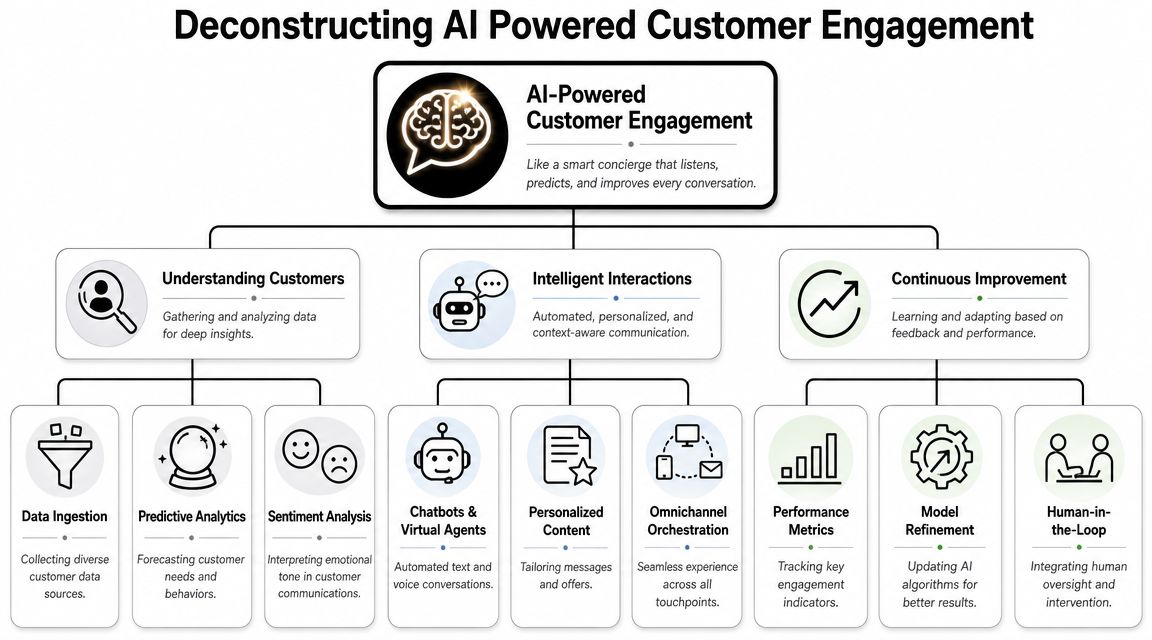
A modern AI engagement platform works less like a chatbot widget and more like the autonomic nervous system of the enterprise. It senses signals, interprets what they mean, decides what should happen next, and coordinates action across channels and systems.
That model is more useful than most product demos because it forces the right question. Not "can it generate an answer?" but "what inputs does it understand, what decisions can it support, and how well can it move work forward?"
The data layer
Everything starts here. The data layer ingests customer records, knowledge articles, transaction history, policy content, ticket context, and event streams from systems such as CRM, CCaaS, CDP, ITSM, and HR platforms.
In practice, many projects often encounter slowdowns at this particular stage. Enterprises often have the data, but it's fragmented, duplicated, or poorly governed. An AI model can sound fluent while still being operationally wrong if the underlying state is incomplete.
A strong data layer does three things well:
- Normalizes records so the same customer or employee isn't represented differently across systems.
- Retrieves current knowledge instead of relying on stale training data.
- Preserves context across sessions, channels, and handoffs.
The intelligence layer
The convergence of NLP, LLMs, sentiment analysis, and retrieval occurs. The job of the intelligence layer isn't only to classify intent. It needs to interpret ambiguity, handle multi-turn conversations, summarize context, and ground responses in enterprise knowledge.
The reason this layer matters now is scale. According to Menlo Ventures' 2025 State of Consumer AI report, 61% of American adults had used AI in the past six months, with nearly 1 in 5 using it daily. The same verified market view notes that this scales to about 1.7 to 1.8 billion people globally who have used AI tools and 500 to 600 million daily users. In customer support, the verified market data also states that 95% of customer interactions are predicted to be AI-powered by 2025, and that AI chatbot use by customer service teams increased 16x from 2020 to 2025.
Those numbers don't just describe adoption. They describe a change in user behavior. Customers and employees now arrive expecting conversational interfaces to be available, useful, and fast.
AI fluency has become a user expectation. Operational accuracy is still the harder part.
The agentic layer
This marks a significant shift. An agentic layer doesn't stop at answering. It can decide which workflow to trigger, when to escalate, what evidence to gather first, and which policy or next best action applies.
For example, a system might detect a billing dispute, retrieve the relevant account context, initiate identity verification, summarize prior contacts, and route the case to a specialist queue with a recommended resolution path. In EX, it might walk a new employee through provisioning steps, collect missing inputs, and nudge the right internal teams when approvals stall.
That doesn't mean fully autonomous action in every case. In regulated workflows, the best pattern is often bounded autonomy with auditability and human approval at the right checkpoints.
The orchestration layer
This is what turns point intelligence into enterprise engagement. Orchestration manages continuity across voice, chat, email, mobile, and human-assisted channels. It determines what context follows the user, what the agent sees, and what the system should do next.
Without orchestration, every channel becomes a reset button. With it, AI powered customer engagement starts to feel like one system, not a stack of disconnected tools.
High-Value Use Cases Across the Enterprise
The highest-value deployments rarely start with "let's automate customer service." They start with a broken journey that is expensive, repetitive, or vulnerable to inconsistency.
In most enterprises, those journeys exist on both sides of the house. Customers experience them as long resolution paths, repeated authentication, and slow follow-up. Employees experience them as policy confusion, approval bottlenecks, and too much swivel-chair work across systems.
Proactive retention before the complaint arrives
A mature engagement platform doesn't wait for a cancellation request to appear in a queue. It uses interaction history and behavioral signals to identify risk, then triggers the right intervention before the relationship degrades.
That's the practical meaning of predictive engagement. As explained in iQor's discussion of predictive intelligence in retention, advanced platforms use every customer interaction as a signal to spot early risk patterns, predict churn, and trigger action before loyalty is lost.
A simple before-and-after view makes the difference clear:
| Journey state | Traditional model | Agentic AI model |
|---|---|---|
| Early warning | Teams notice churn late, often after a complaint or downgrade | Models detect signals across contacts, behavior, and service patterns |
| Outreach | Static campaigns or generic save offers | Timed intervention based on actual risk or intent |
| Escalation | Manual review, limited context | Context-rich routing with recommended next action |
| Outcome | Wasted outreach and inconsistent saves | More targeted retention effort and cleaner workflows |
ai powered customer engagement starts creating value beyond cost takeout. It helps teams spend retention effort where it matters.
Complex service resolution across voice and digital
A lot of vendors still frame support automation as a chat use case. Enterprise operations aren't that simple. Customers might start in chat, move to voice for verification or urgency, then require a live specialist for exception handling.
What works is a pattern with three layers:
- AI handles the opening moves by identifying intent, collecting information, authenticating when appropriate, and retrieving relevant knowledge.
- The system prepares the handoff with a summary, customer history, and likely next best actions.
- The live agent handles judgment-heavy work instead of re-asking basic questions.
This is one reason many buyers are revisiting their service architecture. The useful benchmark isn't bot containment. It's continuity.
A practical library of customer service chatbot use cases can help teams identify where to start, but the strongest use cases usually involve orchestration around the bot, not just the bot itself.
The handoff is part of the experience. If the handoff fails, the automation failed too.
Employee onboarding that actually reduces friction
EX is where agentic systems often prove their value quickly because the journeys are structured, repetitive, and cross-functional.
Take onboarding. In many enterprises, the employee receives a welcome email, then a list of disconnected tasks. HR needs documents. IT needs device and account requests. The manager needs role-specific access approved. Payroll and compliance each have separate systems.
An agentic engagement layer can coordinate that flow. It can answer policy questions, collect missing information, trigger provisioning requests, remind approvers, and keep the employee informed in one conversational thread. The same pattern works for leave requests, benefits questions, policy clarification, travel support, and internal IT triage.
What doesn't work is dropping a generic assistant on top of bad process design. If the underlying approvals are unclear or the knowledge base is contradictory, the AI will expose those problems quickly.
The use cases worth prioritizing
If you're deciding where to begin, focus on journeys with these characteristics:
- High repetition: Frequent interactions with similar structure.
- High context dependency: The answer depends on identity, history, or policy.
- Cross-system work: Resolution requires action in more than one platform.
- Clear escalation paths: The AI can do meaningful prep before a human steps in.
Those are the conditions where agentic engagement outperforms a standalone chatbot by the widest margin.
Measuring Success Benefits and Core KPIs
Teams lose credibility when they pitch AI with broad promises and weak measurement. The business case needs to map capabilities to operating metrics that leaders already trust.
The fastest gains usually come from self-service at scale. Tech Mahindra's perspective on digital process automation in BFSI notes that AI-powered chatbots enable round-the-clock support and faster resolution, while helping teams handle requests more accurately and shift routine work to self-service. In practical terms, that means lower load on agents, shorter handling time, and better first-contact resolution in high-volume environments.
What to measure first
The wrong KPI set focuses only on usage. Sessions, conversations started, and bot traffic are activity metrics. They don't tell you whether the operating model improved.
The stronger scorecard blends service, operational, and business outcomes.
| AI Capability | Impacted KPI | Business Benefit |
|---|---|---|
| Intent detection and smart triage | Routing accuracy, queue time | Faster path to resolution |
| NLP self-service for Tier-1 queries | Average handle time, agent workload | Lower service cost and better capacity use |
| Knowledge retrieval and guided responses | First-contact resolution, consistency | Fewer repeat contacts and more reliable answers |
| Predictive risk signals | Retention workflow performance | Better-timed outreach and less wasted effort |
| Agent assist and conversation summaries | After-call work, agent productivity | More efficient live service operations |
| Workflow automation across systems | Resolution time, process adherence | Fewer manual steps and stronger compliance execution |
| Employee service automation | Employee satisfaction, internal ticket backlog | Faster internal support and lower friction for staff |
Separate channel metrics from journey metrics
Many dashboards break down because they measure what happened inside a single channel instead of what happened across the full journey.
For example, a chat containment rate might look strong while transfer quality is poor and voice handling time rises because agents inherit incomplete context. That's why mature teams pair interaction metrics with journey metrics such as repeat contact, escalation quality, downstream resolution time, and policy adherence.
Operator's lens: Measure the work removed from the system, not just the work moved into AI.
A useful reference point for teams building a practical scorecard is this guide to customer experience KPIs and metrics. The key is to choose a small set that reflects the operating problem you're trying to solve.
Benefits that hold up under scrutiny
When ai powered customer engagement works well, the benefits usually show up in a familiar sequence.
- Service efficiency improves first. Tier-1 automation, better routing, and cleaner handoffs reduce avoidable load.
- Quality improves next. Responses become more consistent, and agents spend more time on exceptions that need judgment.
- Revenue impact follows later. Better retention timing, stronger conversion support, and more relevant engagement become easier once the service foundation is stable.
What doesn't hold up is claiming enterprise transformation from a single bot launch. The durable gains come from combining conversational AI with process design, knowledge quality, and orchestration.
Your Enterprise Implementation Roadmap
Most failed AI programs don't fail because the model is weak. They fail because the enterprise treated implementation as a feature launch instead of an operating model change.
A practical roadmap has to balance ambition with constraint. Large organizations need data discipline, staged rollout, governance, and a clear definition of where autonomy is allowed.
Start with the path, not the platform.
Phase one and two
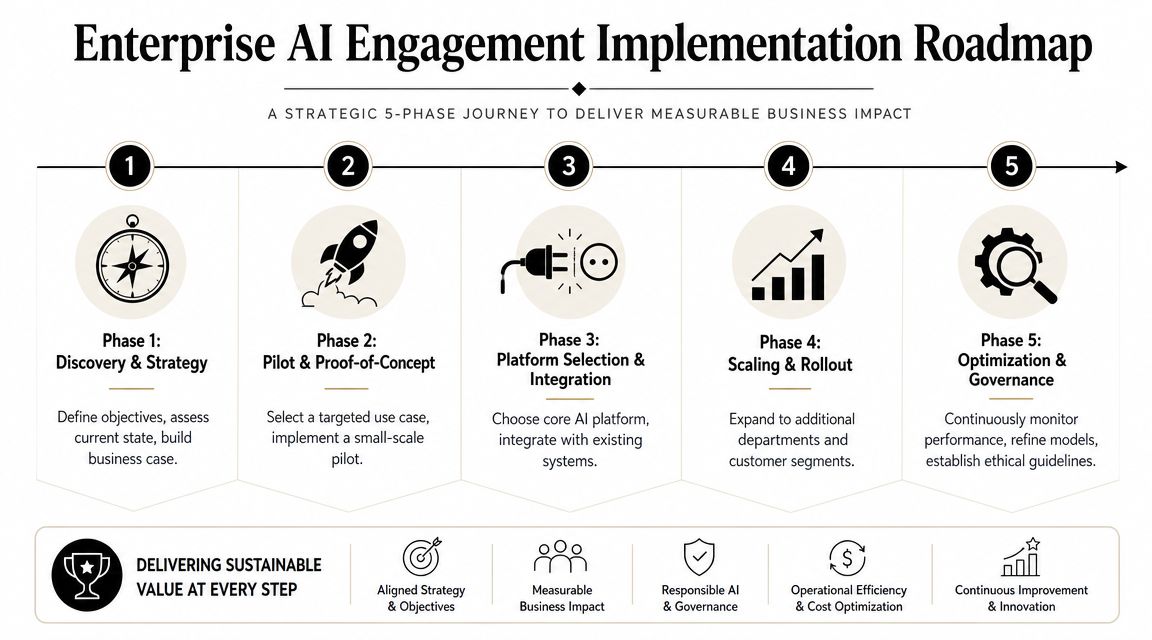
Discovery and strategy should focus on one thing: identifying where engagement breaks operationally. Look for journeys with high volume, low complexity at the front, and expensive human effort at the back. Audit the systems involved, the knowledge sources used, the escalation rules, and the compliance boundaries.
At this stage, leaders should answer questions like these:
- Which journeys matter most: Billing support, claims status, onboarding, employee help desk, policy guidance.
- What data is required: CRM state, knowledge articles, ticket history, identity systems, workflow tools.
- Where can autonomy begin: Information delivery, triage, summarization, form completion, workflow triggering.
- Where must humans stay in control: Approvals, regulated advice, exception handling, high-risk transactions.
Pilot and proof-of-concept comes next. Keep the scope narrow enough to learn, but meaningful enough to test the actual operating model. A good pilot usually includes one journey, live integrations, measurable KPIs, and a formal escalation design.
What doesn't work is a demo-grade pilot with synthetic data and no workflow ownership. That proves the interface, not the business value.
A useful visual walkthrough can help teams align on what an enterprise rollout should look like in practice:
Phase three and four
Platform selection and integration is where architecture discipline matters. The platform has to connect with your existing systems, not force a rebuild around itself. For large enterprises, that usually means CRM, contact center, ticketing, knowledge, identity, and analytics integrations from day one.
This is one place where buyers should look beyond surface features. For example, platforms such as Yellow.ai support omnichannel orchestration across voice, chat, and email, along with pre-built integrations into enterprise systems. That matters less as a brand statement and more as an implementation consideration. Integration depth often determines time-to-value more than model quality alone.
Scaling and rollout should follow proven patterns. Expand from one successful journey to adjacent use cases that share the same data and workflow backbone. For CX, that might mean moving from billing support into collections, renewals, or order changes. For EX, it might mean extending from onboarding into policy Q&A, IT requests, and manager support.
Phase five
Optimization and governance never ends. Once AI is live, the work shifts from deployment to control.
That includes:
- Model and knowledge tuning: Improve retrieval quality, resolve failure modes, retire stale content.
- Conversation review: Inspect escalations, hallucination risk, resolution paths, and agent feedback.
- Governance policies: Define what the system may say, do, trigger, or recommend.
- Compliance controls: Maintain audit trails, access controls, retention policies, and review processes.
The strongest enterprise teams treat governance as product infrastructure, not as a legal afterthought.
Choosing a Vendor and Navigating Compliance
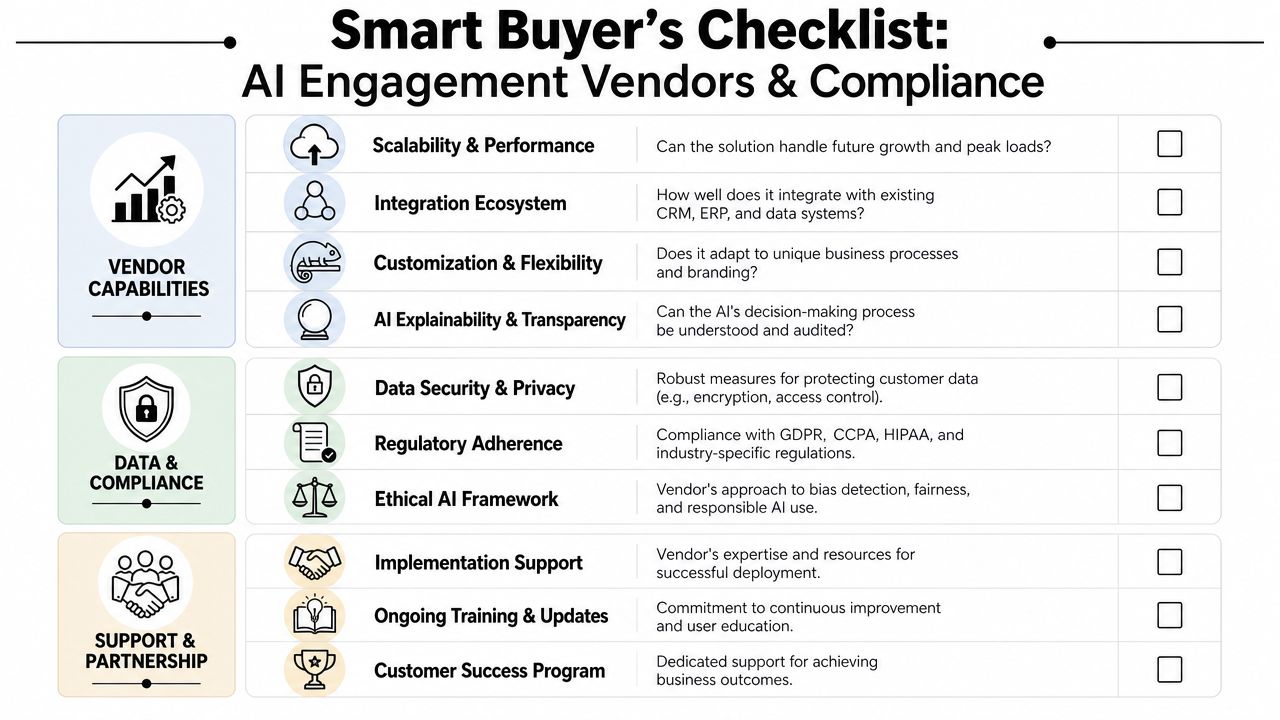
The easiest mistake in vendor selection is buying a polished chatbot and calling it an engagement platform. Enterprise buyers need a harsher filter.
A platform might generate fluent responses, support a nice bot builder, and still fail where it counts. It may not preserve context across channels. It may not integrate cleanly with your systems of record. It may rely on a single model stack that limits flexibility. It may offer weak controls for regulated workflows.
Ask about orchestration, not just automation
The most revealing question in a vendor process is rarely about FAQ accuracy. It's about continuity.
As McKinsey notes in its analysis of AI-enabled customer service, about 75% of customers use multiple channels in an ongoing experience. That means the primary enterprise challenge isn't self-service alone. It's whether the platform can coordinate context across voice, chat, and human agents without breaking the journey.
Ask vendors to demonstrate:
- Context persistence: What follows the user from one channel to another?
- Agent handoff quality: What exactly does the live agent receive?
- Journey memory: Can the system reference prior interaction state intelligently?
- Cross-channel actioning: Can it trigger and track work across systems, not just conversations?
If a vendor only shines inside a single chat window, it isn't solving the enterprise problem.
Buyers should evaluate the handoff path as rigorously as the self-service path.
Evaluate agentic capability carefully
A lot of products now use the word "agentic" loosely. In practice, there are big differences between systems that suggest actions and systems that can execute bounded tasks.
Look for clarity on these points:
| Evaluation area | What to ask |
|---|---|
| Decisioning | Can the AI choose from approved actions based on context and policy? |
| Workflow execution | Can it open tickets, update records, collect inputs, and trigger downstream actions? |
| Guardrails | How are approvals, role-based permissions, and prohibited actions enforced? |
| Explainability | Can teams inspect why the system recommended or triggered a specific step? |
For regulated environments, bounded autonomy is often the right target. You want a system that can move work forward reliably without crossing policy lines.
Compliance isn't a procurement checkbox
Large organizations already know they need privacy, security, and regulatory alignment. The mistake is treating those topics as final-stage review items.
Compliance affects platform design from the start. It influences data architecture, logging, access controls, human review flows, retention rules, and model deployment choices. In sectors such as healthcare, BFSI, and utilities, this isn't separate from engagement design. It shapes what the engagement layer is allowed to do.
Key areas to pressure-test include:
- Data security controls: Encryption, access management, tenant isolation, auditability.
- Regulatory alignment: Support for frameworks relevant to your geography and industry.
- Model governance: Reviewability, version control, testing workflows, fallback behavior.
- Knowledge governance: Who can publish, approve, and retire source content.
- Vendor flexibility: Multi-LLM architecture, deployment options, and integration openness.
What strong buyers do differently
Strong enterprise buyers run live scenario evaluations instead of feature checklists alone. They ask vendors to prove performance in realistic journeys with actual handoffs, actual systems, and actual constraints.
That means testing the ugly parts:
- Identity mismatch
- Ambiguous intent
- Channel switching
- Policy edge cases
- Live-agent escalation
- Incomplete backend data
- Human override
That process surfaces the difference between a conversational demo and a production-grade engagement platform very quickly.
The Dawn of the Autonomic Enterprise
The next phase of ai powered customer engagement won't be defined by better bot scripts. It will be defined by whether enterprises can build an intelligent operating layer across journeys.
That layer sits between people and systems. It listens, interprets, retrieves, decides, and coordinates. In customer experience, it reduces friction across service, sales, and retention journeys. In employee experience, it simplifies internal support, approvals, onboarding, and knowledge access. In operations, it turns fragmented workflows into managed flows with better visibility and control.
The companies that benefit most won't be the ones that automate the most interactions. They'll be the ones that automate the right work, preserve continuity, and keep governance tight enough for scale.
This is what the autonomic enterprise starts to look like. Not a business run by AI, but a business where AI handles more of the sensing, coordination, and routine action that currently slows people down.
That future isn't reached through a single rollout. It comes from better data foundations, smarter orchestration, bounded autonomy, and disciplined measurement. The organizations moving now aren't chasing novelty. They're building the service and operational layer they'll need for the next decade.
If you're evaluating how to operationalize agentic AI across CX and EX, Yellow.ai is one platform to consider. It supports enterprise conversational automation across voice, chat, and email, with orchestration, analytics, integrations, and compliance controls designed for large-scale deployments.
Produced via the Outrank app



