













The surprising part about ai powered customer engagement isn't that adoption is rising. It's that many enterprises still think they're doing personalization well when customers clearly don't agree. In Twilio's 2025 customer engagement research, 84% of businesses say they deliver “good” or “excellent” personalized engagement, but only 54% of consumers agree. That gap explains why basic automation is no longer enough.
At the same time, market projections cited in 2025 coverage say AI is expected to handle 95% of customer interactions by 2025 across voice and text, which signals how fast frontline operations are shifting toward AI-mediated engagement. The important strategic point isn't the forecast itself. It's what enterprises are building in response: systems that don't just answer inbound questions, but actively coordinate conversations, decisions, and next-best actions across customer and employee workflows.
That shift changes the operating model. Old chatbots waited for a prompt and followed a script. Agentic systems interpret context, pull from enterprise knowledge, trigger workflows, and decide when a human should step in. For large organizations, that's the difference between an automation layer and a new way of running service, sales, and internal support.
Table of Contents
- The New Reality of AI Powered Customer Engagement
- Understanding the Architecture of Agentic AI
- High-Value Use Cases for CX and EX
- Measuring the True ROI of AI Engagement
- Your Enterprise Implementation Roadmap
- Adopting Best Practices for Lasting Success
The New Reality of AI Powered Customer Engagement
AI powered customer engagement is no longer a support feature. It is becoming part of the enterprise operating model for how companies sell, serve, retain, and support at scale.
The pressure is not coming from channel growth alone. Large enterprises already run email, voice, messaging, apps, CRM workflows, knowledge systems, and contact center tools. The failure point is coordination. Customers experience disconnected journeys because each system sees only part of the interaction, and employees are left stitching together context after the fact.
That changes the role of AI. The immediate value is not faster replies or lower handling time in isolation. The bigger opportunity is using AI to interpret signals across interactions, decide what should happen next, and carry context between customer touchpoints and internal teams.
Personalization broke before AI fixed it
The gap noted earlier from Twilio's 2025 customer engagement research still matters because it reflects a structural problem, not a messaging problem. Many enterprises believe they are delivering personalized experiences. Customers often experience fragmented service, inconsistent recommendations, and repeated questions instead.
In practice, personalization has been overclaimed for years. Many teams still define it as inserting a first name, assigning a segment, or triggering a prebuilt journey. That model worked reasonably well when engagement was campaign-led and mostly one-directional. It breaks once a customer moves between chat, voice, email, mobile, and live service expecting continuity.
AI engagement becomes strategic when it acts as a decision layer across the business, not just a faster FAQ.
That is the shift many executive teams are now working through. The better question is no longer, "How do we automate support?" It is, "How do we coordinate engagement across channels, systems, and functions without adding more operational drag?" For a practical view of that shift, this overview of AI first trends in customer service is a useful reference.
Why 2026 looks different
The older model was reactive. A customer initiated contact. A bot answered within a narrow flow. If the exchange went off script, the issue moved to a human with incomplete context and a higher cost to serve.
The model taking shape now is proactive and agentic. AI can detect likely friction before a complaint is filed, prompt the right next action, support employees during live interactions, and preserve context across channels. That has implications well beyond the contact center. The same system can help a customer complete a transaction, help an agent resolve an exception, and help an internal team member answer a policy or workflow question.
That is why the category is expanding from CX tooling into enterprise orchestration.
Three shifts tend to separate serious programs from superficial deployments:
- Context over scripts: Systems use interaction history, knowledge, behavioral signals, and business rules instead of fixed trees.
- Orchestration over isolation: AI supports voice, messaging, web, email, and internal workflows as part of one operating layer.
- Outcomes over containment: The target is better resolution, stronger conversion, higher retention, and lower effort across both customer and employee journeys.
There is a trade-off. As companies move from passive bots to agentic systems, governance matters more. More autonomy can improve speed and consistency, but it also raises the bar for permissions, auditability, escalation logic, and system design. Enterprises that treat AI engagement as a workflow and decisioning problem, not just a conversation problem, are the ones most likely to get measurable business value.
Understanding the Architecture of Agentic AI
Most enterprises don't need another chatbot. They need a system that can interpret intent, retrieve the right knowledge, execute actions safely, and coordinate handoffs across channels and teams. That's what separates agentic AI from scripted automation.
From scripted bots to autonomous systems
A basic chatbot behaves like a junior employee reading from a decision tree. It can answer common questions if the wording matches what it was trained on. It struggles when the customer changes channels, asks a compound question, or needs an action across systems.
An agentic platform behaves more like a digital chief of staff. It listens, interprets, retrieves context, decides what tool or model to use, executes a task, and keeps track of what happened. That doesn't mean it should act without guardrails. It means the architecture supports bounded autonomy instead of fixed scripts.
The technical foundation is well understood. Conduent's analysis of AI in BPO notes that effective systems combine NLP, predictive analytics, and automation, enabling 24/7 support, instant handling of common queries, and machine learning-driven intent inference from historical data. That's the mechanism behind faster handling of routine work and more consistent responses at scale.
The four layers that matter
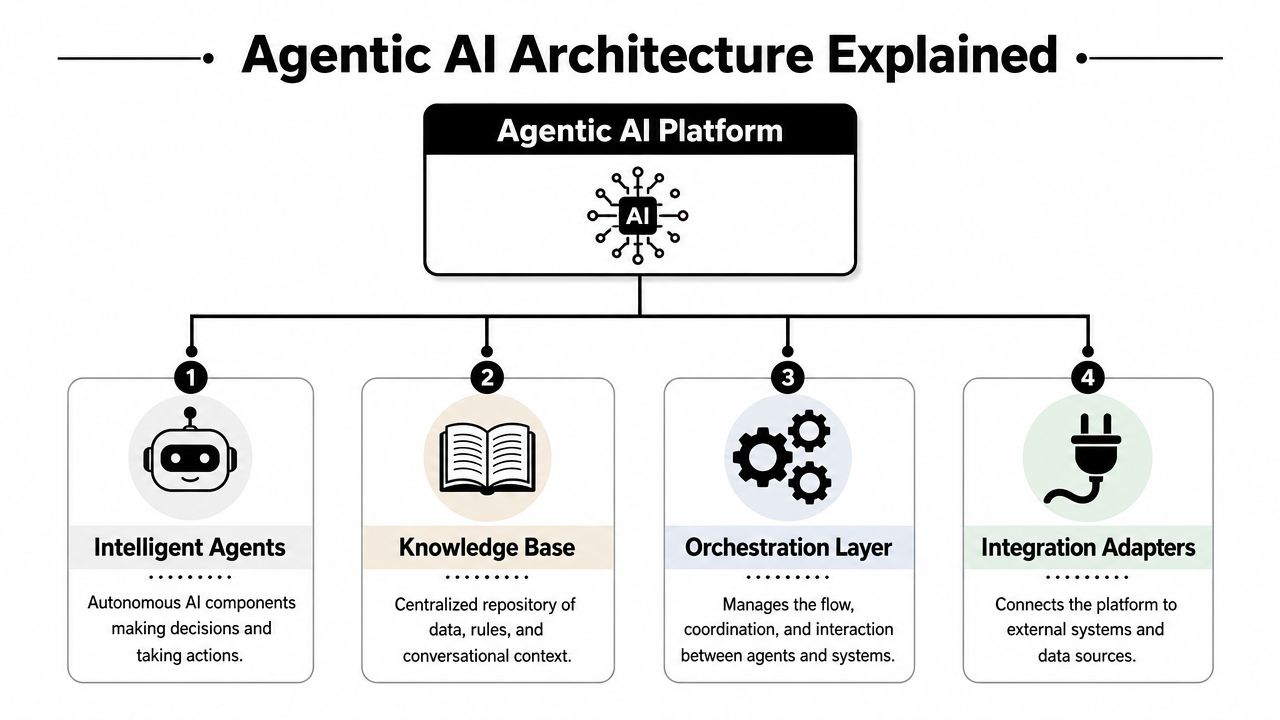
Most enterprise buyers should evaluate agentic architecture in four layers.
| Layer | What it does | What breaks without it |
|---|---|---|
| Intelligent agents | Interpret intent, reason through tasks, and choose actions | Conversations stay shallow and fail on anything non-linear |
| Knowledge base | Grounds responses in enterprise content, policy, and context | Answers sound fluent but aren't dependable |
| Orchestration layer | Coordinates decisions, routing, guardrails, and human handoffs | AI becomes another disconnected tool |
| Integration adapters | Connect CRM, ticketing, CCaaS, ERP, HRIS, and data systems | The agent can talk, but can't actually do work |
The orchestration layer matters more than many teams expect. That's where channel continuity, escalation rules, fallback logic, and action sequencing live. It's also where enterprises reduce model risk by separating business logic from any single model provider.
A few technical capabilities tend to signal maturity:
- Multi-LLM routing: This helps teams avoid hard dependence on one model and lets them optimize for different tasks such as summarization, extraction, or response generation.
- Agentic RAG: Retrieval should bring in live enterprise knowledge, not just static documents, so the system can answer with current policy and operational context.
- Omnichannel continuity: Voice, chat, email, and agent-assist can't be separate products if the goal is one engagement layer.
For a deeper breakdown of these patterns, this explainer on what agentic AI is, how it works, and how it differs from AI agents maps the distinctions clearly.
The architecture decision is operational, not academic. If the platform can't take action across systems, it won't change enterprise throughput.
High-Value Use Cases for CX and EX
The fastest way to understand ai powered customer engagement is to look at where it changes work, not where it generates the most demos. The strongest use cases usually sit in high-volume journeys with repetitive decisions, fragmented data, and expensive handoffs.

Customer experience use cases that create operational lift
In CX, agentic engagement works best when the system can do more than answer a question. It should be able to diagnose, act, and follow through.
Common examples include:
- Proactive service recovery: An AI agent sees a delivery delay, billing anomaly, or outage event and reaches out with status, guidance, and next steps before the customer contacts support.
- Resolution-led support: Instead of replying with policy text, the system verifies identity, checks order or account status, updates the case, and only escalates exceptions.
- Intent-based commercial engagement: If the customer shows a strong buying or renewal signal, the AI can recommend the next action, surface an offer, or tee up a human seller with context.
Utilities, retail, travel, and telecom often benefit quickly because they have repetitive journeys with predictable triggers. The same orchestration model can support messaging campaigns, inbound support, and voice workflows without forcing teams into separate automation stacks.
Employee experience use cases that remove internal friction
EX is where many enterprises find hidden value because internal service environments are full of repetitive requests, policy ambiguity, and routing delays.
Good examples include:
- HR support: Policy questions, leave guidance, onboarding steps, and document requests.
- IT helpdesk: Password resets, access requests, software guidance, and ticket triage.
- Operations support: Workflow nudges, approval reminders, and knowledge retrieval for internal teams.
This is also where AI can support process-heavy functions such as finance or healthcare administration. Teams exploring adjacent operational workflows often benefit from reviewing how others automate revenue cycle management because the same logic applies: unify data, reduce manual routing, and automate low-risk repetitive steps while preserving oversight for exceptions.
A useful benchmark for what “good” looks like in practice is whether the system reduces context switching for employees. If staff still have to search five systems, rewrite the same notes, and reclassify every case, the AI layer isn't doing enough.
What BFSI gets right
Regulated sectors usually expose the difference between shallow AI and operational AI very quickly. In BFSI, isolated chatbots rarely create much enterprise value because core work depends on decisions, records, and process execution across systems.
Tech Mahindra's BFSI process automation analysis gives a strong example of what happens when AI is tied to centralized data and automation. A European bank used Microsoft Copilot and Azure AI to cut chargeback processing from five days to same-day. That isn't just faster service. It's a workflow redesign driven by better data access, process automation, and decision support.
After you've seen the workflow in action, the design principles are easier to spot:
The broader lesson is straightforward. In regulated industries, customer engagement improves when AI is attached to systems of record, rules, and auditability. If it sits outside those layers, it becomes cosmetic.
Measuring the True ROI of AI Engagement
The weakest AI business cases still revolve around one metric: deflection. That's useful, but it doesn't tell a leadership team whether engagement quality improved, whether revenue opportunities expanded, or whether employees became more effective.
McKinsey's perspective on AI-enabled customer service makes the core shift explicit. AI can reduce cost-to-serve, but the larger question is whether it improves measurable outcomes such as retention, conversion, and lifetime value. That is where many teams still lack a practical measurement model.
Deflection is not a business case
A high deflection number can hide poor outcomes. Customers may abandon. They may come back on another channel. Agents may receive more complex escalations because the AI handled the easy part badly. Leaders who only track containment often overstate value and undercount downstream friction.
A better approach is to measure AI engagement by use case and by handoff quality.
Practical rule: If you can't show what changed in resolution quality, revenue opportunity, or employee throughput, you don't yet have an ROI story.
The most useful KPI sets usually include a mix of customer, operational, and workforce measures:
- Customer outcome metrics: First contact resolution, repeat contact rate, retention, conversion progression
- Commercial metrics: Cross-sell acceptance, upsell opportunity creation, revenue influenced by guided journeys
- Operational metrics: Time to resolution, queue pressure, transfer rate, backlog reduction
- Employee metrics: Agent productivity, time spent on repetitive work, knowledge retrieval speed, coaching effectiveness
Mapping AI use cases to business KPIs
The table below is a better starting point than a generic dashboard because it ties measurement to the specific job the AI is doing.
| AI Use Case | Primary KPI | Secondary KPI |
|---|---|---|
| Proactive support outreach | First contact resolution | Repeat contact rate |
| Automated service resolution | Time to resolution | Human escalation quality |
| Agent assist in contact center | Agent productivity | Consistency of resolution notes |
| Personalized renewal or upsell guidance | Conversion rate | Customer lifetime value |
| Employee onboarding assistant | Time to productivity | Internal support ticket volume |
| HR and IT self-service | Resolution speed for common requests | Employee satisfaction with support |
That framework also helps teams avoid the common mistake of combining unlike programs. A sales-assist use case shouldn't be judged by the same KPI set as an HR helpdesk assistant. They serve different outcomes.
If you're refining your scorecard, this guide on measuring AI agent performance in an AI-first world is a useful complement because it focuses on evaluation beyond surface automation metrics.
Your Enterprise Implementation Roadmap
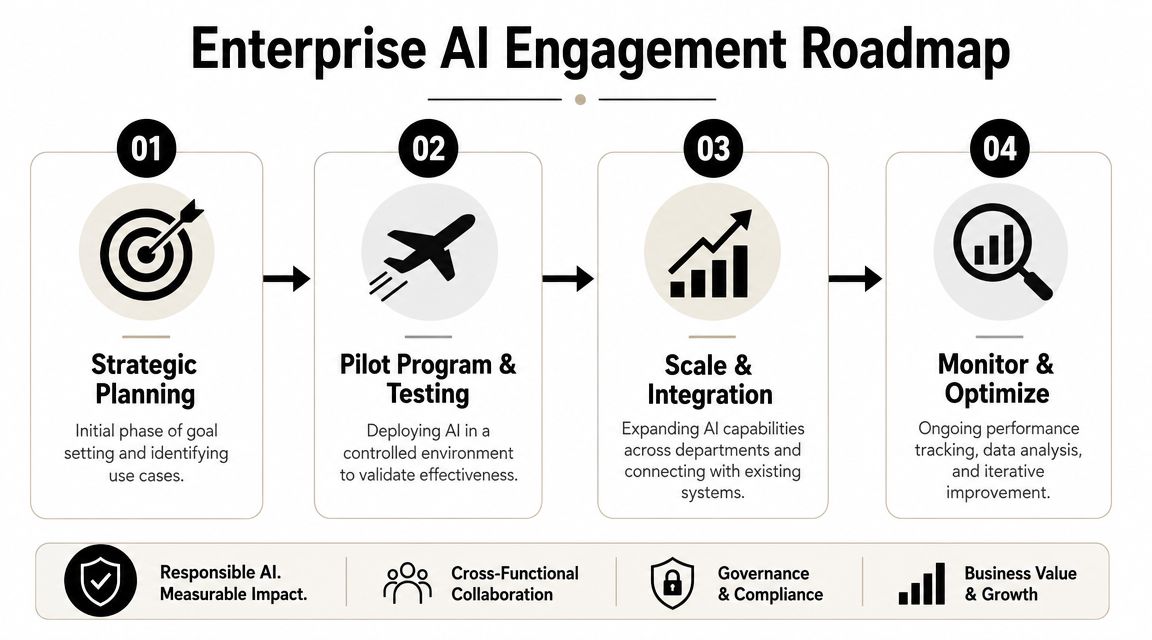
Agentic AI programs break in production long before the model becomes the problem. The failure points are usually operational. Missing context, shallow integrations, unclear ownership, and late-stage governance will stall adoption even if the assistant performs well in a demo. A usable roadmap treats AI engagement as an operating model that coordinates customer and employee work across systems, not as a chatbot rollout.
Start with data and systems readiness
The first implementation decision is not model selection. It is whether the agent has the context and permissions to produce a reliable outcome.
In practice, readiness comes down to four areas:
Unified interaction context
Combine conversation history, identity, account data, case status, and approved knowledge sources. If context stays fragmented across CRM, ticketing, telephony, and knowledge systems, the AI will respond inconsistently and handoffs will degrade.Actionable integrations
Reading is only half the job. The AI should also complete work in systems such as Salesforce, Zendesk, Genesys, ServiceNow, HRIS platforms, or internal tools. The agent can talk, but can't do work, unless those action paths exist.Clear use-case boundaries
Define what the AI can answer, what it can execute, and where human approval is required. That line protects both customer experience and compliance, especially in regulated workflows.Operational ownership
Assign clear responsibility for prompts, policies, routing logic, testing, analytics, and change management. If ownership is spread across too many teams, quality drifts fast.
Platform choice matters here, but the evaluation criteria matter more. Yellow.ai is one example of a vendor built around agentic AI for CX and EX. The primary buying test is whether the platform can coordinate knowledge, actions, policy controls, and channel context under enterprise conditions, not whether it can produce a polished chatbot demo.
Pilot narrowly and govern early
A strong pilot proves execution, not just intent. Choose one customer journey and one employee workflow with high volume, stable rules, and visible operational pain. That creates enough complexity to test orchestration without turning the pilot into a multi-quarter integration program.
A practical pilot structure includes:
- Choose a narrow lane: Password reset, order modification, dispute intake, leave policy guidance, or appointment changes.
- Instrument the workflow: Track what the AI resolved, what it escalated, what it summarized, and what people had to fix afterward.
- Review failures every week: Edge cases expose integration gaps, policy conflicts, and weak grounding faster than success cases do.
- Set expansion gates: Scale only after the pilot meets agreed standards for task completion, handoff quality, and operational trust.
Early governance costs less than post-launch cleanup. Privacy rules, escalation logic, approval thresholds, and audit trails should be defined before broad deployment, because retrofitting them later usually forces teams to redesign workflows they already put into production.
Scale should follow proof in two areas. The first is bounded autonomy. The AI can complete specific tasks with the right context, controls, and fallbacks. The second is maintainability. If the system depends on a small specialist team to tune every prompt, update every workflow, and monitor every exception, the program will not expand into a true enterprise engagement layer.
Adopting Best Practices for Lasting Success
The most durable AI engagement strategies don't aim for maximum automation. They aim for reliable orchestration. That means choosing platforms and operating models that can support autonomy where it's useful and human judgment where it's necessary.
What to look for in a platform
Enterprise buyers should screen for capabilities that hold up under operational load, compliance review, and cross-functional expansion.
A practical shortlist includes:
- Multi-model flexibility: The architecture should support more than one model path so teams can adjust for quality, latency, or policy needs without redesigning the whole stack.
- Knowledge grounding: The platform should retrieve from enterprise-approved content and preserve conversational context across channels.
- Integration depth: It needs prebuilt connectors or a workable integration framework for CRM, CCaaS, ticketing, HR, and data systems.
- Security and compliance posture: In large enterprises, this isn't a procurement checkbox. It determines where the platform can be used.
- Testing and observability: Teams need ways to inspect failures, tune prompts and flows, and evaluate handoff quality over time.
Procurement teams often overweight interface polish and underweight orchestration logic. That's backwards. A clean builder matters, but if the system can't coordinate knowledge, actions, and policy controls, the AI won't survive production complexity.
Where human-led engagement still wins
This is the part many automation programs get wrong. More AI isn't always better. Some moments should remain human-led because trust, judgment, and emotional nuance matter more than speed.
Kaplan's guidance on human partnership in customer engagement captures the best operating principle. Organizations are using AI to become more human, not less. It also notes that an estimated 75% of customers use multiple channels during a single journey, which reinforces the need for AI that assists employees in real time rather than replacing them outright.
Human ownership usually matters most in these situations:
- High-stakes decisions: Financial hardship, fraud concerns, medical or benefits questions, and sensitive complaints
- Emotion-heavy interactions: Escalations where empathy and reassurance influence the outcome
- Exception handling: Cases that break policy logic, involve conflicting records, or require discretionary judgment
The right handoff isn't a failure. It's evidence that the operating model understands risk, trust, and customer reality.
Hybrid orchestration is the pattern that lasts. AI handles repetitive, low-risk work. Human teams handle judgment, recovery, and relationship moments that define the experience.
If you're evaluating how to operationalize ai powered customer engagement across both CX and EX, Yellow.ai is worth exploring as an enterprise option. Its platform is built for agentic AI orchestration across voice, chat, email, and internal workflows, which is the direction many large organizations now need to support.
Crafted with Outrank



