














Usage, not training, usually determines whether a conversational AI platform becomes a durable product or an expensive experiment.
That is the economic shift many teams miss in the AI inference vs training debate. Training is a bounded investment with a clear start and stop. Inference is an operating load that scales with adoption, concurrency, and response length. The better your product performs in market, the more often you pay to run it.
For a CTO, that changes the evaluation model. A pilot can look efficient because training spend is visible and inference demand is still low. Production reverses that picture. Every new conversation, voice turn, escalation path, and peak-hour spike adds serving cost, latency pressure, and infrastructure complexity.
Inference is where revenue is realized, but it is also where architecture is exposed. Teams that build around training benchmarks often discover too late that the true constraint is sustained serving under real user traffic. That mismatch drives budget overruns, slower responses, and avoidable friction in the user experience.
Table of Contents
- The Hidden Shift in AI Economics
- AI Training vs Inference The Core Concepts
- A Detailed Technical Comparison
- The Business Impact Cost Latency and Scale
- Architecting for Production AI Deployment Models
- The CXO's Decision Checklist for AI Platforms
- The Future is Inference-First
The Hidden Shift in AI Economics
A conversational AI system can look financially attractive at launch and still miss its margin targets after adoption. The reason is simple. Enterprise budgets are often built around model creation, while the operating reality is shaped by model usage.
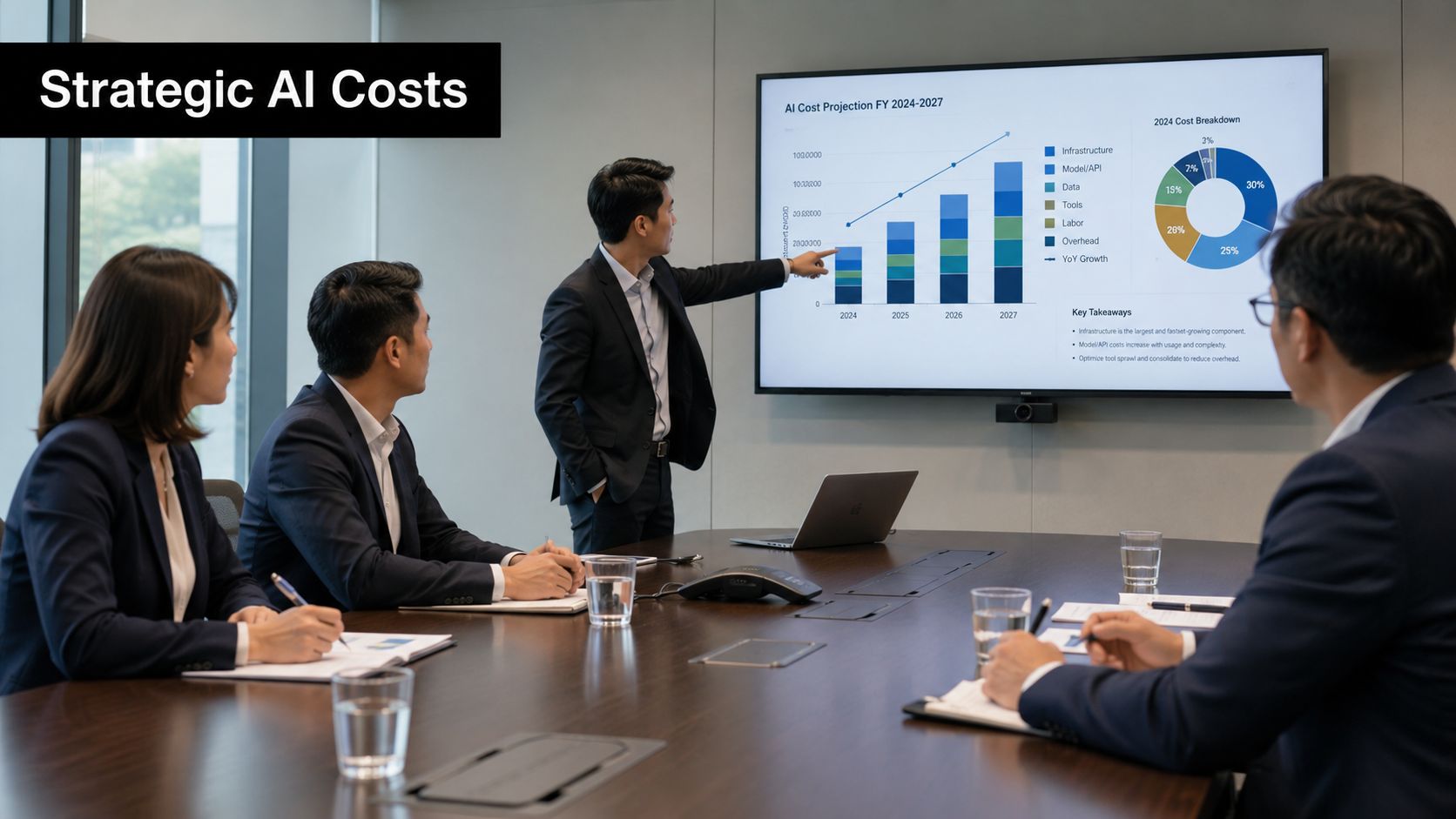
Training is a scheduled engineering event. Inference is a live service that has to answer every prompt, every turn, and every integration call under user-facing latency constraints. That distinction changes the economics. A training job can be delayed, resized, or paused. A production chatbot serving customers during peak hours has no such luxury.
This is the architectural mismatch that traps enterprises. They buy or build AI stacks optimized for training throughput, then discover that production performance depends on a different set of disciplines: request orchestration, concurrency control, caching, token efficiency, model routing, and GPU utilization under spiky demand. The model may be good enough. The serving layer is often what breaks the business case.
For a CTO, the primary risk is not a large training bill. It is the success tax of inference. Each improvement in adoption adds recurring cost pressure. More active users generate more requests. Longer conversations increase token consumption. Higher expectations for response quality push teams toward larger models or more retrieval steps, which raises latency and infrastructure spend at the same time.
| Dimension | Training | Inference |
|---|---|---|
| Economic profile | Planned project spend | Recurring operating expense tied to usage |
| Time pattern | Periodic and schedulable | Continuous and demand-driven |
| Primary business risk | Development overrun | Margin erosion during adoption |
| User visibility | Indirect | Immediate, through speed and answer quality |
| Platform consequence | Shapes model capability | Shapes ROI, reliability, and CX |
The budgeting error follows from that mismatch. Finance sees a development line item. Operations inherits a variable cost engine. Product promises fast, natural conversations. Infrastructure teams then have to deliver those conversations within strict latency targets while controlling token, compute, and vendor costs.
That is why inference changes the AI investment thesis. Once a model is in production, technical choices that looked secondary during experimentation become first-order business decisions. Even upstream work such as synthetic data in AI training matters differently under this lens, because better training only pays off if the serving stack can deliver responses at a cost and speed the business can sustain.
The common strategic error is not underestimating model development. It is treating deployment economics as an implementation detail instead of the main driver of long-term AI returns.
AI Training vs Inference The Core Concepts
Training and inference are often discussed as if they're just two steps in one workflow. That's technically correct, but strategically misleading. They behave like different businesses with different cost structures.
Think of training as writing and printing a reference book. Engineers feed the model massive datasets, run repeated optimization cycles, and adjust parameters until the system learns useful patterns. This is the compute-heavy stage where the model is built.
Think of inference as answering live questions from that reference book at production scale. A customer asks a chatbot for order status. An employee asks for a policy answer. A voice bot handles a billing question. The model isn't learning during those interactions. It's applying what it already knows, fast enough to feel conversational.
What training actually does
Training is the phase where the model learns statistical relationships from data. It requires concentrated compute, long-running jobs, and repeated experimentation. Teams usually treat it like an investment event. They budget for it, schedule it, and complete it before broad deployment.
That bounded nature is why training is easier to reason about financially. Even when it is expensive, it has a beginning, an end, and a planning window.
For teams improving datasets and model quality, topics like synthetic data in AI training matter because they influence what the model can learn before it reaches production.
What inference actually does
Inference is the live execution layer. It turns model capability into user-facing output. It handles prompts, generates responses, classifies intent, calls tools, and supports decision flows in real time.
That changes the economic category. Inference isn't a project cost. It's an operating cost tied directly to usage. If your AI assistant handles more conversations, your inference footprint rises. If you add channels like voice, richer workflows, or more complex reasoning, the pressure grows further.
Practical rule: Training creates potential value. Inference is where your organization either captures that value or pays to discover it can't.
A lot of confusion in AI inference vs training comes from treating inference as the cheaper, simpler afterthought. Per interaction, it may look small. Across a production estate, it becomes the system you fund every day.
A Detailed Technical Comparison
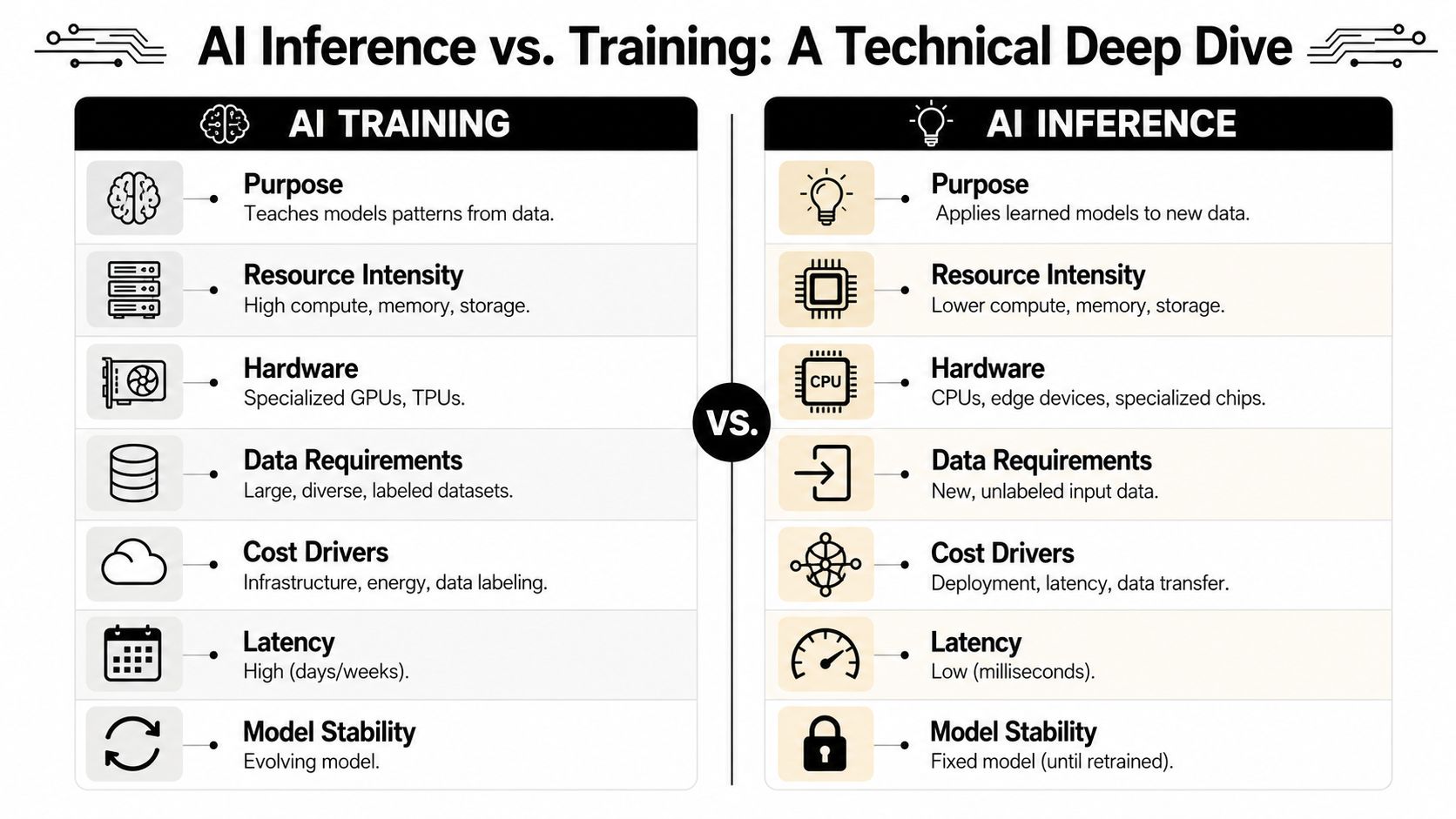
A platform that looks efficient in the lab can become expensive and slow in production because training and inference stress the stack in different ways. That mismatch is one of the main reasons enterprises underestimate the operating cost of conversational AI after launch.
Compute profile
Training concentrates compute into scheduled, high-intensity jobs. The objective is to move through large datasets, update weights efficiently, and finish experiments fast enough to keep model iteration moving. That favors dense GPU or TPU clusters tuned for throughput.
Inference serves live requests one interaction at a time, under unpredictable demand. The objective shifts from raw training speed to consistent response times, stable concurrency, and acceptable cost per request. Depending on the use case, that can point to smaller GPU pools, CPUs, or inference-specific accelerators.
The hardware market reflects that divergence. SoftwareSeni's benchmark-focused review of AI training and inference infrastructure notes large gains in inference-oriented performance on newer hardware, including NVIDIA's reported improvement over H100 and Groq's faster inference positioning. The same analysis also highlights a second issue many buyers miss. Storage and memory behavior that suits training often performs poorly for live serving.
That matters more than benchmark headlines suggest. A CTO buying for a conversational platform is not purchasing peak compute alone. They are purchasing the ability to hold latency steady while usage grows.
Storage and data access
Storage exposes whether the architecture was designed for model development or production service.
Training pipelines are built around sequential throughput. They pull large datasets, stream them into accelerators, and write checkpoints during long runs. Inference systems care about fast random reads, low jitter, and quick access to embeddings, prompts, session state, and model artifacts. In practice, that means training environments are often optimized around very high bulk throughput, while inference environments depend more on high IOPS and low-latency NVMe access patterns.
Training infrastructure is optimized for finishing a job. Inference infrastructure is optimized for answering the next request on time.
For conversational AI, that distinction shows up in user experience immediately. A contact center bot can have an excellent model and still feel unreliable if retrieval, prompt assembly, or token generation stalls under concurrency. Teams evaluating deployment economics should model those production effects early with an AI ROI calculator for projected automation and serving costs, not after traffic exposes them.
Performance metrics that matter
Training teams track metrics tied to learning progress: throughput, utilization, time to convergence, and experiment velocity. Production teams own a different scorecard: p95 latency, tokens per second, concurrency limits, queue depth, error rates, and the cost of serving each interaction reliably.
Those metrics lead to different vendor questions:
- For training efficiency: How quickly can the platform process large training runs and support retraining cycles?
- For inference behavior: What happens to latency and response quality during traffic spikes, long prompts, or tool-calling workflows?
- For production resilience: Can the serving layer maintain consistent performance across chat, voice, retrieval, and orchestration without overprovisioning?
Inference is also becoming a larger strategic variable inside model performance itself. NVIDIA CEO Jensen Huang's discussion of changing inference economics and test-time compute describes how falling inference costs and greater use of query-time compute are shifting where value is created. For business leaders, the implication is straightforward. Accuracy is no longer determined only during training. It is increasingly shaped at runtime, where latency, hardware choice, and cost discipline directly affect the user experience.
That is the architectural shift many enterprises miss. They still buy AI infrastructure as if model creation were the center of gravity. In production conversational systems, the harder problem is serving intelligence repeatedly, quickly, and profitably.
The Business Impact Cost Latency and Scale
A production AI platform fails in business terms long before it fails in technical terms. It fails when usage rises faster than the budget model. It fails when latency creeps into customer conversations. It fails when an apparently successful rollout creates an operating bill nobody planned for.
Why inference becomes a success tax
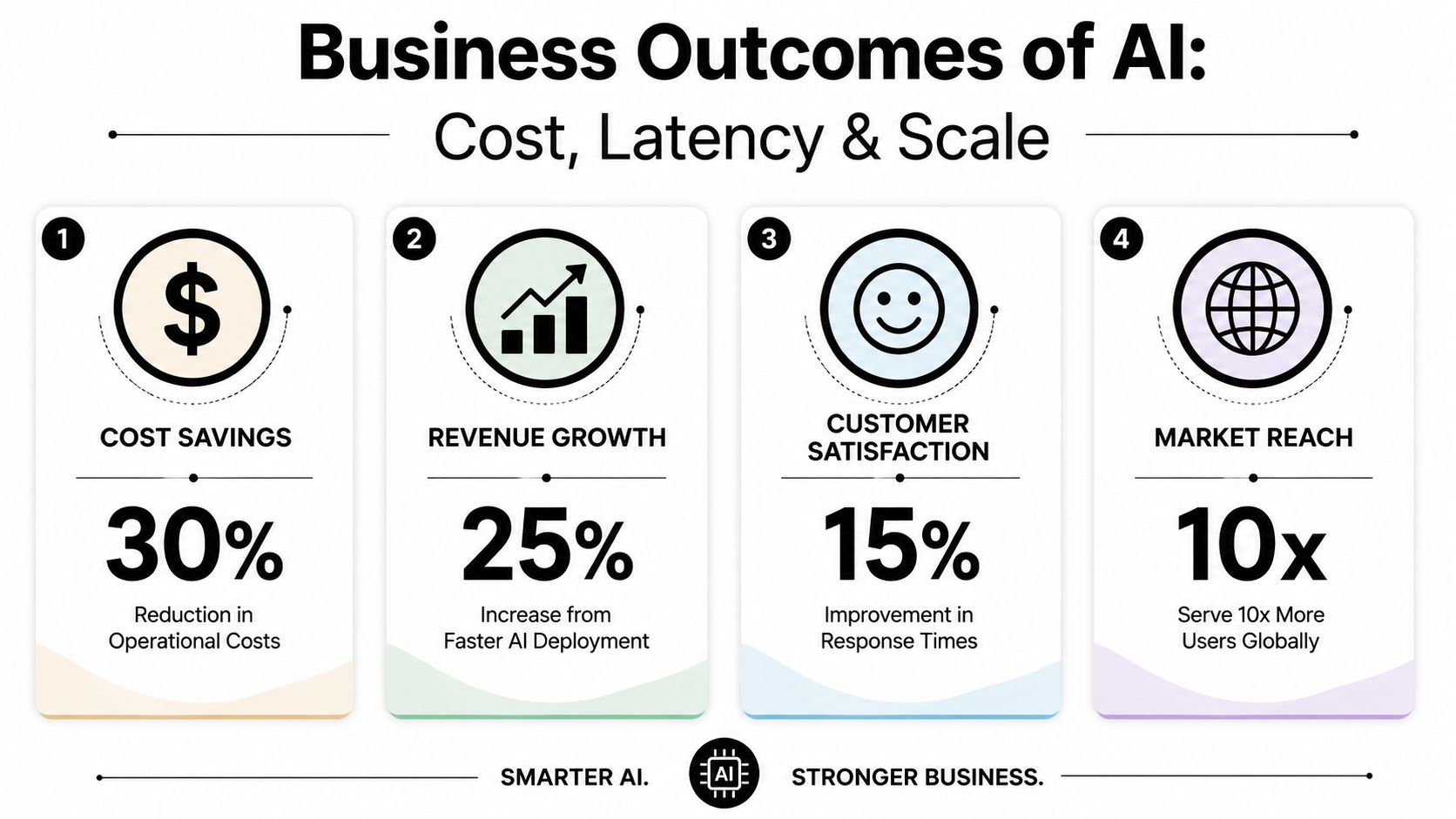
The phrase success tax is useful because it captures the trap precisely. Training is a bounded capital investment. Inference is an unbounded operating expense that scales with user success, creating a hidden budget risk many enterprises miss, as explained in Telnyx's analysis of training and inference cost structure.
That means the better your AI platform performs commercially, the more cost pressure it can create operationally. More automated resolutions, more active users, more channels, and more agentic workflows all increase live compute demand. This is the opposite of traditional software economics, where scale often improves margins cleanly after fixed development costs are absorbed.
For budget owners, the implication is sharp. Pilot economics rarely tell you production economics. If you don't model inference under expanded adoption, you aren't forecasting TCO. You're pricing a demo.
A useful planning discipline is to pressure-test your assumptions with a structured AI ROI calculator. Not because a calculator can predict everything, but because it forces leaders to quantify which outcomes improve margins and which ones increase run-rate costs unnoticed.
Latency is a business metric
In conversational AI, latency isn't a backend detail. It's the user experience. When response timing becomes inconsistent, customers interrupt, repeat themselves, abandon flows, or ask for a human. The platform may still be technically available, but the experience has already degraded.
The distinction between ai inference vs training becomes visible to non-technical stakeholders. A training-centric architecture can produce a high-quality model and still disappoint users because the serving path wasn't optimized for real-time execution.
Budget discipline in AI now depends on two controls. You need to manage cost per interaction, and you need to protect response quality as interaction volume rises.
The companies that handle this well don't just ask whether the model is smart. They ask whether the delivered answer is fast enough, often enough, at a cost the business can sustain.
Architecting for Production AI Deployment Models
Production deployment decisions should start from the user journey, not from the hardware you already own. Enterprises often do the opposite. They build or buy strong training capacity, then try to serve real-time applications on top of it. That's where the architectural mismatch shows up.
Cloud on-premises and edge serve different jobs
Cloud makes sense when demand is variable, experimentation is still active, or geographic distribution matters. It gives teams flexibility, but it can also make inference spend harder to predict once usage stabilizes.
On-premises can work when workloads are sustained, governance is strict, or infrastructure utilization is predictable. But it requires discipline in capacity planning. Overbuild and you waste capital. Underbuild and you damage service quality.
Edge becomes attractive when response time matters at the point of interaction. For conversational AI, especially voice, serving closer to the user can reduce delivery friction and help stabilize experience across regions.
Most enterprise deployments won't live entirely in one model. They end up hybrid, with centralized control for governance and distributed serving for performance-sensitive workloads. That isn't architectural indecision. It's usually the most honest response to conflicting business requirements.
Why training-first infrastructure fails in production
AWS notes a frequently overlooked gap between infrastructure optimized for training, which is throughput-oriented and compute-bound, and infrastructure optimized for inference, which is latency-sensitive and memory-bound. That mismatch leads to performance failures in real-time voice and chat applications when unpredictable traffic spikes cause latency spikes, according to AWS guidance on inference architecture challenges.
That one point explains a surprising number of disappointing launches. Teams assume powerful training hardware will naturally support production. In live environments, the opposite can happen. The architecture is optimized for large batch jobs, not for many simultaneous, jitter-sensitive conversations.
If you're evaluating deployment patterns, focus on these questions:
- Traffic shape: Is demand steady, spiky, global, or tied to business hours?
- Interaction type: Are you serving text chat, voice, or tool-using agents with longer reasoning paths?
- Control point: Which parts of the stack need centralized governance, and which need local responsiveness?
For organizations moving toward autonomous service operations, an agentic AI platform should be judged less by model branding and more by how it handles live orchestration, routing, and response consistency under production conditions.
The CXO's Decision Checklist for AI Platforms
Vendor demos usually optimize for intelligence theater. They show what the model can do in ideal conditions. A CXO needs to probe what the platform costs and how it behaves when usage becomes messy, global, and constant.
Questions that expose hidden operating risk
Ask direct questions. Make vendors answer in operating terms, not product language.
- Inference pricing under success: What is your exact inference pricing model, and how would our costs change if adoption materially increases?
- Latency under load: What do your P95 and P99 latency commitments look like for both chat and voice during traffic spikes?
- Architecture fit: Show us how your production stack is optimized for inference rather than inherited from a training environment.
- Model routing logic: How do you decide which model handles which task, and how do you control cost-performance trade-offs at inference time?
- Fallback behavior: What happens when a primary model slows down, fails, or exceeds budget thresholds?
- Observability: Which production metrics can our team inspect directly, and how quickly can we trace latency or cost anomalies?
- Governance in deployment: How do policy controls, auditability, and access management work once agents are live?
- Commercial resilience: What prevents vendor lock-in if our cost or performance profile changes?
Ask every AI vendor to describe their platform at peak usage, not in the demo environment. That's where the true operating model appears.
The best answers will be specific. They will show routing logic, serving architecture, load assumptions, and budget controls. Weak answers usually drift back to training pedigree, model size, or generic claims about scalability.
A CTO doesn't need perfect certainty before choosing a platform. But they do need clarity about where financial exposure and user experience risk will surface first.
The Future is Inference-First
By the second year of a successful AI rollout, the dominant cost is rarely model creation. It is serving every prompt, every turn, and every peak-hour interaction at production latency.
That is the shift many enterprises still underestimate. Training remains the source of model capability, but budget pressure, customer experience risk, and operational complexity now accumulate at inference. Success creates its own tax. The more useful your conversational AI becomes, the more tokens, routing decisions, GPU seconds, caching layers, guardrail checks, and failover paths your platform must support.
This creates an architectural mismatch inside many companies. They buy or build around training-era signals such as model size, benchmark performance, and research pedigree, then discover that production performance depends on a different stack entirely. Inference architecture decides whether response times stay acceptable under load, whether cost per conversation remains defensible, and whether growth improves margins or erodes them.
For a CTO, the implication is straightforward. Competitive advantage no longer comes only from owning model intelligence. It comes from controlling the economics of deployment.
That changes how AI platforms should be evaluated. The right question is not merely which model is strongest in isolation. The better question is which serving architecture can maintain quality, latency, governance, and unit economics as usage expands across chat and voice. That is also why organizational design matters. Procurement, platform engineering, finance, and CX leaders need a shared view of inference behavior in production. This guide for CTOs on AI is a useful companion for framing that decision at the operating-model level.
One conclusion stands out. Training creates potential. Inference determines whether that potential becomes durable enterprise value or an expensive, slow, and fragile customer experience.
If you're evaluating conversational AI at enterprise scale, Yellow.ai is worth a close look. Its agentic AI platform is built for production-grade voice and chat, multi-LLM orchestration, enterprise governance, and the kind of low-latency deployment model that matters when inference cost and user experience become the battleground.



