













Most companies still approach AI as a software purchase. The higher-stakes decision is operational. Do you want systems that execute assigned tasks, or systems that are accountable for business outcomes within defined limits?
That distinction sits at the center of the AI agent vs agentic AI conversation. An AI agent usually handles a bounded job, such as drafting a reply, routing a ticket, or generating a test case. Agentic AI goes further. It interprets a goal, plans across multiple steps, coordinates tools and data sources, responds to exceptions, and keeps working until it reaches a target or escalates for human input.
The difference is not academic. It changes how enterprises design work.
A task-focused agent can improve throughput inside a single function. An agentic system can reshape the operating model across functions because it is built to manage progress, not just complete a prompt. That means leaders are no longer deciding where to add another AI tool. They are deciding where autonomy belongs, what guardrails it needs, how performance will be measured, and which outcomes a machine can own safely.
I see this as the shift from efficiency programs to enterprise autonomy. The first wave of AI helped teams do existing work faster. The next wave assigns systems a result, gives them policy boundaries, and expects them to execute with oversight rather than constant instruction.
That shift has strategic weight. It affects governance, staffing, vendor selection, risk design, and the economics of scale. Enterprises that understand the difference early can deploy AI with clearer accountability and better returns. Enterprises that do not often end up with a growing stack of disconnected agents that save time locally but add coordination overhead everywhere else.
Table of Contents
- The End of AI Tools and the Dawn of AI Teammates
- What Is an AI Agent The Specialized Doer
- What Is Agentic AI The Autonomous Orchestrator
- Core Differences A Head to Head Comparison
- Enterprise Use Cases From Task Automation to Outcome Ownership
- Evaluating Enterprise Readiness Governance and Safety
- Choosing Your AI Strategy and Selecting a Vendor
The End of AI Tools and the Dawn of AI Teammates
Many enterprises are still buying AI the way they bought earlier automation. One use case at a time. One bot for support deflection, another for routing, another for employee self-service. That approach creates local wins, but it rarely creates enterprise-wide advantage.
The reason is structural. A collection of narrow agents can automate steps, but it can't reliably own a business outcome unless something above those agents handles sequencing, trade-offs, exceptions, and policy. Once leaders see that, the AI agent vs Agentic AI question stops being semantic. It becomes an operating model decision.
Why this distinction changes executive strategy
An AI agent behaves like a specialized digital worker. It's useful, often fast, and usually cheaper to deploy for one bounded task. But the enterprise still carries the burden of orchestration. Humans monitor handoffs, reconcile conflicting outputs, and intervene when the workflow leaves the happy path.
Agentic AI shifts that burden upward into the system itself. It treats a business objective as the unit of work. That could be resolving a service issue end to end, completing onboarding across functions, or coordinating incident response across tools.
The strategic upgrade isn't from manual work to automated work. It's from supervised tools to governed autonomy.
What leaders often underestimate
The hidden cost in most AI programs isn't model access. It's workflow fragmentation. Every time a team deploys another isolated agent, someone still has to define triggers, maintain logic, audit results, and manage exceptions across systems.
That's why enterprises are starting to separate two decisions that used to be bundled together:
- Task automation decision: Can a single agent handle this repeatably inside one boundary?
- Outcome automation decision: Does this process require planning, recovery, escalation, and adaptation across systems?
- Governance decision: Who owns oversight when the system acts with more independence?
The companies that answer those three questions clearly won't just deploy more AI. They'll redesign how work gets done.
What Is an AI Agent The Specialized Doer
An AI agent is a software component built to perform a specific task inside a defined boundary. It receives an input, applies logic or learned behavior, takes an action, and then stops unless another trigger arrives. That makes it valuable. It also makes it limited.
A useful mental model is a highly capable specialist. It knows its lane. It can retrieve records, classify requests, summarize content, route tickets, validate fields, or respond to common questions. But it doesn't naturally own the entire process around that task.
Where AI agents work well
In enterprise environments, AI agents shine when the work is stable and predictable. Think of jobs like:
- Customer support triage: Categorizing an inbound issue and sending it to the right queue.
- HR self-service: Answering a leave policy question from a knowledge base.
- IT operations: Resetting a password or checking software access eligibility.
- Data handling: Extracting information from a form and pushing it into a system of record.
These are practical automations, and many teams start building them through tools like an AI agent builder for enterprise workflows. That's usually the right starting point because the scope is visible and the return is easier to measure qualitatively.
Where they break down
The limitations appear when work becomes conditional, cross-functional, or ambiguous. An isolated AI agent usually doesn't know how to rethink the process if a dependency fails or if the user goal changes halfway through.
For example, a support agent might classify a refund request correctly. But if the refund depends on order status, fraud rules, fulfillment exceptions, finance policy, and customer tier, that's no longer one task. That's a workflow with judgment.
Operational test: If humans still need to stitch together next steps after the agent finishes, you have task automation, not outcome automation.
The real trade-off
AI agents often deliver quick wins because they're easier to deploy, easier to constrain, and often faster on narrow tasks. But they also create a ceiling. When leaders expect them to solve broader process complexity, results get uneven. Teams end up layering scripts, triggers, and manual escalations around the agent until the automation becomes fragile.
That's why AI agents should be treated as building blocks, not as the final architecture for enterprise autonomy.
What Is Agentic AI The Autonomous Orchestrator
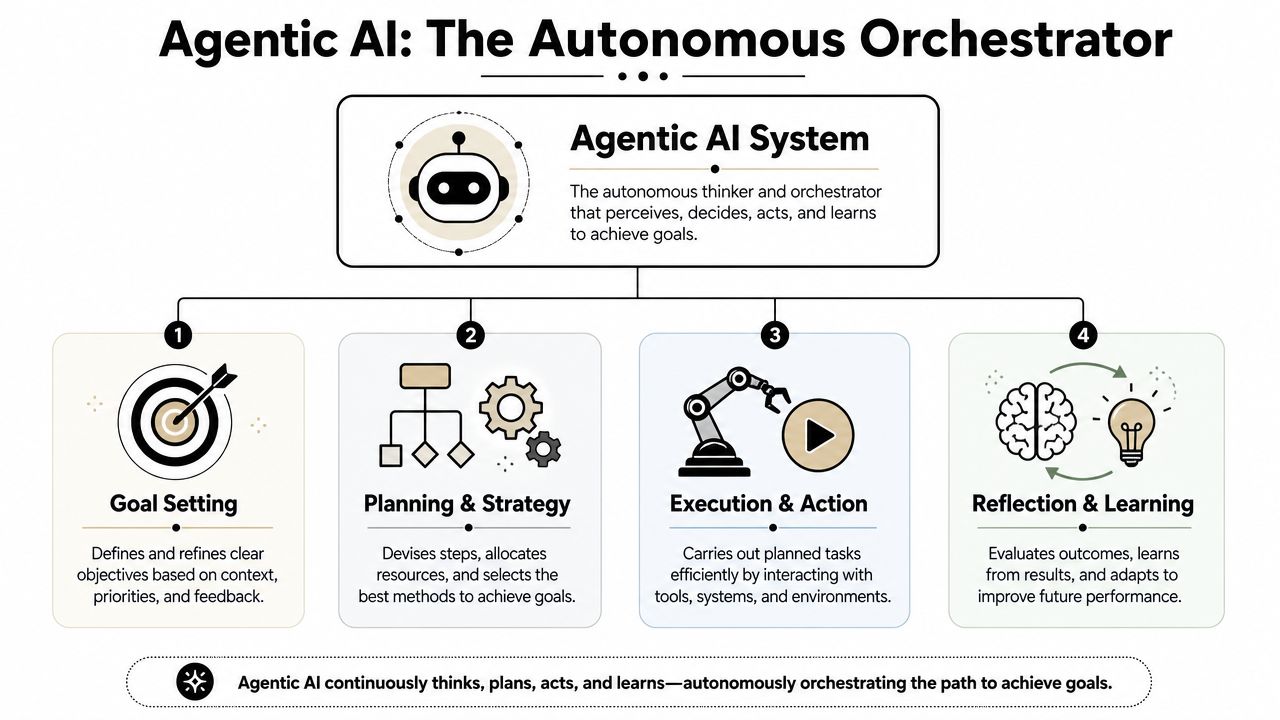
Agentic AI operates at a different level. It doesn't just execute a task. It interprets a goal, decides what sequence of actions is required, invokes the right tools or agents, and adjusts when the environment changes.
Workday describes this clearly. Agentic AI operates at a higher orchestration layer, acting as the “thinker” while AI agents act as the “doers,” and that difference allows the system to reason about broader goals, plan steps, select the right agents, and adapt as conditions change in Workday's explanation of AI agents vs Agentic AI.
The four capabilities that matter
A practical way to evaluate Agentic AI is to look for four capabilities working together:
Goal setting
The system understands the intended outcome, not just the immediate request. “Resolve this complaint” is different from “send this email.”Planning
It decomposes the goal into a sequence of steps. That may include data retrieval, policy checks, tool calls, approvals, and communication.Execution
It can take action through APIs, enterprise apps, knowledge systems, and other agents.Reflection and adjustment
It evaluates progress, handles exceptions, and changes course when the initial plan no longer fits.
This is the core mental model behind agentic AI and how it differs from AI agents. The important point isn't the label. It's that the system owns the logic that connects work across stages.
Why orchestration matters more than raw intelligence
A lot of AI programs over-focus on model quality and under-focus on operational design. In the enterprise, the hard part usually isn't producing a fluent answer. It's coordinating reliable action across systems with permissions, timing constraints, and business rules.
That's where agentic systems create strategic value. They can keep context across steps. They can manage dependencies. They can route work to different specialized agents without losing the objective.
Agentic AI becomes useful when the business problem is no longer “Can AI do this task?” but “Can the system complete the job without me managing every handoff?”
What this changes for leaders
When you deploy Agentic AI, you're not just adding another automation layer. You're creating a new control plane for work. Product, operations, support, HR, and IT can all expose specialized tools and policies to one orchestration layer that pursues outcomes within guardrails.
That's the move from efficiency gains to enterprise autonomy.
Core Differences A Head to Head Comparison
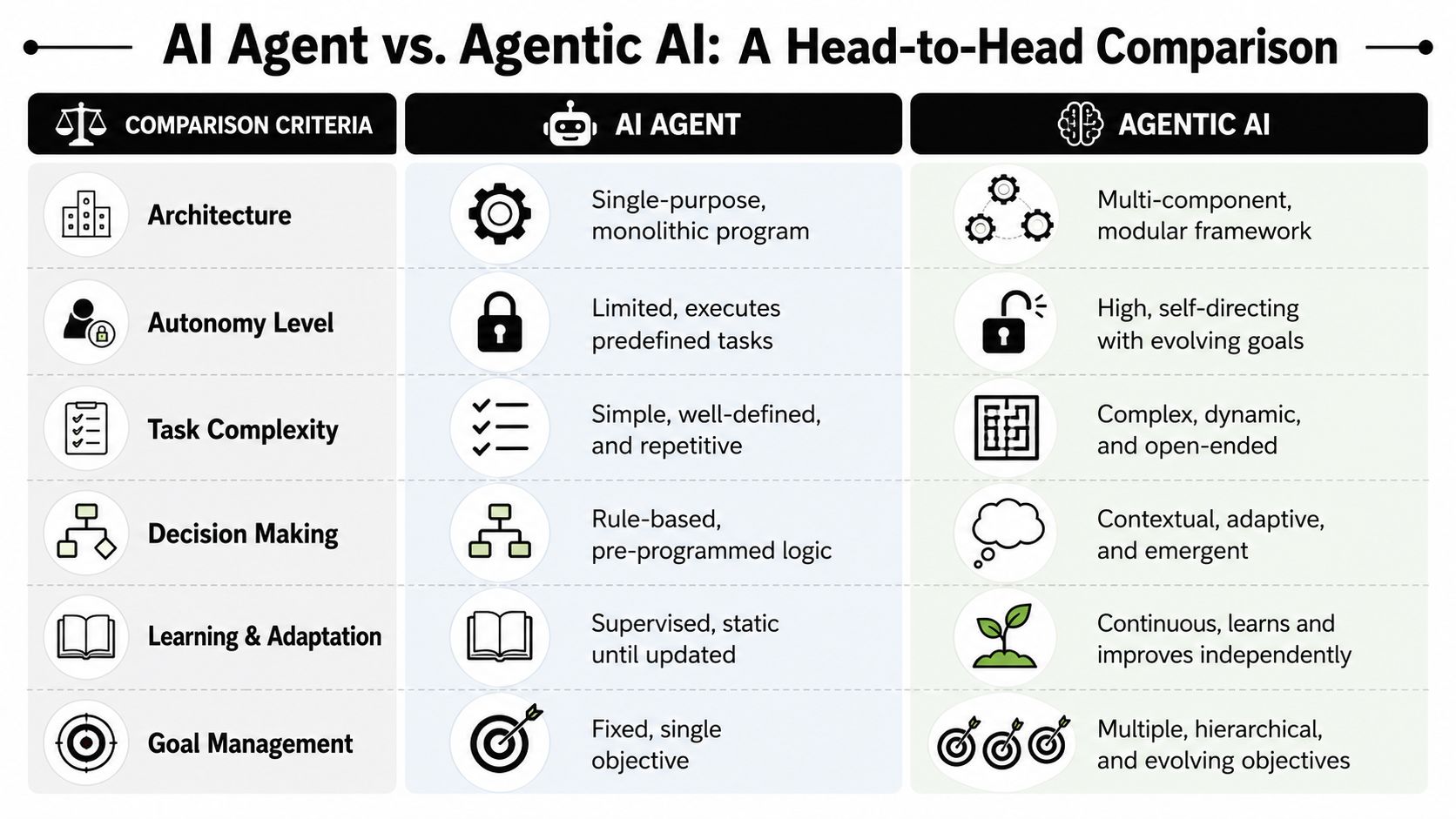
The fastest way to understand AI agent vs Agentic AI is to compare how each behaves under real operating pressure. The terms sound close. The architectures are not.
Early in evaluation cycles, I advise teams to stop asking which one is “more advanced” in the abstract. The better question is: which one fits the work you need done, the risk you can tolerate, and the amount of supervision you're willing to maintain over time?
Architecture and control model
An AI agent is usually designed as a focused unit. It may include prompt logic, a retrieval step, decision rules, and one or two actions. Even when several agents exist in the same environment, each tends to remain locally optimized for its task.
Agentic AI is modular by design. It sits above tools, data sources, and specialized agents. Its job is coordination.
| Comparison point | AI Agent | Agentic AI |
|---|---|---|
| System role | Performs one scoped function | Coordinates many functions toward one outcome |
| Control pattern | Local task logic | Centralized orchestration with distributed execution |
| Enterprise effect | Improves a step | Governs the workflow |
This architecture matters because scale problems rarely appear inside one task. They appear between tasks.
Planning horizon and autonomy
Research summarized in this arXiv paper on agentic system design distinguishes agentic systems by their multi-step planning horizon and use of reinforcement or meta-learning mechanisms, while traditional AI agents operate with a single-step planning horizon and rely on rule-based or supervised learning.
That sounds academic, but the enterprise implication is straightforward. A narrow agent decides the next move. An agentic system manages a path.
Decision lens: If the workflow requires the system to choose among multiple valid next actions and recover from exceptions, you're in agentic territory.
A password reset agent doesn't need much planning. An access remediation workflow that checks eligibility, identifies risk, sequences approvals, updates systems, and communicates status does.
To see the distinction in action, it helps to watch a practical walkthrough before diving deeper into architecture.
Complexity and workflow fit
AI agents often outperform in narrow environments because they're optimized for speed and bounded logic. That's why they remain useful. If the work is repetitive and rules are stable, a specialist usually beats an orchestrator on efficiency.
Agentic systems pull ahead when business conditions move. They're built for workflows that cross departments, encounter exceptions, or depend on context from multiple systems.
Examples where a standard agent is enough:
- Field validation in a ticketing workflow
- Knowledge retrieval for a standard policy question
- Simple appointment scheduling within one system
Examples where agentic design is more appropriate:
- Claims handling with missing documentation and policy-dependent routing
- Enterprise onboarding across HR, IT, security, and facilities
- Service recovery when the customer issue touches billing, fulfillment, loyalty status, and escalations
Learning and adaptation
Traditional agents can improve, but usually inside their narrow assignment. Agentic systems adapt at the workflow level. They can reallocate work, switch tools, and revise the sequence of actions when conditions change.
That changes the KPI model too. With a standard agent, teams usually track task accuracy and response speed. With Agentic AI, they also need to evaluate continuity, exception handling, and whether the business objective was completed.
The practical point is simple. An AI agent helps a team do work faster. Agentic AI helps the enterprise finish work that used to require constant coordination.
Enterprise Use Cases From Task Automation to Outcome Ownership
The difference becomes obvious when you look at actual operating scenarios. Isolated agents complete useful steps. Agentic systems manage the end-to-end result.
Moveworks notes that, in enterprise benchmarks, agentic AI reduces manual work by reasoning about user goals and planning step sequences, while isolated AI agents remain limited to predictable tasks. It also notes that AI agents often perform better in speed for narrow tasks, but agentic AI outperforms in complex, dynamic scenarios that require workflows to adapt on the fly in its enterprise comparison of agentic AI and AI agents.
Customer experience when the issue crosses systems
Take a high-friction return. A customer wants to return one item from a bundled order, replace another, preserve loyalty credits, and update the refund destination because the original card has expired.
A standard AI agent can answer policy questions, generate a label, or update one field. But the workflow itself spans commerce, payments, logistics, CRM, and customer communication. Without orchestration, the customer gets bounced between systems and queues.
An agentic system can hold the objective steady. It can verify order state, check policy, trigger the right operational steps, monitor exceptions, and keep the customer updated until resolution.
Employee experience beyond a chatbot
The same pattern shows up in onboarding. A basic agent can answer “when do I start?” or “where do I upload documents?” That's useful, but it doesn't complete onboarding.
Outcome ownership means coordinating account provisioning, hardware requests, role-based app access, payroll steps, manager notifications, and deadline handling. Teams exploring service transformation often start with examples like how InteleTravel scaled travel support using AI agents and then realize the next frontier isn't another point agent. It's orchestration across the employee journey.
The enterprise value appears when the system manages dependencies, not just conversations.
Operations where conditions keep changing
Supply chain, fraud operations, and IT incident response all have the same challenge. The problem doesn't stay still. Inputs change mid-process. Priorities collide. Human teams spend time coordinating, not just deciding.
That's where agentic approaches make sense. The system can reevaluate the workflow as new data arrives, reroute tasks, and maintain progress toward the outcome even when the original plan breaks.
In contrast, a set of disconnected agents often creates a brittle operating model. Each one performs its step correctly, but nobody owns the whole result. In enterprise operations, that gap is where cost, delay, and customer frustration accumulate.
Evaluating Enterprise Readiness Governance and Safety
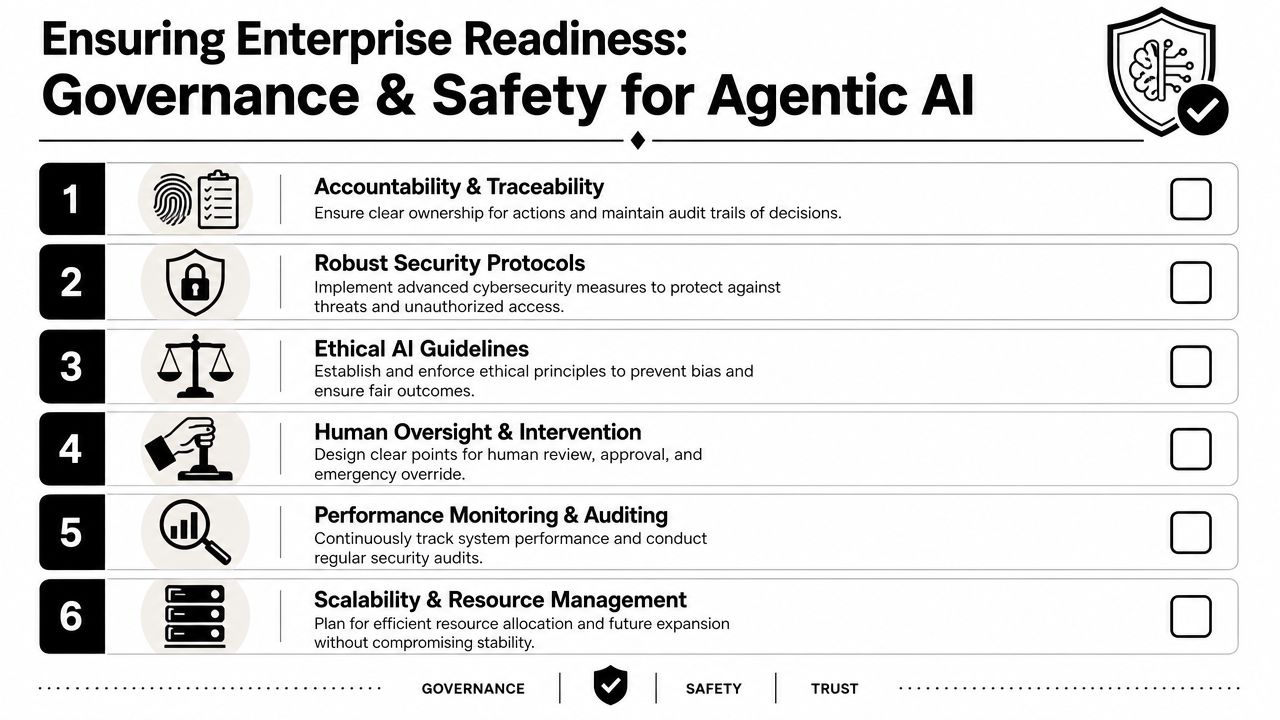
Enterprise readiness for agentic AI is not a model question. It is an operating model question.
An AI agent can be governed like software with prompts and permissions. Agentic AI has to be governed like a digital operator that can pursue goals across systems, trigger actions, and create real business consequences. That changes the standard for risk, accountability, and executive oversight.
What mature governance looks like
Mature governance starts with one principle. Autonomy is only useful if it is controllable.
In practice, that means leaders need clear action boundaries, auditable logs, approval paths, policy enforcement, and ongoing performance review. If a system can make or coordinate decisions, the enterprise must be able to explain what happened, why it happened, and how to stop or redirect it without shutting down the whole workflow.
A safe deployment usually includes several layers working together:
- Action controls: Limit which systems the agentic layer can access and which actions it can take.
- Approval design: Route high-risk decisions, regulated steps, or financial commitments to a human reviewer.
- Traceability: Record context, tool calls, intermediate reasoning artifacts where appropriate, and action history.
- Performance review: Measure workflow outcomes, exception handling, and policy adherence, not just response quality.
- Fallback logic: Define what happens when confidence is low, data is incomplete, or a downstream system fails.
Human oversight still has a clear role. Teams building content and decision workflows can apply the same principle described in maximizing AI SEO performance with human input. Human review belongs at the points where judgment, compliance exposure, customer impact, or brand risk are highest.
Why maintainability is a governance issue
Governance also fails when the system becomes too expensive or fragile to maintain.
That is a common enterprise mistake. Teams treat safety as a policy layer added at launch, then discover six months later that application changes, UI updates, workflow exceptions, and policy revisions have made the system harder to test, audit, and trust. At that point, autonomy stops being a scale advantage and starts becoming an operational burden.
For agentic systems, maintainability is part of governance because drift creates risk. If the environment changes faster than the testing and review process, leaders lose confidence in what the system will do under real conditions. The strongest programs account for change from the start with versioned policies, regression testing, sandbox environments, and clear escalation rules.
Mature governance makes autonomy durable enough to own outcomes.
What CIOs and CTOs should press on
Before approving a rollout, leadership should ask a harder set of questions than they would for a task bot:
- Can we inspect actions after the fact, with enough detail for audit and root-cause review?
- Can we constrain permissions by workflow, role, data class, and business unit?
- Can we insert human approval for sensitive decisions without breaking throughput?
- Can we test changes in connected systems without rebuilding the orchestration layer every time?
- Who owns the business outcome if the system completes the task but fails the objective?
That last question matters most. Once a system is positioned to own an outcome, governance is no longer just a technical control framework. It becomes a management discipline for autonomous operations.
If those answers are vague, the organization is not ready for enterprise autonomy. It is exposing itself to hidden operational risk.
Choosing Your AI Strategy and Selecting a Vendor
AI strategy is now an operating model decision. The key question is not whether to add another automation layer. It is whether the business wants software that assists teams or software that carries part of the result.
That distinction changes budget, governance, org design, and vendor choice.
Use AI agents for bounded work with clear rules, stable inputs, and limited downstream impact. Use agentic AI when the business needs a system to coordinate actions across tools, teams, and decisions to reach a defined outcome. Enterprises that treat those as the same category often buy for short-term efficiency and miss the larger shift toward enterprise autonomy.
When an AI agent is enough
An AI agent is the right fit when the task is narrow and the success criteria are easy to measure. These systems perform well when one workflow step can be improved without redesigning the operating model around it.
Typical examples include:
- FAQ resolution
- Structured document extraction
- Simple triage and routing
- Routine transaction support
These use cases reduce handling time and improve consistency. They rarely change who owns the outcome.
When you need Agentic AI
Agentic AI fits a different class of problem. It is suited to work that spans systems, approval chains, policy checks, and exception paths, where the bottleneck is not execution of one task but management of the full process.
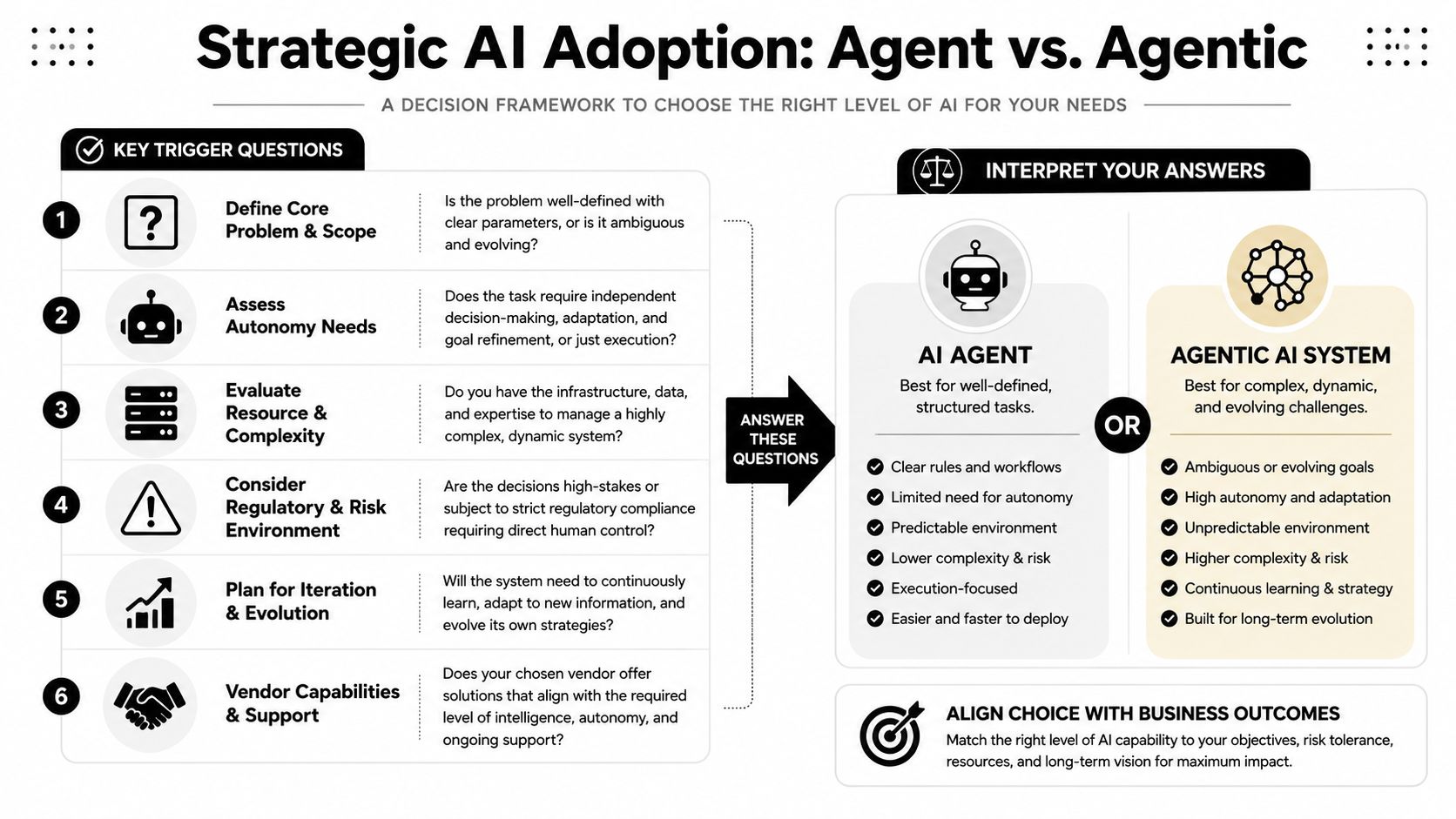
Common signals include:
- Cross-functional workflows with dependencies
- Frequent exceptions or policy branches
- Need for end-to-end auditability
- Pressure to automate outcomes, not just steps
I use a simple test with executive teams. If employees still have to assemble context, chase approvals, and recover from edge cases after the AI completes its part, the company has faster task execution, not autonomous operations. Agentic AI starts to matter when leadership wants the system to own progress toward an outcome and escalate only when judgment, risk, or policy requires it.
Questions to ask vendors
Vendor evaluation should focus on production behavior. Demos usually show successful paths. Enterprise performance shows up in exceptions, controls, maintainability, and how much operating overhead the platform creates after launch.
Ask questions such as:
- How does the system turn goals into sequenced actions and decide what to do next?
- Which enterprise systems, APIs, and tools can it coordinate without rebuilding workflows each time?
- How are permissions, approvals, and human checkpoints configured by workflow and role?
- What records are available for actions, decision paths, exceptions, and policy enforcement?
- How are workflows tested, monitored, and updated as connected systems change?
- Can the platform execute across voice, chat, email, and back-end systems when the process spans all of them?
- How portable is the architecture across models, vendors, and integration layers?
Three signals usually separate mature platforms from polished prototypes. First, they support controlled autonomy instead of simple prompt execution. Second, business operators can manage policies, thresholds, and approvals without waiting on engineering for every adjustment. Third, pricing reflects operating value as usage grows, rather than turning scale into a penalty.
Choose for the business you intend to run. If the goal is higher throughput inside existing workflows, AI agents may be enough. If the goal is to build autonomous operations with accountable controls, select a platform built for outcome ownership in production. For teams evaluating that shift in practice, Yellow.ai is one example of a platform positioned around enterprise orchestration across customer and employee workflows.



