













Most enterprise automation still assumes the world is stable. It assumes workflows stay fixed, inputs stay clean, and exceptions stay rare. That's exactly why so much automation breaks at the edges. The counterpoint is striking: the global AI agent platform market is valued at $7.8 billion in 2025 and is projected to reach $68.4 billion by 2034, growing at a 27.4% CAGR, a shift that reflects enterprises moving AI agents from pilots into operating infrastructure, according to DataIntelo's AI agent platform market analysis.
That change matters because enterprises no longer need software that only waits for instructions. They need systems that can interpret context, decide what to do next, use tools, and complete work across functions. The move toward the autonomic enterprise isn't about adding a better chatbot to the stack. It's about changing the operating model of customer service, employee support, and internal operations.
Table of Contents
- The End of Automation as We Know It
- What Are AI Agent Platforms Really
- The Anatomy of an Enterprise Grade Platform
- Comparing Deployment and Operational Models
- Your Enterprise Evaluation Checklist
- A Strategic Implementation Roadmap
- Conclusion The Dawn of the Autonomic Enterprise
The End of Automation as We Know It
Traditional enterprise automation was built for repeatability. It worked well when a process could be mapped in advance, exceptions could be routed to people, and the software only had to follow rules. That model still has a place, but it doesn't fit the operating environment most enterprises now face.
Customer journeys jump across channels. Employee requests arrive in natural language. Internal decisions require pulling data from multiple systems, applying policy, and choosing among several valid next steps. Rule engines struggle here because they don't reason. Basic bots struggle because they don't act.
The old model breaks on variability
The old bargain was simple: teams changed their process to fit the software. They filled in fields, followed prescribed paths, and escalated whenever the system hit ambiguity. That's why many automations created as much operational overhead as they removed.
AI agent platforms change the direction of travel. Instead of forcing people to adapt to rigid systems, they allow software to work inside messy, changing environments. An agent can interpret the request, retrieve context, choose a tool, take an action, check the result, and continue until the goal is complete.
Enterprises don't need more scripted interactions. They need software that can carry work forward when the next step isn't prewritten.
Why this has become a boardroom issue
This isn't an incremental tooling cycle. It's a shift in how work gets organized. In practice, that means leaders are no longer asking whether AI can draft a response. They're asking whether a platform can resolve a billing issue, complete an employee IT workflow, qualify a service request, or hand off only when judgment is required.
Three conditions are driving urgency:
- Workflows are fragmented: Most service and support journeys span CRM, telephony, ticketing, knowledge systems, and internal data stores.
- Expectations are rising: Customers and employees want answers and actions in the same interaction, not a chain of transfers.
- Labor leverage matters: Teams need systems that reduce manual coordination, not just generate text faster.
From software seats to autonomous capacity
That's the strategic lens leaders should use. AI agent platforms aren't just another application category. They are capacity infrastructure. They add a digital layer that can execute work across CX, EX, and operations.
The enterprises that treat agentic AI as a feature purchase will underinvest in architecture, governance, and operating design. The enterprises that treat it as infrastructure will build a meaningful advantage.
What Are AI Agent Platforms Really
A lot of the market still uses the word “agent” too loosely. If a chatbot is a scripted service rep, an AI agent is closer to an autonomous operations manager. It has a goal, access to tools, memory of the interaction, and the ability to decide what step comes next.
That distinction matters because many offerings marketed as agents are still thin wrappers around prompt-response behavior. They can answer questions. They may call a function. But they don't reliably manage multi-step work.
A practical definition
An AI agent platform is the system that lets enterprises design, deploy, monitor, and govern software agents that can pursue defined outcomes with limited human intervention. The key phrase is “pursue outcomes.”
A true platform supports agents that can:
- Perceive context: Understand the request, user state, system state, and relevant policy or knowledge.
- Plan a path: Break the task into steps instead of producing one isolated response.
- Use tools: Trigger workflows, search knowledge, update records, or call external systems.
- Recover from friction: Handle missing information, failures, conflicting inputs, or changing user intent.
- Escalate intelligently: Hand work to a human with context when the case requires judgment or exception handling.
Chatbots, copilots, and agents are not the same
A chatbot is mainly conversational. It responds to what the user says.
A copilot helps a person do work. It suggests, drafts, summarizes, or recommends, but the human still drives the workflow.
An agent takes responsibility for completing a task. It may ask clarifying questions, but it isn't waiting passively for every next instruction.
That's why the right analogy is not “better bot.” It's “digital operator.” In customer service, that could mean identifying intent, verifying context, searching entitlements, initiating a refund flow, updating a case record, and only escalating if policy or confidence requires it. In employee support, it could mean resetting access, opening the right internal task, and confirming completion across systems.
The platform is what makes autonomy manageable
The platform layer is what separates a useful demo from enterprise execution. It provides the builder, orchestration engine, integrations, evaluation controls, analytics, and governance needed to run agents in production.
Without that platform layer, teams usually end up with disconnected experiments. One group builds a prompt-based bot. Another adds a retrieval layer. A third wires function calls into a help desk workflow. None of it scales cleanly because there's no common system for testing, monitoring, policy enforcement, or lifecycle management.
Practical rule: If the product can generate responses but can't manage decisioning, tool use, observability, and governance, it's not an enterprise agent platform. It's an interface on top of a model.
The right mental model is simple. A model produces language. An agent executes work. A platform makes that execution reliable, governable, and scalable.
The Anatomy of an Enterprise Grade Platform
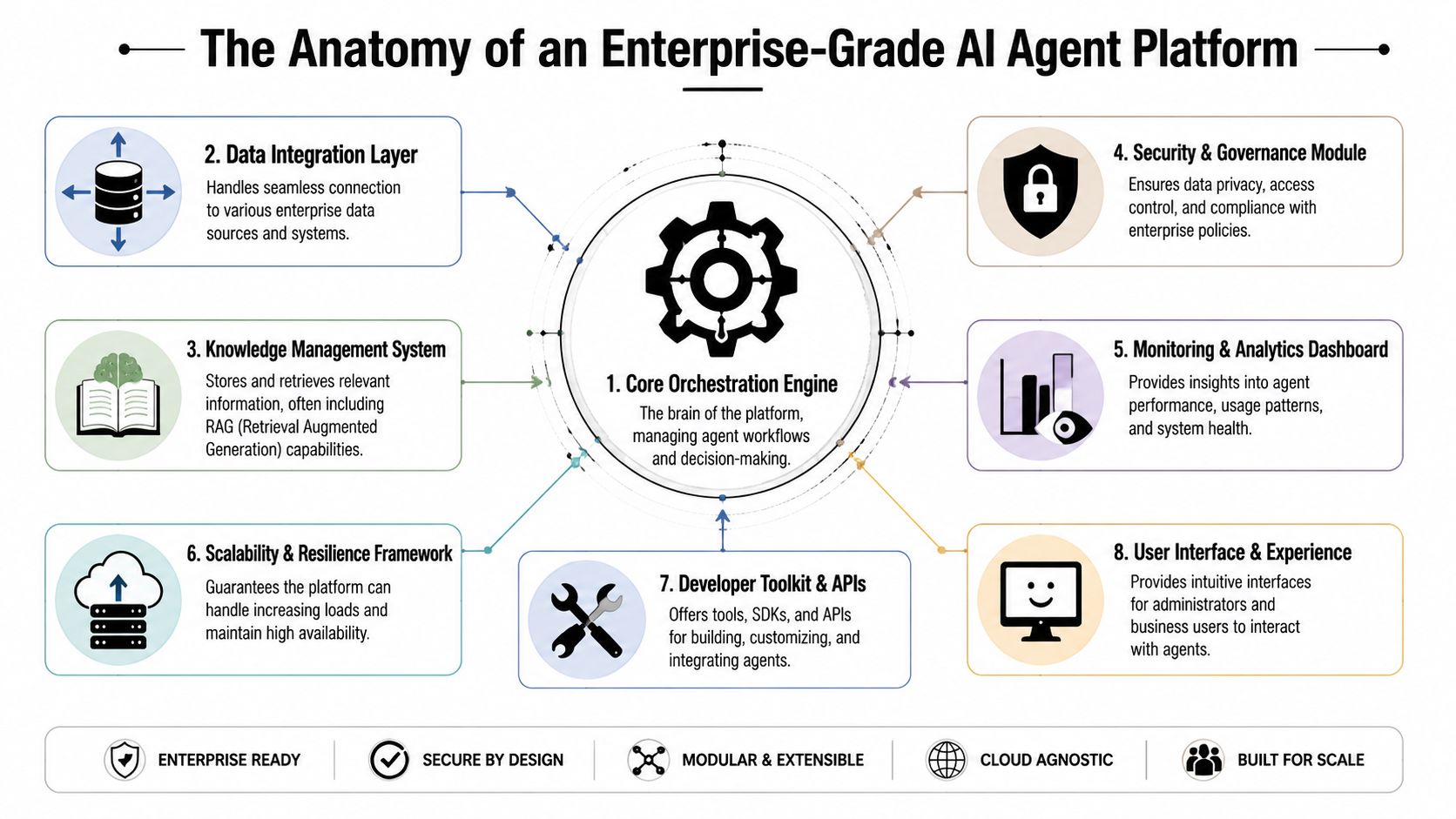
Most failed agent deployments have the same root cause. The team bought a model experience when they needed an operating system for autonomy. Enterprise-grade AI agent platforms are built as layered systems, not single-model interfaces.
A useful visual is below.
Why orchestration matters more than model choice
Buyers often focus first on the model. That's understandable, but it's the wrong first question. The bigger issue is orchestration. Benchmark data summarized by Sierra shows that simple LLM constructs often fall below 50% success on complex real-world tasks, which is why advanced orchestration matters in enterprise settings, as detailed in Sierra's benchmarking of AI agents.
That result tracks with what teams see in production. Function calling looks impressive in a controlled demo. It degrades quickly when the agent has to manage similar cases across different users, tool responses vary, or the user changes direction mid-flow.
The platform needs a control layer that can route work, manage state, apply policy, and recover when one step fails.
A mature architecture usually includes:
- A workflow and planning engine that can manage branching paths.
- State management so the system remembers what has already happened.
- Guardrails and policy checks before and after actions.
- Testing and replay tooling to inspect failure points.
Later in the section, this becomes more concrete.
The components that separate platforms from wrappers
An enterprise platform should include several essential elements.
Agent builder and workflow design
Business teams need a controlled way to define agent behavior without rewriting code for every iteration. Low-code builders matter, but only when they're backed by strong versioning, testing, and approval controls.
Multi-LLM architecture
No single model is optimal for every task. Some models handle reasoning better, others are faster, cheaper, or better suited to specific languages and modalities. Multi-LLM support also reduces dependence on one vendor. One example in the market is Yellow.ai's enterprise-grade security and platform approach, which pairs multi-model support with governance controls. That's the kind of architectural question leaders should inspect, regardless of vendor.
Knowledge and agentic retrieval
Basic retrieval answers questions. Agentic retrieval helps the system use enterprise knowledge as part of task completion. The difference is operational. It's not only “what does the policy say?” It's also “which policy applies here, what evidence is needed, and what action can be taken next?”
Integrations and tool use
Prebuilt integrations cut deployment time, but the quality of tool orchestration matters more than the connector count alone. The platform should manage retries, failed actions, permissions, and system feedback loops.
What leaders should inspect closely
Voice, chat, email, and other channels should not live as separate AI silos. The orchestration layer needs to support omnichannel journeys with shared memory and policy enforcement. If voice and chat run on different logic stacks, teams end up duplicating intent design, analytics, and governance.
Analytics also need a higher standard. Traditional bot dashboards focus on containment and fallback. Agent platforms need tracing that shows decision paths, tool usage, policy triggers, and failure modes. If a case goes wrong, leaders should be able to see not just the final response but the sequence that produced it.
Security belongs in the core architecture, not as a procurement appendix. Access controls, audit trails, data lineage, and action monitoring need to be designed into the platform from the start.
When a vendor says “we support agents,” ask to see how the system handles failed tool calls, policy conflicts, and multi-step recovery. That's where platform maturity shows up.
Comparing Deployment and Operational Models
Deployment decisions shape more than infrastructure. They influence governance, latency, operating cost, procurement flexibility, and how fast the organization can expand agent use cases across teams.
The core choice usually comes down to on-premise, public cloud, or hybrid.
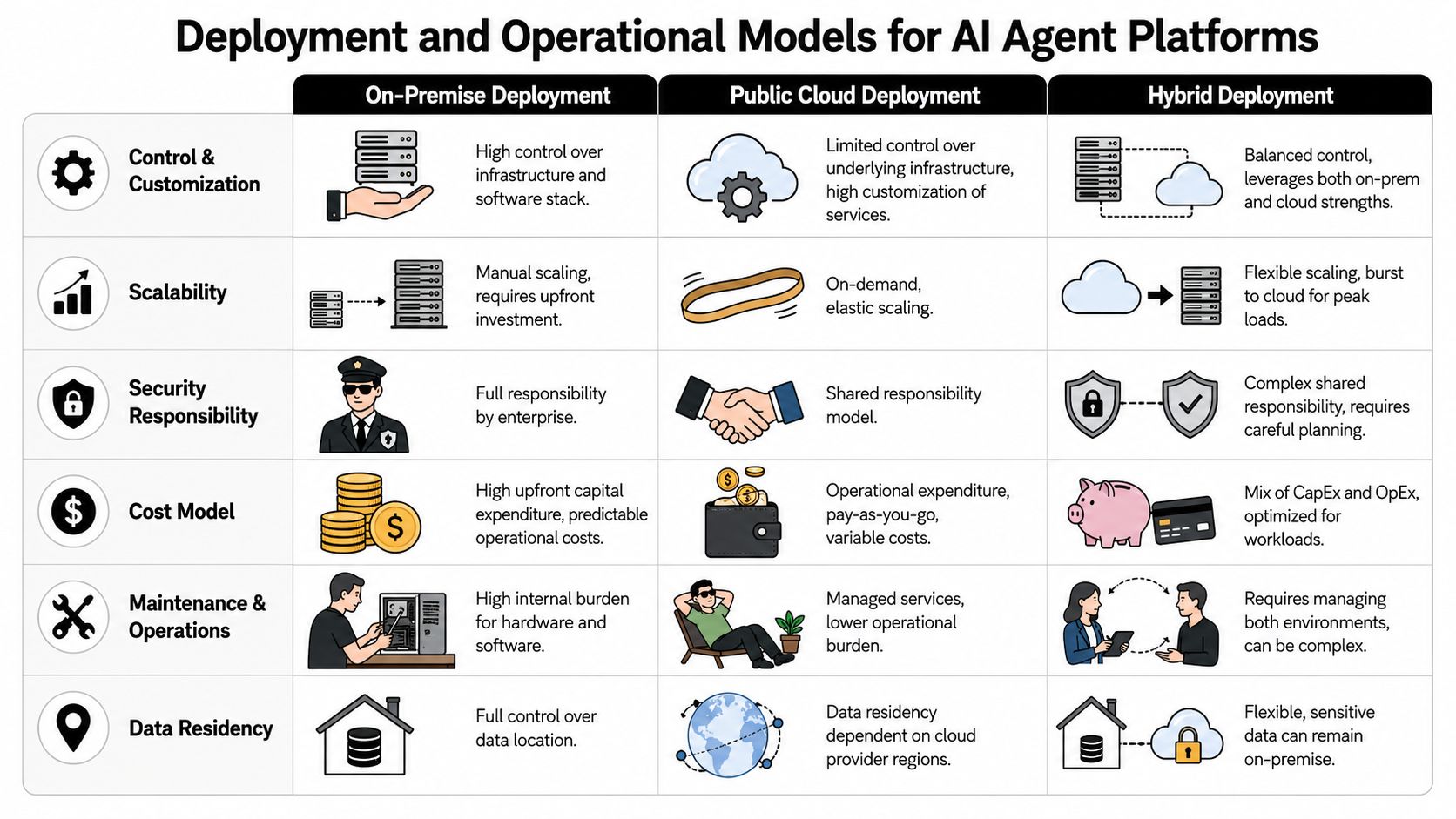
A useful constraint here is scalability. The AA-AgentPerf benchmark highlights that platform scalability, including support for thousands of concurrent agents across 500+ languages, depends heavily on optimized inference backends and multi-LLM orchestration, a factor that should inform infrastructure choices, as discussed in NVIDIA's write-up on the AA-AgentPerf benchmark.
On-premise when control is the priority
On-premise deployment gives the enterprise maximum control over infrastructure location, network boundaries, and operational policy. That often matters in regulated environments, or where data sovereignty and internal security controls are tightly defined.
The trade-off is operational burden. Internal teams own more of the maintenance, capacity planning, and resilience design. Scaling isn't as elastic, and model updates or architecture changes can take longer to operationalize.
Public cloud when speed and elasticity matter
Public cloud is usually the fastest path to launch. Teams can provision environments quickly, experiment faster, and scale capacity without upfront hardware decisions. For organizations expanding across geographies or channels, that flexibility is valuable.
The trade-off is shared responsibility and cost variability. Buyers need a clear understanding of where provider responsibility ends and enterprise responsibility begins. They also need discipline around inference spend, data movement, and environment sprawl.
Hybrid when reality is mixed
Hybrid is often the most practical model because most enterprises already operate that way. Sensitive workflows or data domains can remain under tighter internal control, while burst capacity, model experimentation, or less sensitive workloads run in the cloud.
The cost of hybrid is complexity. Identity, policy enforcement, observability, and routing need to work across environments. If they don't, the architecture becomes fragmented and the operator experience deteriorates.
| Deployment model | Best fit | Main advantage | Main challenge |
|---|---|---|---|
| On-premise | Highly controlled environments | Deep infrastructure control | Higher internal ops burden |
| Public cloud | Fast-moving digital programs | Elastic scale and faster rollout | Shared responsibility and variable cost |
| Hybrid | Large enterprises with mixed requirements | Flexible placement of workloads | More architectural complexity |
The decision shouldn't be ideological. It should be tied to data sensitivity, latency requirements, existing platform maturity, and who will run the system day to day.
Your Enterprise Evaluation Checklist
Vendor demos are designed to make agent platforms look interchangeable. They aren't. Differences appear when you ask how the system behaves under uncertainty, who can operate it safely, and what evidence the vendor can provide beyond the happy path.
That's why an evaluation process needs to be sharper than a feature matrix.
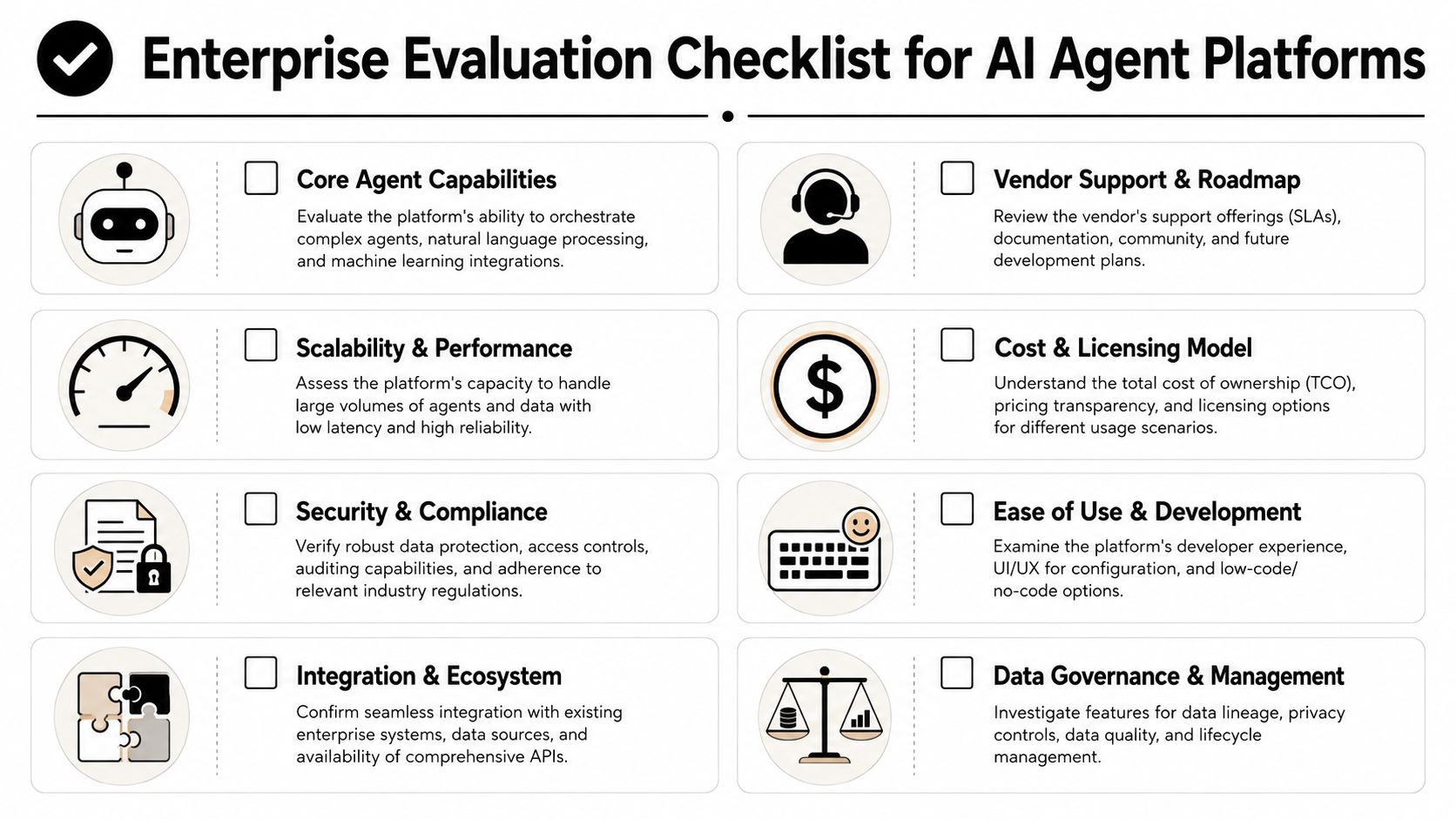
A practical reference for procurement teams is a buyer's guide to evaluating conversational AI solutions, but the most important work still happens in the diligence questions you ask live.
Questions that expose platform maturity
Start with behavior, not branding.
- Ask for failure handling: “Show how the agent behaves when a tool returns an error, partial data, or conflicting state.”
- Ask for evaluation depth: “How do you test behavior across many conversation paths instead of a handful of curated examples?”
- Ask for model strategy: “How does your architecture route tasks across models, and what happens if one provider changes pricing, access, or performance?”
- Ask for governance: “Which users can change prompts, tools, policies, and publishing rules, and how are those changes audited?”
- Ask for handoff discipline: “What context is preserved when the system escalates to a human, and how is that handoff governed?”
AI Agent Platform Evaluation Checklist
| Capability Area | Key Evaluation Question |
|---|---|
| Core agent capabilities | Can the platform complete multi-step tasks, not just answer questions? |
| Scalability and performance | How does the system maintain responsiveness as agent volume and complexity increase? |
| Security and compliance | What controls govern data access, action logging, and policy enforcement? |
| Integration and ecosystem | How easily can the platform connect to CRM, telephony, ticketing, identity, and internal systems? |
| Vendor support and roadmap | Who helps with deployment, change management, and operational tuning after go-live? |
| Cost and licensing model | What drives spend: seats, sessions, model usage, channels, or actions? |
| Ease of use and development | Can business teams iterate safely without creating uncontrolled prompt sprawl? |
| Data governance and management | Can the platform show lineage, permissions, and lifecycle handling for enterprise data? |
The security question most buyers miss
Most security reviews still focus on perimeter controls, retention, and model access. That's necessary, but it isn't enough for agentic systems. A more overlooked issue is endpoint behavior. Cyberhaven argues that endpoint AI agents can create a major visibility gap outside traditional DLP controls, and that robust platforms need endpoint visibility, data lineage, and workflow-level monitoring, as outlined in Cyberhaven's analysis of endpoint AI agents and the DLP blind spot.
That should change the procurement conversation.
Ask the vendor to demonstrate:
- What agents are installed or deployed
- What data those agents can access
- How data moves across workflow steps
- Whether actions can be traced against policy
Security for agent platforms isn't just about model access. It's about knowing what the agent touched, moved, and changed.
If a vendor can't answer those questions clearly, the platform may still be useful for experimentation. It isn't ready to become enterprise infrastructure.
A Strategic Implementation Roadmap
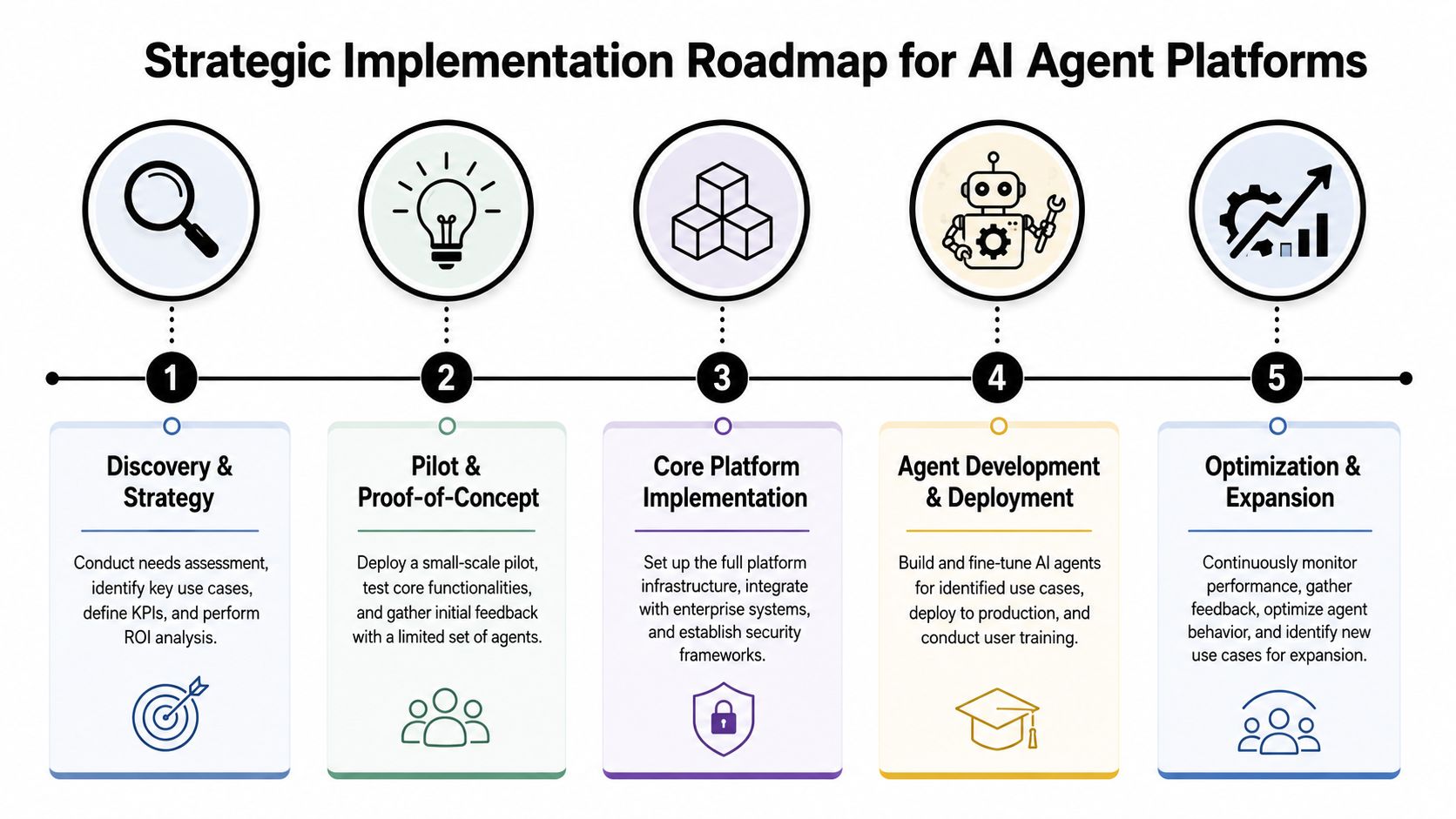
The fastest way to disappoint an executive sponsor is to launch agents as a broad transformation slogan. The right way to implement AI agent platforms is narrower at first, then broader over time. Start with one business bottleneck that has clear ownership, measurable friction, and enough process stability to support controlled automation.
That approach works because it aligns ambition with operational learning.
There is a strong payoff for getting this right. PwC reports that 66% of companies using AI agents report increased productivity, 57% report cost savings, and 81% of customers prefer AI-powered self-service before contacting a human, according to PwC's May 2025 AI agent survey.
Phase one starts with a business bottleneck
Choose a pilot use case with three qualities. It should have clear process boundaries, enough volume to matter, and a manageable risk profile. Common examples include password resets, order status workflows, billing clarification, appointment changes, or tier-one employee service requests.
A poor pilot is broad, politically visible, and dependent on five backend teams before anything can launch.
Use this sequence:
- Define the job to be done: Name the outcome in operational terms.
- Map the workflow: Identify systems, policies, human approvals, and escalation points.
- Set a success frame: Decide what “working” means before the build starts.
- Assign one owner: Shared sponsorship often produces vague accountability.
Production is where discipline starts
After a pilot proves the business case, the next phase is formal platform selection and production design. At this stage, many teams get impatient and skip the hard work. Don't.
Lock down governance before broad rollout:
- Role design: Decide who can build, approve, publish, and inspect agents.
- Knowledge controls: Establish who owns source content and how updates propagate.
- Escalation policy: Define when the agent must hand work to a person.
- Testing standards: Require scenario-based validation before release.
This stage should also include integration hardening. Tool permissions, case updates, CRM writes, and knowledge retrieval all need production-grade controls.
A pilot proves possibility. Governance proves repeatability.
Scale after governance works
Once the first production agents are stable, expansion becomes a portfolio exercise. Don't copy the same design into every function. Different workflows need different levels of autonomy, approval, and auditability.
A sensible scale pattern looks like this:
- Expand by adjacency: Move from one service workflow to another nearby one.
- Use analytics to tune behavior: Inspect drop-offs, policy triggers, and handoff reasons.
- Create a reusable operating model: Templates, prompt standards, testing flows, and governance should be shared across teams.
- Train human teams with the agents: Supervisors, QA leads, and operations managers need new review habits.
The organizations that scale well don't just add more agents. They build a repeatable system for deciding where autonomy belongs, how it's governed, and when a human should take over.
Conclusion The Dawn of the Autonomic Enterprise
Selecting an AI agent platform is no longer a narrow technology decision. It's a decision about how your business will operate when software can perceive, decide, and act across systems. That's why feature lists are an unreliable buying tool. They flatten critical differences in orchestration, governance, observability, deployment fit, and implementation support.
The strongest platforms aren't the ones that produce the flashiest demos. They're the ones that hold up when workflows become messy, policies conflict, users change intent, and security teams ask hard questions. In enterprise settings, that's the definitive test.
Leaders should evaluate AI agent platforms with three lenses at once. First, can the architecture support reliable autonomy? Second, can the operating model fit the organization's security, data, and deployment constraints? Third, can the vendor and internal team implement this in a way that scales beyond a pilot?
The answer to those questions determines whether agents remain isolated tools or become part of the company's operating backbone.
The bigger shift is cultural as much as technical. In the autonomic enterprise, human teams don't disappear. Their role changes. They design policy, supervise edge cases, improve workflows, and focus judgment where judgment matters most. Agents handle the repetitive coordination, the structured service work, and the system-to-system execution that used to consume capacity.
That's the opportunity in front of enterprise leaders now. Not better chat interfaces. A new operating model where digital agents and human experts work as one system.
Yellow.ai is one option enterprises can evaluate when they need an agentic AI platform for CX and EX workflows, including multi-modal agents, multi-LLM orchestration, enterprise integrations, analytics, and governance. If you're assessing how agent platforms fit your service strategy, explore Yellow.ai alongside your broader architecture, security, and operating model requirements.



