









Your customer experience team has three agent pilots in production, and nobody owns the full operating picture. At 9:14 a.m., a Teams message reports that the billing assistant gave a customer an incorrect answer. A Slack thread shows the HR assistant responding in a region where it was never approved to operate. Meanwhile, an analytics agent stopped syncing overnight, and its failure surfaced only because a manager noticed an empty dashboard.
Each agent has its own builder, model configuration, deployment path, logs, and incident process. “Just one more bot” has become an unmanaged fleet. The question for 2026 isn't whether your enterprise should use agents. It's who controls them in production, what each agent is allowed to do, and whether you can prove that every action stayed within policy.
Table of Contents
- When Agent Pilots Become an Agent Fleet
- What an AI Agent Management Platform Actually Is
- Core Capabilities That Define the Category
- Enterprise Use Cases Across CX and EX
- Evaluation Criteria That Matter Beyond Model Quality
- Security, Compliance, and Safe AI Requirements
- ROI, Integration Patterns, and How to Shortlist Vendors
When Agent Pilots Become an Agent Fleet
The first warning sign isn't usually a dramatic outage. It's a routine operational question nobody can answer quickly: which agents are live, who owns them, what systems can they access, and when did their behavior last change?
A CX leader might begin the week by tracing a hallucinated billing response through one vendor's conversation logs. The investigation then moves to a separate identity system, followed by a model provider dashboard and an integration team's ticket queue. Before the first incident closes, an HR leader reports that another assistant has used the wrong regional policy. The analytics team has its own failure, with no shared alerting or escalation path.
These are not isolated bot problems. They're control failures created by fragmented deployment. An agent can call tools, retrieve private information, delegate work, and trigger business actions. Treating each one as a standalone chatbot leaves the enterprise without a reliable record of authority or accountability.
The market is already moving beyond isolated experimentation. A 2026 McKinsey survey of AI adoption found that 40% of respondents were scaling AI agents in at least one business function, compared with 27% a year earlier. The same survey found that 44% said AI was scaling across the enterprise, up from 38%, while nearly nine in ten respondents already used AI in at least one business function. Those figures describe a shift from individual copilots to coordinated agent operations.
Practical rule: If an agent can act, it needs an owner, an identity, a permission boundary, a release history, and a kill path.
An introduction to agentic AI and how it differs from conventional AI agents helps clarify why this distinction matters. A conversational bot that returns an answer has a narrower operating profile than an agent that plans a task, selects tools, hands work to another agent, and completes an action.
The fleet problem grows when teams deploy these systems through separate channels. Voice, chat, email, employee portals, CRM workflows, and internal applications can each create different versions of the same business logic. A policy update made in one channel may not reach the others. A model change can alter behavior without a corresponding regression record. A permission granted for one use case can become an unnoticed pathway into another system.
The answer isn't necessarily to replace every existing agent. It's to place a management layer above the execution layer, giving platform, security, and operations teams one view of the estate. That layer should make the fleet legible before it attempts to make it clever.
What an AI Agent Management Platform Actually Is
Think of an AI agent management platform as air traffic control for autonomous software. The aircraft are the agents, the airports are enterprise systems, the routes are workflows and channels, and the control tower decides which movement is authorized, visible, and safe.
The platform isn't the underlying language model. It isn't an agent builder, a contact center suite, or a developer framework. It is the operational control plane that lets an enterprise register, deploy, monitor, update, and govern agents across departments and environments.
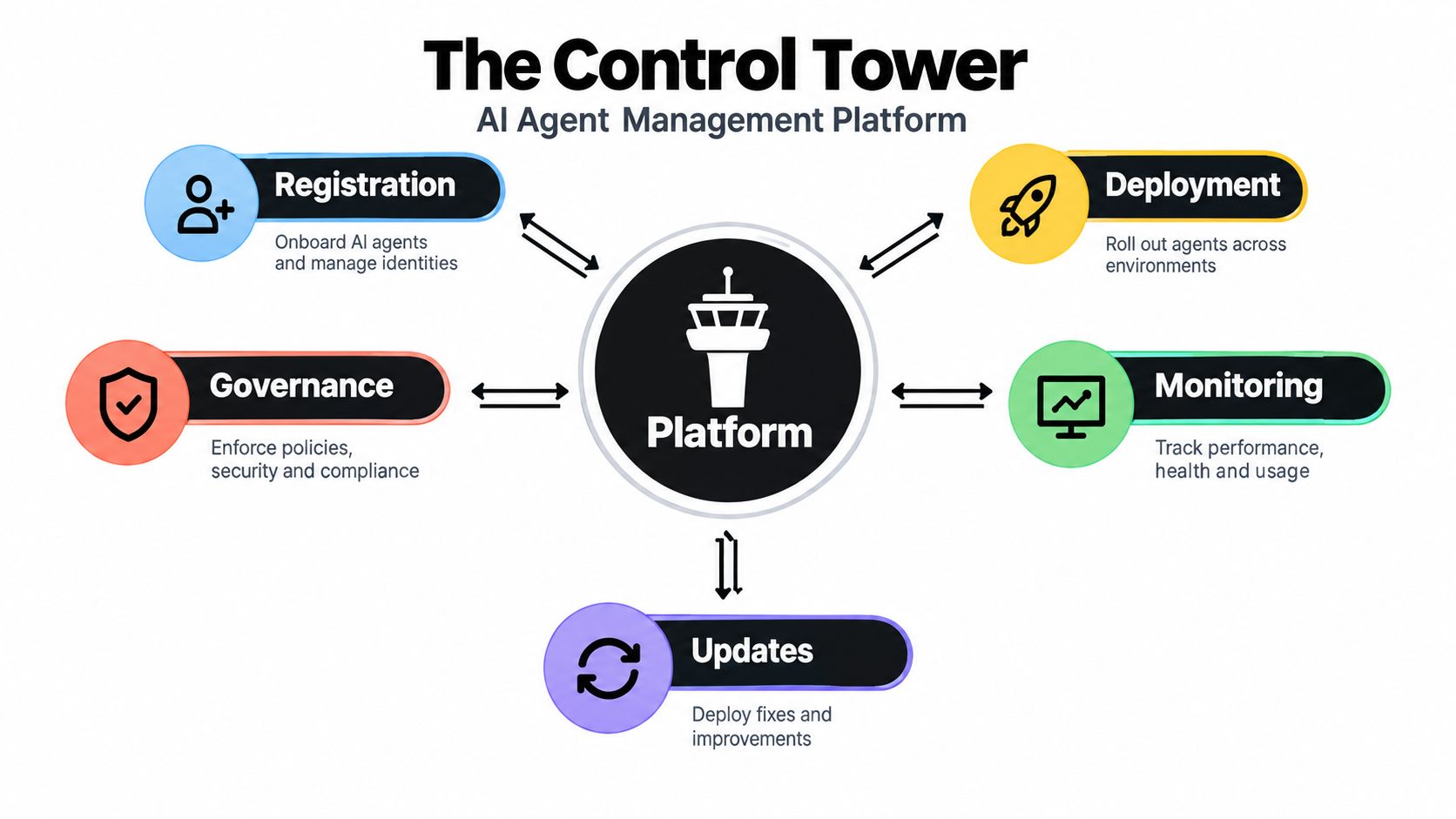
Four jobs define the control plane
First, build the inventory. Every production agent should have a record containing its owner, purpose, version, environment, connected tools, model dependencies, data classification, and approval status. An enterprise shouldn't need to search application repositories and vendor consoles to discover what is running.
Second, coordinate traffic and work. The platform should route tasks across models, tools, workflows, and channels without forcing teams to rewrite an agent every time the underlying provider changes. Routing isn't only about selecting the most capable model. It also involves latency, data location, availability, cost controls, and task-specific policy.
Third, enforce identity and policy. An agent needs a defined identity and bounded authority. The platform should determine which user or business process initiated the action, what the agent is permitted to access, whether a tool call requires approval, and when a human must take over.
Fourth, convert behavior into evidence. Logs should show more than a successful HTTP request. Operations teams need correlated records of prompts, model calls, retrieved context, tool invocations, agent handoffs, policy decisions, outcomes, and human interventions. Without that trail, incident response becomes guesswork.
This is why a framework isn't automatically an enterprise platform. A framework can coordinate a workflow, manage state, or call a model. It may still lack a shared registry, cross-agent identity, release controls, runtime policy enforcement, or business-level outcome reporting. Developers can assemble those elements, but the resulting system often becomes another custom control plane that only one team understands.
A genuine platform should also fit into the broader enterprise architecture. Buyers working with public-sector processes, regulated workflows, or formal procurement requirements may find AI for Government Contracting useful for understanding the surrounding operational context. The same principle applies inside the platform: agents shouldn't operate as anonymous software components disconnected from ownership and accountability.
The practical test is simple. Ask a vendor to show the full path from agent registration to production retirement. If the demonstration jumps between separate products for identity, deployment, monitoring, policy, and cost, you're looking at a collection of adjacent tools rather than a coherent management layer.
Core Capabilities That Define the Category
The core capabilities work as a connected system. Lifecycle management without observability leaves teams unable to tell whether a new version improved behavior. Orchestration without policy creates efficient but uncontrolled access. Channel support without shared context produces several agents that sound similar but behave differently.
Lifecycle management is the foundation
A production agent needs more than a publish button. The platform should support design, versioning, test environments, staged releases, rollback, approval gates, and retirement. Each change should connect to an auditable record that identifies what changed, who approved it, which model or knowledge source was involved, and what evaluation evidence supported release.
Retirement matters as much as deployment. An agent that no longer has an owner or business purpose still represents an access path and a potential cost center. The platform should make inactive agents visible and allow teams to revoke credentials, disconnect tools, preserve required records, and close the operational loop.
Multi-model orchestration should reduce dependency
A serious platform shouldn't force every task through one model. A classification step, a sensitive HR response, a long-form reasoning task, and a voice interaction may have different requirements. The platform should route work according to capability, latency, privacy, availability, and cost while keeping the business workflow stable.
The benchmark evidence supports this broader view of reliability. In one independent 10-task coding suite, Claude Managed Agents and Vertex AI Agent Engine each completed all tasks, but Vertex finished in 1,447 seconds at $1.45, while Claude finished in 1,172 seconds at $2.50 in the reported test (AI agent platform benchmarking). Both reached a 100% pass rate, so correctness alone didn't distinguish the operational choice. Cost and latency did.
Channels need a shared conversation layer
Voice, chat, email, and in-app interactions shouldn't each contain a separate copy of the agent's logic. A unified conversation layer should preserve relevant context, apply the same identity and policy rules, and route an escalation to a human without forcing the customer or employee to start over.
The platform's AI agent builder capabilities should therefore be evaluated alongside its runtime controls. Building a workflow quickly has limited value if teams can't version it, test it across channels, observe its tool calls, and enforce the same restrictions after deployment.
| Capability | What It Must Cover | Common Vendor Gap |
|---|---|---|
| Agent lifecycle | Versioning, approvals, staged release, rollback, ownership, and retirement | Deployment exists, but retirement and ownership remain manual |
| Multi-model routing | Model selection by task, policy, latency, availability, and cost | Routing is tied to one provider or requires custom code |
| Omnichannel context | Shared identity, memory, escalation, and business logic across channels | Each channel runs a separate agent configuration |
| Observability | Correlated traces for models, tools, retrieval, handoffs, and outcomes | Logs stop at the individual agent boundary |
| Human control | Approval queues, escalation rules, overrides, and incident response | Human review is treated as an exception rather than a designed path |
| Policy enforcement | Runtime rules for data, tools, topics, users, and actions | Policies are documented but applied only during audits |
The key buying principle is integration between these capabilities. A dashboard that can't connect behavior to a version is weak. A registry that doesn't expose live permissions is incomplete. A routing layer that doesn't report cost and outcomes encourages optimization by intuition.
Enterprise Use Cases Across CX and EX
Customer experience and employee experience belong on the same operating canvas, even though their risk profiles differ. The same management platform can govern both, but it shouldn't pretend that a customer service interaction and a payroll inquiry have identical requirements.
On the CX side, an agent can handle routine support, identify a renewal opportunity, assist a human representative, or continue a conversation from chat into voice. The important design choice is to define the business capability once and let the platform apply it across channels. A billing policy, customer identity check, escalation rule, and knowledge source should remain consistent whether the interaction starts in a web widget, email, or contact center.
Employee experience uses the same control pattern for a different audience. An IT helpdesk agent can classify requests and retrieve approved troubleshooting steps. An HR agent can answer benefits and payroll questions from controlled policy sources. An internal knowledge copilot can locate product or process documentation without giving every employee unrestricted access to the underlying repositories.
Shared infrastructure, different operating modes
Both environments need identity, context, observability, escalation, and outcome analytics. Both need release controls and a way to investigate why an agent took a particular path. Neither should rely on a single model score as proof of production readiness.
The differences are material. HR workflows usually demand tighter handling of personally identifiable information, regional restrictions, and access segmentation. CX workflows often place greater pressure on concurrency, response time, channel continuity, and human handoff. A platform that handles one use case well may still lack the policy granularity required for the other.
| Dimension | CX Use Cases | EX Use Cases |
|---|---|---|
| Primary users | Customers, prospects, service representatives | Employees, managers, HR and IT teams |
| Typical work | Support deflection, renewals, assisted service, order and billing help | IT requests, benefits, payroll, policy and knowledge access |
| Key channels | Voice, chat, email, messaging, in-app experiences | Employee portal, chat, email, service desk, internal applications |
| Main control concern | Consistent service, fast escalation, conversation continuity | Data minimization, role-based access, policy accuracy |
| Human handoff | Customer service representative or specialist | HR partner, IT technician, payroll or legal specialist |
| Success evidence | Resolution, containment, handle-time change, satisfaction signals | Request completion, employee productivity, policy adherence |
The same agent should not automatically share all memory across these domains. Shared infrastructure doesn't mean shared permissions. The platform must separate tenants, business units, knowledge sources, and operational dashboards while preserving common governance standards.
A CX leader should ask whether an employee-facing workflow can be isolated without creating a second stack. An EX leader should ask whether the platform can preserve an audit trail without exposing sensitive conversations to a broad contact center team. Those questions reveal whether the product provides a true operating layer or merely bundles several front-end experiences.
Evaluation Criteria That Matter Beyond Model Quality
Model quality is important, but it's an overused shortcut in vendor selection. A model can produce an excellent answer in a controlled demo and still fail when it must coordinate tools, respect identity boundaries, recover from an error, and leave an auditable record.
Operational evidence makes the point. In a five-agent workflow benchmark, frameworks converged to roughly 6 to 8 seconds and 650 to 744 tokens without tool calls, suggesting that handoffs and coordination can account for a substantial share of end-to-end performance (agentic orchestration benchmark results). Separate observability testing found that AgentOps and Langfuse added 12% and 15% latency overhead, respectively, against baseline in the reported benchmark. Monitoring isn't free, but the measured overhead can be modest compared with the cost of operating without traceability.
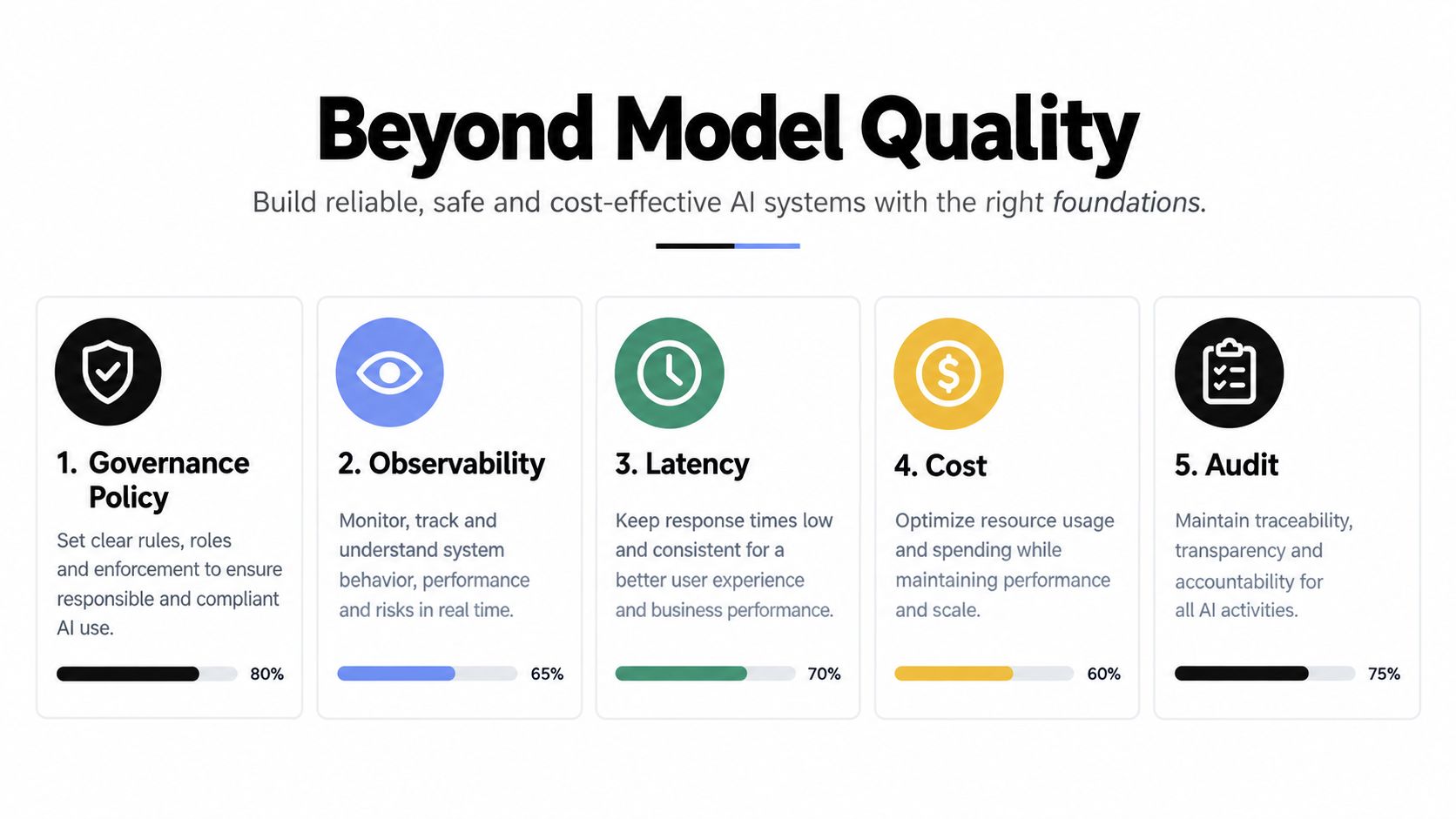
Five questions should drive the scorecard
Can the platform enforce policy at runtime? Ask the vendor to block a prohibited tool call during a live workflow, not merely flag it afterward. Demand evidence for role-based permissions, approval gates, regional restrictions, prompt-injection controls, and an emergency stop. The failure mode is clear: a policy document exists, but the agent completes the action before anyone reviews the log.
Can operators see the complete execution trace? Request a trace that follows a request through retrieval, model selection, tool calls, agent handoffs, and the final outcome. If the vendor can show only a prompt and response, debugging will be slow and accountability will be weak.
What does orchestration add to the workflow? Measure handoff latency, retry behavior, context duplication, and token usage under realistic multi-agent scenarios. A platform that routes work intelligently but adds uncontrolled coordination overhead can erase the value of a faster model.
How quickly can teams release safely? Ask the vendor to demonstrate a change from development through evaluation, approval, staged deployment, rollback, and monitoring. Measure the process in hours or days, not in promises about future automation. If every release requires a specialist services engagement, operational velocity will deteriorate.
What is the complete cost? Include inference, retrieval, integrations, platform fees, monitoring, model switching, human review, incident response, and ongoing evaluation. A low per-call price can become expensive when the platform hides retries, duplicate context, or manual intervention.
Deloitte's 2026 reporting found that only one in five companies had a mature governance model for autonomous AI agents, while most lacked mature controls such as clear decision boundaries, real-time monitoring, and audit trails (Deloitte coverage of agentic AI governance). That gap should carry more weight in a buying process than a polished leaderboard position.
Treat governance, observability, latency, cost, and auditability as weighted scorecard categories. Model quality should be one input, not the deciding vote.
Security, Compliance, and Safe AI Requirements
Security reviews fail when buyers accept broad assurances instead of requesting concrete evidence. An enterprise platform should show how it protects data, limits authority, detects unsafe behavior, and records the decisions that matter.
Ask for technical controls, not slogans
Start with data residency and regional processing. Identify where prompts, retrieved documents, traces, backups, and support data are processed and stored. Confirm whether the vendor can separate regional tenants and prevent sensitive data from crossing an approved boundary.
Then inspect the encryption model. Ask about encryption in transit and at rest, key ownership, rotation, customer-managed keys, secrets storage, and access to operational logs. PII redaction should apply to prompts, responses, traces, recordings, exports, and debugging views. Redaction that works only in the customer-facing transcript isn't enough.
Identity controls need equal precision. Each agent should have a distinct identity, scoped credentials, role-based access, approval requirements for sensitive actions, and a revocation path. Audit trails should connect the human or process that initiated a task with the agent, tools, data sources, decisions, and final action.
Safe AI belongs in the runtime
Guardrails should address prompt injection, jailbreak attempts, unsafe content, sensitive topics, data leakage, and model output quality. Ask to see the policy configuration and a live test, including what happens when an agent encounters an unsafe request or conflicting instruction.
Human override must be designed before launch. Define which actions require approval, where review queues appear, how long unresolved cases can remain open, and how an operator can stop an agent or revoke access without taking down unrelated services.
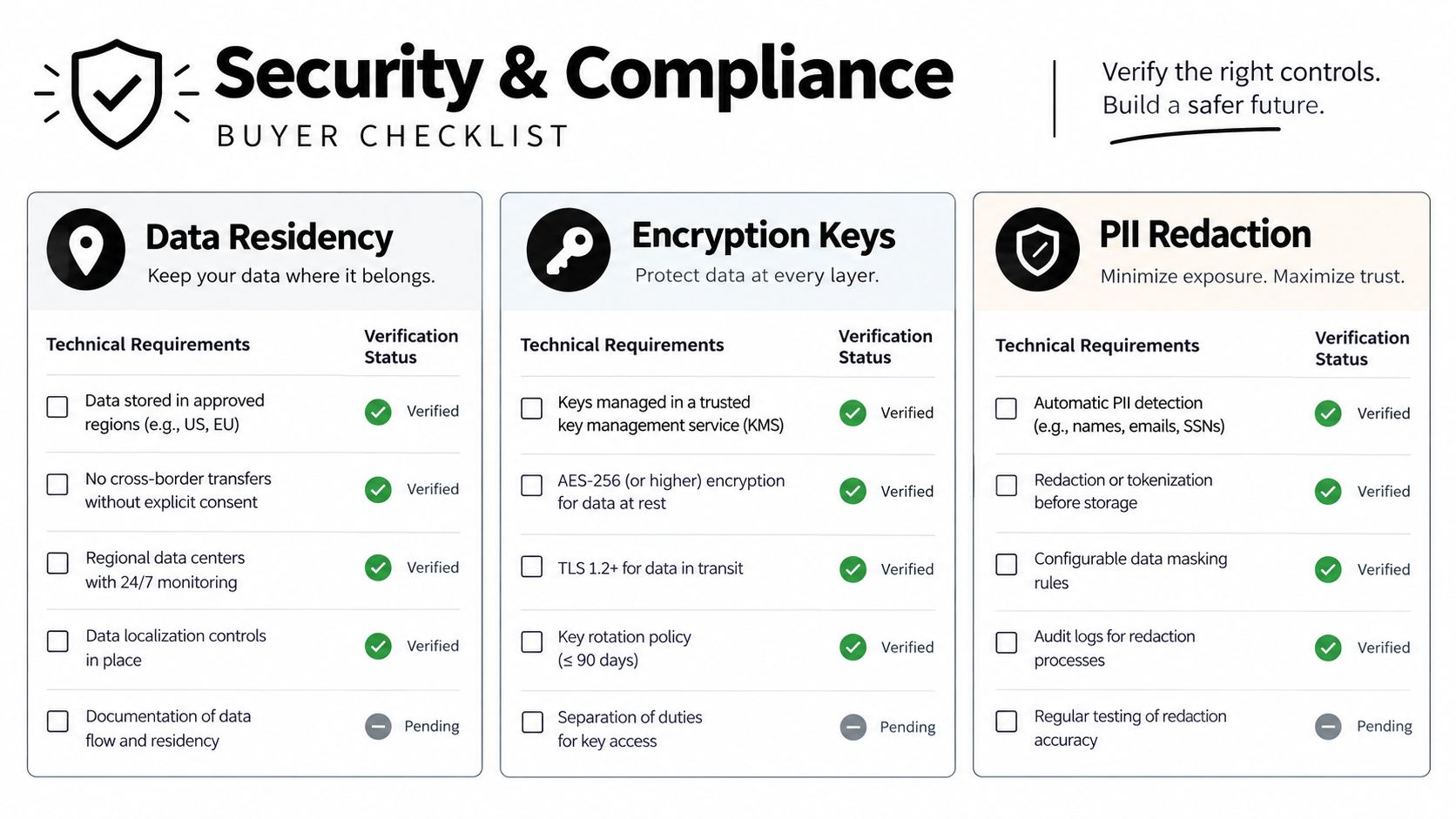
For BFSI, healthcare, telecom, and other regulated environments, request compliance artifacts before contract signing. Depending on the use case, that may include a SOC 2 Type II report, ISO 27001 documentation, a HIPAA BAA template, penetration-test summaries, incident-response procedures, subprocessors, and regional data-processing addenda.
The platform's enterprise-grade security controls should be evaluated against your own architecture, not accepted as a substitute for review. Ask where model inputs go, whether customer data is used for provider training, how long traces are retained, and which administrators can access them.
A vague answer about model provenance, data retention, or delegated access is a procurement red flag.
Compliance is not a PDF collected after implementation. It shapes architecture, contracts, access design, retention, and operating procedures. If the vendor can't provide evidence early, assume the review will become more difficult after deployment.
ROI, Integration Patterns, and How to Shortlist Vendors
ROI starts with business outcomes, but the platform must expose the controls that influence those outcomes. For CX, measure containment, resolution, handle-time compression, assisted-service productivity, and cost per conversation. For EX, measure request completion, employee time recovered, escalation volume, and the cost of human review.
Don't treat these as dashboard decorations. Connect every measure to an operational lever. A rising containment rate may reflect a genuine improvement, or it may show that the agent is refusing to escalate difficult cases. A lower handle time may hide more follow-up work. Cost per conversation should include retries, model calls, integrations, monitoring, and human intervention.
Four integration patterns have different risks
| Pattern | Deployment Timeline | Governance Posture | Best Fit |
|---|---|---|---|
| CRM embedded | Usually fast where native connectors exist | Strong within CRM boundaries, weaker across the wider estate | Customer service and sales workflows centered on one CRM |
| Contact center native | Fast for existing voice and service operations | Good channel control, with integration depth requiring validation | CX teams prioritizing voice, routing, and agent assistance |
| Employee helpdesk overlay | Moderate, depending on identity and knowledge integration | Strong when HR and IT permissions are separated | Internal service delivery across HR and IT |
| Custom API | Flexible, but dependent on engineering capacity | Potentially broad, with governance responsibility retained by the buyer | Complex workflows spanning multiple systems and clouds |
The five-step shortlist process should be disciplined.
- Create a requirements matrix. List every agent, channel, model, tool, data class, owner, policy, integration, and expected outcome. Include retirement and incident response, not just launch requirements.
- Run reference calls. Ask customers how they measure outcomes, handle failed releases, investigate traces, and control model or vendor changes. Request operational examples rather than general satisfaction.
- Use a paid pilot with an exit clause. A 30-day pilot can test one CX workflow and one EX workflow against agreed acceptance criteria. Include rollback, data deletion, support response, and termination terms.
- Build a total-cost worksheet. Capture platform fees, inference, tokens, integrations, implementation, observability, human review, training, and ongoing testing. Compare the cost of switching models or adding channels.
- Conduct a security red team. Test prompt injection, excessive permissions, PII leakage, cross-tenant access, unsafe tool calls, compromised credentials, and incomplete audit trails before production approval.
For enterprises prioritizing omnichannel CX and EX, Yellow.ai offers AI agent building and deployment across voice, chat, email, images, and video, with multi-LLM orchestration, enterprise integrations, analytics, and governance capabilities. Treat it as one option in the shortlist, then test it against the same control, traceability, security, cost, and exit criteria applied to every other vendor.
The right buying decision isn't the platform with the longest feature list. It's the one that gives your organization a defensible answer to five questions: who is running, what can each agent do, what did it do, what did it cost, and how quickly can you stop or change it?
Visit Yellow.ai to evaluate a platform for building and operating AI agents across CX and EX, including omnichannel deployment, multi-LLM orchestration, enterprise integrations, analytics, and governance controls. Bring your requirements matrix and test the platform against real workflows, permission boundaries, traceability, and total cost before approving a production rollout.