













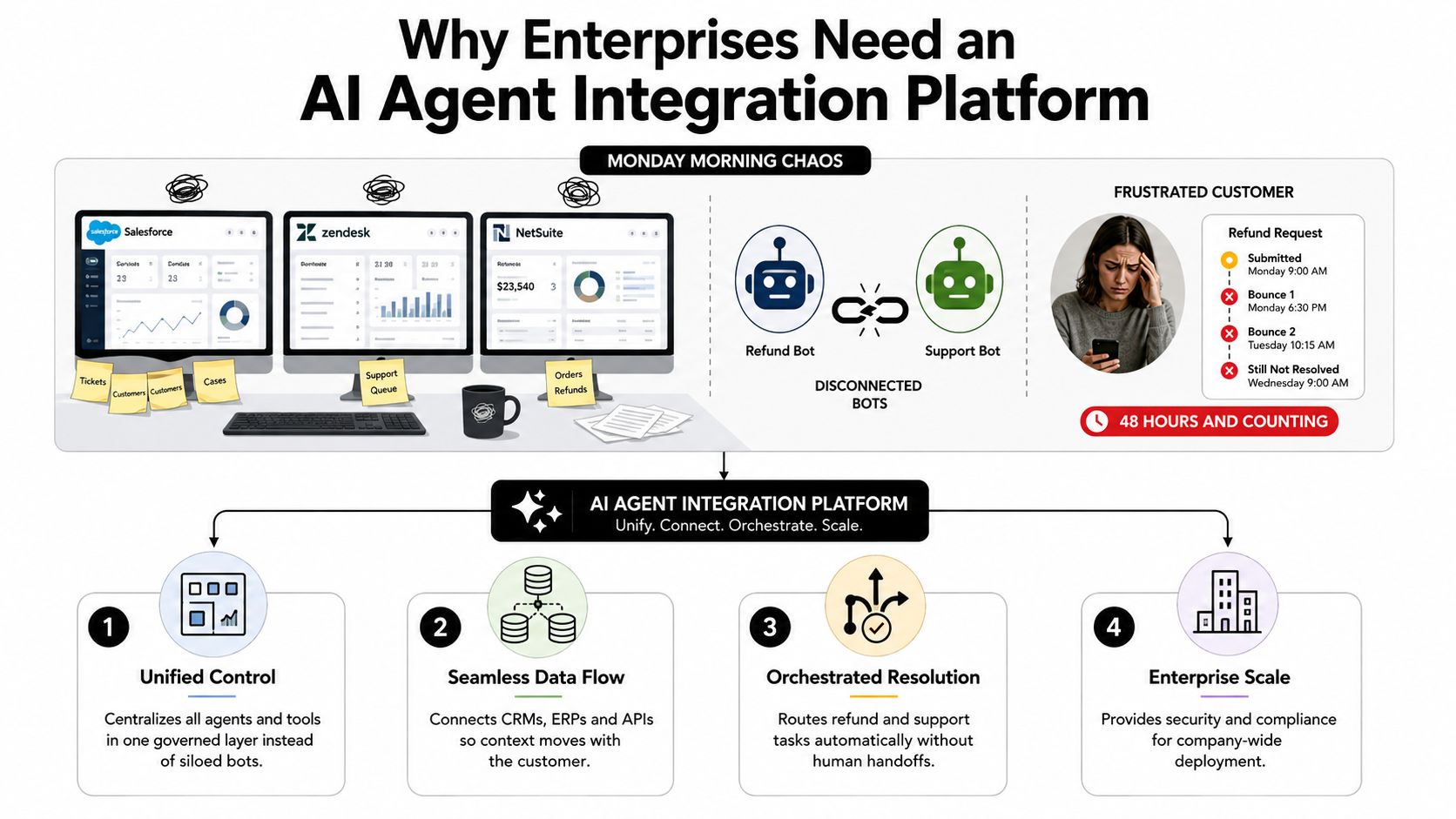
Monday morning starts with three SaaS dashboards, two disconnected bots, and a customer asking why a refund still hasn't arrived after moving between support, billing, and finance systems. One bot can read the CRM, another can create a ticket, and neither can safely complete the transaction without a human copying context across screens.
That gap is where an AI agent integration platform earns its place. It provides the control plane that lets agents use enterprise tools, move context between systems, follow shared policies, and record what happened. The category matters because enterprise AI has moved beyond isolated experiments. One industry synthesis reports that 80% of enterprise applications shipped or updated in Q1 2026 embedded at least one AI agent, compared with 33% in 2024, and 31% of enterprises had at least one AI agent in production (Digital Applied's 2026 enterprise data synthesis).
The buying question, therefore, isn't whether an agent can produce a convincing answer. It's whether your organization can let agents take reliable, governed action across CRM, ERP, ITSM, contact center, HR, and data platforms. The following guide treats the platform as infrastructure, then evaluates its architecture, integration patterns, migration demands, and selection criteria against the failures enterprises encounter at scale.
Table of Contents
- Why Enterprises Need an AI Agent Integration Platform
- The Core Architecture Behind Every AI Agent Integration Platform
- Common Integration Patterns and APIs You Will Use
- Selection Criteria for Enterprise-Grade Platforms
- Migration and Implementation Considerations
- What a Mature Platform Looks Like in Practice
- Choosing Your AI Agent Integration Platform in 2026
Why Enterprises Need an AI Agent Integration Platform
A refund request can cross customer service, finance, and operations before anyone can answer a simple question: what happened, and who owns the next step? Each team may automate its preferred SaaS product, yet those automations often understand only one system. The customer journey remains fragmented.
That design can support a demonstration. Production work is different. A support agent may need to verify identity, inspect an order, check payment status, create a finance request, update the CRM, and explain the result. Without a shared integration layer, developers repeat API chains, authentication logic, error handling, and monitoring for each bot.
From isolated bots to governed action
An AI agent integration platform centralizes the machinery between an agent and enterprise systems. It exposes approved tools, routes credentials, validates schemas, enforces permissions, coordinates asynchronous work, preserves state, and records an audit trail. The model proposes an action. The platform checks whether that action is permitted, valid, and deliverable to the target system.
That separation turns an impressive conversation into an operable workflow. The platform is more than a connector catalog. It serves as the control plane for agent actions, similar to how an enterprise integration platform governs conventional workflows and APIs.
Practical rule: If an agent can change a customer record, issue a financial action, or access private data, treat every tool call as a governed transaction, not as a clever prompt.
The market signal reflects this operational need. A 2026 forecast estimates that the AI agent platform market will increase by USD 31.46 billion from 2025 to 2030, at a 41.5% CAGR (Technavio's AI agent platform market analysis). The analysis points to connections with CRM, IT service, HR, contact center, and analytics systems. Buyers are purchasing a way to coordinate action across those environments, not merely another chat interface.
Multi-agent designs raise the control requirements. An industry synthesis reports that multi-agent orchestration rose from 1% in 2024 to 22% in 2026 (Digital Applied's enterprise adoption analysis). As agents coordinate with other agents and workflows, shared identity, isolated state, failure handling, and operational visibility become platform responsibilities. A product built only for isolated chatbot replies cannot provide the controls required for that operating model.
The Core Architecture Behind Every AI Agent Integration Platform
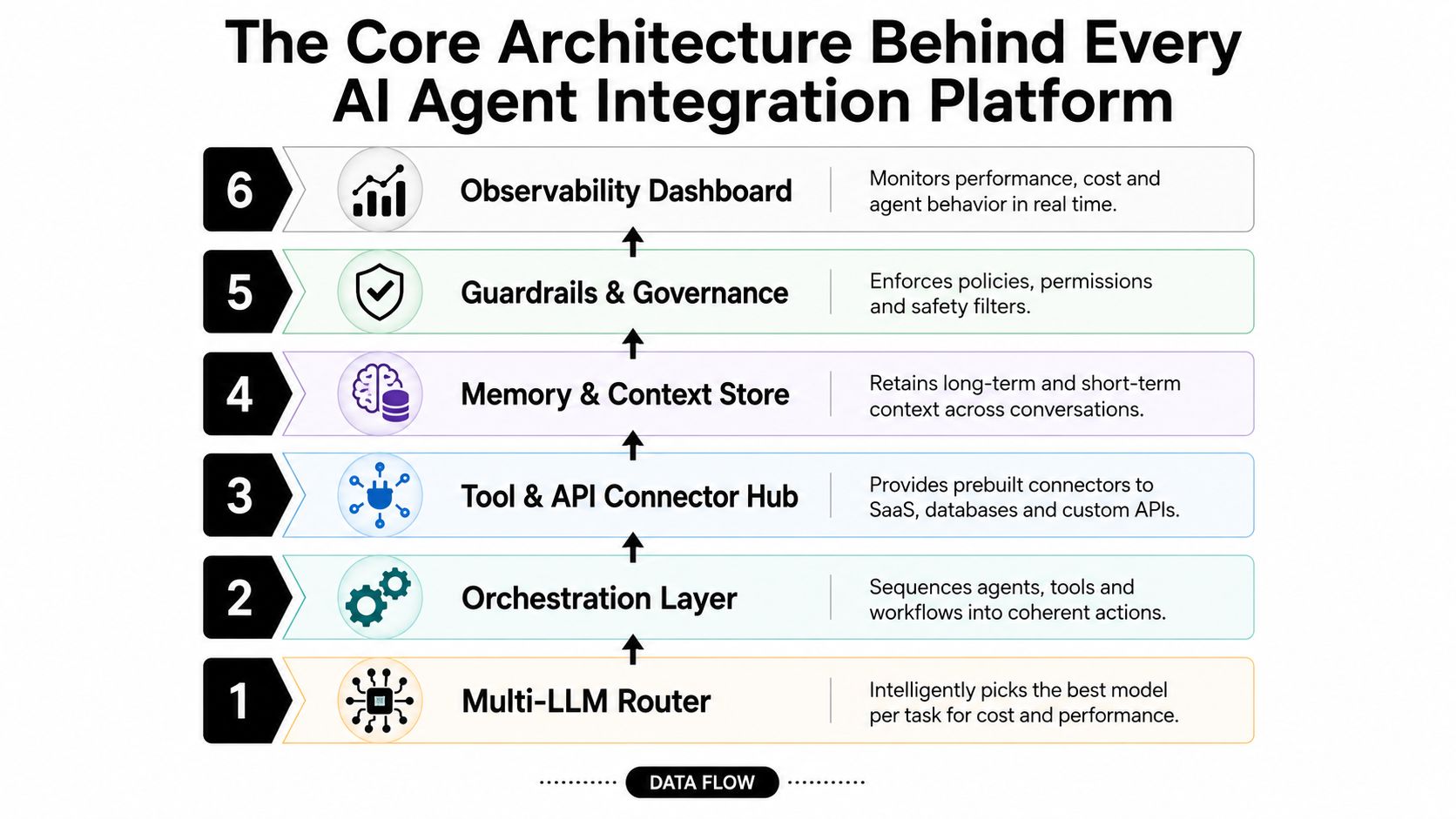
Think of the architecture as air traffic control for autonomous software. Aircraft represent agents, runways represent enterprise tools, weather data represents private knowledge, and the control tower coordinates movement without allowing every pilot to improvise around the airport.
Start with model choice and orchestration
The multi-LLM router acts as the flight planner. It selects a model according to the task, such as a fast model for classification, a reasoning model for complex case handling, or a specialized model for voice. This flexibility reduces dependence on one provider and lets architects balance capability, latency, and operating cost.
The orchestration layer is the control tower. It sequences agents and tools, decides which actions can run in parallel, waits for external events, and handles retries or escalation. It should understand that checking an order and retrieving a customer profile may happen concurrently, while issuing a refund must wait for authorization and validation.
The tool and API connector hub supplies the runways. Each connector should expose a typed, documented interface rather than asking an agent to construct arbitrary HTTP requests. A production platform also needs authentication routing, rate-limit metadata, timeout behavior, and clear error responses.
Ground context and govern execution
The memory and context store preserves the information an agent needs across a conversation or workflow. Short-term state might contain the current refund request, while longer-lived context could include approved customer preferences or prior case history. Isolation matters, because one customer's state must never leak into another customer's session or another agent's task.
The guardrails and governance layer checks identity, permissions, data policies, and tool inputs and outputs. A production architecture typically separates a tool registry, planner or controller, execution engine, memory or state, and guardrails. It also isolates execution in a sandbox with timeouts, cancellation, concurrency control, and circuit breakers, reducing the blast radius when a downstream system slows or fails (technical guidance on AI agent tool-calling implementation).
The final layer is analytics and observability. It records prompts, tool calls, responses, errors, approvals, escalations, and timing so teams can investigate an incident rather than guess. A platform such as an AI agent builder for authoring governed workflows can support the creation layer, but the surrounding runtime still needs independent operational controls.
For a concise visual explanation of how agents, tools, and orchestration interact, this embedded overview is useful:
Skipping one layer creates a recognizable production weakness. Without routing, teams hard-code model decisions. Without orchestration, workflows become brittle chains. Without typed connectors, agents guess parameters. Without state isolation, privacy risk rises. Without observability, the operations team can't explain why an action occurred.
Common Integration Patterns and APIs You Will Use
The integration surface is the contract between the agent platform and the rest of the enterprise stack. Four patterns appear repeatedly, and each solves a different timing and ownership problem.
A synchronous API call fits a short transactional action. For example, a support agent can verify an order or retrieve an account balance while the customer waits. The design is easy to understand, but it couples the user experience to the availability and response time of every downstream service. Under load, a chain of synchronous calls can become fragile.
An asynchronous webhook or event-driven flow suits work that may take time or cross several systems. Claims triage, document processing, and refund reconciliation can begin from an event, continue through queues, and notify the agent when a result is ready. This pattern handles long-running work more gracefully, but the platform needs idempotency, replay logic, dead-letter handling, and clear ownership for failed events.
An embedded SDK or chat API places the agent inside an existing product or employee portal. It can feel native because the host application controls the interface, session, and user identity. The trade-off is that the enterprise becomes dependent on the SDK's supported surfaces and release cycle.
A headless function-calling interface exposes approved skills to an existing copilot or agent framework. It's useful when the organization already has a conversational front end and wants a governed backend for actions such as creating tickets or updating a CRM record. The platform inherits the calling model's latency and must still validate every request independently.
| Pattern | Best Fit Scenario | Key Trade-off |
|---|---|---|
| Synchronous API | Order lookup, identity check, immediate account action | Simple interaction, but sensitive to downstream latency and availability |
| Webhook and event flow | Claims triage, reconciliation, long-running fulfillment | Scales across delayed work, but requires replay and idempotency controls |
| Embedded SDK or chat API | In-product assistance and employee portals | Native experience, but ties delivery to the host surface |
| Headless function calling | Existing copilots invoking approved enterprise skills | Flexible adoption, but inherits model and orchestration delay |
A useful enterprise integration catalog can accelerate connector selection, but catalog size shouldn't decide the architecture. Ask whether each connector supports the required authentication, schemas, error semantics, write actions, and audit fields. The right API contract makes an agent predictable even when the model is probabilistic.
Selection Criteria for Enterprise-Grade Platforms
Procurement teams often compare platforms through feature checklists. A better method maps every criterion to a failure mode that appears after launch. The question isn't “Does the vendor have observability?” It's “Can our incident team reconstruct a failed cross-system action, identify the responsible agent, and stop similar actions?”
| Criterion | What to Measure | Failure Mode It Prevents |
|---|---|---|
| Scalability | Concurrency behavior, queue depth, backpressure, tenant isolation, and multi-region recovery | Traffic spikes, starvation, cascading failures, and regional outages |
| Security | Identity propagation, secret vaulting, least-privilege scopes, sandboxing, and PII handling | Unauthorized tool calls, credential exposure, and cross-tenant data access |
| Compliance | Immutable audit records, data residency, retention controls, and applicable certifications or legal controls | Unprovable access history and noncompliant data movement |
| Latency | P50 and P95 end-to-end timing, TTFT, TPOT, streaming, tool overhead, and cold starts | Abandoned conversations and unusable voice or interactive experiences |
| Observability | Request-level traces, agent-to-agent visibility, alerts, cost attribution, and export options | Blind post-mortems and unowned failures |
| Portability | Model abstraction, exportable prompts and workflows, open interfaces, and connector replacement options | Vendor lock-in and expensive platform migration |
Latency deserves a full-path test. Industry guidance places simple-query targets below 500 milliseconds at P50 and 1,000 milliseconds at P95, while complex workflows are expected below 2 seconds at P50 and 4 seconds at P95. Multi-agent orchestration can reach 3 seconds at P50 and 6 seconds at P95, and voice experiences often require response times below 1,000 milliseconds to feel natural (AI agent latency, cost, safety, and ROI guidance). Ask vendors to separate time to first token, token generation time, tool time, and total orchestration time.
Security and governance should receive equal weight. Independent 2026 reporting says only 24.4% of organizations have full visibility into which AI agents communicate with one another, while more than half of agents operate without security oversight or logging. The report also says 34% of enterprises rank security and governance above integration and performance when selecting an agentic AI stack (enterprise AI agent integration challenges).
Use a platform's enterprise-grade security controls as a reference point for the questions procurement should ask, not as a substitute for your own testing. Require demonstrations of identity propagation, audit export, kill switches, policy evaluation, and failure recovery with your data shapes and workload patterns.
Migration and Implementation Considerations
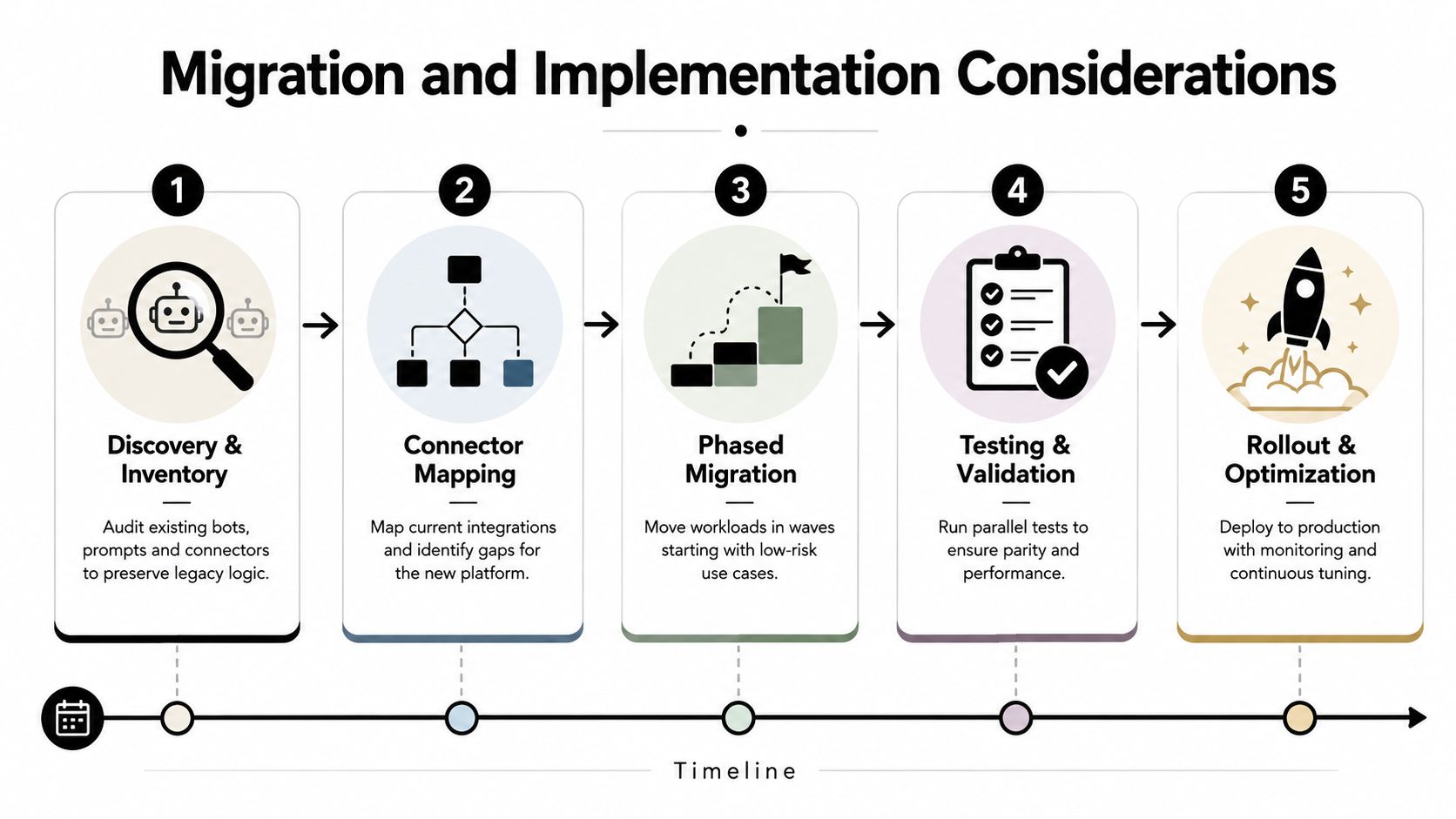
Migration fails when teams treat agent adoption as a model swap. The difficult work usually sits in the existing prompts, undocumented permissions, connector assumptions, and exception paths that live inside legacy bots.
Build the inventory before the design
Begin with discovery. Create an inventory of every bot, prompt, connector, API credential, workflow owner, data store, escalation rule, and business channel. Record what each automation reads and writes, which user identity it carries, and what happens when a downstream service times out.
Then map connectors to target capabilities. Identify duplicate integrations, unsupported write actions, inconsistent schemas, and data sources that need access governance. Provision the retrieval layer and vector store only after security owners agree on tenancy, indexing, retention, and document permissions. Connecting a model before preparing this foundation creates a convincing demo with an unreliable knowledge boundary.
Prove one reference workflow
Choose a reference use case with a clear business owner and measurable acceptance criteria. A refund workflow might require correct customer authentication, accurate order retrieval, approved finance actions, complete CRM updates, and a human escalation when confidence or authorization is insufficient.
Run the workflow in a sandbox with shadow traffic against production. Compare tool selection, field mappings, response quality, timing, and escalation behavior without allowing the new agent to commit live changes. Test malformed inputs, revoked credentials, duplicate events, partial outages, prompt injection, and conflicting records.
Cut over in controlled waves
Move by channel and region rather than switching every interaction at once. Assign named owners for hallucination risk, latency regression, privacy exposure, compliance breach, and downstream service failure. Each owner needs authority to pause the rollout, not merely a responsibility listed in a project document.
Keep a rollback path that restores the previous bot or human queue without losing case state. After cutover, maintain a stabilization window long enough to review production traces, tune policies, fix connector edge cases, and confirm that business owners accept the escalation quality. “Live” should mean the operating model works, not just that the endpoint is receiving traffic.
What a Mature Platform Looks Like in Practice
A mature platform is visible in the handoffs. A customer asks for help in voice, the agent identifies the intent, retrieves approved knowledge, checks the relevant CRM record, calls an authorized service, and escalates with a complete summary when policy or confidence requires human judgment. The customer shouldn't need to know which model, connector, or workflow executed the request.
In a platform such as Yellow.ai, that operating model can include multi-LLM routing, a visual agent builder, enterprise connectors, retrieval grounded in organizational knowledge, and analytics for examining containment, deflection, escalation quality, and workflow behavior. These capabilities matter only when they connect to operational outcomes. A low-code builder can shorten the path from process owner to tested workflow, while model flexibility can help teams assign different models to different workloads rather than forcing every interaction through one choice.
The capability is the control loop
A mature implementation doesn't stop at deployment. Operations teams review failed tool calls, identify repeated escalations, inspect knowledge gaps, and examine whether the agent took the shortest safe path. Contact center leaders care about handle time and resolution quality. HR teams care about accurate employee-service answers and permission boundaries. CIOs care about change control, auditability, resilience, and the cost of operating a growing agent estate.
The same standard applies to specialized experiences. Teams evaluating voice automation in regulated environments may find practical context in this resource on AI voice agents for medical practices, especially when assessing identity, escalation, privacy, and conversational timing requirements.
A platform earns enterprise trust when business users can author within guardrails, engineers can extend the runtime, security teams can inspect and stop actions, and executives can connect agent activity to service outcomes. Those roles need different interfaces, but they must operate on the same underlying state, policy, and audit model.
What to test during a working session
Ask the vendor to demonstrate a complete scenario rather than a feature tour:
- Cross-system context: Start with a customer request and follow the data through the CRM, ticketing system, and transaction service.
- Controlled failure: Make one dependency slow, unavailable, or unauthorized, then observe retries, circuit breaking, escalation, and user messaging.
- Policy enforcement: Attempt a write action outside the user's permissions and inspect the denial, audit event, and operator notification.
- Operational diagnosis: Search a trace from the initial message through every tool call, model response, policy decision, and final outcome.
That demonstration reveals more than a connector count. It shows whether the vendor has built a control plane or assembled a collection of disconnected agent features.
Choosing Your AI Agent Integration Platform in 2026
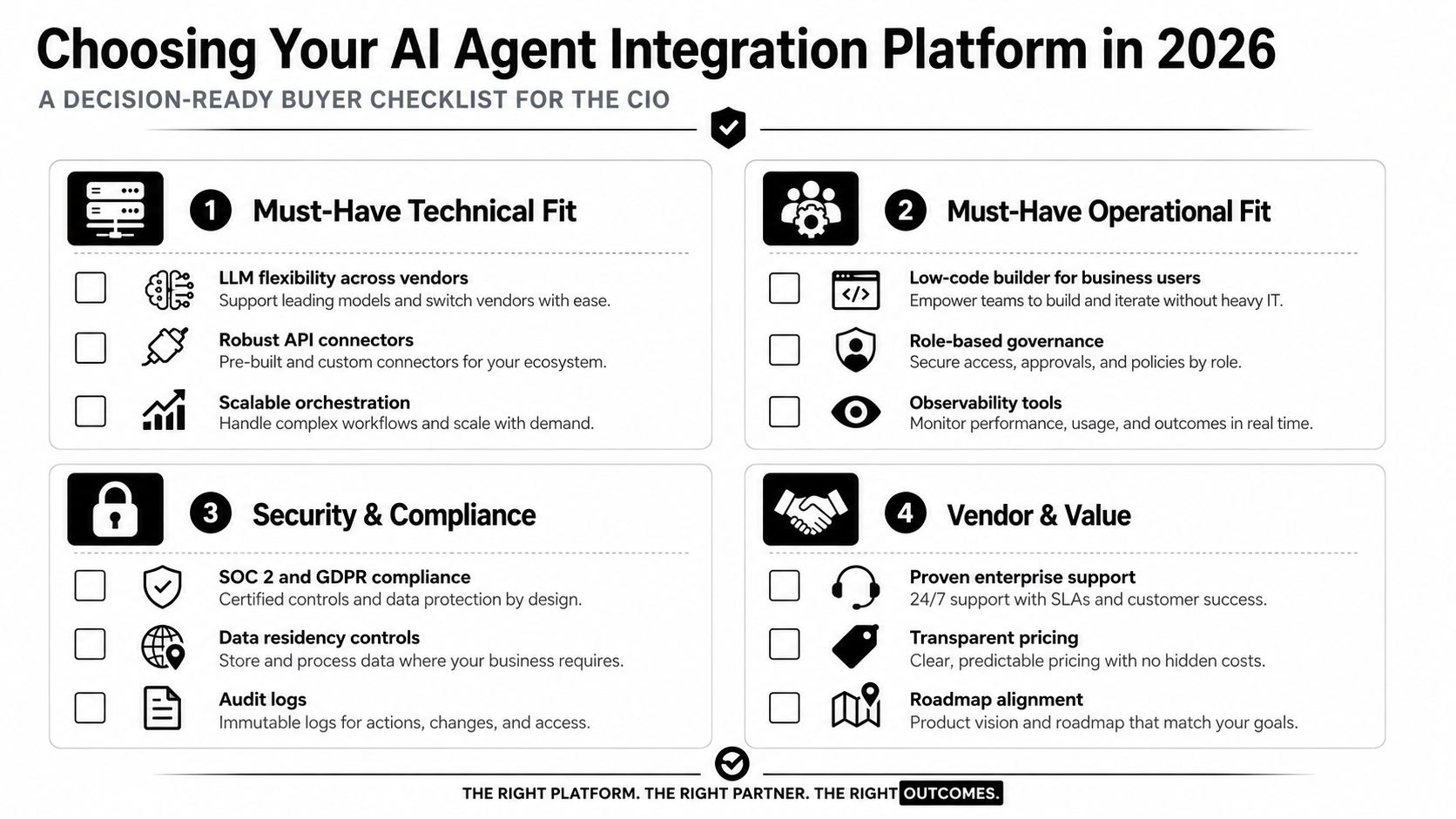
A CIO can make the shortlist easier to score by separating mandatory fit from future signals. The categories below keep technical reviewers, security teams, operators, and procurement professionals focused on the same production risks.
Must-have technical fit
The platform should support multiple model providers, typed tools, enterprise authentication, asynchronous execution, state isolation, and connectors for the systems that matter to your business. Test actual workflows, not claimed compatibility. A connector that reads Salesforce but cannot safely perform the required write action isn't a complete fit.
Must-have operational fit
Require role-based administration, environment separation, audit trails, trace-level observability, test tooling, alerts, and kill switches. Operators need to know which agent acted, which user authorized it, what data it accessed, and how to stop it. These controls directly reduce security, compliance, and incident-response risk.
Must-have commercial fit
Pricing should be explainable across model calls, tool executions, users, environments, data volume, and support tiers. Procurement should also examine data-processing terms, exit assistance, service commitments, roadmap governance, and the cost of replacing a connector or moving a workflow.
Watch-list items for the next 12 to 18 months
Interoperability standards, agent identity, cross-agent policy enforcement, evaluation frameworks, and hybrid deployment will shape the next buying cycle. The category is moving toward environments where agents from different teams and vendors must exchange structured context without weakening authorization. Governance frameworks will need to catch up with workflows that act autonomously, while most enterprises will continue operating hybrid stacks rather than consolidating every model and system under one provider.
Selection test: Choose the platform that makes unsafe, slow, opaque, or vendor-dependent behavior difficult to ship.
Use the production risks as the final filter. Latency requires full-path measurement, not a model benchmark. Security requires identity and policy tests, not a checkbox. Compliance requires exportable evidence. Scalability requires failure and concurrency testing. Portability requires open interfaces and ownership of your prompts, schemas, workflows, and data.
For teams building a market map, a resource that helps you compare AI agent platforms can support early discovery. Treat directories as a starting point, then run every serious candidate through your own reference workflow, security review, integration test, and commercial model.
Yellow.ai fits this category as one option for enterprises seeking multi-modal agent design, multi-LLM support, enterprise integrations, knowledge grounding, governance, and analytics in a unified environment. The decision should still rest on demonstrated behavior against your systems and risk controls, not on feature volume.
Yellow.ai offers an enterprise agent platform with AI Agent Builder, multi-LLM orchestration, agentic retrieval, omnichannel experiences, enterprise integrations, and analytics for governed customer and employee workflows. Visit Yellow.ai to evaluate how its control-plane approach could fit your reference use case, security requirements, and production rollout plan.



