













The counterintuitive reality is that agentic AI adoption is moving faster than production readiness. Agentic AI pilots nearly doubled from 37% in Q4 2024 to 65% in Q1 2025, while full deployment remained as low as 11% in some surveys, with other estimates placing enterprise production usage closer to 31% by mid-2026 (industry reporting compiled by Paul Okhrem). The problem isn't a lack of capable models. It's that enterprises are trying to attach autonomous decision-making to workflows, permissions, data, and operating structures that were designed for humans and deterministic software.
By 2026, 55% of organizations were actively developing or deploying an agentic AI operating model, while 60% planned to adopt next-generation delivery structures tied to these systems, according to IBM's research on agentic AI and enterprise operations. That marks a shift from isolated automation toward workflow-level orchestration. Leaders now have to decide which work an agent may perform, which systems it may touch, how every action is verified, and when a person must take over.
Table of Contents
- What an Agentic AI Workflow Actually Is
- The Eight Core Components of a Production-Ready Workflow
- Architecture Patterns for Orchestration, RAG, and LLM Selection
- Testing and Monitoring as a Continuous Loop
- Security, Compliance, and Governance in Multi-Step Workflows
- CX and EX Use Cases That Show the Pattern in Action
- Metrics, Pitfalls, and Your Next 30 Days
What an Agentic AI Workflow Actually Is
An agentic AI workflow isn't a chat feature. It's an operating-model redesign. A chatbot generates a response. A copilot assists a person inside an existing process. A scripted bot follows predetermined paths. An agentic workflow pursues a goal through a sequence of steps, retaining state, selecting tools, reacting to new information, and checking whether its actions produced the intended result.
A useful production definition is a chained, goal-seeking system that can:
- Plan: Translate an outcome into ordered tasks and dependencies.
- Retrieve: Pull relevant records, policies, and live system information.
- Decide: Select the next action within defined boundaries.
- Act: Call approved tools, APIs, databases, or business applications.
- Check: Evaluate the result, detect errors, and confirm policy compliance.
- Loop: Continue, revise the plan, or escalate until the goal is complete.
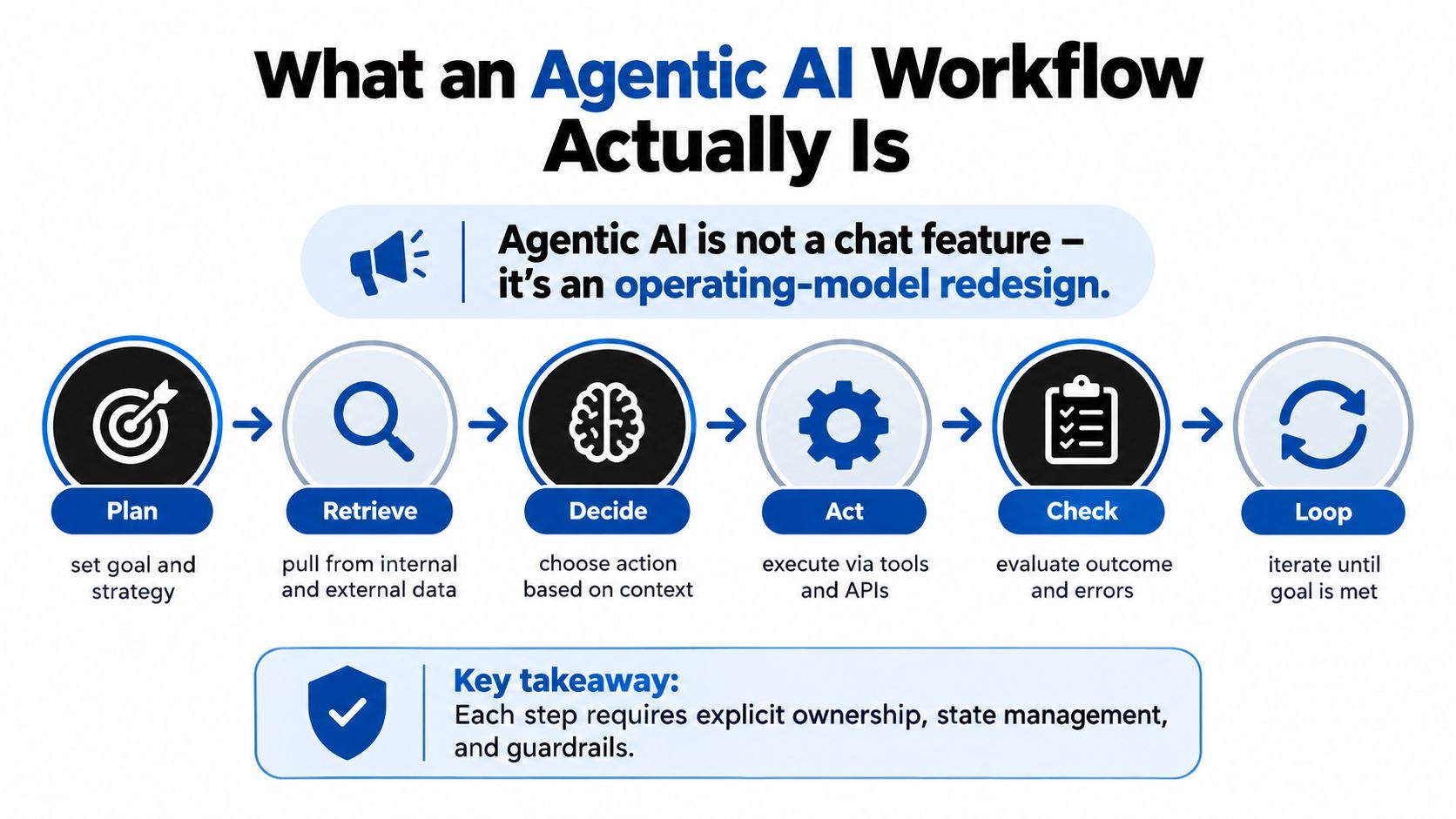
The difference matters because each step creates an ownership decision. Someone must define what counts as a valid plan, which data is authoritative, which actions are reversible, and what evidence the agent must produce before proceeding. A prompt rarely needs that operating discipline. An agent that can change a customer record or trigger a payment does.
A concrete enterprise pattern
Consider a Tier-1 customer support agent handling a refund request. It reads the ticket, verifies the customer, retrieves account history from a CRM, searches current refund policy through a retrieval-augmented generation layer, checks eligibility, issues a credit through a payment API, updates the case, and sends a confirmation. If identity is ambiguous, the policy result conflicts with account data, or the confidence score falls below the approved threshold, the workflow routes the case to a human.
That workflow isn't “answer the refund question.” It combines state management, retrieval, tool use, policy enforcement, exception handling, and verification. The agent's language model is only one component. The surrounding system determines whether the workflow is safe enough to operate.
Leaders evaluating the distinction can use this practical introduction to agentic AI and how it differs from AI agents, then apply the same discipline used to craft AI content that ranks: define the intended outcome, understand the audience or system context, and verify the result against explicit criteria.
Practical rule: If the proposed agent has no persistent state, no approved tools, and no outcome check, you're probably designing a chatbot or a rules engine, not an agentic workflow.
The Eight Core Components of a Production-Ready Workflow
A production workflow needs more than a capable model. It needs eight assigned owners, each responsible for a boundary that can fail independently.
1. Agent design and persona scope
The business owner defines the agent's role, tone, allowed decisions, and prohibited behavior. A support agent may explain policy and issue an eligible credit, but it shouldn't decide fraud cases or invent exceptions. If scope is vague, the model fills the gaps with plausible but unauthorized behavior.
2. Orchestration and state
Platform engineering owns routing, session state, retries, timeouts, and handoffs between agents or workflows. The orchestrator should record what the agent knows, what it has attempted, and why it selected the next action. Without it, a workflow loses context, repeats calls, or escalates without a useful summary.
3. Multimodal input handling
The channel or experience team owns voice, text, images, structured events, and document parsing. An insurance workflow may need to connect a spoken request with a claim image and a structured policy record. Skipping normalization creates inconsistent downstream decisions because each modality reaches the model in a different shape.
4. Retrieval and knowledge management
The knowledge owner controls source authority, indexing, freshness, access policy, and document retirement. Retrieval must distinguish current policy from obsolete guidance and enforce tenant or role boundaries. A stale knowledge base turns a confident answer into an operational defect.
5. Model selection
The AI platform team chooses models by task rather than brand preference. Routing, classification, rewriting, extraction, reasoning, and verification may need different capabilities. Using a heavyweight reasoning model for every turn adds latency and cost, while using a lightweight model for a high-risk decision weakens reliability.
6. Testing harnesses
Quality engineering owns branching tests, adversarial scenarios, tool-failure simulation, and regression evaluation. A test that checks only the final answer misses whether the agent used the wrong source, skipped an approval, or called a tool in the wrong order.
7. Monitoring and observability
The operations owner needs trace-level telemetry, not only a conversation transcript. Teams should be able to inspect retrieval results, tool arguments, latency, retries, escalation reasons, and final outcomes. If monitoring captures only user messages, engineers can't diagnose the step that failed.
8. Security and compliance
Security, privacy, and risk teams must participate before launch. Permissions, redaction, auditability, retention, and approval controls belong inside the workflow, not in a policy document stored beside it. When this component is skipped, an agent can become an unauthorized integration layer.
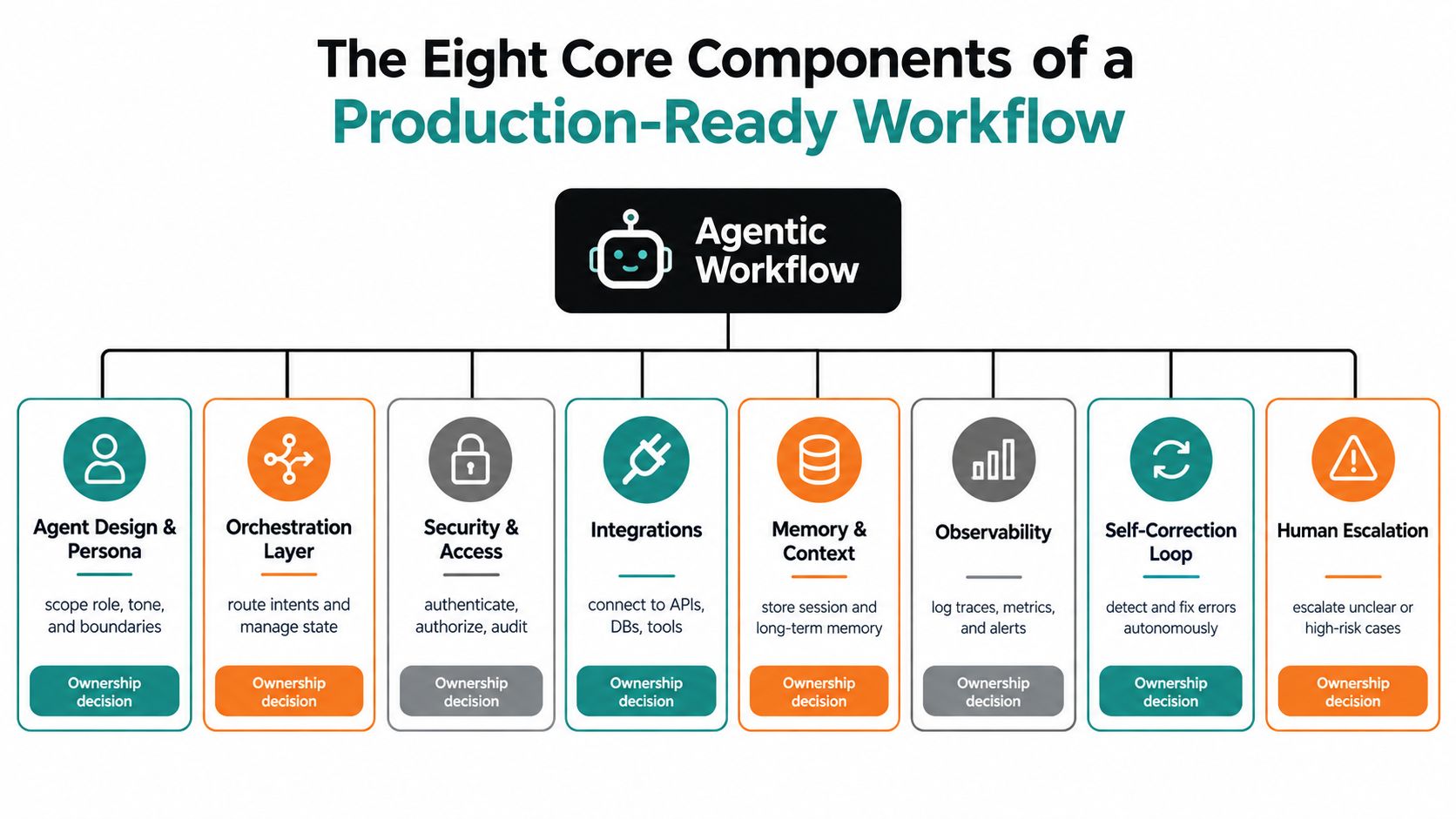
The ownership test is simple: for every component, name the person or team that can approve a change, investigate a failure, and accept the associated risk. If nobody owns it, it isn't production-ready.
Architecture Patterns for Orchestration, RAG, and LLM Selection
A durable architecture separates decision-making from execution. The model can propose an action, but the orchestration layer should determine whether that action is available, authorized, rate-limited, and correctly formatted.
A practical request path starts with an intent classifier at the edge. The classifier routes routine requests to deterministic workflows and sends ambiguous goals to a planner. The planner decomposes the goal into tasks, while a tool registry exposes only approved APIs with schemas, retries, timeouts, idempotency rules, and rollback behavior.
The retrieval layer should combine a vector store with structured queries. Semantic search is useful for policy language and unstructured knowledge. Structured queries are better for account balances, order status, entitlement records, and other fields where exactness matters. A verifier then checks whether the proposed answer or action is supported by retrieved evidence and whether the result satisfies business rules.
For changing web or external knowledge, teams may evaluate a specialized Web Scraping API for RAG rather than building every ingestion connector themselves. The important design question isn't how much information the system can retrieve. It's whether the source is trusted, current, permission-aware, and linked to an auditable decision.
Route models by responsibility
A multi-LLM pattern usually works better than assigning one model to every step:
| Workflow Stage | Recommended Tier | Typical Latency | Relative Cost | Reason |
|---|---|---|---|---|
| Intent routing and classification | Small, fast model | Low | Low | Handles high-volume, low-complexity decisions |
| Query rewriting and extraction | Small to mid-tier model | Low to moderate | Low to moderate | Produces structured inputs for later steps |
| Planning and tool selection | Mid-tier reasoning model | Moderate | Moderate | Balances reasoning quality with operational efficiency |
| Policy interpretation and exception analysis | Strong reasoning model | Moderate to high | High | Handles ambiguity and competing constraints |
| Final verification for high-risk actions | Strongest available model or deterministic validator | Variable | High | Protects irreversible decisions with an independent check |
These latency and cost categories are architectural comparisons, not universal benchmarks. Actual performance depends on provider, prompt size, retrieval volume, tool behavior, and concurrency. Teams should measure each route in their own workload rather than assume that a model hierarchy will produce savings automatically.
Platforms such as Yellow.ai package parts of this pattern through agent building, conversational knowledge management, multi-LLM routing, integrations, and testing capabilities. Whether a team uses a packaged platform or builds with frameworks and cloud services, the principle remains the same: centralize orchestration and policy instead of re-implementing them inside every agent.
The Conversational Knowledge Base is relevant to this architecture because retrieval quality depends on how enterprise content is connected, governed, and presented to the agent. RAG is not a magic memory layer. It is an information supply chain that requires source ownership and operational maintenance.
Testing and Monitoring as a Continuous Loop
Pre-launch QA is necessary, but it isn't sufficient. A multi-step workflow creates branching states that static test cases rarely cover, especially when users change intent, provide incomplete information, or trigger a tool failure halfway through a process.
A support agent can appear correct in a scripted refund test and still fail in production after a model provider changes behavior. It may retrieve a different policy passage, alter the order of tool calls, or stop asking for identity confirmation. The final transcript might look reasonable while the underlying control path has weakened.
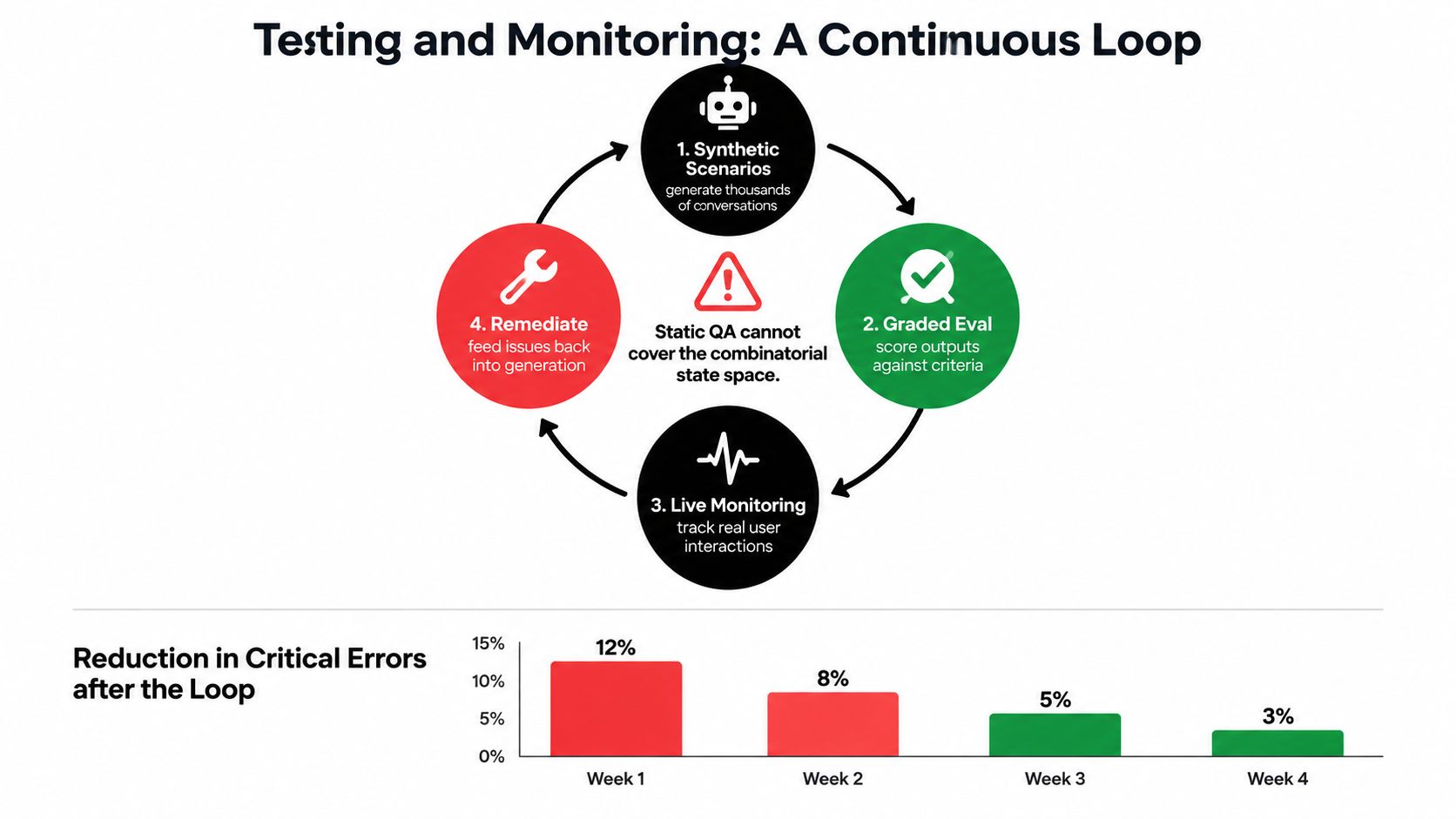
Four operating phases
Generate synthetic scenarios. Create conversations from real policy documents, anonymized cases, edge conditions, incomplete inputs, and adversarial instructions. Include tool timeouts, conflicting records, and unavailable systems.
Grade the workflow. Score not only the final response, but also retrieval relevance, tool selection, argument correctness, policy compliance, escalation behavior, and completion state. Dedicated benchmarks reflect this broader requirement. WorfBench and WorfEval evaluate graph-structured workflow generation, including ordering and dependency preservation, while TRAIL focuses on long-horizon agent traces and failure localization.
Run in shadow mode. Let the agent observe live work and produce recommendations without taking action. Compare its proposed path with the human team's resolution, then classify disagreements by severity.
Release in stages. Begin with bounded cases and confidence-based escalation. Expand the action set only after the workflow demonstrates stable behavior across real input variation.
Monitoring must connect each signal to a remediation owner:
- Retrieval failures trigger source review, re-indexing, or policy retirement.
- Tool-call failures trigger schema, authentication, timeout, or integration fixes.
- Escalation changes trigger threshold review and scope analysis.
- Hallucinated or unsupported answers trigger prompt, retrieval, or verifier changes.
- Policy violations trigger immediate containment and governance review.
- Outcome deterioration triggers rollback or a narrower operating scope.
The automated testing capabilities can support this loop, but no testing product replaces ownership. Monitoring becomes valuable only when a named team reviews traces and changes the workflow in response.
Security, Compliance, and Governance in Multi-Step Workflows
An agentic workflow creates an attack surface at every retrieval, tool call, and handoff. A secure perimeter doesn't protect an agent that can read a poisoned document, pass sensitive context to another tool, or use a broadly scoped credential to perform an irreversible action.
Three control layers
Data-layer controls govern what enters the system and what each agent may retrieve. Redact sensitive data at ingestion where possible, isolate tenant data, enforce role-aware retrieval, and treat documents as untrusted input. Prompt injection can arrive through a knowledge source that looks authoritative to the model but contains instructions unrelated to the user's request.
Action-layer controls govern what the agent can do. Use allowlisted tools, typed arguments, least-privilege credentials, transaction limits, dry runs, and human approval for irreversible operations. The agent should never infer authorization from conversational context alone.
Audit-layer controls make the workflow reconstructable. Store immutable records of inputs, retrieved sources, model and prompt versions, tool arguments, approvals, outputs, and errors. Teams need enough evidence to explain an action without exposing unrestricted internal reasoning or sensitive data.
| Layer | Required Controls | Primary Risk Addressed | Compliance Mapping |
|---|---|---|---|
| Data | Redaction, tenant isolation, role-aware retrieval, retention rules | Data leakage and unauthorized access | HIPAA privacy safeguards, SOC 2 access controls, EU AI Act data governance |
| Action | Allowlisted tools, least privilege, approval gates, rollback | Unauthorized or harmful execution | SOC 2 change and access controls, HIPAA security safeguards, EU AI Act risk controls |
| Audit | Immutable event logs, versioning, trace IDs, review workflows | Untraceable decisions and weak accountability | SOC 2 evidence, HIPAA audit controls, EU AI Act transparency and monitoring |
| Model | Version pinning, evaluation gates, fallback policy | Silent behavior changes and regression | Governance evidence across regulated deployments |
Compliance frameworks don't become effective because a policy mentions AI. They become operational when the workflow enforces the policy at the point of retrieval, decision, execution, and review.
A provider update can change behavior even when application code remains unchanged. Pin model versions where possible, run regression evaluations before promotion, and keep a rollback path. Platform engineering should own technical enforcement, risk should define control requirements, and the business owner should accept or reject the agent's permitted scope.
The business owner of an agent must be able to answer one question clearly: “What is the most damaging action this workflow could take, and where does approval occur before it happens?”
CX and EX Use Cases That Show the Pattern in Action
The same workflow primitives can support customer service and employee service, but the data, permissions, and escalation rules differ. Treating them as interchangeable is a design mistake.
A CX support agent might handle order status, returns, and refund eligibility. It reads the conversation, verifies identity, retrieves order and account history from a CRM, consults policy through RAG, calls payment or order APIs, and writes the outcome back to the case. Ambiguous identity, suspected fraud, conflicting policy, or an irreversible exception should route to a specialist with a complete action summary.
An EX IT helpdesk agent follows a different path. It identifies the employee and device context, searches the internal knowledge base, checks identity-provider status, resets a password or provisions approved software, creates or updates an ITSM ticket, and confirms access. Requests involving privileged access, unusual devices, or policy exceptions should pause for human approval.
| Dimension | CX Support Agent | EX IT Helpdesk Agent |
|---|---|---|
| Primary goal | Resolve customer service requests | Restore or enable employee productivity |
| Core systems | CRM, order management, payments, case management | Identity provider, ITSM, endpoint management, knowledge base |
| Typical tools | Account lookup, order status, returns, refund eligibility | Password reset, software provisioning, access request, ticket update |
| High-risk trigger | Identity ambiguity, fraud signals, exception refunds | Privileged access, unusual device, policy exception |
| Useful outcome measures | Cost per resolved contact, first-contact resolution, quality-gated deflection | Time to resolution, employee time-to-productivity, access accuracy |
| Human handoff | Specialist support or fraud review | Service desk, security, or system owner |
The workflow generalizes because both cases use the same control pattern: identify the request, retrieve authoritative context, select a tool, verify the result, and escalate when the boundary is unclear. The business outcome differs, so the evaluation set and success criteria must differ too.
A platform evaluation should focus on practical capabilities rather than feature labels: a unified agent builder, multimodal and omnichannel deployment, workflow calls, prebuilt integrations, knowledge synchronization, human handoff, trace-level analytics, and automated testing. Those capabilities matter only when they connect to the systems the CX or EX team already operates.
For CX leaders, the CFO-facing question is whether resolution quality improves while cost per resolved contact falls. For EX leaders, the equivalent question is whether employees regain access or complete routine service requests faster without increasing security incidents.
Metrics, Pitfalls, and Your Next 30 Days
The most defensible enterprise position is bounded autonomy, not unrestricted autonomy. A workflow should act independently where the risk is low, pause for approval where the action is consequential, and provide a clear handoff when evidence is incomplete.
Avoid vanity metrics such as total AI messages or conversation volume. Measure completed outcomes with quality gates:
- Deflection with quality: Count a case as deflected only when the user receives a correct, policy-compliant resolution.
- First-contact resolution: Separate true resolution from conversations that merely end without escalation.
- Handling-time reduction: Verify that automation doesn't shift work into reopens, callbacks, or manual corrections.
- Cost per resolved conversation: Include model calls, integrations, human review, and failure recovery.
- Reliability score: Track unsupported answers, policy violations, tool failures, and incorrect escalations separately from business outcomes.
Five failure patterns appear repeatedly:
- Orphaned pilots: No executive sponsor or business owner can approve scope, budget, or risk decisions.
- Stale retrieval: The agent cites obsolete material because nobody owns source freshness.
- Missing escalation: The workflow reaches uncertainty but has nowhere useful to send the case.
- Over-orchestration: Too many agents and handoffs make state harder to track and errors harder to diagnose.
- Late governance: Security and compliance teams discover the workflow only after it connects to production systems.
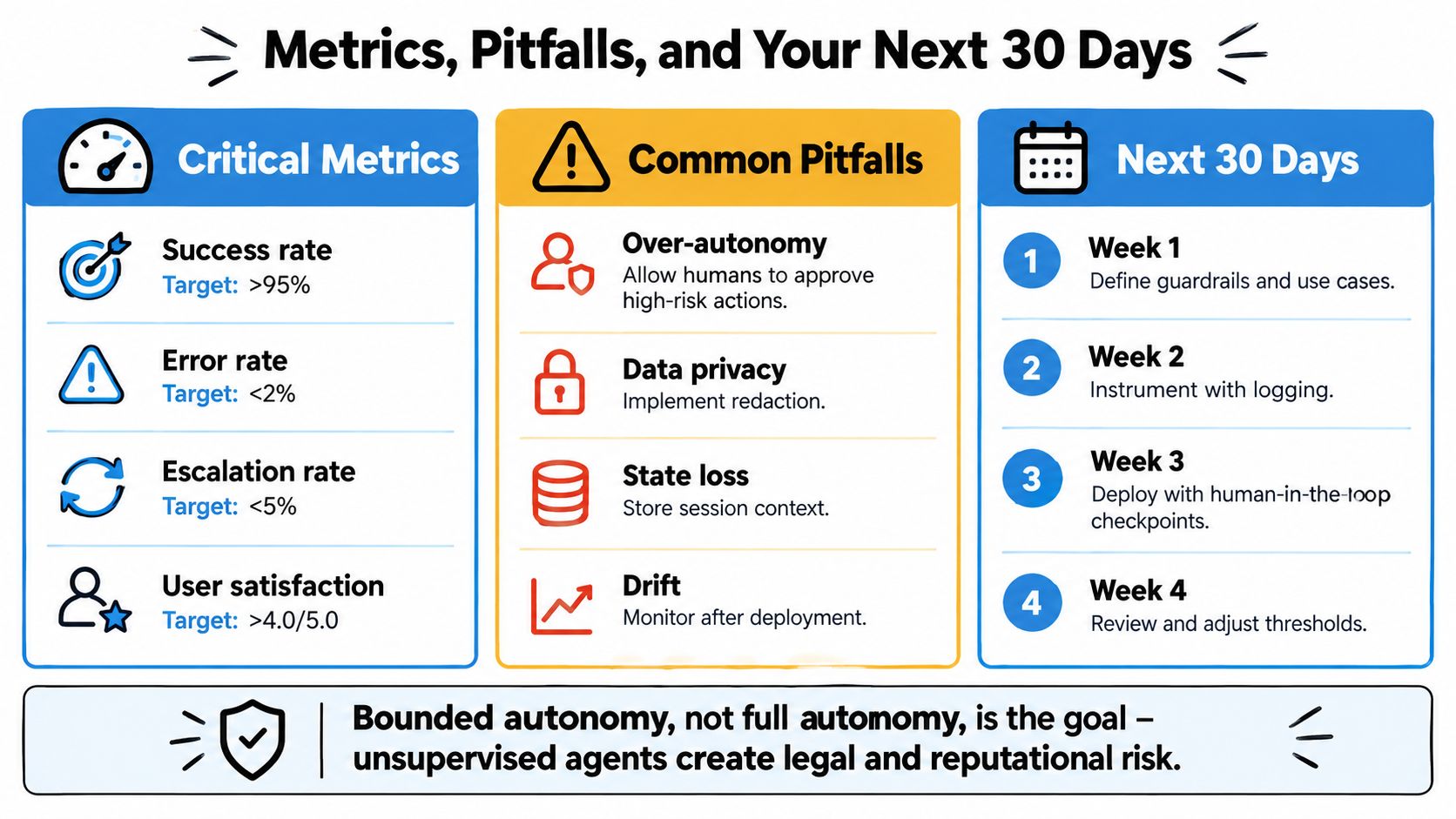
A practical 30-day start
- Week 1: Choose one narrow workflow, document the desired outcome, identify prohibited actions, map data sources, and name an executive sponsor.
- Week 2: Define tools, permissions, escalation rules, evaluation scenarios, trace fields, and rollback conditions.
- Week 3: Run synthetic tests and shadow mode, then release to a bounded channel with human checkpoints.
- Week 4: Review outcomes, inspect failure traces, update thresholds and knowledge sources, and decide whether to expand, narrow, or stop.
The Deloitte analysis of agentic AI strategy highlights the risk of layering agents onto legacy processes without redesigning those processes first. Before scaling, ask whether the workflow should be augmented, simplified, or rebuilt for agent-native execution. That decision often matters more than the choice of model.
The goal isn't to remove humans from every workflow. It's to give agents enough authority to complete useful work while keeping accountability visible.
Yellow.ai provides an enterprise agentic AI platform for CX and EX workflows, combining agent building, omnichannel deployment, conversational knowledge management, integrations, testing, and analytics for systems such as CRM, ITSM, and contact-center platforms. Visit Yellow.ai to evaluate how bounded, human-supervised agentic workflows could fit your first production use case.



