









You've probably seen it already. A CX team launches a polished chatbot in a few weeks, it handles simple refunds and order checks, and everyone calls it a win. Then real traffic hits, customers switch languages mid-conversation, policy exceptions show up, and compliance wants audit trails the bot can't produce. That's usually where an agentic AI platform architecture stops being a concept deck and starts becoming an operating model.
The mistake is treating the model as the product. In enterprise CX and EX, the model is just one component inside a larger system that has to route work, hold state, manage permissions, connect to enterprise data, and fail safely. That's why the architecture question matters more now than the model choice. Gartner's projection that by 2028, 33% of enterprise software applications will include agentic AI, up from less than 1% in 2024, and that 15% of day-to-day work decisions will be made autonomously by agentic AI, with none in 2024, signals a platform shift, not a feature shift, and it changes how teams should think about control planes, orchestration, and governance (Deloitte on Gartner's projection).
If you've been comparing vendors or sketching a build, the right reference point isn't a chatbot demo. It's the stack behind it, the parts that decide what each agent is allowed to do, what should stay centralized, and what can be delegated safely. That's also why practical resources like agent architectures for SEO teams are useful. They show how quickly agent design gets tangled when you don't separate workflow control from the work itself.
For a working definition of how this differs from basic AI agents, the internal overview at Yellow.ai's agentic AI primer is a clean companion read.
Table of Contents
- Why Agentic AI Platform Architecture Matters Now
- The Seven Layers of a Modular Agentic Stack
- Inside the Agent Runtime and Reasoning Loop
- Single Agent vs Multi-Agent vs Layered Designs
- Multi-LLM Orchestration, RAG, and Voice Pipelines
- Production Readiness Through Observability and Safe AI
- Real-World Deployments and Failure Modes
- Implementation Checklist and FAQ for Platform Owners
Why Agentic AI Platform Architecture Matters Now
A retail support team usually feels the pain first. A single-agent assistant works fine for a handful of FAQs, then it starts to crumble when the queue includes cancellations, charge disputes, address changes, and policy exceptions. The agent can answer a question, but it can't consistently decide when to stop, when to call a tool, when to escalate, or when to preserve evidence for audit. That's not a model quality issue, it's an architecture issue.
The pattern repeats across CX and EX. The first version of the system is often built around one prompt, one model, one tool call, and one happy-path workflow. Real customers don't stay on the happy path, and employees don't either. If the platform can't separate the agentic layer from the systems of record, the bot becomes a brittle wrapper around enterprise risk instead of a controlled execution layer. Salesforce's architecture guidance describes the agentic layer as the runtime where planning, reasoning, memory, tool utilization, state management, and lifecycle control assemble workflows from application and data services at execution time, which is exactly why this layer deserves so much attention (Salesforce architecture guidance).
What changes when the stack becomes the product
The most useful mental shift is to stop asking which model is “smartest” and start asking which parts of the platform must stay centralized. That includes identity, permissions, audit logging, retrieval policies, and fallback behavior. Everything else, especially task-specific logic, can often be delegated closer to the agent.
Practical rule: if a design decision affects security, compliance, cost, or recovery, keep it in the control plane. If it only affects one workflow's behavior, delegate it.
That's the reason CIOs and CX leaders are rethinking their stack. A model can reason, but a platform has to survive. Google's reference architecture makes that separation explicit by dividing frontend, agent development, tools, memory, design patterns, runtime, AI models, and model-serving infrastructure into distinct layers so the agent logic can evolve independently of the runtime and execution environment (Google Cloud reference architecture).
A useful way to think about it is that enterprise agentic systems are becoming less like apps and more like operating systems for work. The winners won't be the teams that let every agent do more. They'll be the teams that decide what must remain shared, what can be specialized, and where the hard boundaries belong.
The Seven Layers of a Modular Agentic Stack
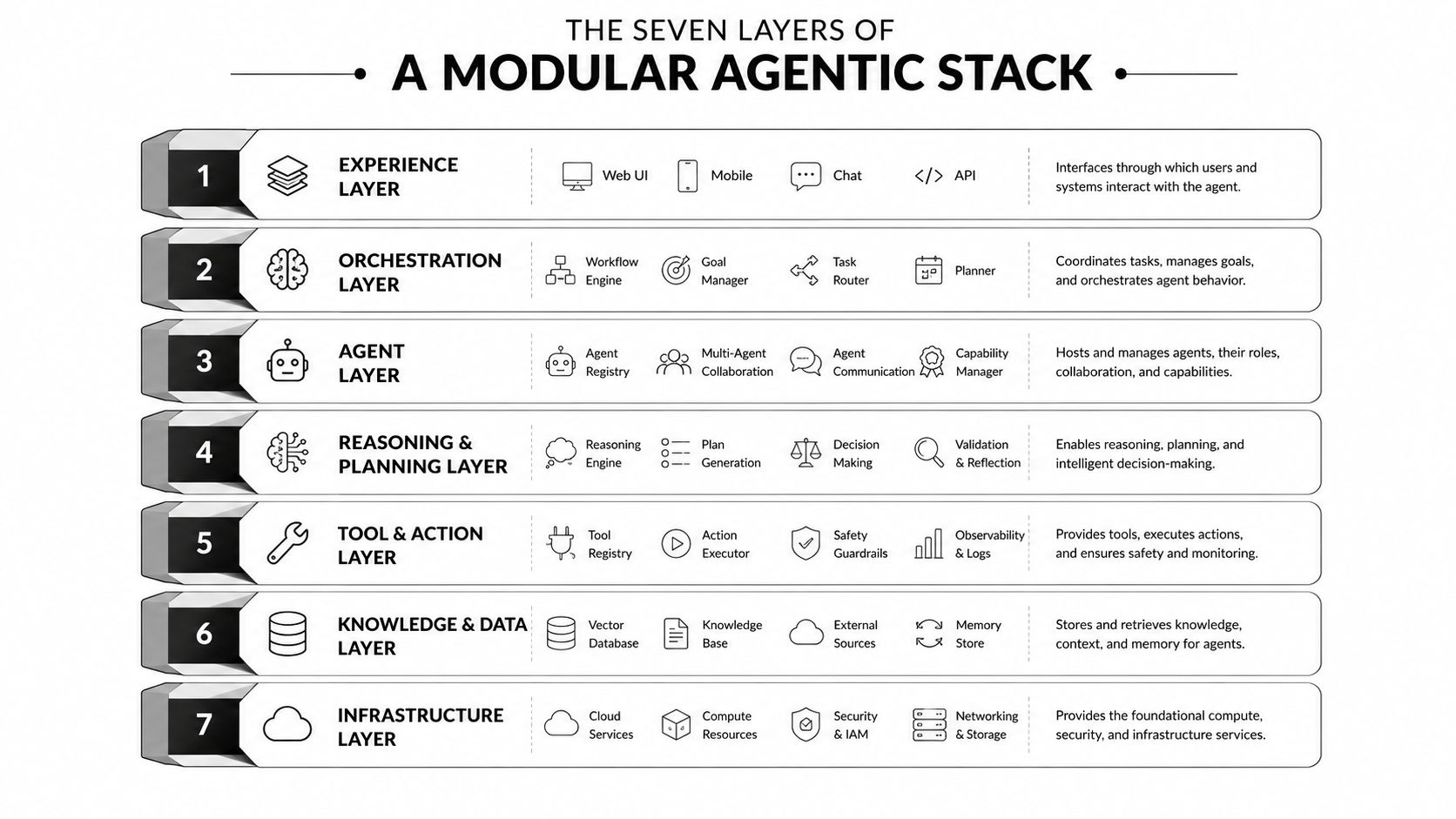
Think of a strong agentic AI platform architecture like a set of interlocking building blocks. You don't pour the whole structure in one piece, because then every change becomes a rebuild. The useful pattern is layered, where each block has a clear job and a clean interface to the next one.
The layers, in the order that matters
- Frontend experience. This is the chat, voice, or embedded workflow where users make requests.
- Agent development environment. Teams define prompts, policies, and task logic here.
- Tools and integrations. The agent reaches into CRM, ticketing, ERP, or knowledge systems here.
- Memory and knowledge. Context lives here, but it has to be governed, not dumped in blindly.
- Design patterns. Routing, planning, approvals, and fallback logic get standardized here.
- Agent runtime. The agent executes work, manages state, and coordinates decisions.
- Model-serving infrastructure. The underlying models, inference stack, and deployment environment sit here.
The payoff of this separation is simple. You can swap the model without rewriting the orchestration. You can change a tool without touching the frontend. You can improve memory policy without rebuilding your integrations. That's how a demo turns into a platform.
A healthy stack lets teams move at different speeds without stepping on each other. Product can change the experience, platform engineering can harden runtime behavior, and security can tighten access control without blocking every release.
Google's reference architecture is valuable because it treats the agent logic as separable from the model runtime and execution environment, which keeps the platform adaptable as models and use cases evolve (Google Cloud reference architecture). The same principle shows up in Yellow.ai's patented approach to agentic AI, where modularity is treated as a design constraint instead of an afterthought (Yellow.ai patented approach).
Why modularity beats a monolith
A monolithic agent is tempting because it's fast to prototype. It's also the fastest way to create coupling you can't see until something breaks. Once your memory, orchestration, and model logic are fused together, one change in business policy can ripple through the whole system. With a modular stack, that same change usually lands in one layer.
That's why the seven-layer view matters. It gives platform owners a way to decide what should be shared across CX and EX, what should be reusable across teams, and what should be unique to a single workflow. If you can't explain those boundaries, the architecture probably isn't ready for production.
Inside the Agent Runtime and Reasoning Loop
A real agent runtime is not a prompt wrapper. It's a lifecycle control plane that decomposes intent, selects tools, tracks state, and decides what to do when the first answer isn't enough. Salesforce's guidance calls out planning, reasoning, memory, tool utilization, state management, and lifecycle control for good reason, because those pieces are where most production issues surface (Salesforce architecture guidance).
Consider a customer disputing a charge. They don't want a summary of policy. They want the dispute opened, the evidence checked, and the outcome explained clearly. The runtime needs to parse intent, identify the account, retrieve transaction history, compare the charge against policy, decide whether it can resolve the issue or must escalate, and preserve the full trail of actions. A wrapper can't do that reliably. A runtime can, if it's designed with explicit control.
What the reasoning loop actually does
The sequence usually looks like this:
- Decompose the request. The agent splits “I need to dispute this charge” into account lookup, transaction verification, policy check, and resolution path.
- Select the tool. It chooses the billing API, the CRM record, or the knowledge base, depending on what's needed next.
- Hold state. It remembers which transaction the customer means, what evidence has already been fetched, and whether a human has joined the case.
- Recover gracefully. If the account lookup fails, the agent shouldn't hallucinate a resolution. It should retry, switch paths, or escalate with context intact.
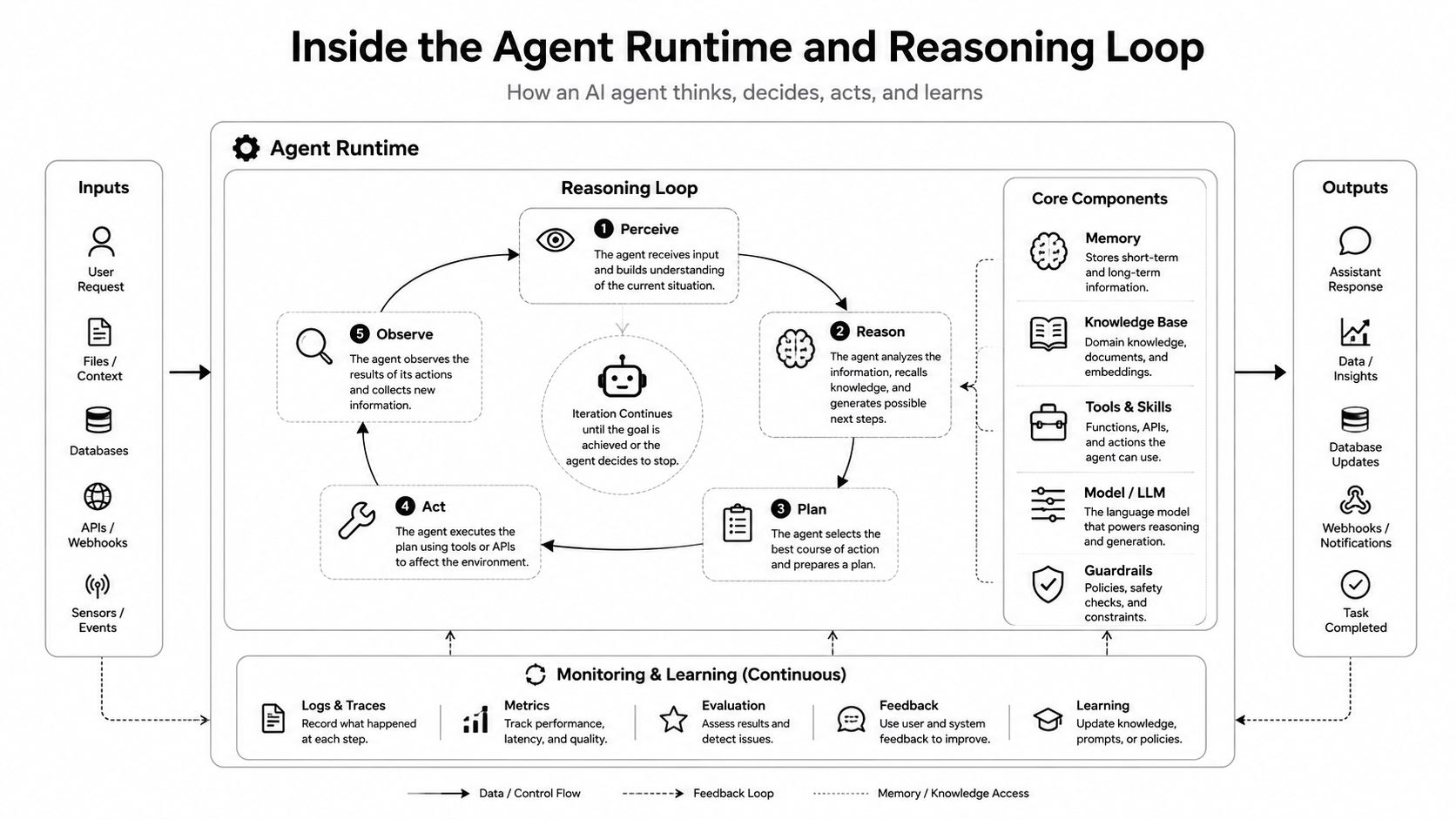
The runtime becomes the place where the platform enforces policy as much as it executes logic. That's why over-permissioned agents are so dangerous. If an agent can call too many tools, see too much data, or continue too long without a stop condition, the failure mode isn't just a bad answer. It's uncontrolled behavior.
Recovery is part of the design
Production teams often underestimate recovery because recovery feels like an edge case. It isn't. It's the path that keeps a customer from being dropped when a tool is slow, a record is missing, or a policy check returns an ambiguous result. The runtime should know when to stop reasoning and when to hand off with a clean summary.
That is the key distinction between a clever agent and a production one. The first can impress in a demo. The second can survive a Monday morning queue.
Single Agent vs Multi-Agent vs Layered Designs
The market has clearly moved toward coordinated systems rather than one giant agent. One industry forecast says 66.4% of the market now focuses on coordinated agent systems, while another reports 53.30% market share for multi-agent architectures in 2025 and a 43.50% CAGR through 2031, which explains why orchestration and composability keep showing up in enterprise roadmaps (Landbase statistics on agentic AI). The architectural lesson is straightforward. Enterprise workloads rarely fail because one agent isn't smart enough. They fail because one agent is asked to do too much.
How the patterns differ
| Architectural Pattern | Best for | Governance complexity | Time-to-value | Operational risk |
|---|---|---|---|---|
| Single agent | Narrow, repetitive flows with few tools | Low at first, then rises quickly | Fastest | Grows fast as scope expands |
| Multi-agent | Broader workflows that need specialized roles | Higher, because coordination has to be controlled | Moderate | Lower than a monolith if boundaries are clear |
| Layered platform | Enterprise CX and EX with shared governance, memory, and integrations | Highest upfront, lowest long-term surprise | Slower to launch, faster to scale | Lowest when control planes are explicit |
Where each one fits
A single agent still makes sense when the task is narrow, the data sources are limited, and the stakes are low. Think simple HR policy lookups or a controlled FAQ flow. The moment you add approvals, multiple systems, or regulated outcomes, a single-agent design starts carrying too much risk in one place.
Multi-agent designs work better when distinct responsibilities need distinct behavior. One agent can gather context, another can draft a response, and a third can validate policy or check formatting. That can be powerful, but only if the handoffs are governed. Without that, you just create more failure points.
Layered platforms are the right answer when CX and EX share infrastructure, but not behavior. That's the common enterprise reality. The platform should centralize identity, observability, memory policies, and routing rules, while allowing individual agents to specialize in a task or channel. Production-safe scaling begins, because the control plane stays tight while the delegated work remains flexible.
Decision rule: if a behavior has compliance implications, keep it centralized. If it only changes the shape of an answer or the order of steps, delegate it to the agent or workflow.
Multi-LLM Orchestration, RAG, and Voice Pipelines
A production platform should assume that one model won't be the right answer for every task. The practical pattern is a model consortium with task-scoped routing, where the platform picks the cheapest capable model for the job instead of forcing every request through the same path. That reduces unnecessary reasoning calls and gives the architecture room to adapt as new models appear.
Routing is a platform capability, not a prompt trick
The value of multi-LLM orchestration comes from control, not novelty. A router can send a quick FAQ to a lightweight model, route a complex policy exception to a stronger one, and fall back to a deterministic path when confidence is too low. That's much safer than betting the entire workflow on a single model and hoping it behaves consistently.
The same logic applies to retrieval. Agentic RAG is not just search plus generation. It's retrieval that's tied to reasoning and action, so the agent can decide what to fetch, how much context to use, and when to stop searching. Yellow.ai's Conversational Knowledge Base and agentic RAG approach fit that pattern, because the agent can use enterprise knowledge without forcing teams to rewrite content for every use case. Yellow.ai also presents its platform as a modular, enterprise-grade agentic system with multi-modal support and 150+ pre-built integrations, which makes it a practical option when a team wants a packaged platform rather than a from-scratch orchestration layer.
Voice and multimodal flows need one pipeline
Voice is where many platforms become clumsy. If automatic speech recognition, the language model, and text-to-speech are split across disconnected services, latency adds up and the experience feels stitched together. Yellow.ai's Nexus Vox is designed as one unified voice system, which is the right direction architecturally because the whole path, from ASR to LLM to TTS, has to behave as a single flow.
For enterprise teams, that matters in contact center, field service, and employee support use cases. Voice isn't an extra channel bolted on after chat. It's a first-class execution path with its own performance and compliance expectations.
A strong platform should also make integration breadth boring. That sounds strange, but it's a compliment. If the platform can connect reliably to CRM, ITSM, HR, and knowledge systems without custom one-off glue for every use case, then your teams spend time designing behavior instead of re-implementing plumbing.
Production Readiness Through Observability and Safe AI
A platform reaches production safety when it becomes more controlled, not more permissive. Many teams reverse that instinct when they first see agent autonomy. They give the agent wider freedom so it can “figure things out,” then spend the next few weeks cleaning up side effects. In enterprise systems, tighter permissions, deterministic fallbacks, and stronger observability usually hold up better.
What safe really means in practice
Safe AI starts with explicit bounds. The agent needs to know which datasets it can access, which actions it can take, and where it must stop. Compliance frameworks like HIPAA, ISO 27001, SOC 2 Type II, and PCI-DSS matter because they force the platform to prove that identity, data handling, and auditability are part of the runtime contract, not separate paperwork.
Practical rule: if you cannot trace the decision, the tool call, and the data access path, you do not have production readiness yet.
Observability has to cover behavior, cost, and failure modes together. If the agent is looping, over-calling tools, or sending too many requests to expensive models, the platform should surface that before the bill or the incident report does. Testing needs to follow the same logic. Yellow.ai's guidance on why AI agent testing needs to be agentic too matters because static test scripts miss dynamic tool loops, state drift, and weak fallback logic.
Governance belongs in the control plane
The stronger pattern is to centralize permissions, audit trails, and sensitive-data handling. PII controls, red-teaming, secure logging, and policy enforcement should not live as ad hoc logic inside each agent. They belong in platform services that every agent inherits. Deterministic fallbacks matter for the same reason. When the model is uncertain, a predictable response is safer than a creative one.
The same control-plane mindset shows up in web scraping for AI agents. Fetch, parse, and decisioning work only when the orchestration layer constrains what can happen next.
This is why mature agentic architecture looks stricter than many teams expect. The more serious the deployment, the more the platform behaves like an operating environment with rules instead of an open-ended brainstorming engine. Teams that design for that reality get farther in production because they can defend the system to security, compliance, and finance at the same time.
Real-World Deployments and Failure Modes
One CX rollout worked cleanly for order status and returns, then stalled as soon as support teams used it for exceptions and escalations. The model was not the problem. The platform had exposed too many tools to the agent, and it had no deterministic fallback when the billing API returned incomplete records. The fix was straightforward in practice. Centralize permissions, narrow the tool surface, and route unresolved cases into a controlled human handoff.
An EX deployment ran into a different failure pattern. A service desk assistant connected to HR, IT, and policy sources kept accumulating stale context in memory. Employees received answers that mixed current policy with older conversations, which added confusion and created extra tickets. The platform needed tighter memory expiry, better relevance filtering, and clearer session boundaries. That is delegation pushed too far. The agent was remembering more than it should have.
The failure modes show up in every industry
BFSI teams see risk when agents can touch too much data or drift outside approved workflows. Healthcare teams run into trouble when retrieval is incomplete and auditability is weak. Retail and logistics teams usually feel the pain as integration drift, tool sprawl, and runaway inference cost.
A useful comparison comes from web scraping for AI agents. Fetch, parse, and validate work only when each step is separated cleanly. Agent platforms fail in the same way when every task sits inside one opaque loop. Debugging turns into guesswork, and the control plane loses visibility into what the agent did.
The recurring architectural mistakes are predictable:
- Tool sprawl: too many integrations exposed before the operating model is defined.
- Runaway inference cost: too many reasoning calls for tasks that should be routed deterministically.
- Brittle prompts: behavior depends on prompt wording instead of stable workflow design.
- Missing fallbacks: the agent has no safe exit when a tool fails or data is incomplete.
- Integration drift: source systems change, but the platform's context and schema assumptions don't.
Each one points back to the same lesson. Centralize the controls, delegate task execution, and make the failure path explicit.
Implementation Checklist and FAQ for Platform Owners
Before you approve a build or compare vendors, check five things. Where does the platform centralize policy? What can each agent delegate on its own? How broad are the integrations, and who maintains them? Can the model layer change without breaking orchestration? How do voice, chat, and multimodal flows stay consistent?
If ROI comes up, don't settle for vague claims about productivity. Ask how the platform measures repeatability, fallback rates, auditability, and cost control across real workflows. That's the difference between a pilot that looks good and a platform that scales.
Quick FAQ
Should centralization always win over delegation? No. Delegate task logic, but centralize identity, permissions, audit, and fallback behavior.
How portable should the model layer be? Very. The orchestration layer should survive model swaps.
Do voice and chat need separate stacks? They need separate behavior, but not separate control planes.
What's the fastest sign of a weak architecture? Agents that work in demos but fail when tools, memory, and governance collide.
If you're evaluating platforms or hardening a rollout, bring these questions into your next architecture review and map them directly to the control plane, runtime, and integrations. For teams that want to see how a modular agentic platform can support CX and EX without losing governance, Yellow.ai is worth a close look.