










The biggest risk in enterprise AI isn't weak model performance. It's unmanaged success. By mid-2025, the average AI-forward organization was already running 15–30 agents across departments, which means many companies no longer have an AI experiment problem. They have an operations problem.
That shift changes the conversation. Once agents spread across customer support, HR, IT, operations, and back-office workflows, monitoring a few bots from a dashboard stops being enough. Leaders need a way to govern identity, permissions, routing, quality, and cost across a mixed workforce of autonomous systems. That's what an agent management system is for. Not as an admin utility, but as a strategic layer for running an autonomous enterprise without losing control.
Table of Contents
- The Rise of the Unmanaged AI Workforce
- What Is an Agent Management System Really
- The Core Capabilities of an Enterprise AMS
- Strategic Use Cases Across the Enterprise
- Architecture and Integration Imperatives
- Measuring Success KPIs and Realizing ROI
- Your Agent Management Implementation Roadmap
The Rise of the Unmanaged AI Workforce
Agent sprawl usually starts with a budgeting decision, not a grand AI strategy. One business unit licenses a customer support agent, another pilots an HR assistant, IT adds triage automation, and operations tests task-specific copilots. Within a few quarters, the enterprise is running a mixed workforce of agents across multiple vendors, models, and data environments without a shared operating model.

At that point, the issue is bigger than visibility. Leadership needs to know which agents can take action, which systems they can touch, how they are performing, and whether their cost is justified by business outcomes. In large enterprises, those answers rarely live in one place. They sit inside separate teams, vendor dashboards, prompt libraries, and workflow tools.
That fragmentation creates three immediate problems.
The first is operational inconsistency. Teams define success differently, tune agents differently, connect different knowledge sources, and review outputs with different levels of rigor. The result is uneven quality across the business.
The second is governance exposure. Agents do not just generate content. They retrieve records, call APIs, trigger workflows, and influence customer or employee decisions. If identity, permissions, and audit controls vary by team or vendor, security risk stops being theoretical.
The third is economic opacity. Enterprises can spend heavily on licenses, model usage, integration work, and human oversight while still struggling to answer a basic question: which agents are reducing cost, increasing throughput, or improving service levels enough to warrant further rollout?
Unmanaged agents rarely fail in one dramatic incident. More often, performance slips, exception handling weakens, duplicate tools spread, and policy drift grows until quality, compliance, or cost reaches the executive agenda.
This is why agent management has become a strategic capability. Enterprises are no longer managing a few isolated bots. They are coordinating a heterogeneous AI workforce that spans business functions, channels, and vendors. The hard part is not deployment. The hard part is orchestration across that estate with common governance, measurable performance standards, and security controls that hold up under scale.
Customer operations make the problem visible fastest because channel handoffs, service quality, and workforce coordination are exposed every day. A practical example appears in Yellow.ai's InteleTravel chat and voice support scaling case study, where the challenge is coordinating service delivery across growing volumes, not merely putting another bot into production.
What Is an Agent Management System Really
An agent management system is easiest to understand as air traffic control for AI agents. Air traffic control doesn't build aircraft and it doesn't fly them. It coordinates movement, enforces rules, manages exceptions, and keeps a complex system operating safely under changing conditions. An enterprise agent management system plays the same role for autonomous software workers.
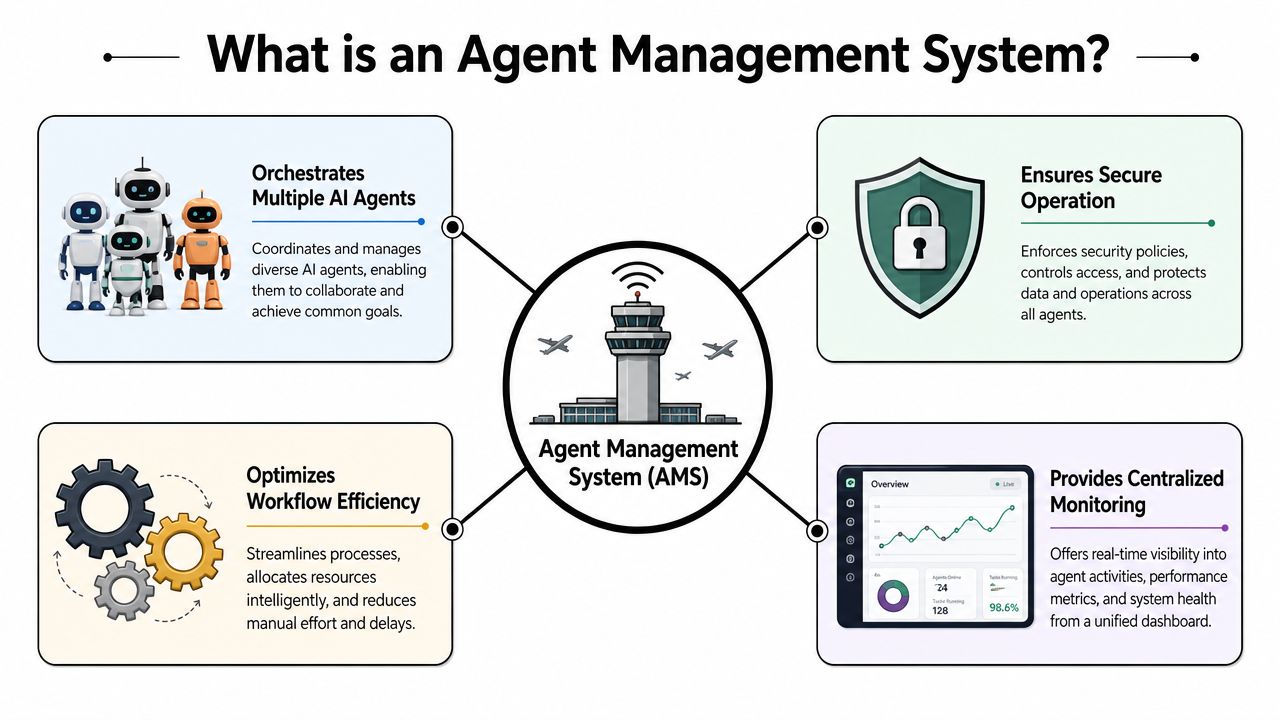
The key architectural idea is separation. According to Microsoft's framing, an agent management system is a control plane for runtime governance that manages agent identity, traffic, tool access, observability, and permissions, separating orchestration from the agent's internal logic. That distinction matters because enterprise teams shouldn't have to hard-code governance into every single agent.
Why the control plane matters
Once you separate management from agent logic, several things become possible.
- Consistent policy enforcement across different teams and use cases
- Centralized observability for model calls, tool usage, and outputs
- Reusable permission models based on least-privilege access
- Operational changes without agent rewrites when routing, thresholds, or controls need to evolve
That's the difference between managing a handful of experiments and running an agent fleet as enterprise infrastructure. The management layer becomes the place where leaders define what agents are allowed to do, how they're monitored, where they can connect, and how exceptions are handled.
A visual overview helps make that concrete:
What an AMS is not
A lot of confusion comes from vendors bundling multiple categories together. An agent management system is not just an agent builder. It's not just a monitoring console. It's not just a security wrapper either.
A builder helps teams create agents. A dashboard helps teams watch them. A true AMS governs runtime behavior across the fleet.
Practical rule: If a platform can only tell you what one agent is doing, it's a tool. If it can govern how many agents operate together, it's becoming an agent management system.
That's also why enterprises should evaluate AMS capabilities separately from model quality. Strong models help. But without a management layer, even capable agents become hard to govern once they span multiple business units, channels, and backend systems.
The Core Capabilities of an Enterprise AMS
An enterprise agent management system earns its place by making a distributed agent estate operable. Not impressive in a demo. Operable in production.
Lifecycle and fleet visibility
The first job is to know what exists. That includes agent discovery, ownership, version tracking, environment control, and deployment status. If teams can't answer who owns an agent, what version is live, which tools it can access, and where it's running, they don't have agent management. They have inventory confusion.
Mature systems also make work visible in business terms. The category has evolved from passive monitoring toward active orchestration with Kanban boards, status panels, and activity feeds, so operators can see what is in progress, stalled, or escalating across workflows rather than only checking logs after something breaks. That matters when agents are cooperating across service, sales, and operational tasks.
Routing quality and operating discipline
The second job is orchestration. Requests shouldn't go to the nearest available agent. They should go to the right agent based on channel, intent, task complexity, permissions, and business rules.
An AMS should support several operating motions:
- Task routing: Send work to the best-fit agent, not a generic fallback.
- Escalation control: Define when the system hands work to another agent or a human.
- State tracking: Preserve context across handoffs, retries, and channel changes.
- Exception handling: Flag failures, loops, and anomalous outputs before they become systemic.
At this point, enterprise buyers often look beyond pure builders and compare ecosystem capabilities. If you want a useful outside reference for what agent orchestration features look like in practice, Orbit AI's overview of AI Agents features is a good checklist-oriented resource.
For teams building and deploying agents directly, platforms such as Yellow.ai's AI agent builder fit into this picture as the creation layer, while the AMS sits above that layer to govern how those agents operate together.
Knowledge policy and improvement loops
The third job is quality management. Not in the abstract. In day-to-day operations.
A strong AMS gives operators one place to audit interactions, review tool calls, trace failures, and decide whether the root issue is prompt design, missing knowledge, poor routing, weak authorization, or a model mismatch. That matters because most production failures aren't caused by one dramatic breakdown. They come from repeated small misses that no team catches early enough.
A useful capability set usually includes:
| Capability | What it solves |
|---|---|
| Audit trails | Explains why an agent produced an output or took an action |
| Shared knowledge controls | Reduces conflicting answers across agents |
| Role-based permissions | Limits tool and data access by business need |
| Feedback workflows | Turns operator reviews into prompt, policy, or knowledge updates |
The practical test is simple. Can your team improve the fleet every week without rebuilding the fleet every week? If the answer is no, the system still behaves like a collection of isolated bots.
Strategic Use Cases Across the Enterprise
The value of an agent management system becomes obvious when you look at how work moves through large organizations. The same governance model supports very different operating environments, but the business problem is similar in each one. Multiple agents are doing meaningful work, and someone has to coordinate them.
Customer experience operations
In customer service, the challenge isn't deploying a chat agent or a voice agent in isolation. It's managing an interconnected service layer. One agent may authenticate, another may answer product questions, another may process a refund request, and a human may take over when policy or emotion requires judgment.
An AMS keeps those handoffs orderly. It applies channel-specific routing, ensures the right tools are available, and preserves the context of the interaction across touchpoints. Without that layer, customers experience the familiar breakdowns: repeated questions, conflicting answers, and service journeys that reset every time the channel changes.
The difference between automation and service orchestration is continuity. Customers notice it immediately when it's missing.
Employee service delivery
In employee experience, the same pattern shows up in a different form. HR, IT, and workplace operations often deploy separate service agents because their systems and processes are different. That makes sense locally, but employees don't think in departmental boundaries. They ask one question that spans benefits, access, payroll, policy, or equipment.
A well-run AMS coordinates those specialist agents so the employee sees one service layer instead of several internal silos. It also helps enterprise teams apply different controls to different kinds of tasks. A simple leave-balance question doesn't need the same review path as a payroll correction or an access provisioning request.
Common EX scenarios where an AMS changes outcomes:
- HR service desks: Policy guidance, document lookups, case routing, and escalation.
- IT support: Triage, categorization, reset workflows, and context-rich handoffs.
- Workplace operations: Facilities requests, onboarding tasks, and status tracking.
BPO and multi-client operations
BPO environments raise the stakes because the operating model is multi-tenant by nature. Teams may run large fleets of agents across clients with different knowledge bases, workflows, compliance rules, and service targets. A dashboard alone won't manage that complexity.
An AMS helps isolate client environments, standardize oversight, and compare performance without collapsing everything into one shared control model. It gives operations leaders a way to enforce policy boundaries while still managing the broader fleet efficiently.
In practice, the system matters most where there are frequent handoffs, strict process requirements, and pressure to prove value client by client. That's why BPOs often become early candidates for more formal agent governance. They feel the cost of inconsistency faster than most in-house teams do.
Architecture and Integration Imperatives
The hard part of agent management isn't inside one platform. It's across many.
Large enterprises already run mixed estates. Some agents are built in open frameworks. Others sit inside enterprise SaaS products. Some use one model provider for reasoning-heavy tasks and another for low-latency interactions. Some live in one cloud, others in another. If your management approach only works inside a single vendor's stack, it won't hold up in production.
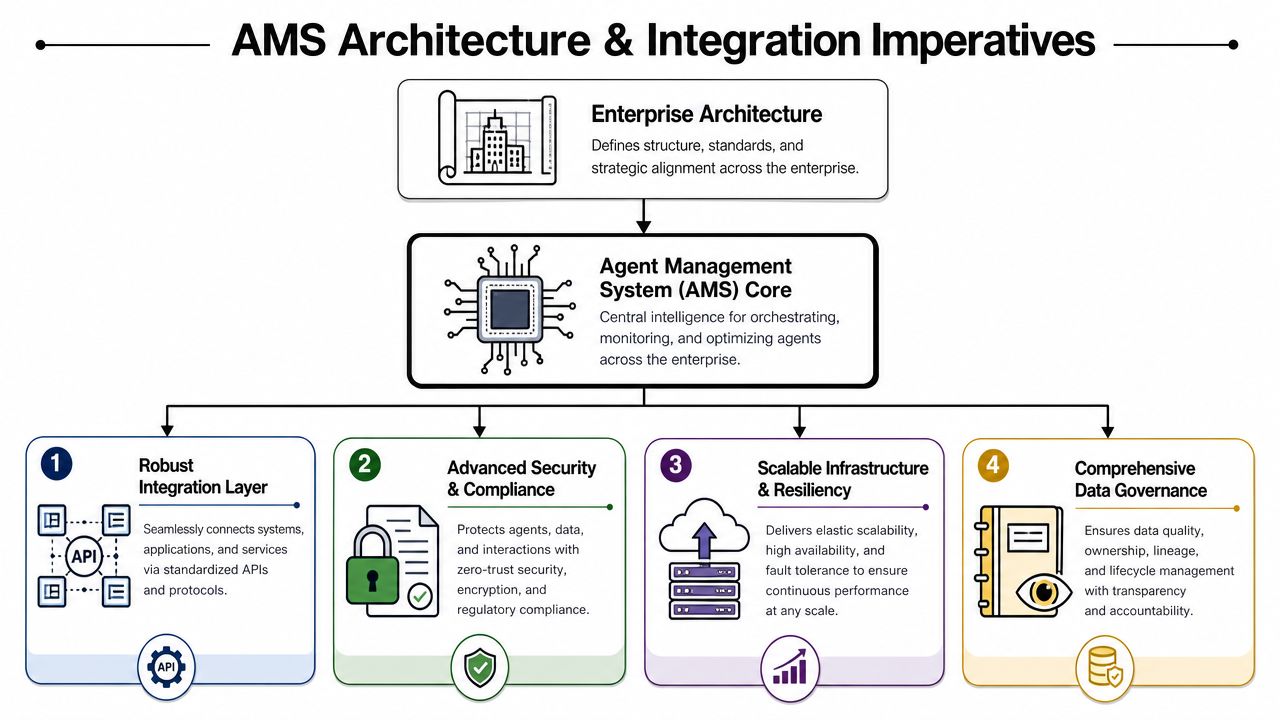
One of the clearest descriptions of the problem comes from industry analysis focused on multi-vendor deployments. It argues that the emerging enterprise problem is governing agent sprawl across multiple vendors, frameworks, and clouds, requiring a central control plane to avoid fragmented telemetry and inconsistent policy enforcement. That's the architectural standard modern AMS platforms need to meet.
Open by design not trapped by stack
The best enterprise pattern is API-first and model-agnostic. The AMS should ingest telemetry from different agent runtimes, route tasks across heterogeneous systems, and enforce common policy without forcing every team into one builder or one model family.
That usually means looking for:
- Interoperable APIs: The system should connect to agents built inside and outside the vendor's own ecosystem.
- Model flexibility: Teams should be able to change underlying models without redesigning governance.
- Portable observability: Logging and tracing should survive tool changes and platform expansion.
- Layered orchestration: The management plane should coordinate agents that perform different roles, not flatten them into one generic runtime.
A closed architecture often feels simpler early on. Later, it becomes expensive. Every exception turns into custom integration work, every new framework becomes a governance blind spot, and every business unit starts asking whether the central platform is helping or constraining them.
Security and governance have to travel with the agent
Security for agents can't depend on where the workflow started. It has to remain intact as tasks move across channels, tools, and systems.
That pushes architecture teams toward runtime controls such as identity, least-privilege authorization, tool whitelisting, auditability, and policy-based intervention. In regulated environments, these controls also need to align with the company's broader compliance posture, including frameworks such as HIPAA or SOC 2 when those obligations apply.
A useful design review asks three questions:
| Architectural question | Why it matters |
|---|---|
| Can we govern agents built by different teams and vendors? | Prevents new silos from replacing old ones |
| Can we trace actions across models, tools, and workflows? | Makes audits and incident reviews possible |
| Can we change models or clouds without losing control? | Reduces lock-in risk over time |
Buy for heterogeneity, not for the neatness of the current stack. Your current stack won't stay current for long.
Measuring Success KPIs and Realizing ROI
The fastest way to weaken an agent management initiative is to measure activity instead of outcomes. Number of agents deployed, number of prompts processed, and number of workflows automated might look useful on a steering committee slide. They don't tell you whether the system is working.
The metrics that actually matter
Industry guidance on agent performance management is far more operational. DataRobot's guidance emphasizes goal accuracy with a recommended production benchmark of 85%+, an immediate warning threshold below 80%, and a hallucination rate below 2% for customer-facing agents, alongside business metrics such as cost per successful outcome, weekly audits, and real-time dashboards showing accuracy, cost burn, compliance alerts, and satisfaction trends. That's a much stronger management model because it ties governance directly to service quality and economics.
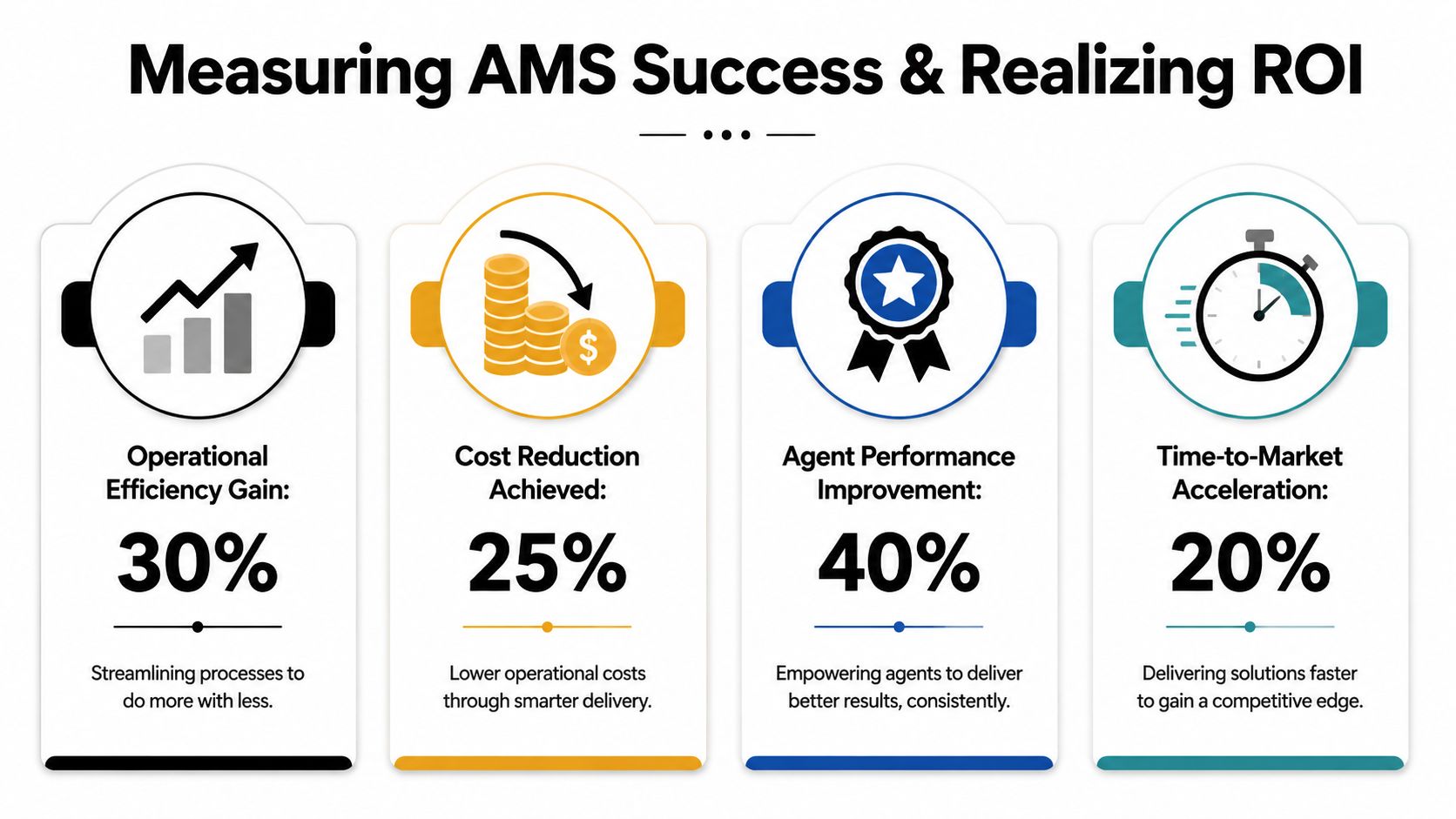
Those metrics work because they force teams to answer practical questions.
- Goal accuracy: Did the agent complete the intended task correctly?
- Hallucination rate: Did it introduce unsupported content into the interaction?
- Cost per successful outcome: What did the company spend to reach a valid resolution?
- Audit cadence: Are operators reviewing behavior frequently enough to catch drift?
For customer service leaders evaluating broader impact, outside references such as Recepta.ai's discussion of AI in customer service can be useful context, but actual proof still comes from your own operating metrics and governance discipline.
If teams need one place to centralize this measurement layer, Yellow.ai's AI analytics is an example of the type of analytics environment organizations use to track resolution quality, operational trends, and optimization opportunities across service automation.
How to connect governance to ROI
ROI from an agent management system doesn't come from owning a control plane. It comes from reducing waste and improving outcomes across the fleet.
There are four places to look.
Lower failure cost
Better routing, permissions, and QA reduce avoidable errors, rework, and escalations.Higher consistency
Shared policy and knowledge controls reduce variance across teams, channels, and geographies.Cleaner compliance operations
Centralized logs and review workflows make regulated oversight easier to manage.Better investment decisions
Leaders can see which agents, workflows, or business units are worth expanding and which should be redesigned or retired.
A useful ROI review doesn't ask whether AI is productive in the abstract. It asks whether the management system improved success rates, lowered the cost of valid outcomes, reduced governance overhead, and helped the business scale reliable automation with less operational friction.
Your Agent Management Implementation Roadmap
Most companies don't need more agent pilots. They need a path from scattered deployments to governed scale.
The urgency is rising. One industry commentary notes that Gartner's 2026 projection says Agent Management Platforms could dominate 80% of successful agent-to-agent interactions and capture over 60% of AI's compounded value by 2030. Treat that as a projection, not a current market fact, but the strategic signal is clear. Enterprises that wait too long to formalize management will spend more time untangling sprawl later.
A practical rollout sequence
Start with discovery, not procurement. Many organizations underestimate how many agents, copilots, embedded assistants, and workflow automations already exist across teams.
A practical sequence looks like this:
Audit the current estate
Identify active agents, owners, channels, models, tool connections, and business purpose. Include unofficial or lightly governed deployments.Define operating policy
Set rules for identity, access, escalation, approval, logging, and review. Decide which use cases need strict controls and which can move faster.Choose a high-value pilot domain
Pick a process with clear ownership, measurable outcomes, and visible operational pain. Customer support, employee service desks, and high-volume back-office workflows are common candidates.Integrate before you expand
Connect telemetry, security controls, and analytics early. If the pilot can't be governed cleanly, scaling it will only multiply the mess.Scale with review discipline
Expand through a regular operating rhythm of audits, policy updates, and performance reviews.
Start with one business-critical lane, but design the control model for the whole highway.
Vendor Evaluation Checklist for Agent Management Systems
| Capability Area | Key Questions to Ask | Vendor A Score | Vendor B Score |
|---|---|---|---|
| Architecture | Does the platform operate as a control plane separate from agent logic? Can it manage a heterogeneous fleet? | ||
| Integration | Does it support API-first integration with existing systems, channels, and external agent frameworks? | ||
| Security | Can it enforce least-privilege access, role-based controls, and runtime policy consistently? | ||
| Observability | Can it trace model calls, tool usage, handoffs, and outputs across workflows? | ||
| Orchestration | Can it route tasks across multiple agents and humans with context preservation? | ||
| Analytics | Does it support business KPIs such as goal accuracy, hallucination control, and cost per successful outcome? | ||
| Governance | Can it support audit workflows, review cadences, version control, and policy enforcement centrally? | ||
| Portability | Can you change models, clouds, or agent frameworks without rebuilding governance? | ||
| Operating model | Does the platform support business ownership as well as IT and security oversight? |
Common mistakes that slow adoption
Some implementation failures are predictable.
- Buying a closed platform first: It solves today's narrow problem and creates tomorrow's lock-in.
- Treating governance as a security-only issue: Operations, finance, CX, and EX teams all need visibility into outcomes.
- Measuring output volume instead of business results: More agent activity isn't the same as better performance.
- Skipping change management: Teams need clarity on ownership, review, escalation, and acceptable use.
- Scaling before instrumentation: If you can't audit and compare agents early, you won't be able to optimize them later.
The objective isn't to install another AI tool. It's to create the operating system for an autonomous enterprise. That's what separates sporadic AI usage from a durable enterprise capability.
Yellow.ai offers an enterprise platform for organizations building and governing autonomous customer and employee service operations across voice, chat, and other channels. If you're evaluating how to bring agent creation, orchestration, analytics, and compliance into a more unified operating model, Yellow.ai is one option to assess alongside your broader architecture, security, and ROI requirements.