














74% of customers now require 24/7 service availability, according to a 2026 industry roundup citing Zendesk, and 57% expect the same response time at night and on weekends as during normal business hours. The same roundup says 88% expect faster responses than they did one year earlier (Ringly's 2026 roundup). That combination changes the executive question. The issue isn't whether your company should be available around the clock. The issue is whether your operating model can resolve issues profitably when the human team is asleep, overloaded, or split across regions.
Most enterprise programs still treat 24 hour customer service as a coverage problem. They add after-hours staff, bolt on a chatbot, and publish extended hours. That approach creates presence, not resolution. Customers don't buy “someone looked at your ticket.” They buy progress, certainty, and continuity.
The better model is hybrid by design. AI handles intake, authentication steps, intent capture, routine actions, and knowledge retrieval. Human teams handle ambiguity, exceptions, policy judgment, and emotionally charged or revenue-critical cases. The architecture matters more than the promise. Enterprises that get this right don't just keep the lights on. They compress response time, protect margin, and reduce the operational drag of overnight demand.
Table of Contents
- Why 24-Hour Customer Service Is Now Table Stakes
- Designing Your Hybrid AI-Human Operating Model
- Building the Technology Stack for Always-On Support
- Defining Success with the Right 24/7 KPIs
- Managing Compliance and Security in an Always-On World
- From Service Availability to Strategic Advantage
Why 24-Hour Customer Service Is Now Table Stakes
Availability now signals reliability
In enterprise CX, availability has become a proxy for trust. Customers don't separate brand promise from service architecture. If they can place an order, access an account, or trigger a workflow at any hour, they assume support should exist on the same clock.
That expectation is now explicit, not implied. A 2026 industry roundup reported that 74% of customers require 24/7 service availability, 57% expect the same response time at night and on weekends, and 88% expect faster responses than they did a year earlier (Ringly's roundup). This isn't a premium-service signal anymore. It's the baseline for being considered reachable.
For a Fortune 500 operator, that changes the investment frame. 24 hour customer service isn't just a support budget decision. It affects digital conversion, account retention, field operations, and partner confidence. If your customer base spans time zones, your support model is part of your market access strategy.
Practical rule: Customers rarely praise a company for being available at 2 a.m. They notice immediately when it isn't.
The competitive risk is more subtle than churn
The cost of weak after-hours support usually appears before cancellation. It shows up as abandoned carts, repeated contacts, unresolved billing issues, stalled onboarding, and preventable escalations into higher-cost channels. In B2B settings, it can also trigger internal friction. Procurement blames service. IT blames tooling. Operations blames staffing.
This is why “office hours plus intake after hours” no longer qualifies as a serious answer. If a customer reaches you overnight and all you do is capture a message for the next shift, you've created delay while implying responsiveness. That gap erodes confidence.
A more accurate executive lens looks like this:
- Brand trust: Can a customer believe your promise of support at any hour?
- Commercial continuity: Can a buyer, subscriber, or partner complete the next needed step without waiting for a region to wake up?
- Operational resilience: Can your service organization absorb spikes outside standard staffing windows without degrading quality?
The strongest programs treat 24 hour customer service as a design discipline. They align channels, workflows, and escalation logic to customer intent. They don't attempt to make every interaction “live” in the same way. They decide where immediacy matters, where automation is sufficient, and where a delayed but context-rich human response is acceptable.
That distinction is where profitability starts.
Designing Your Hybrid AI-Human Operating Model
The operating model should follow demand shape, not fashion. Some enterprises need true global continuity. Others need high-quality after-hours containment with selective human intervention. The mistake is copying a competitor's org chart instead of mapping your own contact mix.
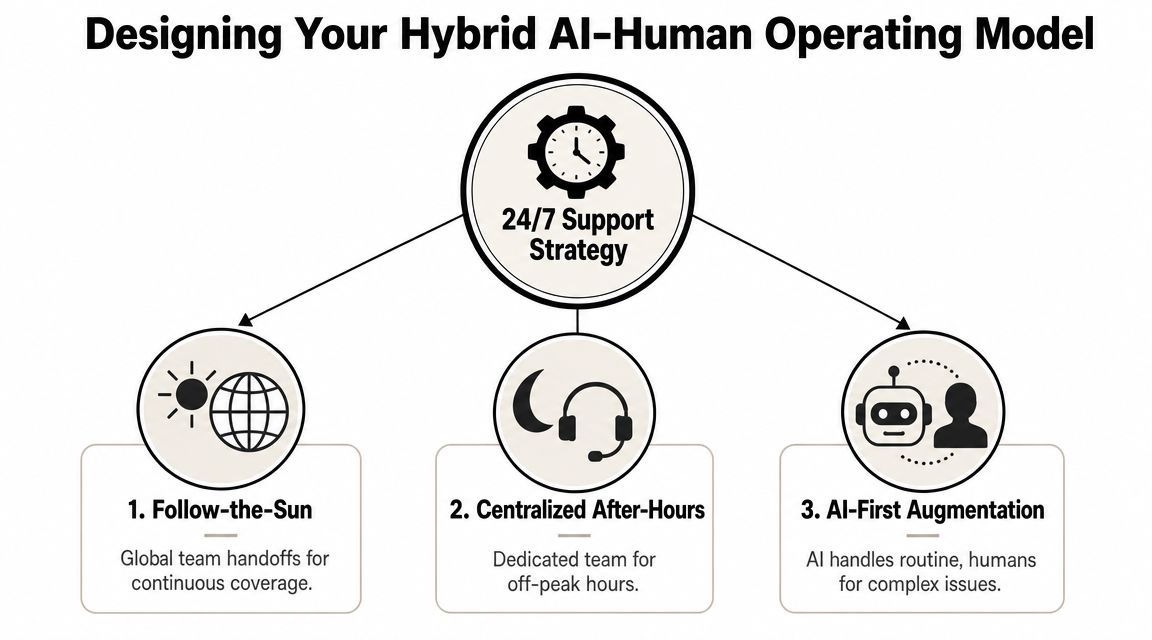
Three viable models
| Model | Best fit | Core strength | Main trade-off |
|---|---|---|---|
| Follow-the-Sun | Global enterprises with meaningful volume across regions | Human continuity across time zones | Requires disciplined handoffs and process standardization |
| Centralized After-Hours | Firms with concentrated demand in one primary market | Easier governance and lower operating complexity | Overnight teams may lack deep product or account context |
| AI-First Augmentation | Enterprises with high repeat volume and clear workflows | Scales routine resolution without linear staffing growth | Success depends on strong knowledge design and escalation logic |
Follow-the-Sun works when you already operate regional service teams. The value isn't just coverage. It's native-language support, local context, and less fatigue. But this model fails fast if teams use different macros, different categorization, and different judgment standards. A handoff without consistent case structure becomes a replay request for the customer.
Centralized After-Hours is often the cleanest step for companies early in their 24/7 maturity. A smaller team handles overnight exceptions, priority queues, and channels where latency matters most. This model benefits from simple routing and predictable management control. It struggles when specialized product or policy issues dominate after-hours volume.
AI-First Augmentation is the most scalable option when demand includes repeatable requests such as order status, password resets, refunds, appointment changes, and basic troubleshooting. It can also front-load triage for complex issues before a human joins. Tools such as agent assist for support workflows are a natural fit for this, because the handoff quality matters as much as the bot response.
Where AI should lead and where humans must take over
The service level architecture should differ by channel and issue type. Industry guidance recommends live chat responses in under 30 to 60 seconds, while priority email or ticket workflows can target under 4 to 6 hours. It also notes that chat abandonment rises above 50% after 90 seconds, which means slow live response creates direct demand loss, not just a poor experience (Feedback Robot guidance on customer service best practices).
That has direct design implications:
- Let AI own high-volume routine work: Status checks, account lookups, password resets, refund initiation, appointment confirmation, and FAQ resolution are good candidates.
- Route humans by trigger, not by availability alone: Escalate when the customer shows frustration, the issue touches revenue, the workflow crosses policy boundaries, or the system confidence is weak.
- Protect chat like a real-time channel: If you can't meet the live expectation, don't disguise a delayed queue as chat. Offer async messaging with a clear SLA instead.
- Use tickets for depth, not overflow dumping: Email and forms work well when the case needs attachments, investigation, or cross-team coordination.
If every inquiry gets a human, costs expand faster than quality. If every inquiry gets automation, exception handling collapses. The hybrid model works only when each side has a defined job.
A practical enterprise rule is simple. AI should resolve what is repeatable, gather context for what is not, and never force the customer to restate known information after escalation. Humans should spend their time where judgment changes the outcome.
Building the Technology Stack for Always-On Support
A 24/7 service promise is only as strong as the stack behind it. If knowledge lives in one system, customer history in another, routing in a third, and voice in a separate silo, after-hours support will feel fragmented no matter how many channels you light up.
The platform is the operating core
The center of the modern stack is an agentic AI layer that can orchestrate conversations across chat, voice, email, and messaging, while pulling the right context from enterprise systems. CIOs should evaluate this layer less like a chatbot and more like a control plane.
The critical capabilities are architectural:
- Omnichannel orchestration: One interaction history across voice, chat, email, and messaging.
- Knowledge retrieval: A conversational knowledge base with tight source control, approvals, and versioning.
- Multi-LLM flexibility: The ability to choose and govern models by use case, latency requirement, and risk tolerance.
- Workflow execution: Secure actions into CRM, ticketing, billing, identity, and order systems.
- Testing and observability: Simulation, regression testing, prompt controls, and failure monitoring.
Platforms differ sharply. Some are front-end chat tools with weak enterprise integration. Others are workflow engines with poor conversational quality. Enterprises need both.
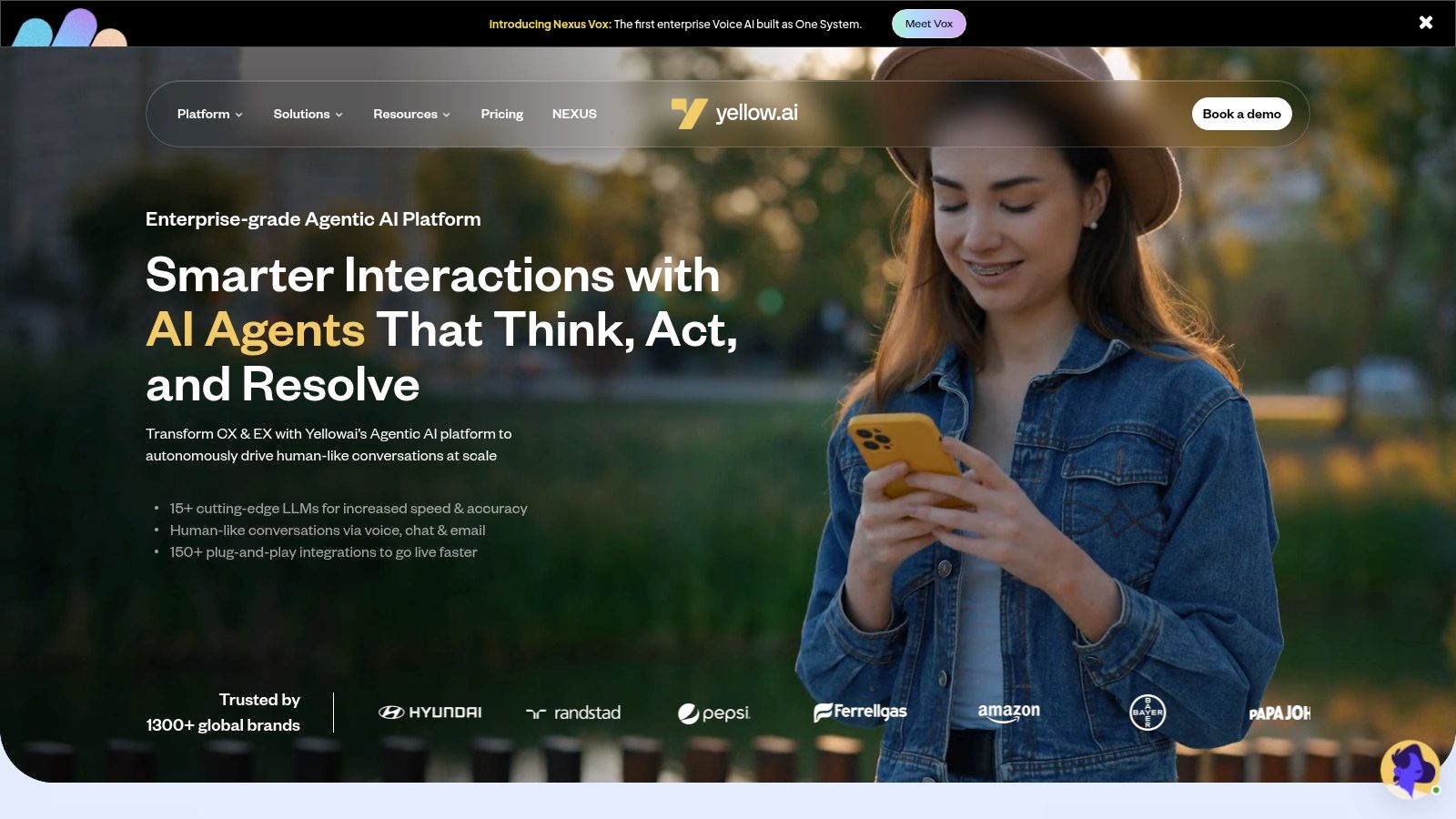
Yellow.ai is one example of a platform built around this model. Its published product positioning describes multi-LLM orchestration, agentic RAG, omnichannel support, copilot capabilities, automated testing, and integrations across tools such as Salesforce, Zendesk, Genesys, Freshdesk, HubSpot, and NICE. Those are the ingredients that matter in always-on operations because they keep AI responses grounded and human escalations informed.
Integrations decide whether the experience feels continuous
Customers don't care which team owns the system boundary. They only notice when context disappears. An overnight bot that can answer FAQs but can't see order status, entitlement, or prior case history creates another queue, not resolution.
A durable stack usually connects these layers:
| Stack layer | What it must do in a 24/7 model |
|---|---|
| CRM and customer data | Surface account status, service tier, recent interactions, and ownership |
| Ticketing and case management | Preserve conversation state, priorities, notes, and escalation path |
| Telephony and digital channels | Keep routing logic consistent across voice and text |
| Knowledge systems | Serve approved answers that update with product and policy changes |
| Identity and security controls | Verify users and limit action permissions by role and risk |
The second media asset is worth watching if you're assessing how AI-led service orchestration works in practice.
What technical leaders should test before rollout
Most failures come from hidden edge cases, not from the demo path. Before launch, teams should pressure-test the stack against real service conditions.
- Cross-channel continuity: Start in chat, escalate to voice, then reopen by email. The transcript and intent should persist.
- Knowledge drift: Product, policy, and pricing changes must flow into the response layer quickly, with approvals.
- Fallback behavior: The AI should disclose limits, capture context, and route cleanly when it can't complete the task.
- Role-aware actions: The system shouldn't offer the same permissions to every user, customer segment, or internal agent.
- Overnight observability: Leaders need morning visibility into unresolved cases, automation failures, and handoff friction.
The stack should reduce dependency on heroics. If the system only works when an experienced supervisor is online, it isn't ready for true 24 hour customer service.
Defining Success with the Right 24/7 KPIs
The usual dashboard for contact centers doesn't tell you whether a hybrid after-hours program is healthy. Average speed to answer, ticket counts, and occupancy still matter, but they don't reveal whether automation is solving the right work, whether human teams are inheriting clean context, or whether customers are getting meaningful progress overnight.
Customer expectations for immediacy are unforgiving. 90% of customers rate an immediate response as essential or very important, and 60% define “immediate” as 10 minutes or less (HelpSquad's 24/7 support guidance). That means KPI design has to separate fast acknowledgment from actual resolution.
Why legacy contact center reporting falls short
A program can look efficient on paper and still frustrate customers. For example, a chatbot can produce rapid first response while bouncing users into a queue. An overnight team can hit SLA while handing unresolved work to the morning shift. A voice channel can answer quickly but force the customer to repeat context.
That's why enterprises need segmented reporting by:
- Time band: business hours, shoulder hours, overnight, weekends
- Channel: chat, voice, email, messaging
- Intent: billing, technical support, order management, access issues, complaints
- Resolution path: AI-only, AI plus human, human-only
Measure the handoff, not just the hello. Fast response with weak transfer discipline creates the illusion of service.
A scorecard that reflects hybrid resolution
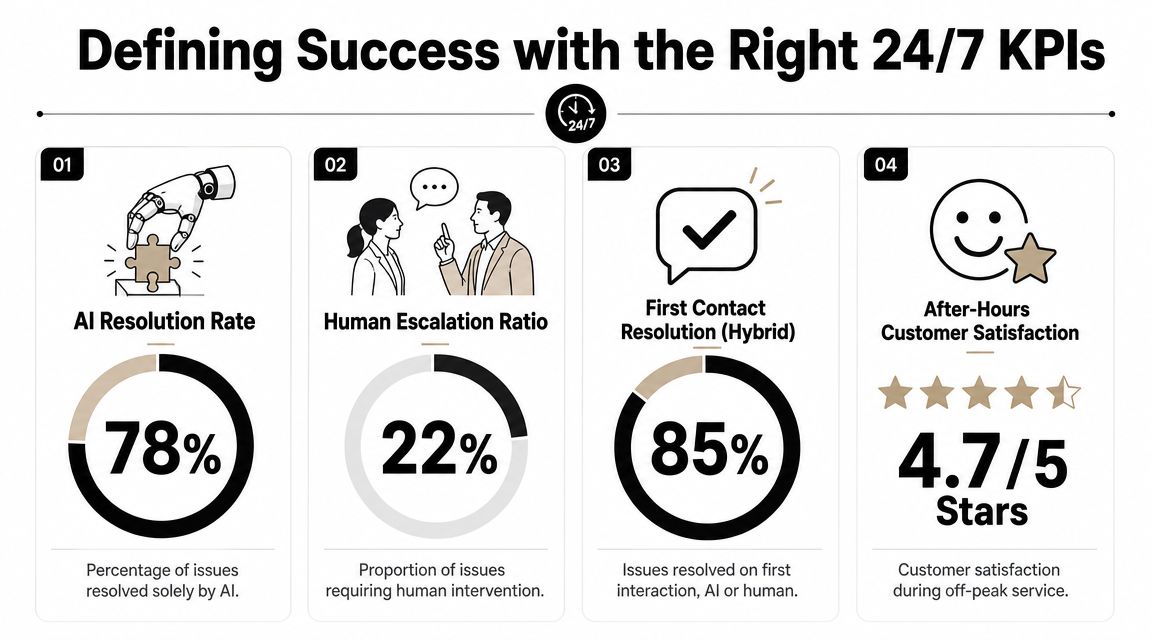
A more useful scorecard combines quality, efficiency, and containment. It should also let leaders inspect whether AI is reducing work or relocating it.
Start with these operational measures:
- First response time by channel: Chat and voice need near-immediate responsiveness. Email can tolerate longer windows, but only if expectation-setting is clear.
- Resolution time by issue type: Track whether overnight workflows move cases forward.
- First contact resolution in the hybrid path: Count AI-only and AI-plus-human journeys that solve the issue without repeat contact.
- Containment or AI resolution rate: Useful only when paired with downstream repeat-contact checks.
- Escalation quality: Measure whether the human received customer intent, transcript, account context, and prior steps.
- After-hours CSAT: Daytime satisfaction can mask overnight failure patterns.
Teams evaluating AI-heavy service models also need analytics that can expose breakdowns in intent mapping, knowledge retrieval, and escalation behavior. Tools for AI support analytics and journey reporting help when they show not just volume, but where automation succeeds, stalls, or hands off poorly.
A simple interpretation model helps executives avoid false positives:
| KPI pattern | What it usually means |
|---|---|
| Fast response, low first contact resolution | The front door is quick, but the system isn't solving enough |
| High containment, high repeat contacts | Automation is closing conversations without closing issues |
| Good overall CSAT, weak after-hours CSAT | Daytime operations are masking overnight service gaps |
| Low escalation volume, high complaint severity | Customers may be trapped in automation or giving up |
Review overnight tickets every morning. Look for repeated intents, failed macros, broken integrations, and handoffs that required the customer to restate the problem. In high-performing environments, optimization happens daily, not as a quarterly reporting exercise.
Managing Compliance and Security in an Always-On World
24 hour customer service expands access, but it also expands exposure. Every always-on channel is a place where personal data can be entered, retrieved, routed, stored, or mishandled. Compliance can't be the legal review at the end of deployment. It has to shape the service design from the first workflow map.

The first compliance risk is misrepresentation
One of the most important distinctions in this space is the difference between true 24/7 live coverage and 24-hour access that only captures requests. Public guidance around hotlines and referral services shows how often “available 24 hours” really means triage and routing rather than immediate resolution (United Way 211 example of 24-hour access models).
For commercial enterprises, that matters beyond marketing language. If your site, IVR, or chatbot suggests live help is available now, but the system only creates a callback ticket, you've introduced operational and reputational risk. In regulated environments, that can become more serious if customers disclose sensitive information expecting immediate handling.
A better standard is explicit service truth:
- State what is live: Which channels are staffed by humans at all hours.
- State what is automated: Which requests can be fully resolved by AI after hours.
- State what is deferred: Which cases will be reviewed on the next business shift, and on what timeline.
Security controls have to survive handoffs
Security design gets harder in hybrid environments because data passes between bots, agents, channels, and systems. The controls need to move with the interaction, not stay trapped in one application.
Key requirements include:
- Identity verification before action: Answering a general question is different from changing account details or exposing protected records.
- Role-based permissions: The AI agent, frontline support, specialist teams, and supervisors shouldn't share the same access envelope.
- Auditability: Every action, retrieval, escalation, and override should be traceable.
- Regional data controls: Cross-border support models need clear rules for data storage, transfer, and access.
- Domain-specific safeguards: Healthcare, financial services, and insurance workflows need specific controls for sensitive records.
If your support operation handles health-related content, adjacent workflows matter too. Teams often focus on chat and voice security but overlook downstream documentation tasks such as ensuring medical transcription compliance, where protected data can be exposed if vendors and processes aren't aligned.
Platforms built for enterprise support should expose their security posture clearly, including certifications, access controls, and governance features. This is the baseline to look for in any review of enterprise-grade AI security controls.
The safest after-hours workflow is the one that limits data exposure before a customer ever reaches a human queue.
From Service Availability to Strategic Advantage
The companies that win with 24 hour customer service don't think of it as a schedule extension. They treat it as an enterprise operating capability. That means designing a model where AI absorbs repeatable work, humans focus on judgment-heavy exceptions, and the technology stack preserves context across every channel and handoff.
The strategic payoff is larger than support availability. A well-built always-on service layer protects revenue after hours, reduces unnecessary labor expansion, and gives customers confidence that the business is responsive when it matters. It also gives CIOs and CX leaders a cleaner foundation for broader automation across service, sales, and employee support.
Three choices determine whether the program becomes an advantage or just another cost center:
Architecture over channel count
Adding more channels doesn't improve service if the underlying workflows are disconnected. Resolution depends on shared context, secure system actions, and disciplined escalation paths.
Resolution over presence
Customers care about outcomes. If your AI can authenticate, retrieve, guide, and complete common tasks, after-hours support becomes useful. If it only greets, deflects, and apologizes, you've built a digital waiting room.
Governance over improvisation
Always-on support creates daily operational drift unless teams govern knowledge, prompts, routing logic, and handoff quality. The enterprises that sustain quality review those controls continuously, especially after overnight volume exposes edge cases.
A CIO evaluating this investment should ask one direct question. At 2 a.m., which customer problems can our company solve, end to end, without introducing unnecessary risk or cost? The honest answer to that question will shape staffing, platform selection, security design, and KPI reporting far better than any generic 24/7 benchmark.
24 hour customer service is no longer the differentiator. Effective, profitable, and trusted 24/7 resolution is.
If you're evaluating how to operationalize hybrid AI-human support at enterprise scale, Yellow.ai is worth reviewing as one option. Its platform is built for autonomous conversations across voice and digital channels, with workflow automation, knowledge integration, analytics, and enterprise security controls that fit always-on service environments.



