














Most enterprises don't have a channel problem. They have a memory problem.
The evidence is hard to ignore. Companies with strong omnichannel strategies retain 89% of customers, compared with 33% for weak strategies, and omnichannel customers spend 10% more online and 30% more in-store according to RethinkCX's summary of omnichannel customer service research. That gap is too large to treat as a tooling preference. It points to a deeper operating model issue. When systems forget what the customer already said, service gets slower, loyalty gets weaker, and revenue leaks out through preventable friction.
That's why omnichannel customer service matters now. Not as a rebrand for multichannel support, and not as a cosmetic layer over disconnected tools. The core work sits underneath the interface. Enterprise leaders need a service fabric that carries identity, context, routing logic, and policy across every touchpoint.
Table of Contents
- Beyond Multichannel Why Omnichannel Is Now Table Stakes
- What True Omnichannel Customer Service Really Means
- The Architectural Blueprint for Omnichannel Success
- Key Technology Components and Required Integrations
- Measuring What Matters With Omnichannel KPIs and Governance
- Common Pitfalls and How to Mitigate Them
- A Phased Roadmap for Enterprise Adoption
Beyond Multichannel Why Omnichannel Is Now Table Stakes
Omnichannel is no longer a channel strategy. It is service infrastructure.
Large enterprises rarely struggle because they offer too few ways to contact support. They struggle because each channel runs on different records, routing rules, and operating assumptions. Voice can verify identity but lacks the digital interaction trail. Email stores case history but misses live order or billing context. Social teams are expected to respond in public at speed, yet many still work outside the same service fabric used by the contact center. The result is familiar to any architect who has inherited a patchwork stack. Customers repeat themselves, agents rekey data, and every handoff creates avoidable cost.
That is why omnichannel has moved from aspiration to baseline expectation. Customers do not evaluate your org chart or your platform boundaries. They judge whether the company remembers them and can continue the work already in progress.
For enterprise leaders, the business case is broader than CX. Omnichannel changes margin, operating complexity, and the pace of service delivery because continuity depends on shared identity, shared context, and shared workflow state across channels. If those foundations are missing, adding another touchpoint just creates another intake queue. Teams then compensate with manual workarounds, including copy-pasting notes, duplicating tickets, and building local process exceptions that are expensive to govern.
Practical rule: If a customer switches channels and your systems open a new trail instead of continuing the existing one, the problem is architectural, not cosmetic.
This is also where the conversation needs to get more concrete. Many guides define omnichannel in customer-facing terms. Enterprise teams need to build the engine behind it: a common interaction model, routing and orchestration that survives channel changes, and governance that keeps every business unit from creating its own version of "customer history."
The operational pressure is showing up fastest in digital channels. Teams responsible for scaling social media support see it early because social volume rises quickly, context is thin, and handoffs into private channels often break unless identity and case state are already unified.
The implications are practical:
- Retention: Customers stay when service interactions continue without resets and repeated verification.
- Revenue: Cross-channel continuity supports purchasing, renewals, and issue resolution without introducing friction at the point of decision.
- Cost: Shared context cuts repeat explanations, duplicate work, and transfer time.
- Operating model: Standard data and workflow definitions let regions, brands, and business units run with more consistency.
The companies that make progress do not start by launching every possible channel. They standardize the journeys that drive the most volume, risk, or revenue, then connect those journeys to a shared customer record and common service logic. That is the shift from fragmented multichannel support to an omnichannel operating model that can hold up at enterprise scale.
What True Omnichannel Customer Service Really Means
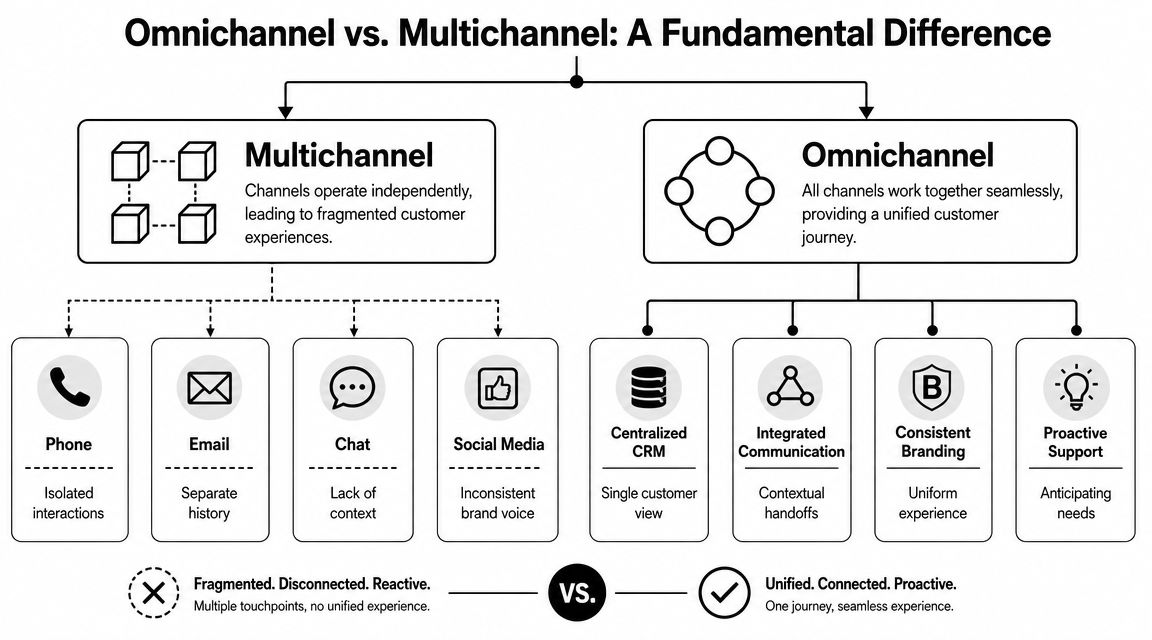
Omnichannel customer service is one conversation carried through many interfaces. Multichannel support is many conversations about the same problem.
That distinction sounds simple, but it changes everything. In a multichannel setup, each touchpoint keeps its own memory. In a true omnichannel model, the system carries forward the customer's identity, prior interactions, current case status, and relevant context no matter where the next message arrives.
The difference is continuity
Think about the customer journey as a single thread rather than a set of tickets. A customer might start in mobile chat, move to email when attachments are needed, then finish on the phone because the issue is urgent. In a real omnichannel design, the handoff is contextual. The next agent sees the transcript, the account record, prior notes, open tasks, and system status without asking the customer to reconstruct the story.
That continuity is now expected. One-third of customers use a mobile device to initiate contact, and 9 in 10 expect a smooth transition if they switch to another channel, according to eDesk's customer service statistics roundup. That expectation is one reason disconnected support models keep failing in modern environments.
A lot of teams feel this pain first in messaging and social channels, where context decays quickly if queues and ownership aren't clear. For leaders dealing with that challenge, this guide on scaling social media support is useful because it focuses on the operational side of high-volume, asynchronous interactions.
Why the old model broke
Historically, multichannel was a reasonable transitional state. Businesses added email, then web forms, then live chat, then messaging, then social, usually as separate projects. Each channel solved a local problem. Very few organizations stopped to ask whether the customer record itself was portable.
The result was predictable:
| Model | What the business sees | What the customer experiences |
|---|---|---|
| Multichannel | More points of contact | Repetition, inconsistent answers, restart costs |
| Omnichannel | Connected service operations | A continuous journey with context preserved |
Omnichannel customer service isn't defined by the number of channels you support. It's defined by whether context survives the switch.
What works is treating channels as presentation layers over a common service core. What doesn't work is adding one more inbox, one more chatbot, or one more routing rule while the underlying records remain fragmented.
The Architectural Blueprint for Omnichannel Success
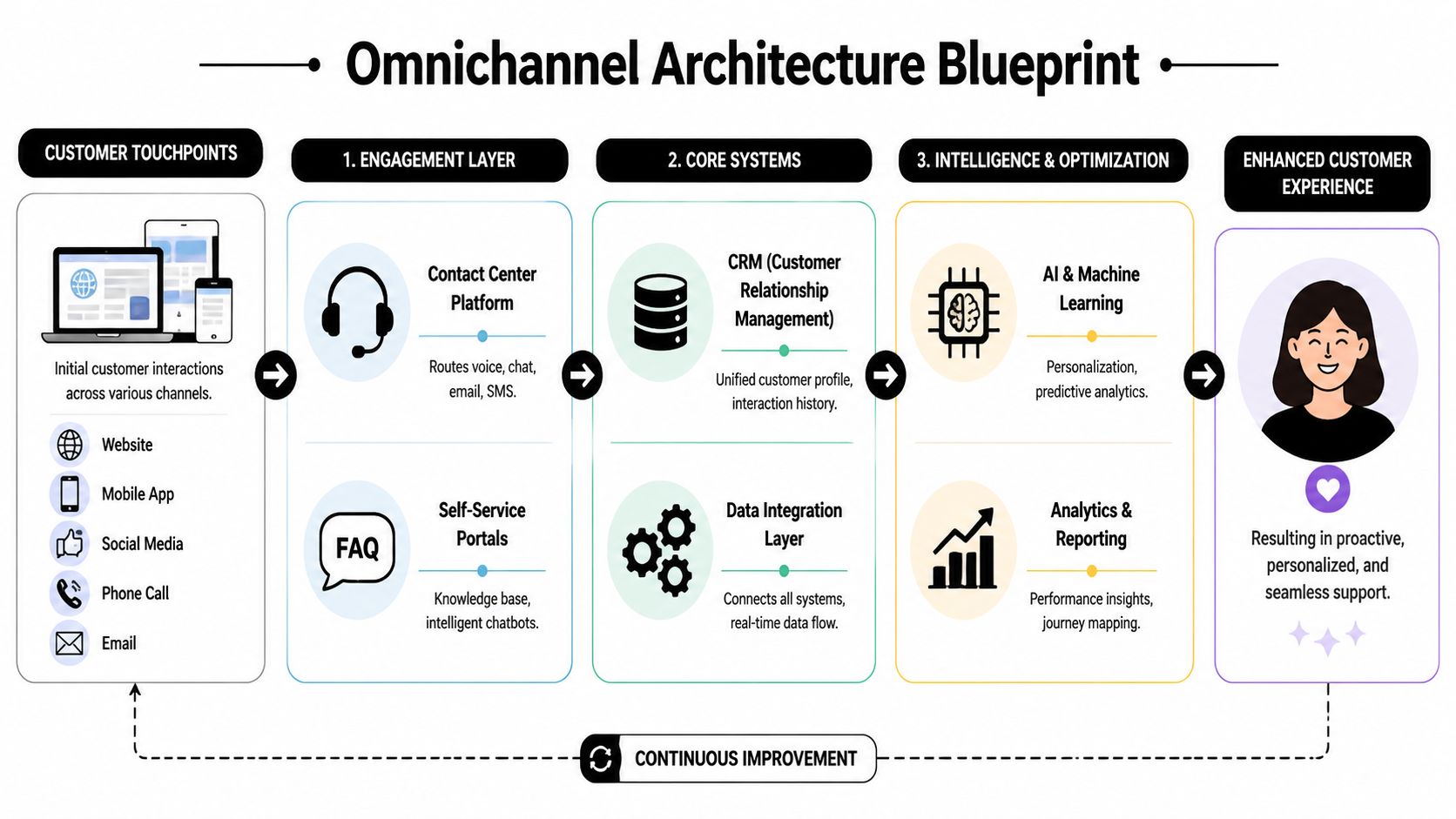
Most omnichannel programs succeed or fail at the data model. If there is no durable customer record underneath the channels, there is no continuity to orchestrate.
A technically strong omnichannel architecture requires a single customer record at the data layer, so conversation threads, ticket status, and interaction notes are accessible across channels in real time, as explained in Kayako's overview of omnichannel customer service. This is the primary technical distinction between omnichannel and parallel multichannel support.
The unified data layer
Start at the bottom, not the front end. The unified data layer is the foundation that binds identity, interactions, entitlements, and operational state into a usable service object.
At minimum, that layer should support:
- Customer identity resolution: Match a person, account, or household across email addresses, phone numbers, device identifiers, and authenticated sessions.
- Conversation persistence: Store transcripts, notes, attachments, and event history in a structure other systems can read.
- Case state management: Keep ticket status, ownership, priority, and next actions visible across channels.
- Business context: Pull in billing, subscription, order, claims, or service status data that changes the handling path.
Many programs cut corners by connecting channels first and postponing the hard identity and schema work. That creates a polished interface sitting on top of weak context.
The orchestration engine
Once the record exists, the next requirement is orchestration. Routing can't rely only on channel and queue. It needs to account for customer value, journey stage, issue type, language, authentication status, prior failures, and open dependencies in adjacent systems.
Salesforce's guidance on omnichannel design emphasizes real-time contextual routing through a unified routing engine that uses CRM and interaction data to direct work to the right queue or specialist, preserving continuity during channel switches and improving resolution when connected systems stay in sync, as described in Salesforce's contact center overview of omnichannel customer service.
That routing layer should make three decisions well:
- Who should handle this interaction now
- What context they need before they respond
- Whether automation, self service, or a human should own the next step
When enterprises evaluate orchestration tooling, the build path matters too. Platforms such as AI agent builder capabilities can be relevant when teams need to design and deploy conversational flows that connect routing, knowledge retrieval, and escalation logic in one system.
The agent experience layer
Agents don't need another dashboard full of tabs. They need a single workspace that assembles the record, recommended actions, knowledge, and collaboration signals in one place.
A usable agent layer usually includes:
| Layer need | What good looks like | What breaks operations |
|---|---|---|
| Unified inbox | One queue across channels with preserved thread history | Separate queues by tool with manual copy-paste |
| Context panel | Account, case, order, billing, and prior contact data in one view | Agents hunting through CRM, ERP, and notes |
| Action layer | Agents can update status, trigger workflows, and collaborate internally | Read-only context with no operational controls |
The architecture is only complete when governance reinforces it. If teams are free to create side records, local macros, and ad hoc escalation paths, the fabric frays quickly.
Key Technology Components and Required Integrations
Enterprise omnichannel customer service doesn't come from one product category. It comes from a stack of coordinated systems with clear roles.

Systems of record and systems of action
The first split to understand is between systems that hold truth and systems that execute service.
Systems of record usually include the CRM, customer master, identity service, order system, billing platform, policy platform, and case repository. These systems answer foundational questions. Who is the customer? What did they buy? What is their current status? What obligations, entitlements, or constraints apply?
Systems of action include the contact center platform, messaging layer, agent desktop, workflow automation, bot framework, and notification engine. These systems run the interaction itself.
If those two groups are loosely connected, agents get stale context and customers get inconsistent answers. If they are tightly integrated, the interaction layer becomes intelligent enough to route, personalize, authenticate, and resolve without unnecessary switching.
A practical stack often includes these categories:
- CRM and customer master: The anchor for account relationships and service history.
- CCaaS or contact center platform: Voice, chat, email, messaging, and queue management.
- Knowledge base: Structured content for customers, agents, and automation.
- Workflow and orchestration tools: Case creation, approvals, escalations, and task handoffs.
- Integration platform: The connective tissue for data movement and event sync.
Where automation fits
Automation should sit inside the operating model, not beside it. A bot that can't read the same case state as a human agent creates a parallel support path. That's one of the fastest ways to produce duplicate work and confusing handoffs.
What works better is a shared service flow where automation can:
- Classify intent: Detect what the customer is trying to do.
- Fetch context: Pull account, order, or service data before asking redundant questions.
- Resolve simple tasks: Handle status checks, routine changes, or common policy questions.
- Escalate cleanly: Pass the transcript, metadata, and next-best action into the human queue.
This is also where integration depth matters more than polished demos. A platform with broad connectors can reduce implementation friction if those connectors support real operational sync rather than shallow notification hooks. Teams evaluating options often look at catalogs such as enterprise integration options for CX systems to understand what can connect to CRM, helpdesk, telephony, and workflow layers.
After the platform view, the implementation view matters just as much. This walkthrough is a useful reference point:
Why integration depth matters more than feature breadth
In enterprise programs, feature lists distract buyers. The harder questions are operational.
Can the routing layer read live account state? Can the knowledge system expose approved content to both bots and agents? Can the conversation transcript persist across voice and digital channels? Can internal notes stay separate from customer-visible messages? Can identity and consent travel with the interaction?
Buy for joined-up workflows, not for isolated features. Omnichannel breaks when one step in the chain has to be done by memory.
A smaller, well-integrated stack will outperform a broader but fragmented environment almost every time.
Measuring What Matters With Omnichannel KPIs and Governance
Most support dashboards still measure channel speed better than customer continuity. That's a problem, because the handoff is where omnichannel customer service either proves its value or exposes its weakness.
Public guidance often says to monitor feedback and watch service performance, but it rarely defines a rigorous way to verify whether context transfer between channels worked. That measurement gap is called out clearly in Global Response's discussion of omnichannel customer service. The gap matters because businesses can add channels and still make the experience worse if the handoff fails.
Measure continuity not just speed
A mature KPI set should cross channel boundaries. If one team optimizes call handling, another optimizes chat responsiveness, and a third manages email backlog, nobody is accountable for the total journey.
A more useful scorecard includes measures like these:
| KPI area | What to look for | Why it matters |
|---|---|---|
| Cross-channel resolution | Whether the issue was resolved without forcing a restart after a channel switch | Captures journey success rather than channel closure |
| Customer effort | How much work the customer had to do to get help | Repetition is usually a design failure |
| Context transfer quality | Whether the next agent or bot received the right history and state | Measures handoff integrity directly |
| Repeat issue containment | Whether the same issue reopens in another channel | Exposes false resolution and fragmented ownership |
For leaders refining the metric model itself, insights from Querio on KPIs are useful because they reinforce the idea that a KPI only matters if it changes decisions and operational behavior.
A practical governance move is to instrument the handoff itself. Record whether the receiving agent had prior transcript visibility, whether the customer had to restate core details, and whether the case object remained the same through the transition. Those fields create an auditable continuity layer.
Governance decides whether metrics change behavior
Metrics alone won't fix fragmented service. Someone has to own the horizontal journey across support, operations, digital, and IT.
That governance model usually needs:
- Journey ownership: A named leader for each critical service journey, not just each channel.
- Data stewardship: Clear rules for identity matching, note quality, tagging, and case state.
- Review cadence: Regular operational reviews that look at handoff failures, not just queue volumes.
- Shared analytics tooling: One reporting layer, often supported by platforms such as AI analytics for conversational operations, so teams can inspect behavior across automation and human handling.
If every channel has a manager but no journey has an owner, continuity will always be accidental.
Common Pitfalls and How to Mitigate Them
The most common omnichannel failures are rarely caused by lack of ambition. They're caused by bad sequencing and false assumptions.
More channels can make service worse
A common strategic error is assuming success means adding more connected channels. A more grounded approach is to use customer behavior data to identify which channels people prefer for specific journeys, because more channels aren't automatically better if they increase complexity and routing errors, as noted in Talkdesk's perspective on omnichannel customer service.
That failure pattern shows up in predictable ways:
- Channel sprawl: Teams launch WhatsApp, web chat, SMS, and social DMs before stabilizing routing and ownership.
- Inconsistent support models: Some channels are staffed live, others asynchronously, with no common service policy.
- Queue confusion: Cases bounce between specialists because the taxonomy doesn't map to real customer intents.
The fix is selective expansion. Start with the journeys that matter most and the channels customers already use for those journeys. Then prove continuity before adding more touchpoints.
Technical debt shows up in the handoff
A second failure pattern is shallow integration. The interface looks unified, but each channel still writes to a different record or syncs on delay. That creates the worst version of omnichannel: customers expect continuity, then discover the system only simulates it.
Mitigate this with explicit architecture controls:
| Pitfall | Mitigation |
|---|---|
| Duplicate customer profiles | Establish identity resolution rules and a governed master record |
| Conflicting case states | Define one case object and one source of status truth |
| Routing drift | Centralize rules and retire channel-specific exceptions over time |
Change management is usually underestimated
Even strong platforms fail when agents, supervisors, and operations teams don't change how they work. Omnichannel customer service alters queue ownership, escalation rules, note discipline, and training design. It asks frontline teams to trust shared context instead of rebuilding the case from scratch.
That requires deliberate enablement:
- Train for journey handling: Teach agents how to pick up an in-flight interaction, not just how to respond in their primary channel.
- Standardize internal notes: Poor notes corrupt downstream handoffs.
- Align incentives: If teams are rewarded only for local speed, they'll push work away instead of resolving it.
What works is treating omnichannel as an operating model transformation with architecture, workflow, and governance moving together. What doesn't work is calling it done when the inboxes are connected.
A Phased Roadmap for Enterprise Adoption
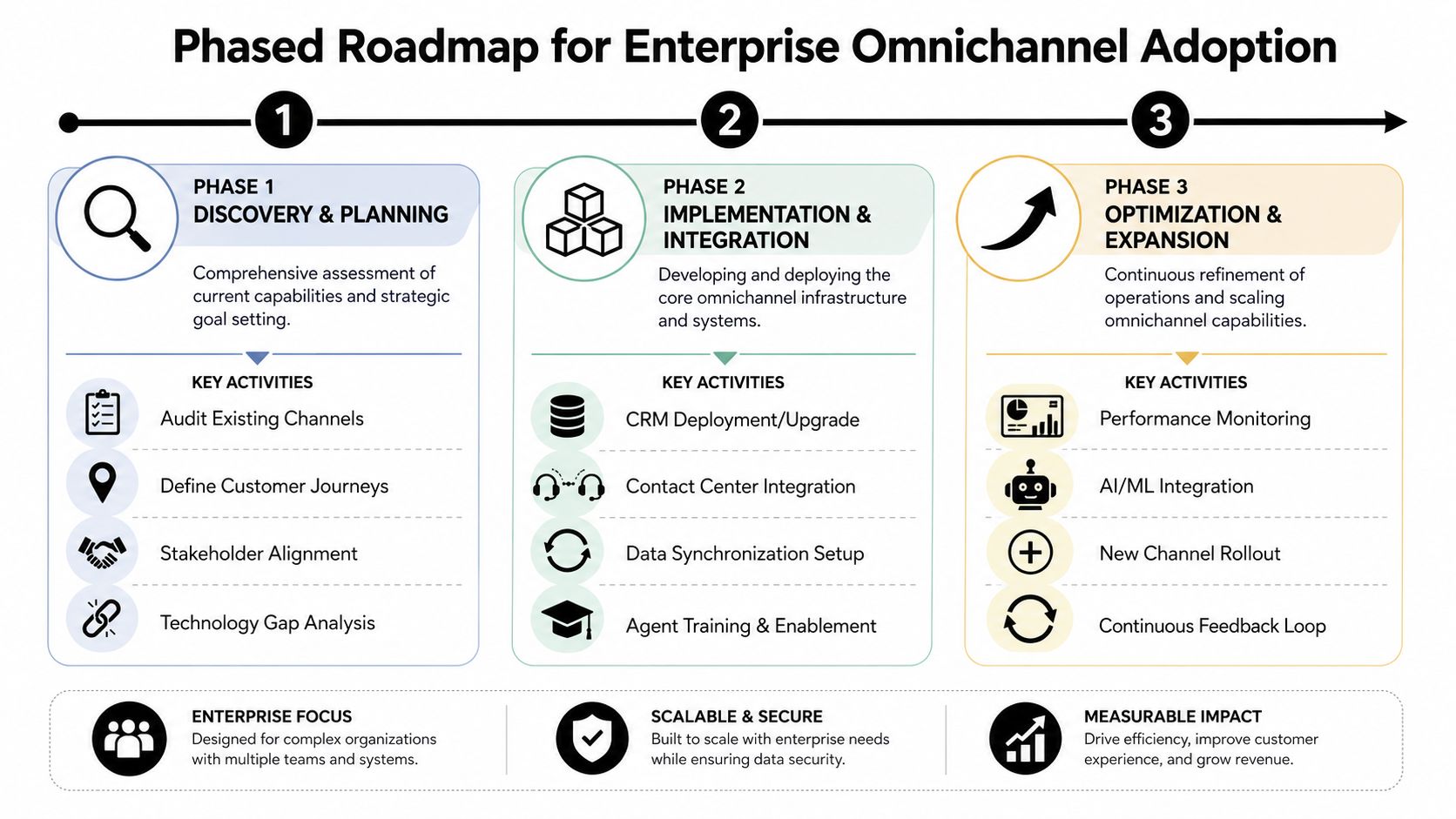
Big-bang omnichannel programs usually collapse under integration complexity. The practical path is phased, with each stage reducing uncertainty before the next one adds scope.
Phase 1 discovery and planning
Start with an audit, not a vendor demo. Map the service journeys that generate the most friction, escalation, and repeat contact. For each journey, identify the channels involved, the systems touched, the handoff points, and the places where context gets lost.
This phase should produce a short list of decisions:
- Which journeys matter first
- Which systems hold identity and case truth
- Which channels deserve integration now
- Which policies need standardization before rollout
Keep the scope tight. The goal is architectural clarity, not enterprise-wide launch theater.
Phase 2 implementation and pilot
The pilot should connect a small number of core channels around one shared customer and case model. In many enterprises, that means choosing the combination that carries the highest support load and the most painful handoffs, then giving agents a unified view and a governed routing model.
A good pilot usually includes:
- One identity model that reconciles customer records
- One case object that survives channel changes
- One routing layer with explicit escalation logic
- One agent workspace for the selected journeys
Use the pilot to expose real issues. Data quality defects, note discipline problems, taxonomy gaps, and routing exceptions are easier to fix at this stage than after broad rollout.
Start where continuity matters most, not where implementation looks easiest.
Phase 3 optimization and expansion
Scale only after the core journey works. Expansion should follow evidence from pilot operations, not channel fashion. Add automation where the data and case state are mature enough to support accurate routing, summaries, and assistive responses. Add new channels only when the same continuity standards can be maintained.
The optimization phase should focus on three things:
- Refining handoffs: Reduce customer effort during transitions between automation and human support.
- Improving knowledge quality: Keep agent guidance and customer-facing content aligned.
- Strengthening governance: Review handoff failures, taxonomy drift, and journey ownership regularly.
Enterprise programs become durable not when they support every channel, but when the underlying engine keeps context intact as complexity rises.
Yellow.ai can fit into this model when an enterprise needs one platform for omnichannel orchestration across voice, chat, email, images, and video, along with agent building, analytics, and integrations into systems such as CRM, contact center, and helpdesk tools. For teams modernizing fragmented service operations, the practical question isn't whether to add another channel. It's whether the underlying engine can preserve memory, route intelligently, and let customers move without starting over.



