













You're in a noisy park, your dog is halfway across the grass, and your voice keeps disappearing into conversations, bicycles, and wind. That's the exact moment some might wonder if a dog whistle offers a magic shortcut. It isn't. It's a simple communication tool built on a very specific piece of sound science, and it only works well when the dog has been taught what the sound means.
A whistle can feel mysterious because you may not hear much, or anything at all, while your dog responds immediately. That gap between human hearing and canine hearing is the whole trick. It's also why whistles can be useful for recall, distance work, and quiet, consistent cues, especially when speech gets lost in the background noise.
This guide keeps the science and the training side by side, because the two are inseparable. If you want a broader view of how voice systems can translate signals reliably, Yellow.ai's voice automation overview is a useful companion reference for thinking about consistent cue delivery in noisy environments.
Table of Contents
- Introduction Beyond Human Hearing
- The Science of Sound and Hearing
- How a Whistle Creates Ultrasonic Sound
- Practical Applications in Dog Training
- Choosing and Using a Whistle Correctly
- Common Myths and Ethical Considerations
Introduction Beyond Human Hearing
A dog whistle looks small enough to be forgettable, but it solves a real problem, which is getting a dog's attention when ordinary speech isn't reliable. In a busy park, on a trail, or near traffic, a spoken cue can get buried under background noise. A whistle gives you a sharper signal, one that's less dependent on how loud you are or how calm the environment feels.
That's why people often ask how do dog whistles work in the first place. The answer starts with sound frequency, then moves into canine hearing, then into training. The whistle itself doesn't command anything on its own, it only becomes meaningful after a dog learns to connect the sound with a behavior and a consequence.
Why the whistle feels “silent” to people
To humans, the whistle may seem nearly silent because it sits beyond much of our hearing range. To dogs, the same sound can be clear and attention grabbing. That difference creates the impression that the device is somehow sending a secret message, when it's really just using a frequency band that dogs can detect more easily than we can.
Practical rule: if a whistle works, it's because the dog learned it, not because the whistle has special authority.
The useful part is consistency. A whistle doesn't get tired, hoarse, distracted, or emotional. That matters when you're teaching a dog a recall cue or a stop signal and you want the sound to stay the same every time.
For a quick visual overview of the hearing gap, the next section includes a comparison chart that makes the frequency difference easier to picture.
The Science of Sound and Hearing
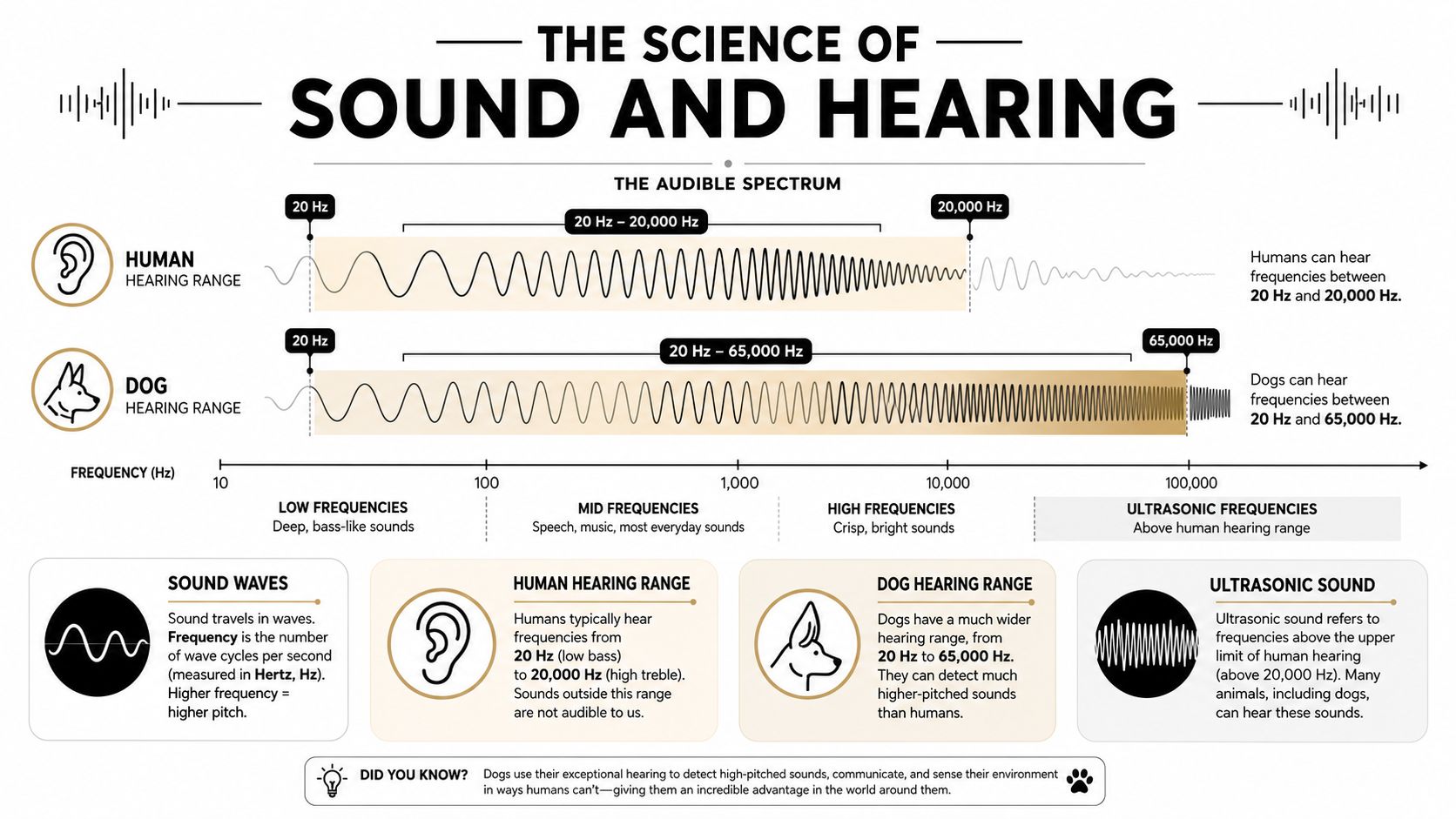
Sound is vibration moving through air. Frequency describes how fast that vibration repeats, and that idea becomes easier to picture if you compare it to water ripples. Wide, slow ripples arrive less often, while tight ripples pass in quick succession. In sound, those faster vibrations create a higher pitch.
Hertz, or Hz, is the unit used to measure frequency. It counts cycles per second. A low note has fewer cycles, a high note has more. That is why a whistle can seem faint, sharp, or almost absent to you while still standing out clearly to a dog. The whistle is not breaking physics, it is producing sound in a range many humans do not hear well.
Human hearing versus dog hearing
Standard references place dog whistle sound in the roughly 16,000 to 45,000 Hz band, while humans are typically described as hearing up to about 20,000 Hz. Some training whistles operate in the upper 20 kHz to low 30 kHz range, and many commercial whistles are described around 23 to 54 kHz dog whistle frequency ranges. That puts the whistle's sound above the upper edge of much of human hearing, but still within the range dogs can detect.
Dogs are often described as hearing much higher frequencies than people. The American Kennel Club notes that whistle cues matter because they are taught, not because the sound is magical AKC whistle training guidance. The practical point is easier to understand than the biology behind it. Dogs can detect sounds that people either miss or barely notice, which is why a whistle can cut through a noisy yard, a park, or a trail more reliably than spoken words.
A whistle seems “silent” because it is tuned for an audience you are not part of.
That is what ultrasonic means in this context, sound above the normal human hearing range. The term gets used loosely in product listings, but the core idea is simple. The whistle sends out a signal in a band where your dog is more likely to notice it, especially when the environment is noisy.
Consistency matters as much as frequency. A spoken command changes with your mood, volume, and the environment. A whistle stays the same if you blow it the same way, which is why it can be easier for a dog to recognize during recall work and other cue-based training. That same need for standardized signals shows up in other voice systems too, including Yellow.ai's voice bot platform, where consistent patterns help recognition in noisy interactions.
How a Whistle Creates Ultrasonic Sound
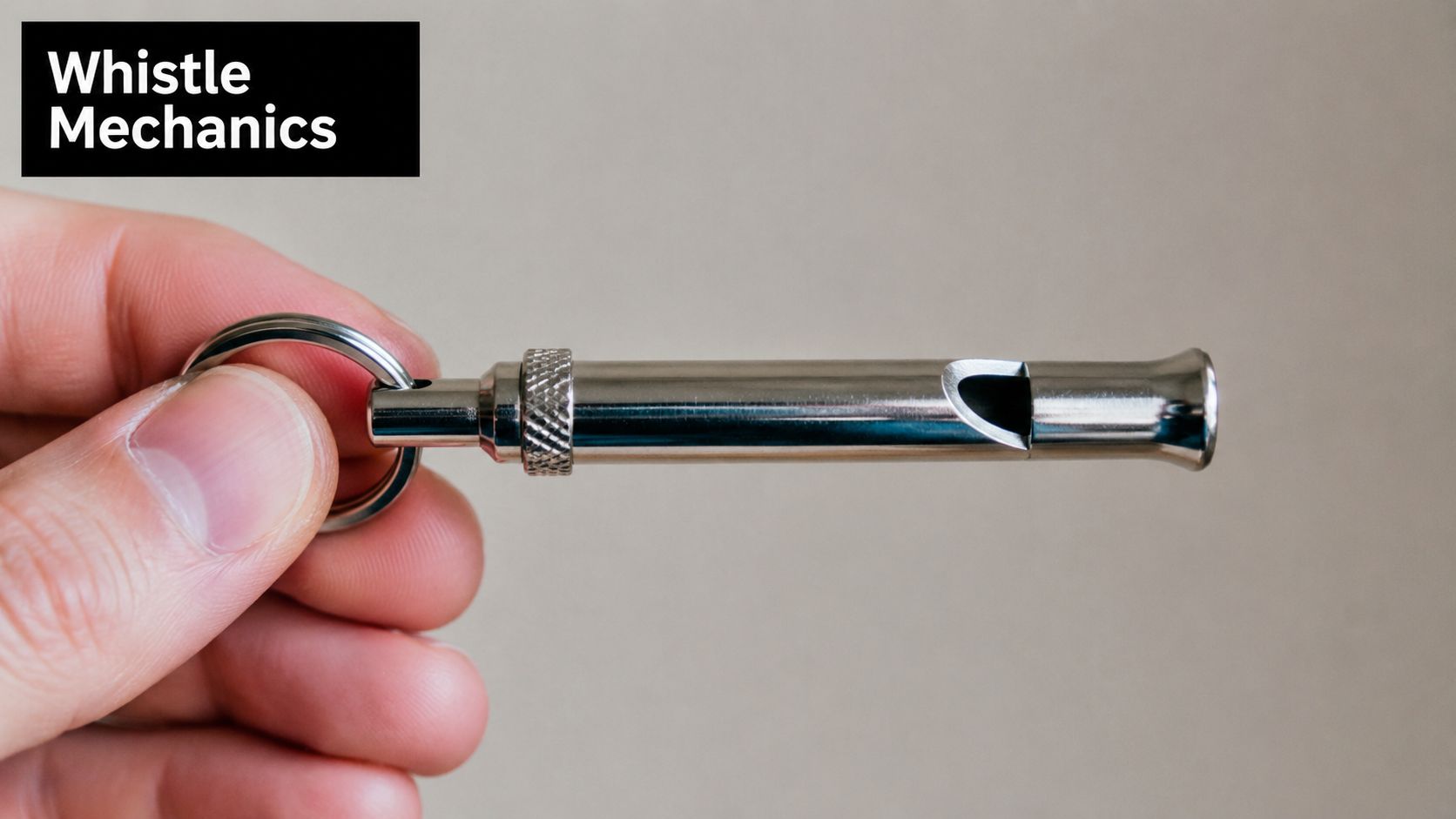
A dog whistle works because air is pushed through a small opening or chamber, and that airflow makes the whistle vibrate at a particular resonant frequency. The whistle's shape sets the pitch, much like the length and size of a flute tube affect the notes it can produce. A narrower, more precisely built chamber can produce very high frequencies that sit above what most humans hear clearly.
That is why these whistles are often called “silent.” They are not silent at all. They are pitched in a range that people commonly miss. The sound still exists, and dogs can still hear it, which is why the device can be useful even when the handler hears almost nothing. The National Animal Health Foundation describes dog whistles as producing ultrasonic sound in the 16,000 to 45,000 Hz range dog whistle physics overview. The whistle does not create a command, it creates a repeatable sound pattern.
Galton-style whistles and everyday whistles
Dog whistle history is often linked to “Galton's whistle”, an early name tied to ultrasonic sound devices used in animal training and hearing research. That matters because it shows the idea is old and practical, not mysterious. For a dog owner, the useful takeaway is simple. A whistle gives you a signal that can be heard more reliably by a dog than by a person, especially when background noise makes spoken cues harder to catch.
A standard sports whistle works differently. It is built to be heard by people, so its pitch stays in the everyday hearing range. A dog whistle is designed to push the sound higher. Some versions are adjustable, which lets the handler fine-tune the pitch, while fixed whistles rely on one consistent output. The adjustable model offers more control. The fixed model offers simplicity.
Consistency matters more than style. If the whistle changes too much from one use to the next, the dog hears a less reliable cue. If the sound stays stable, the dog gets a cleaner signal to learn from.
Training advice also matters here. Many guides recommend starting at low intensity and close range, then slowly increasing distance and volume as the dog learns to respond step-by-step whistle conditioning. That gradual build helps the dog link the sound to the outcome without confusion. It also protects the training relationship, because a whistle that is too loud, too close, or too frequent can become noise instead of a clear cue.
Practical Applications in Dog Training
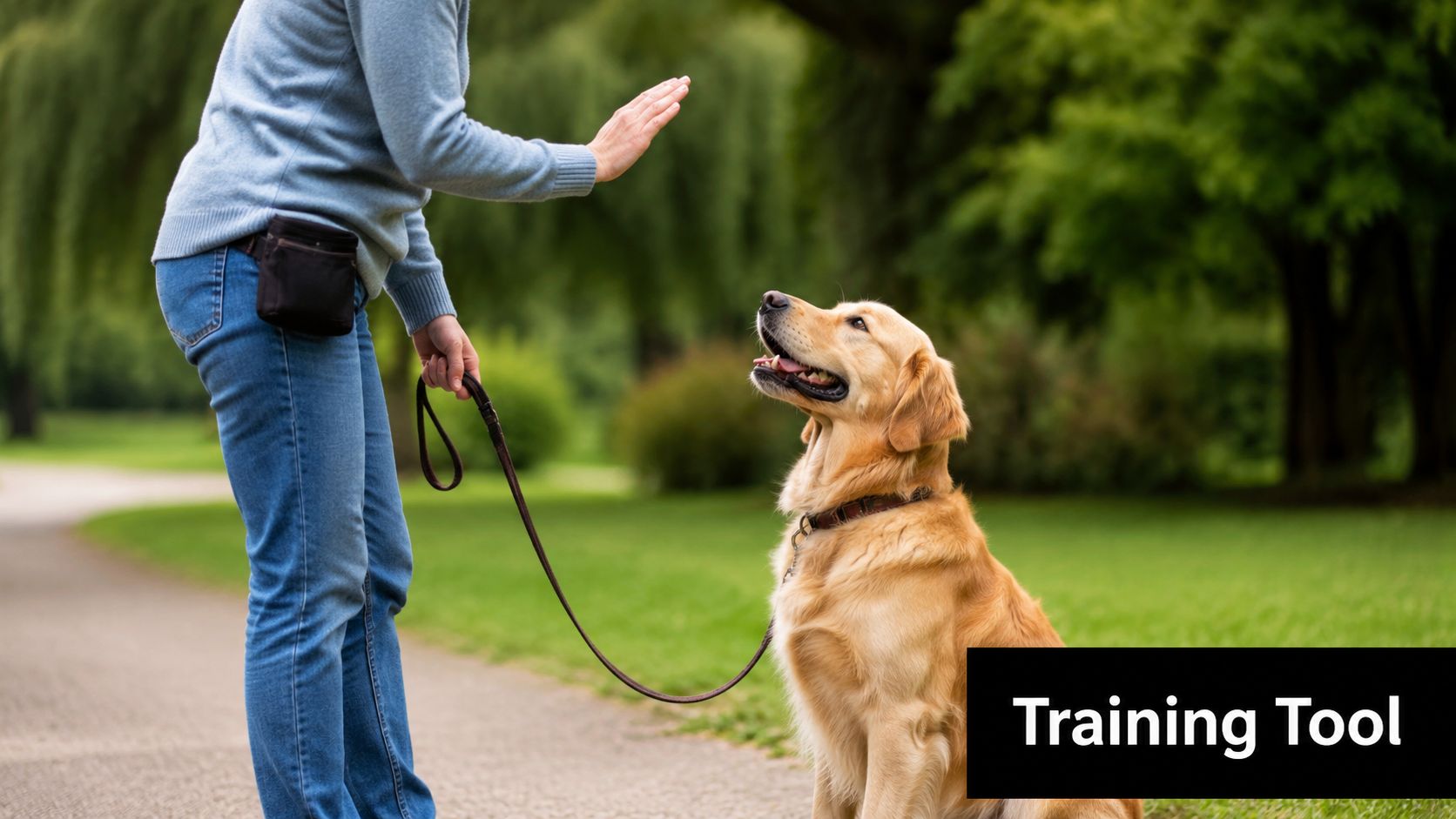
A whistle does not control a dog by itself. It only becomes meaningful after the dog learns that the sound predicts something worth responding to, much like a light switch that works only after the wiring is connected. The American Kennel Club describes a whistle as another cue, like a spoken word or hand signal, and the handler has to pair it with behavior and reward until the dog understands the association. That basic conditioning step is what turns an ultrasonic sound into a training tool.
The cleanest way to begin is with one behavior, usually recall. Blow the whistle once, then reward the dog the moment it moves toward you. The dog is not decoding a mystery. It is learning a simple pattern, whistle first, movement second, reward third.
Building the association
Use a short whistle pattern and keep it identical every time. If the cue is meant to mean “come,” do not mix it with random blasts or emotional shouting. A whistle works best when the signal stays stable, because the dog learns the relationship between sound and outcome, not your tone of voice.
A clear reward helps the lesson stick. If your dog is food motivated, keep a small supply of dog treats ready so you can reinforce the response the moment it happens. That timing matters because recall training depends on making the correct choice feel worth it, even when the dog was distracted.
Practical rule: reward the behavior you want right away, not after a long delay.
Whistle cues can also be used for other commands, but it is better to introduce them one at a time. A dog that is still learning recall does not need several new signals before the first one is reliable. One clear cue gives the dog a cleaner pattern to follow, and that usually makes training easier for both sides.
The same principle applies to human communication in other settings. A clear signal works best when it is consistent, brief, and tied to one expected response, which is why structured cueing also matters in systems like voice AI for customer service quality. Dogs do not need the technology, of course, but the communication rule is similar.
The main advantage of a whistle is that it carries a crisp signal in noisy places. Voice can get lost in traffic, people, wind, or distance, while a whistle stays more uniform. That does not make it the best choice for every dog or every situation, but it does make it especially useful when consistency matters more than vocal nuance. It also helps explain why some handlers prefer whistles for field work or off-leash recall, where a clear cue matters more than carrying a conversational tone.
Choosing and Using a Whistle Correctly
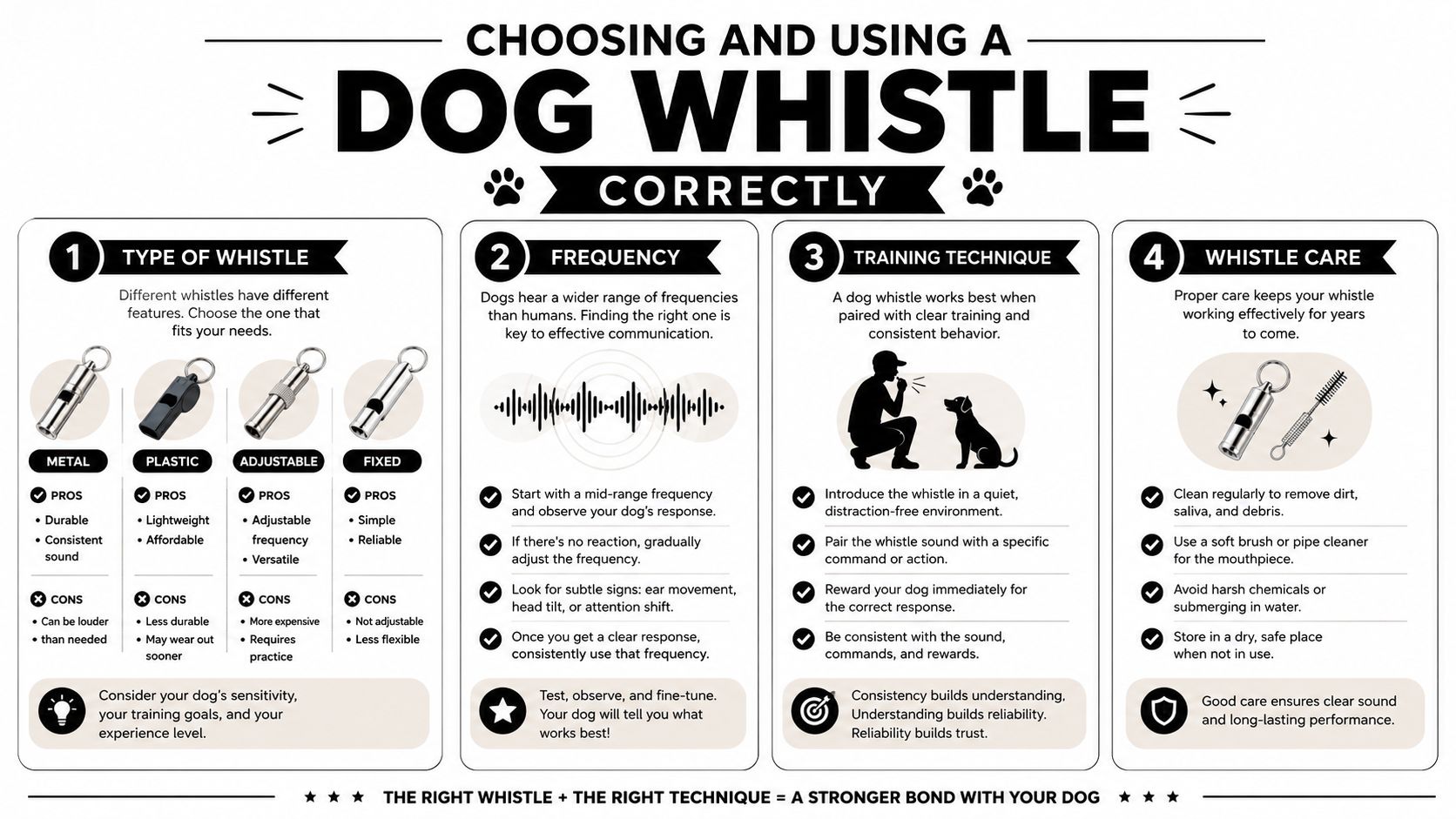
A whistle works only if it matches the dog in front of you and the way you train. A metal model may feel sturdier in the hand, while a plastic one can be lighter and easier to carry. Adjustable whistles give you room to find a sound that gets a clear response, while fixed whistles remove the need to fine-tune the pitch once you have chosen one that works.
The tool itself matters less than the way it is used. A poor response can come from timing, distance, distractions, or a pitch that does not stand out well for that dog. The same whistle may work well in a quiet yard and fail in a busy park if the dog has not learned what the cue means under those conditions.
What to look for first
- Type of whistle: choose between metal, plastic, adjustable, or fixed based on comfort and how much control you want over pitch.
- Frequency fit: use the whistle your dog notices most clearly, then keep it consistent once you have found it.
- Training setup: start in a quiet place, pair the whistle with one simple behavior, and reward quickly.
- Care and handling: keep the whistle clean and easy to reach, because fumbling it during training can weaken the cue.
The science is simple, but the practice needs patience. Start with a low-intensity cue at close range, then increase distance only after the dog responds reliably. That kind of setup helps the dog connect the sound with a known outcome instead of guessing what the whistle means. The same principle appears in other communication systems too, including voice AI for strong interpersonal customer service, where consistency and clear signals make the exchange easier to follow.
A quick field test can reveal a lot. Stand near your dog, use the whistle once, and watch for attention before adding movement or distance. If the dog startles, seems unsure, or ignores the cue, the whistle may need a different pitch or a fresh training association. Silent cues work best when the dog is calm enough to connect the sound with action.
Common Myths and Ethical Considerations
A common myth is that every dog understands a whistle the moment it hears one. That is not how cue learning works. A whistle has no intrinsic meaning to the dog, so it becomes useful only after training and reinforcement, much like a spoken cue or a hand signal.
Another misconception is that the whistle's pitch alone decides whether training succeeds. Frequency affects whether the dog can hear the sound clearly, but timing, consistency, and the handler's emotional state shape what the dog learns from it. Guidance on whistle training also stresses that a frustrated or angry handler can turn the cue into a stressful experience, and that any sign of distress means the association should be rebuilt with care whistle training and emotional state guidance. The tool stays neutral, but the experience attached to it does not.
What responsible use looks like
- Stay calm: a whistle used in frustration can become a fear trigger instead of a cue.
- Keep the cue clean: avoid repeating the whistle over and over, because that teaches the dog to tune it out.
- Watch for stress: if the dog flinches, freezes, or avoids the sound, pause and reassess the training context.
- Rebuild associations when needed: if the cue has been paired with stress, start again with a gentler setup.
A whistle works best when the dog can predict what happens next. That means one clear cue, one clear response, and a reward that arrives soon enough for the dog to connect the sound with the outcome. If the handler is inconsistent, the whistle starts to function like background noise. The dog may hear it, but not understand that it matters.
The ethical question is simple. Used to teach safely, clearly, and predictably, a whistle can be a humane training tool. Used as pressure, it can create tension and avoidance. The device itself is not cruel. The handling determines whether the dog experiences guidance or stress.



