









Introduction
Enterprises have spent a decade buying voice AI that sounds better every year and performs roughly the same every year.
The voices are sounding more natural. The demos are more impressive. The marketing is more confident. And yet the customer experience, the actual moment when a real person picks up the phone to call your business, has barely moved. Containment rates on complex calls are still low. Language support is still shallow. Brand voice is still generic. Calls that should resolve in 60 seconds still end up in the agent queue.
Something isn’t adding up.
The question we’ve spent the last two years trying to answer at Yellow.ai isn’t “how do we build better voice AI?” It’s “why has every attempt to build better voice AI produced the same robotic result?”
The answer turned out to be architectural. And once we understood that, we could build the thing that was supposed to exist a decade ago, but didn’t, because nobody had the right foundation underneath it.
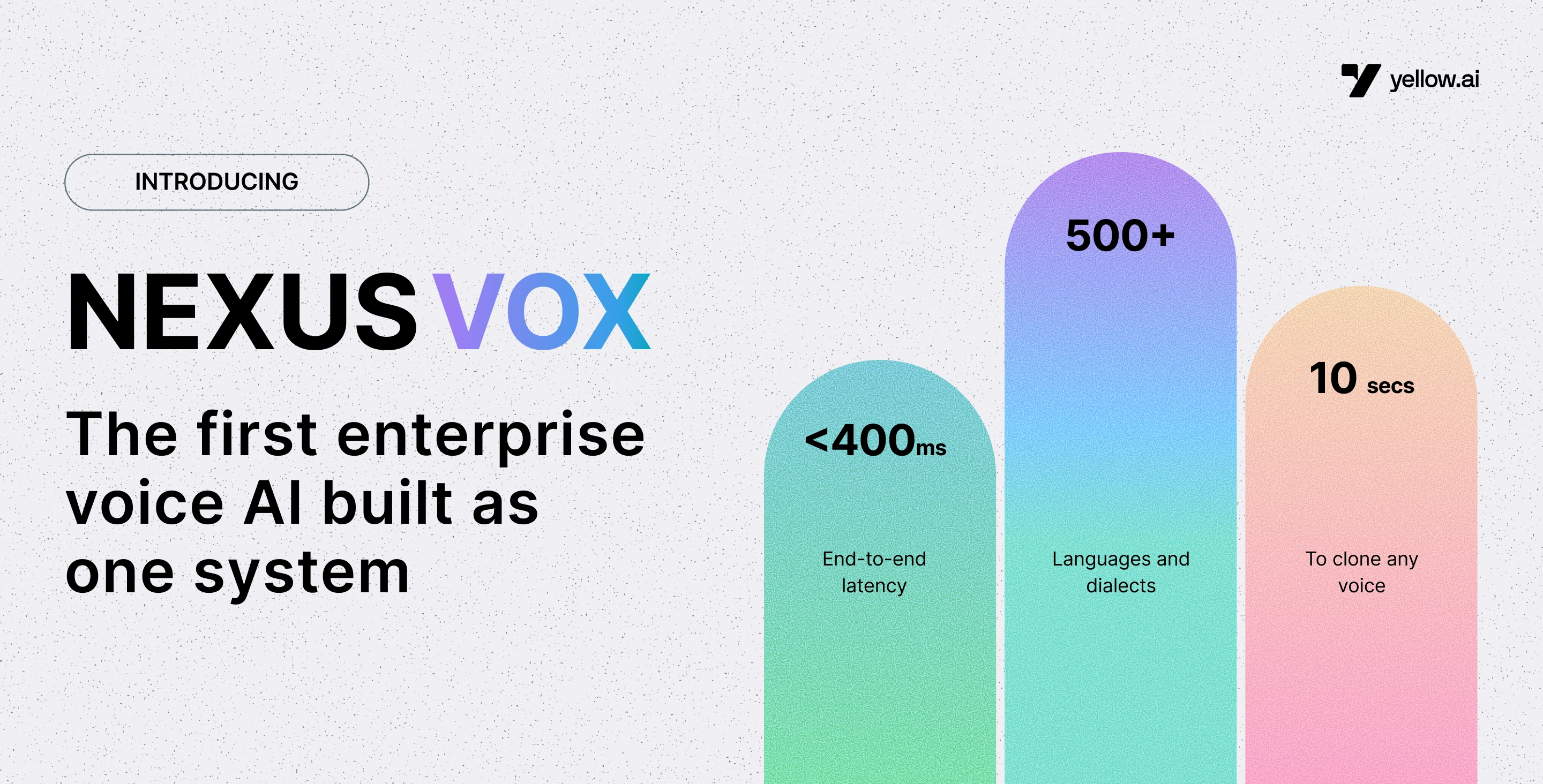
Today we’re excited to announce the launch of Nexus Vox, a native voice AI built inside Yellow.ai’s Nexus – the industry’s first unified agentic interface. It’s the first enterprise voice AI that sounds like a specific human(s) you choose, understands customers in 500+ languages and dialects, and is wired directly into the systems of record that actually run your business , from one configuration, on one runtime, with one SLA.
Read on to learn what was actually broken, why this fix took this long, and what becomes possible now.
What Is a Stitched Voice AI Stack, and Why Does It Matter for Enterprise Deployments?
Here’s a pattern I’ve seen across hundreds of enterprise deployments: two different companies pick two different voice AI vendors, and both end up with roughly the same customer experience. Same awkward pauses. Same robotic tone. Same inability to handle a real conversation.
That’s not a coincidence. It’s because, under the hood, they’re actually running the same complex architecture.
Almost every enterprise voice AI product on the market today is assembled from four separate pieces of software, each made by a different vendor:
- One company’s technology does speech recognition
- Another company’s model generates the voice
- A third company’s platform runs the conversational AI
- A fourth company handles the telephony
Every handoff between these systems adds 100–200 milliseconds of latency. Every handoff introduces a potential point of failure. Every vendor is a separate contract, a separate SLA, and another line in your procurement budget. And because the voice layer doesn’t share context with the conversation layer, the system can’t actually understand what’s happening in the call , it can only pass text back and forth between disconnected systems.
This is what we’ve been calling, internally, the stitched voice stack, kind of like Frankenstein’s monster. And it has three structural failure modes that no amount of model improvement can fix:
1. It fails to sound human.
Four vendors’ APIs chaining together produce 800ms+ round-trip response times. That’s twice the latency of a natural human pause. The result is the awkward, slightly-too-long silence every caller recognizes , and the generic synthetic voice shared across dozens of other brands, because every enterprise on the same TTS vendor gets the same handful of voices to choose from.
2. It fails to serve the business’s global customer base.
Most voice AI platforms support fewer than 30 languages. For a multinational operating across the Middle East, Southeast Asia, Africa, or South Asia, that’s not a feature gap , it’s a structural ceiling on who the business can even attempt to serve through automation. English-speaking customers get a voice bot. Everyone else gets an agent queue, a dropped call, or an IVR that can’t understand them.
3. It fails to provide autonomous resolutions.
This is the one that matters most, and the one that voice AI marketing most consistently obscures. A voice bot that sounds perfect but can’t change a flight, refund a charge, or reset a password is a more expensive IVR. Because the voice layer and the conversation layer don’t share context in a stitched stack, the system can’t orchestrate the CRM, ticketing, and booking engines that actual resolution requires. Containment rates on complex calls stay low as a direct consequence and every unresolved call spills back into the agent queue the automation was supposed to reduce.
A voice agent that sounds human but can’t complete the task is not voice AI. It’s a more expensive IVR with better vocabulary.
Why Better AI Models Haven’t Produced Better Voice AI
If the architecture is the problem, why hasn’t someone built an integrated voice AI before?
The honest answer is that most voice AI startups don’t have the platform layer underneath to make integration worthwhile. Building a voice model is one job. Building an enterprise agent platform , the kind that orchestrates systems of record, handles governance and version control, maintains context across channels, integrates with 150+ business applications , is a completely different job, and it takes years.
The voice AI vendors you’re evaluating today started with voice. They built an excellent TTS model, or an excellent STT model, or both. Then they tried to bolt on the rest , and ended up stitching in the same third-party components everyone else uses for conversational AI, telephony, and system integration. The voice got better. The stack didn’t.
We came at this from the other direction.
For the past several years, Yellow.ai has been building Nexus , the enterprise agentic platform that already handles millions of resolutions a month for 600+ enterprises across voice, chat, and email. Nexus has the Eyes, Hands, and Authority to operate as a true agentic layer inside an enterprise’s systems. What it needed was a voice interface that could match what the platform beneath it could already do.
Nexus Vox is that voice interface. And because we built it inside Nexus, not as a separate product stitched on top, we were able to do something no pure-play voice AI vendor can: run listening, thinking, speaking, and calling all on the same runtime, sharing the same understanding of the conversation in real time.We call this a zero-hop architecture. There are no API round-trips between voice processing and conversation processing, because they are literally the same system.
What Zero-Hop Actually Gets You
Architecture is abstract. Here’s what that architectural choice delivers in practice, and why each of these is something a stitched stack cannot match:
| Capability | What it means | Why stitched stacks can’t do it |
| Sub-400ms end-to-end latency | Response times within the range of natural human conversation | Four API handoffs add 800ms+ of unavoidable delay |
| 500+ languages and dialects | Not a one-size-fits-all multilingual voice that sounds foreign to native speakers. | Multilingual TTS vendors typically max out at 20-40 languages |
| 10-second voice cloning | Clone any voice from 10 seconds of audio, deployable across all 500+ languages with preserved timbre, cadence, and emotional range | Cloning requires tight integration between synthesis and the multilingual model layer — impossible across vendor boundaries |
| Real-time sentiment awareness | Tone, pacing, and escalation adjust mid-conversation based on the caller’s emotional state | Requires the voice layer and conversation layer to share context in real time — which they don’t, in a stitched stack |
| Autonomous resolution | Voice conversations directly orchestrate CRM, ticketing, booking, and knowledge systems | Requires deep integration with the agentic platform beneath — which voice-first vendors don’t have |
| One SLA, one contract, one configuration | Telephony, web, and API deployment from a single platform | Stitched stacks multiply vendor count, contract count, and operational complexity |
Each of these is a direct consequence of the same architectural decision. When listening, thinking, speaking, and acting live in the same runtime, every one of these capabilities stops being an integration challenge and starts being a feature you can just turn on.
What This Actually Unlocks for Enterprises
I want to be specific about the enterprise impact, because “better voice AI” is a marketing phrase, not a business outcome.
Here’s what three of our early deployments look like in practice:
A global bank using Vox to handle 12 million monthly customer calls in 47 languages , expanded from the three supported by its legacy IVR. Crucially, that language expansion happened without adding regional call centers or contracting per-market voice AI vendors. First-call resolution improved significantly. Cost per call dropped by more than half.
A hospitality group deploying a single cloned concierge voice across 30 properties in the Middle East, Europe, and Asia. Every guest is greeted in their native language by the same branded voice , without the cost of recording localized assets per property or contracting voice talent per market. Brand identity consistent across every touchpoint, at a fraction of the traditional cost base.
A telecommunications provider running 24/7 internal IT helpdesk support in 15 regional languages, from a single deployment. Level-1 tickets that previously took hours to resolve across time zones now close in under two minutes. Headcount that used to be spent on basic password resets is now focused on complex incidents.
Notice the pattern across all three: scope expands while cost stays flat.
That’s the argument that stitched voice stacks fundamentally cannot make. In a four-vendor architecture, every additional language, channel, or region multiplies the vendor bill , because you’re paying per-minute fees to each layer of the stack. In Vox’s single-runtime architecture, marginal cost of cognition approaches zero. Scaling from 3 languages to 47 languages is a configuration change, not a new procurement cycle.
That’s not an incremental ROI story. It’s a different curve.
The Voice Layer Nexus Was Always Meant to Have
When we introduced Nexus earlier this year, we described it as the industry’s first Universal Agentic Interface , the operating system for an autonomous enterprise. It has Eyes that analyze every conversation, Hands that manipulate the environment, and Authority to execute on high-level business goals.
What Nexus has always needed, to be complete, was a voice that matched the ambition of the platform beneath it. A voice that sounded like a specific human, not a generic synthetic. A voice that could speak the languages our enterprise customers’ customers actually speak , not just English and a few European majors. A voice that could act, not just talk.
Nexus Vox is that voice.
It’s the first enterprise voice AI built as one system, eliminating the multi-vendor complexity, latency tax, and language ceilings that have held enterprise voice automation back for a decade. It inherits Nexus’s integration surface , 150+ business applications, every major enterprise system of record , so conversations don’t just sound right, they resolve. And it’s deployable across every channel your customers actually use, from a single configuration.
The voice channel has been the last unmodernized surface in enterprise customer and employee experience. That era ends today.
Try It With Your Own Voice
The most interesting thing about Vox is that you don’t have to take our word for any of it. Visit yellow.ai/nexus-vox, record 10 seconds of your voice, and hear yourself speak fluent Arabic, Mandarin, Hindi, or Japanese within seconds.
Then, if you want to see what it looks like at enterprise scale , deployed across your real call types, integrated into your real systems , book a demo. We’ll walk you through how Vox would handle your top three highest-volume call types, using your own leadership team’s voice.
If you’ve been evaluating voice AI and walking away unconvinced, this is why: you’ve been evaluating the same architecture dressed in different vendor logos. What you haven’t seen yet is what happens when voice AI is built the way the rest of the enterprise AI stack was built – as one system, on one runtime, inside a platform that actually runs your business.
That’s Vox. And it’s ready.