








Second in a twelve-week series on the four layers behind every Yellow.ai deployment. Last week Raghu made the case that it’s not the model, it’s the stack. This week I want to show where it breaks, and when.
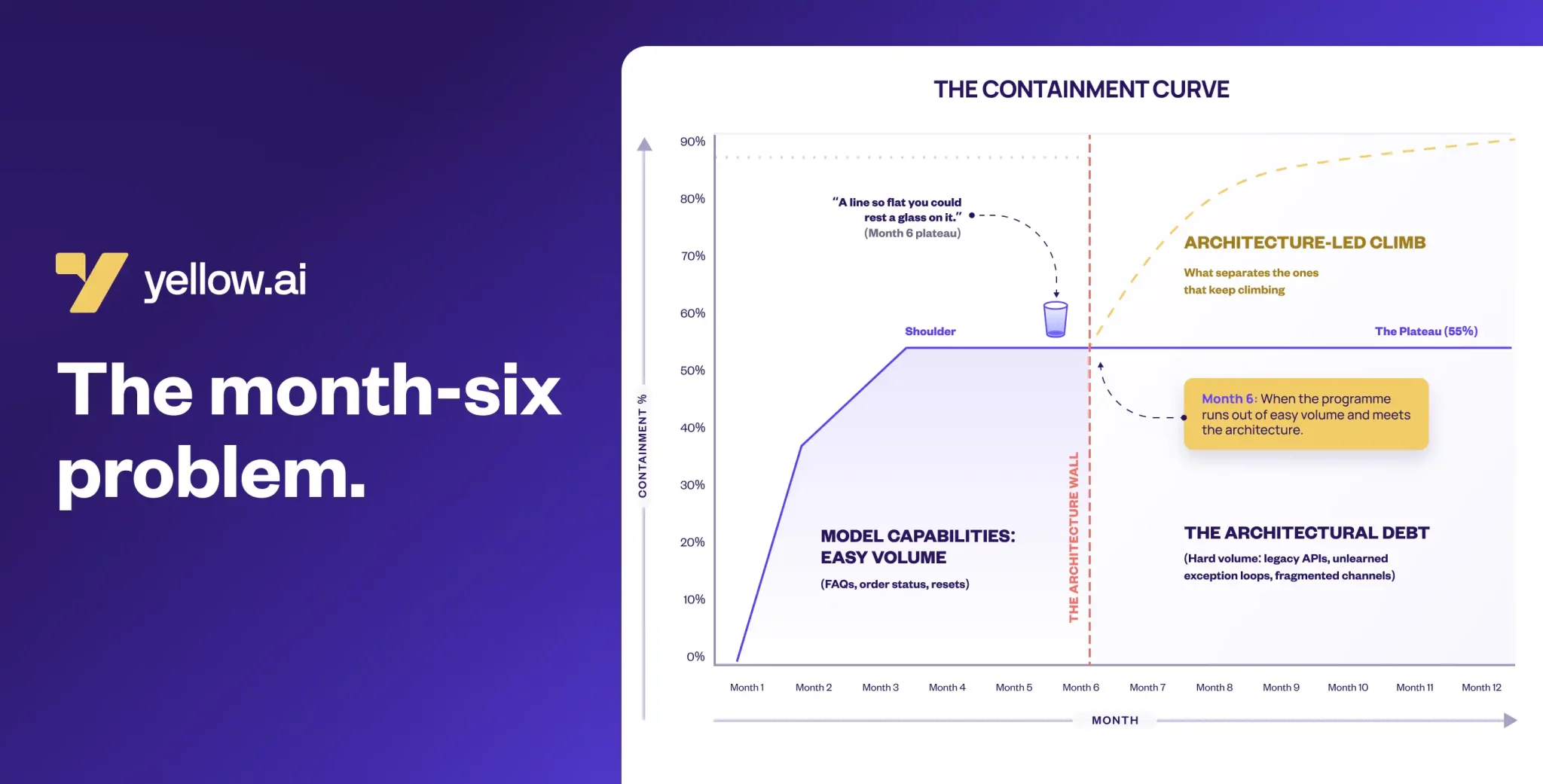
There is a typical containment curve for an enterprise AI pilot that has started to stall. Containment refers to the share of conversations the AI resolves without a human agent, and the curve usually has a recognizable shape: it climbs steeply for three or four months, forms a shoulder, and then flattens. I have seen enough of these curves to say that the shoulder, more often than not, arrives at around the six-month mark. The explanation offered for it is almost always the same: “the model isn’t good enough yet.”
It is the wrong explanation. The model is rarely why a program stalls well short of target and stays there. The root cause is what surrounds the model, and month six is simply when that becomes impossible to ignore.
Why month six
The first half of containment is the easy half. Order status, balance enquiries, password resets, opening hours, the thirty questions that make up most of the volume. A competent model and a decent knowledge base will handle those by month three, and the early numbers look wonderful.
What is left after that is the hard half: the question that needs two systems to answer, the exception that doesn’t fit the policy, the second market with a different language and a different regulatory context, the customer who moves from chat to voice mid-issue. None of that is a language problem. All of it is an architecture problem, and month six is when the program runs out of easy volume and meets the architecture.
Here is what that looks like from the inside. Five scenes, drawn from real deployments and lightly disguised.
Scene one: the integration that turned out to be a quote
A retail bank selected a platform whose proposal listed its CRM, its ticketing system and its core banking platform under “supported integrations”. In month two the team discovered what “supported” meant: an API endpoint and a statement of work. Each integration became a bespoke build with its own authentication, its own field mapping, its own governance review. The CRM took nine weeks. The ticketing system took eleven. By the time the AI could read an account and write a case, the pilot’s budget was two-thirds spent and containment was capped at whatever could be answered from the knowledge base alone.
This is a failure of the enterprise readiness layer. The difference between a four-month deployment and a fourteen-month deployment is almost never the AI. It is whether the integrations exist as accelerators before the first conversation, or as projects after it.
Scene two: the pricing email
A telecommunications operator ran its entire customer-facing AI estate on one model from one provider. The pilot was strong. Then two things happened in the same quarter. The provider changed its pricing, and the cost per conversation moved sharply upward overnight with no option to route around it. A month later the provider had a multi-hour outage, and containment went to zero for the duration, with every conversation falling to a human team that had been sized for a world where the AI handled 60% of volume.
Neither event was anyone’s fault. Both were predictable, and both landed on a programme that had no second option. This is the orchestration layer, or its absence: when the platform cannot select, combine and route across models, you inherit every provider’s volatility and your only response is waiting.
Scene three: the exception that escalated a hundred times
A logistics company had a refund case that didn’t fit the policy. Partial delivery, two currencies, one item on back order. There was no playbook entry for it. There were two senior agents who had resolved it dozens of times and knew exactly what to do.Over one quarter the same shape of exception was escalated more than a hundred times, each one a seven-minute human handle, each one a customer who had already explained the situation once.
The knowledge to resolve it existed. It lived in two people. The platform had no way to capture how they resolved it and turn that into a path the AI could take next time.That is the Context Graph problem, and it is the single biggest reason containment flattens: the AI never learns the cases that make up the hard half, so the hard half stays with humans forever.
Scene four: the two brains
An insurer launched chat first and added voice a year later from a different module of the same vendor’s platform. Customers did what customers do: started a claim on chat, called when it got complicated, and discovered that the voice agent had never heard of them. Context was lost at the handover. The voice agent gave slightly different answers from the chat agent, because it had been trained separately. Satisfaction on voice calls that followed a chat session ran well below satisfaction on voice calls that started cold, which is the opposite of what any CX leader would want.
That is a retrofit seam. The intelligence had been written into the channel rather than behind it, so the second channel was a second brain. The omnichannel layer exists so that every channel is a surface on one intelligence; without it, adding a channel adds inconsistency.
Scene five: the number nobody connected
A subscription business celebrated containment rising to 70%. Two quarters later someone noticed that CSAT had fallen several points over the same period and that re-contact rates had risen. The AI was deflecting, not resolving. Customers were giving up rather than being helped, and the dashboard counted that as success.
This one is not a layer failure. It is what happens when the infrastructure conversation never ends and the outcome conversation never starts. Containment is an input. Resolution, satisfaction and cost per resolution are the outputs, and the stack exists to move them.
What the programs that got past month six did differently
The deployments that kept climbing after the shoulder did not have better models. They had made six decisions, usually before signing.
- They treated the first market as a template, not a product. Every integration, flow and exception was captured in a form that would transfer to the second market.
- They insisted on pre-built accelerators for the systems they actually ran, and they tested them during the evaluation rather than taking the proposal’s word for it.
- They asked the vendor to switch the primary model in front of them and re-run the same flow, and they asked what the cost per resolution would do under a pricing change.
- They asked, at month three, what the platform had learned: which exceptions it had captured, which paths it now preferred, and what it would do differently with the top ten escalations.
- They deployed on the channels their customers used, from one intelligence layer, rather than deciding between voice and chat as if those were two different products.
- They reported containment and CSAT on the same slide, every time, so that deflection could never be mistaken for resolution.
Each of those decisions maps to a layer of the stack, and that is not a coincidence. The four layers exist because these are the four places a program breaks.
Five questions before you sign
Five questions before you sign
If your pilot is a few months in, check it against these. Two or more means you are closer to month six than the dashboard suggests.
- Is there a pre-built integration for every system you need to connect?
- What changes when the model switches, and what is the impact on price?
- What are the month-three versus month-twelve containment rates for a live customer?
- Does customer context carry over when a conversation moves from chat to voice?
- How are containment and CSAT reported together?
Over the next four weeks my colleagues will take each layer apart in turn: Madhav on enterprise readiness and orchestration, Kishore on the Context Graph and omnichannel. The month-six problem is where the series starts because it is where most CX leaders already are. The layers are how you get past it.