







How Our Compliance Simplifies Yours
If you’re deploying AI agents that touch payments, billing, or transactions, here’s a question worth asking your vendor: “Are they PCI DSS validated as a service provider, for which environment, and under what scope?” The answer has direct consequences for your own compliance scope, audit costs, and risk exposure.
Yellow.ai’s North America region has just achieved PCI-DSS v4.0.1 validation as a Service Provider, one of the more stringent validation paths in the payments ecosystem. I want to explain why we pursued it and, more importantly, what it changes for the enterprises building on our platform.
The Timing Isn’t A Coincidence
Three forces converged to make this the right moment for us to pursue PCI-DSS v4.0.1 Service Provider compliance.
1. Compliance Landscape Has Fundamentally Shifted
PCI DSS v4.0.1 builds on the most significant evolution of payment security standards in over a decade, reinforcing stronger expectations around authentication, encryption, and vulnerability management.
For enterprises in e-commerce, fintech, and retail, this is the new baseline their auditors and regulators are measuring against. We wanted our customers to have a platform that already meets that bar, so they can focus on building great experiences rather than managing vendor compliance gaps.
2. AI Platforms Have Become High-Value Targets
In the past year alone, the industry has seen a series of alarming breaches across the AI landscape. In one high-profile incident, attackers compromised a sales engagement platform‘s embedded chatbot tool, stealing authentication tokens that cascaded into over 700 downstream organizations — including major cybersecurity companies. Google’s Threat Intelligence Group characterized it as a critical supply chain attack.
Separately, a generative AI aggregator was breached, exposing 34 million conversation lines. And in early 2026, a consumer AI chat application leaked 300 million messages from 25 million users. The pattern is unmistakable: any platform that handles conversational data at scale — whether consumer or enterprise — sits at the intersection of sensitive data and broad access, making it a prime target.
3. Enterprise Buyers Have Sharpened Their Requirements
In KPMG’s Q4 2025 AI Quarterly Pulse Survey, 75% of leaders at U.S. companies with $1 billion or more in annual revenue said security, compliance, and auditability are the most critical requirements for agent deployment.
This isn’t aspirational; it’s showing up in RFPs, vendor assessments, and procurement checklists. CISOs and CTOs are asking pointed questions about their AI vendors’ compliance posture, and “we’re working on it” is no longer an acceptable answer.
What PCI-DSS v4.0.1 Service Provider Compliance Actually Means
Not all PCI-DSS compliance is created equal. The distinction between merchant and service provider compliance matters enormously, and I want to be transparent about what we achieved and why we chose this path.
A Higher Bar By Design
In PCI-DSS terms, a Service Provider is any entity that stores, processes, or transmits cardholder data on behalf of other organizations, or that could affect the security of that data. Yellow.ai fits this definition: our AI agents handle customer interactions that may involve payment information, billing details, and transaction data across dozens of enterprise deployments.
This validation applies to Yellow.ai’s scoped North America environment and the services covered by that assessment. Customers should evaluate the Attestation of Compliance and shared responsibility boundaries based on their specific deployment.
Beyond the baseline requirements that apply to all entities, service providers are subject to additional PCI DSS obligations, including more frequent scope-review requirements, customer responsibility considerations, and certain service-provider-specific controls. In multi-tenant environments, segmentation, logical isolation, and testing practices become especially important.
We pursued this path deliberately.
Yellow.ai is the infrastructure that other businesses depend on. The Service Provider designation reflects that reality and holds us to the standard our customers deserve.
What v4.0.1 Demands Technically
The leap from v3.2.1 to the current framework was the first major overhaul of the PCI standard in over a decade. Version 4.0.1 clarified portions of the framework in response to stakeholder feedback from early implementation.
Here are some of the most consequential changes our engineering team addressed:
- MFA requirements expanded significantly in PCI DSS v4.x, including broader use for access into the cardholder data environment.
- Minimum password length requirements increased from 7 to 12 characters. PCI DSS v4.x also introduced stronger controls around payment-page scripts, including inventory, authorization, and mechanisms to detect unauthorized changes.
- Internal vulnerability scanning must now be authenticated, giving scans the access needed to find real issues rather than surface-level ones.
- Anti-phishing protections must be automated, not just policy-based, and full-disk encryption is no longer sufficient on its own as the method for rendering stored cardholder data unreadable.
Each of these requirements drove meaningful engineering work on our platform. They aren’t just policy updates; they’re architectural decisions baked into how our system operates.
Why This Matters When AI Agents Handle Payments
There was a time when chatbots handled FAQs and maybe routed you to a human agent. That time is over. Today’s AI agents process orders, verify payment details, handle billing disputes, initiate refunds, and guide customers through transactions in real time. When a customer shares a credit card number in a chat window or talks about payment details to a voice agent, the AI platform becomes a cardholder data environment.
If your AI vendor isn’t PCI-DSS compliant, the AI platform may become part of the cardholder data environment or otherwise affect its security, depending on the deployment architecture.
Your audit costs increase.
Your risk surface grows.
And if a breach occurs, fines that can escalate to $100,000 per month flow from card brands through acquiring banks and ultimately land on you.
When your AI platform vendor holds PCI-DSS Service Provider compliance, the equation reverses. This can help reduce assessment effort, simplify vendor reviews, and give your security team a clear, documented basis for vendor risk management.
Put simply: our compliance can make your compliance easier.
For a comprehensive view of Yellow.ai’s security posture, please visit our Trust Center.
At Yellow.ai, Security Is A Foundation, Not An Afterthought
PCI-DSS v4.0.1 is the latest milestone in a security investment that has been central to Yellow.ai since our earliest days. But it doesn’t stand alone. Our compliance portfolio reflects the reality that our enterprise customers operate across industries, geographies, and regulatory regimes, and they need a platform that meets them where they are.
Today, Yellow.ai holds SOC 2 Type II attestation, validating the operational effectiveness of our security controls over time. We maintain ISO/IEC 27001:2022 validation for information security management systems and ISO/IEC 27701:2019 for privacy information management systems. We support HIPAA-regulated healthcare use cases in the U.S. and help customers meet GDPR-related requirements through our security, privacy, and data handling controls.
At the platform level, Yellow.ai has implemented all the security controls as per the PCI DSS v4.0.1 standard applicability in the scoped Cardholder Data Environment (CDE) to protect the cardholder data during storage, processing and transmission. Yellow.ai conversational platform serves as an intermediary to connect customers with payment processors/Service providers and follows appropriate security & compliance measures to prevent unintentional storage, processing, or transmission of CHD. We host data across six regions — the United States, European Union, Singapore, India, Indonesia, and the UAE — with N+1 availability zone disaster recovery. Continuous third-party vulnerability scanning, monitoring, and penetration testing are standard practices across our entire global infrastructure. This PCI-DSS validation applies specifically to the scoped environment covered by the assessment.
Today, I am sharing these details not as a marketing exercise but because I believe transparency about security architecture is itself a security practice. Enterprises evaluating AI vendors deserve to know exactly what they’re building on.
A Competitive Reality Check
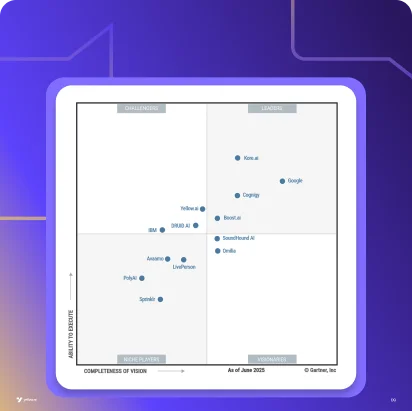
I want to be candid about where this positions us in the market. Among pure-play enterprise conversational AI platforms, PCI DSS compliance is not universal. PCI DSS maturity is not uniform across the conversational AI market. In some cases, buyers still encounter vendors with limited payment-data controls, narrower validation scope, or architectures that push more of the compliance burden back onto the customer.
The most robust PCI DSS positioning in the customer experience space comes from large contact center-as-a-service (CCaaS) providers — but these are infrastructure platforms, not purpose-built conversational AI. In deals where Yellow.ai competes alongside these incumbents, our PCI DSS Service Provider compliance removes what has historically been a significant procurement blocker.
For enterprises in financial services, insurance, retail, e-commerce, and healthcare, or any industry where payment card data routinely flows through customer service channels, this matters. You can deploy Yellow.ai’s AI agents with confidence that the platform won’t create compliance gaps in your environment.
What Comes Next
Compliance is never finished. The regulatory landscape for AI is evolving rapidly: the EU AI Act is moving from policy into phased implementation, with obligations for different categories of AI systems taking effect on different timelines, including high-risk systems over the coming years, state-level AI legislation is proliferating across the United States, and cyber insurance carriers are beginning to require AI-specific security controls. Gartner projects that AI compliance spending will grow four-fold by the end of this decade.
We are treating PCI-DSS v4.0.1 not as a destination but as a foundation. We’re actively pursuing ISO/IEC 42001:2023, an international standard for AI management systems, the world’s first international standard for AI management systems — which establishes a governance framework for managing AI-specific risks around bias, transparency, accountability, and lifecycle oversight. As AI regulations like the EU AI Act move from policy to enforcement, we believe our customers deserve a platform that’s already built to meet those standards. Our broader security and compliance roadmap continues to expand in response to where our customers are headed, and we’ll continue to share our progress openly.
To organizations evaluating AI platforms: I invite you to hold every vendor to this standard. Ask to see their Attestation of Compliance. Ask to see their Attestation of Compliance. Ask whether they have been validated as a service provider, and at what level and scope. The answers will tell you a great deal about whether a vendor treats security as a core competency or a future aspiration.
Security is not the enemy of innovation. It’s the foundation that makes innovation trustworthy. That’s been our belief at Yellow.ai since day one, and PCI-DSS v4.0.1 compliance is our latest proof point.