







For the past decade, the relationship between humans and enterprise software has been one of servitude. We became “operators” of complex dashboards, navigating rigid decision trees, manually curating intent lists, and laboring over brittle integrations. In this era of traditional SaaS, you worked for the software—spending your days feeding the “System of Record” so it could tell you what already happened.
But the emergence of Agentic AI has inverted this paradigm. We are entering the era of the Autonomous Enterprise, where the software finally works for you.
Introducing Nexus, the industry’s first Universal Agentic Interface (UAI). Nexus is not just another tool or a passive sidebar “Copilot” that makes suggestions; it is a first-class citizen of your technical stack—a unified control plane that transforms the user from a manual operator into a strategic commander.
Service as a Software: The New Economic Reality
As we move into 2026, the traditional Software as a Service (SaaS) model is being superseded by “Service as a Software.” In the legacy world, vendors sold tools; in the Nexus era, the software itself replicates and augments human labor.
Nexus handles the cognitive labor of building, maintaining, and optimizing AI agents while you define only the strategic outcome. This is made possible by the collapse of the unit cost of cognition—where pattern-matching and reasoning now approach near-zero marginal cost. For the enterprise, this translates to a workforce that is instantly scalable, 24/7, and free from the constraints of human staffing shortages, reducing Total Cost of Ownership (TCO) by up to 60%.
| Metric Category | Traditional SaaS (SaaS 1.0) | Service as a Software (Nexus Era) |
| Primary Value | Facilitating human tasks via tools | Delivering outcomes via autonomous agents |
| System Role | System of Record | System of Work / System of Action |
| Operational Focus | Human efficiency and tool mastery | Autonomous execution and strategic reasoning |
The Architecture of Nexus: Eyes, Hands, and Authority
To function as a Universal Agentic Interface, Nexus is built on three functional pillars that grant it the capability to operate with strategic independence.
- Eyes (Intelligence): Nexus securely analyzes every conversation log, data table, and user interaction to identify patterns that human analysts frequently miss. It provides the visual intelligence to understand the “why” behind the numbers, turning unstructured data into actionable insights.
- Hands (Execution): Nexus possesses the manual dexterity to directly manipulate the environment. It can build flows, fix broken nodes, generate UI components (GenUI) on the fly, and index entire sitemaps without a single line of code.
- Authority (Autonomy): Nexus operates with an understanding of high-level business goals. It doesn’t just suggest a fix; it executes the solution, requiring human intervention only for final strategic approval.
Lifecycle Architecture: The Multi-Agent System (MAS)
Nexus utilizes a specialized multi-agent architecture to manage the complete lifecycle of an AI agent, from initial discovery to continuous self-healing.
The Strategist: Discovery and Pattern Finding
The Strategist persona constructs a “World Model” of your business. By generating Automation Heatmaps, it identifies “Quick Wins”—high-volume support tickets that can be instantly automated for immediate ROI—eliminating the “Blank Slate” problem.
The Architect: Natural Language First Build
The Architect persona handles technical construction via “Text-to-Flow” orchestration. A user provides a high-level intent, and the Architect synthesizes the logic, creates variables, and maps branches. It also utilizes Generative UI (GenUI) to create interactive elements, such as seat maps or forms, based on real-time data.
The QA Engineer: Simulation and Red Teaming
To ensure reliability, the QA Engineer persona spawns thousands of “Virtual Users” to stress-test the agent. It employs “Adversary Personas” to attempt prompt injections, ensuring safety guardrails and brand compliance are impenetrable.
The Coach and Mechanic: Autonomic Maintenance
The Mechanic persona provides “Self-Healing Logic,” performing Automated Root Cause Analysis (RCA) to identify and fix broken nodes—like expired API tokens—autonomously. Simultaneously, the Coach persona provides real-time “Sentiment Coaching” for human agents, suggesting “Magic Rewrites” to improve empathy.
The Capabilities Matrix: A Functional Deep Dive
Nexus is structured into seven layers of capability, providing a comprehensive command center for the modern enterprise.
| Functional Layer | Capability | Strategic Impact |
| Studio (Builder) | Text-to-Bot, Persona Tuning, KB Indexing | Reduces build time from months to minutes. |
| Support (Inbox) | Smart Prioritization, Sentiment Scanning | Focuses human agents on critical “Angry” customers. |
| Memory (Database) | Natural Language Query, Instant Table Creation | Removes technical barriers to data manipulation. |
| Brain (Analytics) | Health Monitoring, ROI Modeling, CSAT Tracking | Provides real-time executive visibility. |
| X-Ray (Forensics) | AI Reasoning Trace, Topic Clustering | Uncovers the “why” behind every agent decision. |
| Query Engine | Channel Economics, Voice Latency Debugging | Optimizes spend across WhatsApp and Voice. |
| Admin (Provisioning) | Zero-Touch Project Setup | Enables instant deployment of new bot identities. |
Hero Scenarios: Nexus in Action
The “Instant Analyst”
A CX Manager notices a drop in resolution. Instead of sifting through logs, they ask Nexus: “Summarize what went wrong in unresolved chats today.” Nexus analyzes the transcripts and reports: “Users are asking for ‘partial refunds,’ which the current agent doesn’t understand.”
The “Zero-to-One” Architect
An Innovation Lead wants to build a luxury hotel concierge bot. Nexus brainstorms the persona, plans the “Super Agent” structure, scrapes the hotel website for FAQs, and delivers a testable MVP in minutes.
The “Consumer Intel” Engine
A Product Manager asks: “Analyze the sentiment of iPhone users asking about refunds versus Android users.” Nexus segments the data, identifies a UI glitch specific to iOS, and creates a database table of the affected users for targeted engagement.
Competitive Differentiation: Why Nexus Leads
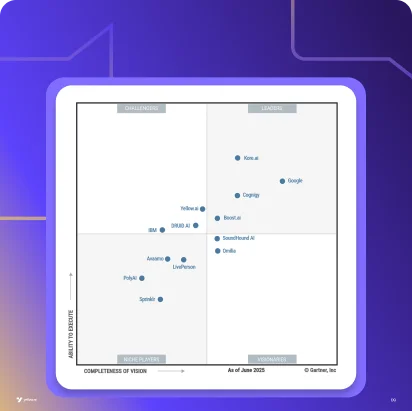
While platforms like Salesforce Agentforce and Microsoft Copilot Studio focus on their own ecosystems, Nexus is the operating system for the universal agentic enterprise.
| Feature | Yellow.ai Nexus | Salesforce Agentforce | Microsoft Copilot Studio |
| Scope | Universal (Agnostic) | CRM-centric | M365 Productivity |
| Autonomy | Full (Commander) | High (Atlas Reasoning) | Assistive (Copilot) |
| Integration | 150+ Plug-and-Play | Locked to Salesforce | Locked to Microsoft |
| LLM Flexibility | Multi-LLM (15+ Models) | Einstein / Proprietary | Azure / OpenAI |
Conclusion: The Era of Autonomy
Nexus represents the end of software as a mere facilitator and the birth of “Service as a Software.” By reducing friction and collapsing the cost of cognition, Nexus allows enterprises to transform from reactive service centers into proactive, value-creation engines.
The “Copilot” era was about assistance, but the “Nexus” era is about autonomy. Welcome to the future where the interface doesn’t just talk about the work—it does the work for you.